
Puck, 1878-10-30 · page 12 of 16
Puck — October 30, 1878 — page 12: what you’re looking at
What you’re looking at
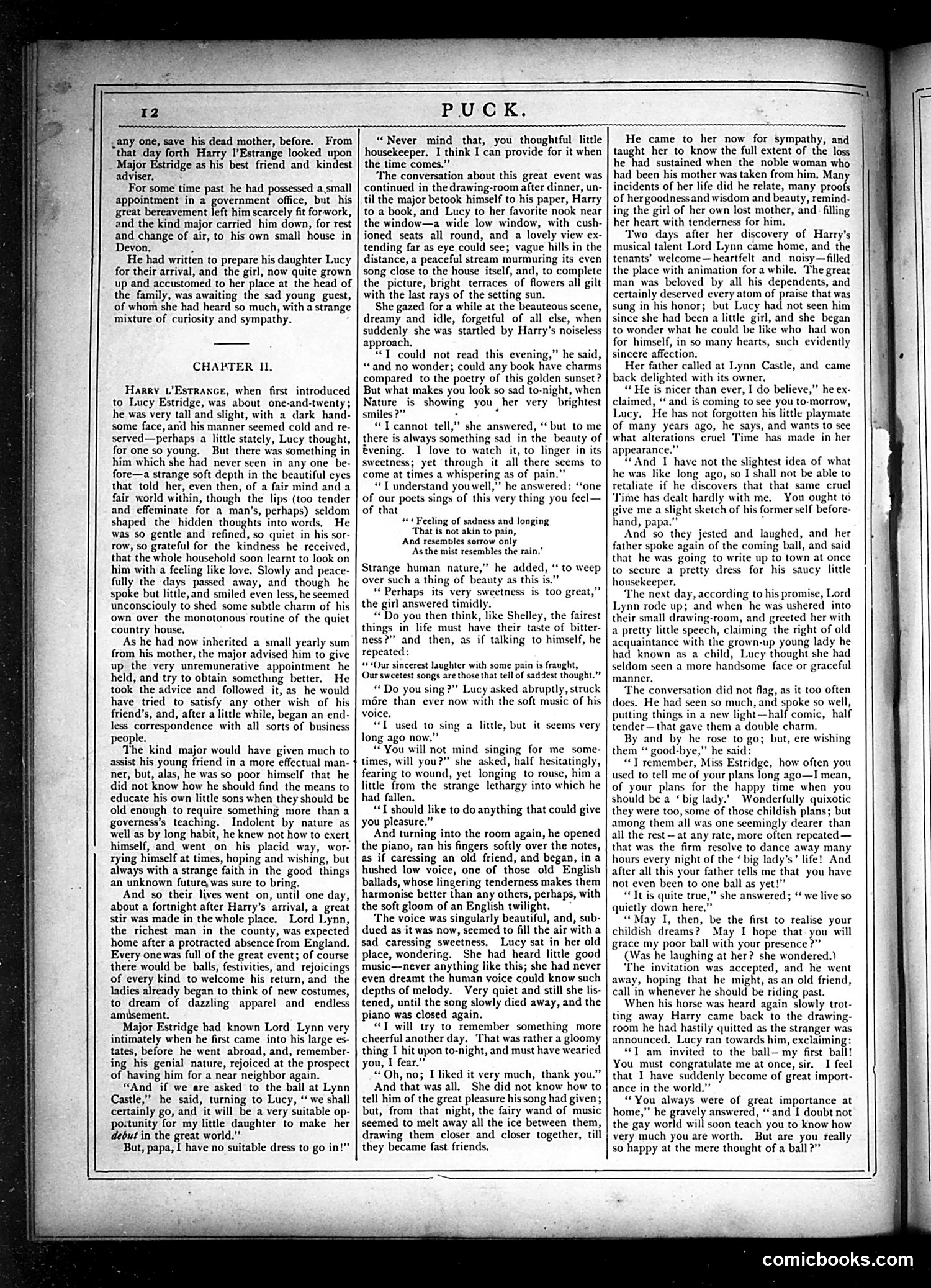
This page contains serialized fiction rather than political cartoons or satire. The text is Chapter II of a story titled "PUCK" involving characters named Harry, Lucy Estridge, and Lord Lynn at Lynn Castle. The narrative focuses on romantic and domestic themes—Harry's arrival at the estate, Lucy's emotional responses, piano playing, and social interactions. There are poetic passages about nature and sentiment ("A feeling of sadness and longing / Comes o'er me..."). This appears to be entertainment fiction rather than satirical political content. Puck magazine, while known for satire, also published literary serials for readers. Without visible illustrations or explicit political/social commentary on this page, the content reads as straightforward romantic period drama rather than satire requiring historical context to decode.
📄 Transcribed text from this page (OCR, searchable)
Machine-transcribed from the original scan — historical spelling and the odd misread are preserved.
12 PUCK. any one, save his dead mother, before. From “that day forth Harry I’Estrange looked upon Eatridge as his best friend and kindest Major adviser. For some time past he had possessed a.small appointment in a government office, but his great bereavement left him scarcely fit forwork, and the kind major carried him down, for rest and change of air, to his own small house in Devon, r He had written to prepare his daughter Lucy for their arrival, and the girl, now quite grown up and accustomed to her place at the head of the family, was awaiting the sad young guest, of whom she had heard so much, with a strange mixture of curiosity and sympathy. CHAPTER II, Harry _t’EstRance, when first introduced to Lucy Estridge, was about one-and-twenty; he was very tall and slight, with a dark hand- some face, and his manner seemed cold and re- served—perhaps a little stately, Lucy thought, for one so young. But there was something in him which she had never seen in any one be- fore—a strange soft depth in the beautiful eyes that told her, even then, of a fair mind anda fair world within, though the lips (too tender and effeminate for a man’s, perhaps) seldom shaped the hidden thoughts into words, He was so gentle and refined, so quiet in his sor- row, so grateful for the kindness he received, that the whole household soon learnt to look on him with a feeling like love. Slowly and peace- fully the days passed away, and though he spoke but little,and smiled even less, he seemed unconsciouly to shed some subtle charm of his own over the monotonous routine of the quiet country house, As he had now inherited a small yearly sum from his mother, the major advised him to give up the very unremunerative appointment he held, and try to obtain something better. He took the advice and followed it, as he would have tried to satisfy any other wish of his friend’s, and, after a little while, began an end- less correspondence with all sorts of business people. The kind major would have given much to assist his young friend in a more effectual man- ner, but, alas, he was so poor himself that he did not know how he should find the means to educate his own little sons when they should be old enough to require something more than a governess’s teaching. Indolent by nature as well as by long habit, he knew not how to exert himself, and went on his placid way, wor- rying himself at times, hoping and wishing, but always with a strange faith in the good things an unknown future, was sure to bring. And so their lives went on, until one day, about a fortnight after Harry’s arrival, a great stir was made in the whole place. Lord Lynn, the richest man in the county, was expected home after a protracted absence from England. Every onewas full of the great event; of course there would be balls, festivities, and’ rejoicings of every kind to welcome his return, and the ladies already began to think of new costumes, to dream of dazzling apparel and endless amusement. Major Estridge had known Lord Lynn very intimately when he first came into his large es- tates, before he went abroad, and, remember- ing his genial nature, rejoiced at the prospect of having him for a near neighbor again. “And if we are asked to the ball at Lynn Castle,” he said, turning to Lucy, “we shall certainly go, and it will be a very suitable op- postunity for my little daughter to make her debut in the great world.” But, papa, 1 have no suitable dress to go in!” “Never mind that, you thoughtful little housekeeper, I think I can provide for it when the time comes.” ‘The conversation about this great event was continued in the drawing-room after dinner, un- til the major betook himself to his paper, Harry to a book, and Lucy to her favorite nook near the window—a wide low window, with cush- ioned seats all round, and a lovely view ex- tending far as eye could see; vague hills in the distance, a peaceful stream murmuring its even song close to the house itself, and, to complete the picture, bright terraces of flowers all gilt with the last rays of the setting sun. She gazed for a while at the beauteous scene, dreamy and idle, forgetful of all else, when suddenly she was startled by Harry’s noiseless approach. “T could not read this evening,” he said, “and no wonder; could any book have charms compared to the poetry of this golden sunset? But what makes you look so sad to-night, when Nature is showing you her very brightest smiles ?”” . ° “T cannot tell,” she answered, ‘ but to me there is always something sad in the beauty of évening. I love to watch it, to linger in its sweetness; yet through it all there seems to come at times a whispering as of pain.” “T understand youwell,” he answered: “one of our poets sings of this very thing you feel— of that «<4 Feeling of sadness and longing ‘That is not akin to pain, And resembles sorrow only Asthe mist resembles the rain.’ Strange human nature,” he added, ‘ to weep over such a thing of beauty as this is.” “Perhaps its very sweetness is too great,” the girl answered timidly. “Do you then think, like Shelley, the fairest things in life must have their taste of bitter- ness?” and then, as if talking to himself, he repeated: «Our sincerest laughter with some pain is fraught, Our sweetest songs are those that tell of saddest thought.” “Do you sing?” Lucy asked abruptly, struck mére than ever now with the soft music of his. voice, “T used to sing a little, but it seems very long ago now,” “You will not mind singing for me some- times, will you?” she asked, half hesitatingly, fearing to wound, yet longing to rouse, him a little from the strange lethargy into which he had fallen. “I should like to do anything that could give you pleasure.” And turning into the room again, he opened the piano, ran his fingers softly over the notes, as if caressing an old friend, and began, in a hushed low voice, one of those old English ballads, whose lingering tenderness makes them harmonise better than any others, perhaps, with the soft gloom of an English twilight. ‘The voice was singularly beautiful, and, sub- dued as it was now, seemed to fill the air witha sad caressing sweetness. Lucy sat in her old place, wondering. She had heard little good music—never anything like this; she had never even dreamt the human voice could know such depths of melody. Very quiet and still she lis- tened, until the song slowly died away, and the piano was closed again. “T will try to remember something more cheerful another day. ‘That was rather a gloomy thing I hit upon to-night, and must have wearied you, I fear.” “Oh, no; I liked it very much, thank you.” And that was all, She did not know how to tell him of the great pleasure his song had given; but, from that night, the fairy wand of music seemed to melt away all the ice between them, drawing them closer and closer together, till they became fast friends. He came to her now for sympathy, and taught her to know the full extent of the loss he had sustained when the noble woman who had been his mother was taken from him. Man: incidents of her life did he relate, many proofs of her goodness and wisdom and beauty, remind- ing the girl of her own lost mother, and. filling her heart with tenderness for him. Two days after her discovery of Harry’s musical talent Lord Lynn came home, and the tenants’ welcome—heartfelt. and_ noisy—filled the place with animation fora while. The great man was beloved by all his dependents, and certainly deserved every atom of praise that was sung in his honor; but Lucy had not seen him since she had been a little girl, and she began to wonder what he could be like who had won for himself, in so many hearts, such evidently sincere affection, Her father called at Lynn Castle, and came back delighted with its owner. “He is nicer than ever, I do believe,” he ex- claimed, “ and i8 coming to see you to-morrow, Lucy, He has not forgotten his little playmate of many years ago, he says, and wants to see what alterations cruel Time has made in her appearance.” ‘And I have not the slightest idea of what he was like long ago, so I shall not be able to retaliate if he discovers that that same cruel ‘lime has dealt hardly with me. You ought to give me a slight sketch of his former self before- hand, papa.” And so they jested and laughed, and her father spoke again of the coming ball, and said that he was going to write up to town at once to secure a pretty dress for his saucy little housekeeper. The next day, according to his promise, Lord Lynn rode up; and when he was ushered into their small drawing-room, and greeted her with a pretty little speech, claiming the right of old acquaintance with the grown-up young lady he had known as a child, Lucy thought she had seldom seen a more handsome face or graceful manner. The conversation did not flag, as it too often does. He had seen so much, and spoke so well, putting things in a new light—half comic, half tender—that gave them a double charm. By and by he rose to go; but, ere wishing them ‘“ good-bye,” he said: “T remember, Miss Estridge, how often you used to tell me of your plans long ago—I mean, of your plans for the happy time when you should be a ‘big lady.’ Wonderfully quixotic they were too, some of those childish plans; but among them all was one seemingly dearer than all the rest —at any rate, more often repeated — that was the firm resolve to dance away many hours every night of the ‘ big lady’s’ life! And after all this your father tells me that you have not even been to one ball as yet!” “(Tt is quite true,” she answered; ‘ we live so quietly down here.” “May I, then, be the first to realise your childish dreams? May I hope that. you will grace my poor ball with your presence ?”” (Was he laughing at her? she wondered.) ‘The invitation was accepted, and he went away, hoping that he might, as an old friend, callin whenever he should be riding past. When his horse was heard again slowly trot- ting away Harry came back to the drawing- room he had hastily quitted as the stranger was announced. Lucy ran towards him, exclaiming : “T am invited to the ball— my first ball! You must congratulate me at once, sir. I feel that I have suddenly become of great import- ance in the world.” “You always were of great importance at home,” he gravely answered, “and I doubt not the gay world will soon teach you to know how very much you are worth, But are you really so happy at the mere thought of a ball?” comicbooks.com