
Puck, 1878-10-30 · page 7 of 16
Puck — October 30, 1878 — page 7: what you’re looking at
What you’re looking at
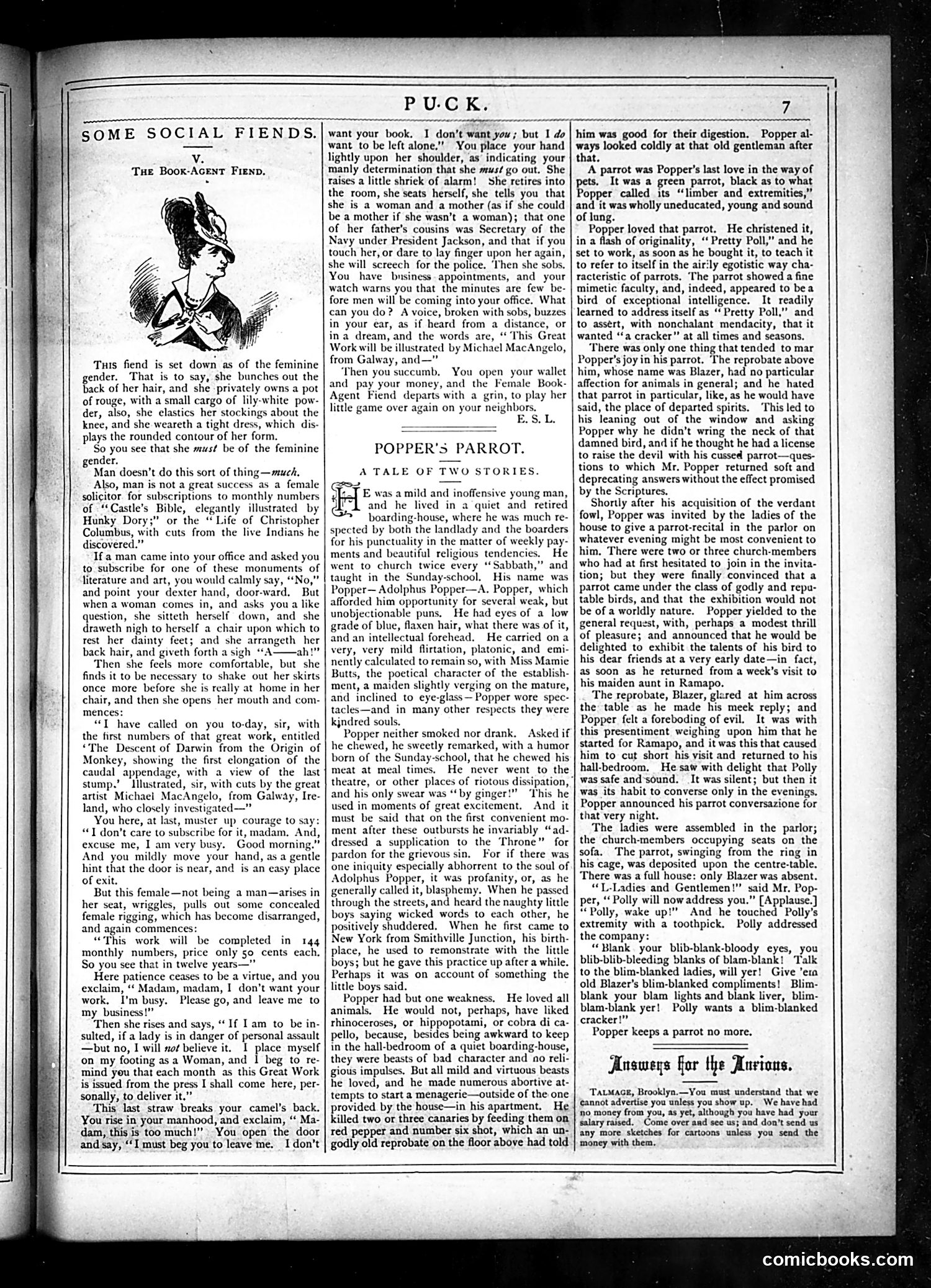
This page contains two distinct pieces: 1. **"Some Social Friends" (left)**: A satirical column by E.S.L. mocking the "Book-Agent Friend"—a social type who aggressively pushes subscriptions to illustrated books and encyclopedias on acquaintances, using manipulative tactics and false friendliness to make sales pitches. 2. **"Popper's Parrot" (right)**: A two-part humorous tale about Adolphus Popper, a mild-mannered man whose pet parrot becomes increasingly crude and embarrassing in public. The parrot's foul language and behavior humiliate Popper at social gatherings, particularly among church ladies, until he eventually surrenders the bird. The satire targets both Victorian prudishness and the awkwardness of uncontrollable social embarrassment.
📄 Transcribed text from this page (OCR, searchable)
Machine-transcribed from the original scan — historical spelling and the odd misread are preserved.
SOME SOCIAL FIENDS. Tue Boox-AGENT Fienp. Tuis fiend is set down as of the feminine gender. That is to say, she bunches out the back of her hair, and she privately owns a pot of rouge, with a small cargo of lily-white pow- der, also, she elastics her stockings about the knee, and she weareth a tight dress, which dis- plays the rounded contour of her form. So you see that she must be of the feminine gender. Man doesn’t do this sort of thing—much. Also, man is not a great success as a female solicitor for subscriptions to monthly numbers of “Castle’s Bible, elegantly illustrated by Hunky Dory;” or the “Life of Christopher Columbus, with cuts from the live Indians he discovered.” Ifa man came into your office and asked you to subscribe for one of these monuments of literature and art, you would calmly say, “No,” and point your dexter hand, door-ward. But when a woman comes in, and asks you a like question, she sitteth herself down, and she draweth nigh to herself a chair upon which to rest her dainty feet; and she arrangeth her back hair, and giveth forth a sigh ““A——ah!”” Then she feels more comfortable, but she finds it to be necessary to shake out her skirts once more before she is really at home in her chair, and then she opens her mouth and com- mences: “T have called on you to-day, sir, with the first numbers of that great work, entitled ‘The Descent of Darwin from the Origin of Monkey, showing the first elongation of the caudal appendage, with a view of the last stump.’ Illustrated, sir, with cuts by the great artist. Michael Ma lo, from Galway, Ire- land, who closely investigated —” You here, at last, muster up courage to say: “T don’t care to subscribe for it, madam. And, excuse me, I am very busy. Good morning.” And you mildly move your hand, as a gentle hint that the door is near, and is an easy place of exit. But this female—not being a man—arises in her seat, wriggles, pulls out some concealed female rigging, which has become disarranged, and again commences: “This work will be completed in 144 monthly numbers, price only 50 cents each. So you see that in twelve years—” Here patience ceases to be a virtue, and you exclaim, “ Madam, madam, I don’t want your Please go, and leave me to Then she ri and says, “If Iam to be in- sulted, if a lady is in danger of personal assault —but no, I will of believe it. I place myself on my footing as a Woman, and I beg to re- mind you that each month as this Great Work is issued from the press I shall come here, per- sonally, to deliver it.” This last straw breaks your camel's back. You rise in your manhood, and exclaim, ‘‘ Ma- dam, this is too much!” You open the door and say, ‘‘I must beg you to leave me. I don’t want your book. I don’t want you; but I do want to be left alone." You place your hand lightly upon her shoulder, as’ indicating your manly determination that she must go out. She raises a little shriek of alarm! She retires into the room, she seats herself, she tells you that she is a woman and a mother (as if she could be a mother if she wasn’t a woman); that one of her father’s cousins was Secretary of the Navy under President Jackson, and that if you touch her, or dare to lay finger upon her again, she will screech for the police. ‘Then she sobs. You have business. appointments, and your watch warns you that the minutes are few be- fore men will be coming into your office. What can you do? A voice, broken with sobs, buzzes in your ear, as if heard from a distance, or ina dream, and the words are, “ This Great Work will be illustrated by Michael MacAngelo, from Galway, and—” ‘Then you succumb. You open your wallet and pay your money, and the Female Book- Agent Fiend departs with a grin, to play her little game over again on your neighbo E POPPER’S PARROT. A TAL Ger . - ‘Rey E was a mild and inoffensive young man, APA and he lived in a quiet and retired boarding-house, where he was much re- spected by both the landlady and the boarders for his punctuality in the matter of weekly pay- ments and beautiful religious tendencies. He went to church twice every “Sabbath,” and taught in the Sunday-school. His name was Popper— Adolphus Popper—A. Popper, which afforded him opportunity for several weak, but unobjectionable puns, ‘He had eyes of a’ low grade of blue, flaxen hair, what there was of it, and an intellectual forehead. He carried ona very, very mild flirtation, platonic, and emi- nently calculated to remain so, with Miss Mamie Butts, the poetical character of the establish- ment, a maiden slightly verging on the mature, and inclined to eye-glass—Popper wore spec- tacles—and_ in many other respects they were kjndred souls. Popper neither smoked nor drank. Asked if he chewed, he sweetly remarked, with a humor born of the Sunday-school, that he chewed his meat at meal times. He never went to the theatre, or other places of riotous dissipation, | and his only swear was “by ginger!” ‘This he used in moments of great excitement. And it must be said that on the first convenient mo- ment after these outbursts he invariably “ad- dressed a supplication to the Throne” for pardon for the grievous sin. For if there was one iniquity especially abhorrent to the soul of Adolphus Popper, it was profanity, or, as he generally called it, blasphemy. When he passed through the streets, and heard the naughty little boys saying wicked words to each other, he positively shuddered, When he first came to New York from Smithville Junction, his birth- place, he used to remonstrate with the little boys; but he gave this practice up after a while. Perhaps it was on account of something the little boys said. Popper had but one weakness. He loved all animals. He would not, perhaps, have liked rhinoceroses, or hippopotami, or cobra di ca- pello, because, besides being awkward to keep in the hall-bedroom of a quiet boarding-house, they were beasts of bad character and no reli- gious impulses. But all mild and virtuous beasts he loved, and he made numerous abortive at- tempts to start a menagerie—outside of the one provided by the house—in his apartment. He killed two or three canaries by feeding them on red pepper and number six shot, which an un- godly old reprobate on the floor above had told OF TWO STORIES. him was good for their digestion. Popper al- wary looked coldly at that old gentleman after that. A parrot was Popper’s last love in the way of pets. It was a green parrot, black as to what Popper called its “limber and extremities,” and it was wholly uneducated, young and sound of lung. Popper loved that parrot. He christened it, in a flash of originality, ‘Pretty Poll,” and he set to work, as soon as he bought it, to teach it to refer to itself in the airily egotistic way cha- racteristic of parrots. ‘The parrot showed a fine mimetic faculty, and, indeed, appeared to bea bird of exceptional intelligence. It readily learned to address itself as ‘Pretty Poll,” and to assért, with nonchalant mendacity, that it wanted “a cracker” at all times and seasons. There was only one thing that tended to mar Popper's joy in his parrot. The reprobate above him, whose name was Blazer, had no particular affection for animals in general; and he hated that parrot in particular, like, as he would have said, the place of departed spirits. ‘This led to his leaning out of the window and asking Popper why he didn’t wring the neck of that damned bird, and if he thought he had a license to raise the devil with his cussed parrot—ques- tions to which Mr. Popper returned soft and deprecating answers without the effect promised by the Scriptures, Shortly after his acquisition of the verdant fowl, Popper was invited by the ladies of the house to give a parrot-recital in the parlor on whatever evening might be most convenient to him. There were two or three church-members. who had at first hesitated to join in the invita- tion; but they were finally convinced that a parrot came under the class of godly and repa- table birds, and that the exhibition would not be of a worldly nature. Popper yielded to the general request, with, perhaps a modest thrill of pleasure; and announced that he would be delighted to exhibit the talents of his bird to his dear friends at a very early date—in fact, as soon as he returned from a week’s visit to his maiden aunt in Ramapo. The reprobate, Blazer, glared at him across the table as he made his meek reply; and Popper felt a foreboding of evil. It was with this presentiment weighing upon him that he started for Ramapo, and it was this that caused him to cut short his visit and returned to his hall-bedroom. He saw with delight that Polly was safe and’sound. It was silent; but then it was its habit to converse only in the evenings. Popper announced his parrot conversazione for that very night. The ladies were assembled in the parlor; the church-members occupying seats on the sofa. The parrot, swinging from the ring in his cage, was deposited upon the centre-table. There was a full house: only Blazer was absent. “L-Ladies and Gentlemen!” said Mr. Pop- per, “Polly will now address you.” [Applause.] “Polly, wake up!” And he touched Polly’s extremity with a toothpick. Polly addressed the company: “Blank your blib-blank-bloody eyes, you blib-blib-bleeding blanks of blam-blank! Talk to the blim-blanked ladies, will yer! Give era old Blazer's blim-blanked compliments! Blim- blank your blam lights and blank liver, blim- blam-blank yer! Polly wants a blim-blanked cracker!”” Popper keeps a parrot no more, Answers for the Anrions. TALMAcE, Brooklyn.—You must understand that we cannot advertise you unless you show up. We have had no money from you, as yet, although you have had your salary raised. Come over and see us; and don’t send us any more sketches for cartoons unless you send the money with them, comicbooks.com