
Puck, 1878-10-30 · page 6 of 16
Puck — October 30, 1878 — page 6: what you’re looking at
What you’re looking at
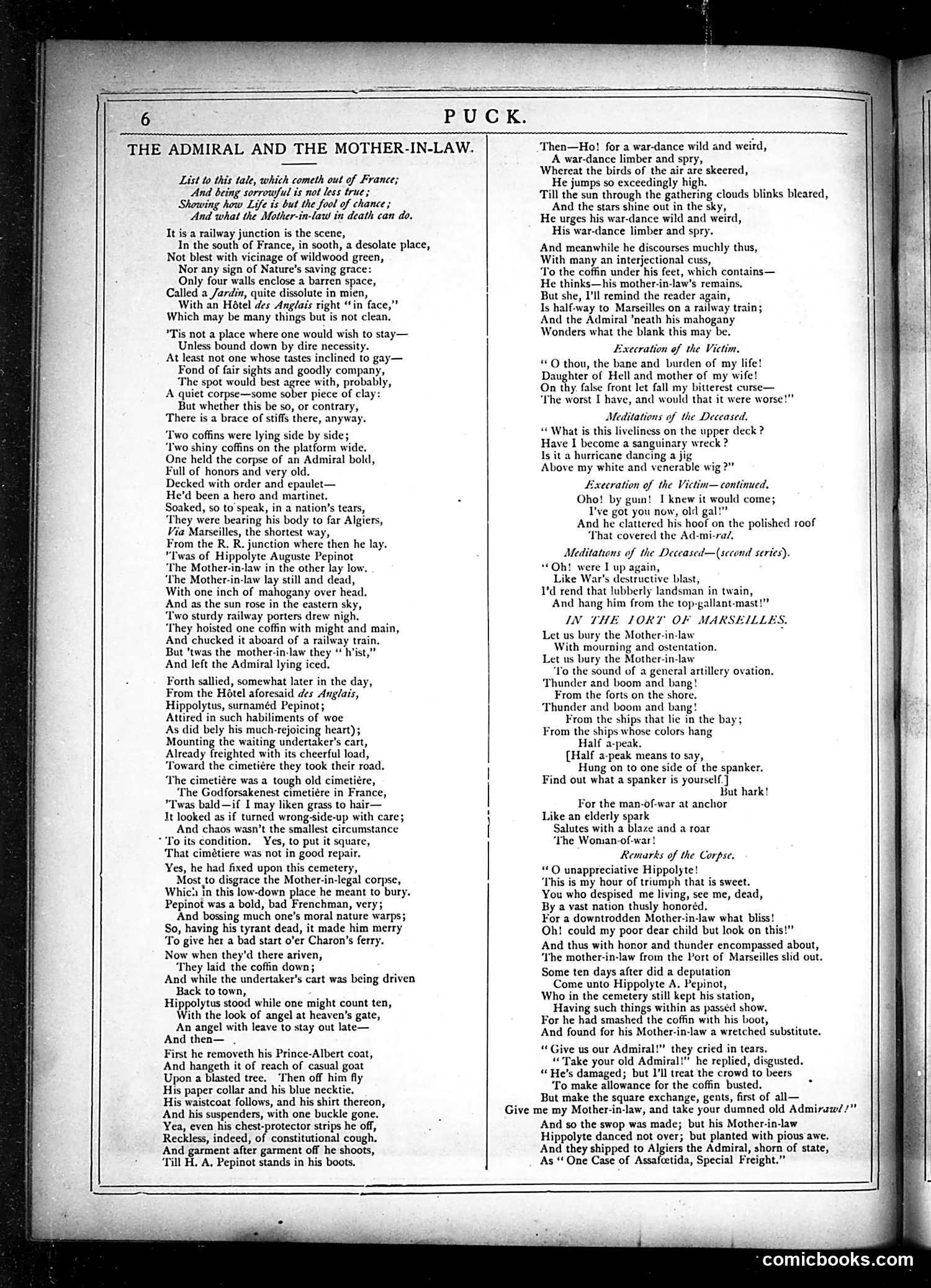
This is a narrative poem rather than a cartoon. It tells of Admiral Hippolyte (likely referring to a French naval officer), who dies and is given an elaborate funeral procession from a French railway junction to Marseilles. The satire centers on the Admiral's mother-in-law, who accompanies the coffin and makes absurd demands throughout—insisting on military honors, complaining about accommodations, and ultimately negotiating a financial "swap" to accept the Admiral's burial arrangement. The joke appears to mock both pretentious military funeral customs and the stereotypical meddling mother-in-law figure. The poem uses the contrast between solemn military ceremony and her petty, mercenary concerns for comic effect, suggesting that even death cannot escape domestic absurdity.
📄 Transcribed text from this page (OCR, searchable)
Machine-transcribed from the original scan — historical spelling and the odd misread are preserved.
PUCK. ‘Then—Ho! for a war-dance wild and weird, THE ADMIRAL AND THE MOTHER-IN-LAW. List to this tale, which cometh out of France; ‘And being sorrowful is not less true ; Showing how Life is but the fool of chance ; ‘And what the Mother-in-law in death can do, It is a railway junction is the scene, In the south of France, in sooth, a desolate place, Not blest with vicinage of wildwood green, Nor any sign of Nature’s saving grace: Only four walls enclose a barren space, Called a Jardin, quite dissolute in mien, With an Hotel des Anglais right ‘in face,” Which may be many things but is not clean, ‘Tis not a place where one would wish to stay— Unless bound down by dire necessity. At least not one whose tastes inclined to gay— Fond of fair sights and goodly company, The spot would best agree with, probably, A quiet corpse—some sober piece of clay: But whether this be so, or contrary, There is a brace of stiffs there, anyway, ‘Two coffins were lying side by sid ‘Iwo shiny coffins on the platform wide. One held the corpse of an Admiral bold, Full of honors and very old. Decked with order and epaulet— He'd been a hero and martinet. Soaked, so to speak, in a nation’s tears, ‘They were bearing his body to far Algiers, Via Marseilles, the shortest way, From the R, R. junction where then he lay. "Twas of Hippolyte Auguste Pepinot ‘The Mother-in-law in the other lay low. ‘The Mother-in-law lay still and dead, With one inch of mahogany over head. And as the sun rose in the eastern sky, ‘Two sturdy railway porters drew nigh. ‘They hoisted one coffin with might and main, And chucked it aboard of a railway train, But 'twas the mother-in-law they ‘‘ h’ist,”” And left the Admiral lying iced. Forth sallied, somewhat later in the day, From the Hétel aforesaid des Anglais, Hippolytus, surnaméd Pepinot; Attired in such habiliments of woe As did bely his much-rejoicing heart); Mounting the waiting undertaker’s cart, Already freighted with its cheerful load, ‘Toward the cimetiére they took their road. ‘The cimetiére was a tough old cimetiére, ‘The Godforsakenest cimetiére in France, "Twas bald—if I may liken grass to hair— It looked as if turned wrong-side-up with care; And chaos wasn’t the smallest circumstance * To its condition. Yes, to put it square, ‘That cimétiere was not in good repair. Yes, he had fixed upon this cemetery, Most to disgrace the Mother-in-legal corpse, Which in this low-down place he meant to bury. Pepinot was a bold, bad Frenchman, very; And bossing much one’s moral nature warps; So, having his tyrant dead, it made him merry To give her a bad start o’er Charon’s ferry. Now when they’d there ariven, They laid the coffin down; And while the undertaker’s cart was being driven Back to town, Hippolytus stood while one might count ten, With the look of angel at heaven's gate, An angel with leave to stay out late— And then— | First he removeth his Prince-Albert coat, And hangeth it of reach of casual goat Upon a blasted tree. ‘Then off him fly His paper collar and his blue necktie. His waistcoat follows, and his shirt thereon, And his suspenders, with one buckle gone. Yea, even his chest-protector strips he off, Reckless, indeed, of constitutional cough, And garment after garment off he shoots, ‘Till H. A, Pepinot stands in his boots, ‘A war-dance limber and spry, Whereat the birds of the air are skeered, He jumps so exceedingly high. Till the sun through the gathering clouds blinks bleared, And the stars shine out in the sky, He urges his war-dance wild and weird, His war-dance limber and spry. And meanwhile he discourses muchly thus, With many an interjectional cuss, To the coffin under his feet, which contains— He thinks—his mother-in-law’s remains, But she, I’ll remind the reader again, Is half-way to Marseilles on a railway train; ‘And the Admiral 'neath his mahogany Wonders what the blank this may be. Exeeration of the Victim, “© thou, the bane and burden of my life! Daughter of Hell and mother of my wif On thy. false front let fall my bitterest curse— ‘The worst I have, and would that it were worse!" Meditations of the Deceased, “ What is this liveliness on the upper deck ? Have I become a sanguinary wreck ? Is ita hurricane dancing a jig Above my white and venerable wig ?” Lxecration of the Victim— continued, Oho! by gun! I knew it would come; I've got you now, old gal!”” And he clattered his hoof on the polished roof ‘That covered the Ad-mi-ra/. Meditations of the Deceased—(second series). “Oh! were I up again, Like War's destructive blast, I'd rend that lubberly landsman in twain, And hang him from the top-gallant-mast IN THE IORT OF MARSEILLES. Let us bury the Mother-in-law With mourning and ostentation. Let us bury the Mother-in-law “Lo the sound of a general artillery ovation. Thunder and boom and bang! From the forts on the shore. Thunder and boom and bang! From the ships that lie in the bay; From the ships whose colors hang Half a-peak. [Half a-peak means to say, Hung on to one side of the spanker. Find out what a spanker is yourself.] But hark! For the man-of-war at anchor Like an elderly spark Salutes with a blaze and a roar ‘rhe Woman-of-w: Remarks of the Corpse. “O unappreciative Hippolyte! ‘This is my hour of triumph that is sweet. You who despised me living, see me, dead, By a vast nation thusly honoréd. For a downtrodden Mother-in-law what bliss! Oh! could my poor dear child but look on this!” And thus with honor and thunder encompassed about, ‘The mother-in-law from the Port of Marseilles slid out. Some ten days after did a deputation Come unto Hippolyte A. Pepinot, Who in the cemetery still kept his station, Having such things within as pass¢d show. For he had smashed the coffin with his boot, And found for his Mother-in-law a wretched substitute. “ Give us our Admiral!” they cried in tears. “Take your old Admiral!” he replied, disgusted. “He's damaged; but I'll treat the crowd to beers ‘To make allowance for the coffin busted. But make the square exchange, gents, first of all— Give me my Mother-in-law, and take your dumned old Admiraw/, And so the swop was made; but his Mother-in-law Hippolyte danced not over; but planted with pious awe, ‘And they shipped to Algiers the Admiral, shorn of state, As “One Case of Assafcetida, Special Freight.” ” ‘comicbooks.com