
A complete issue · 16 pages · 1878
Puck — October 2, 1878
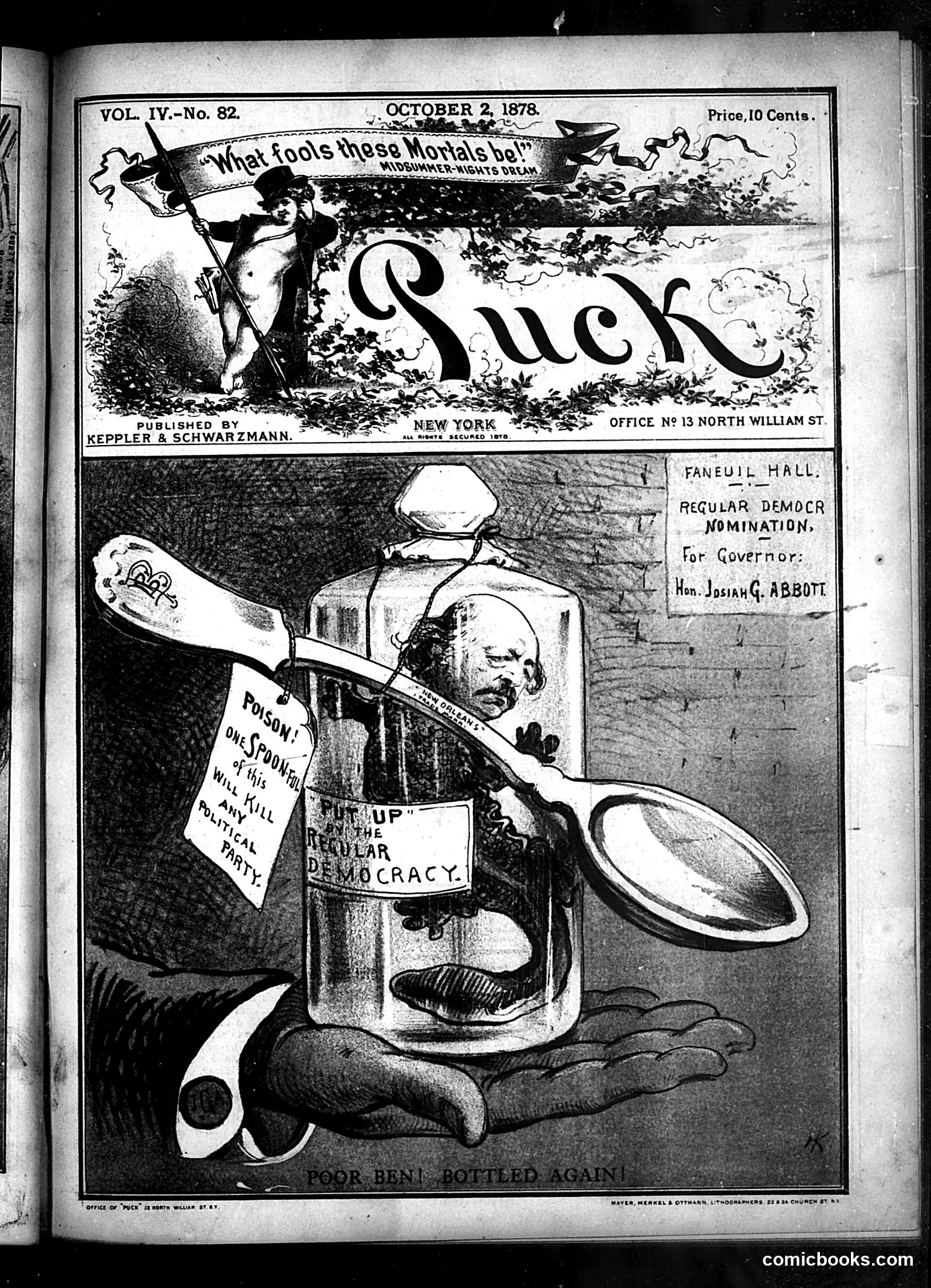
This political cartoon satirizes the Democratic Party's gubernatorial nomination of Josiah G. Abbott for New York Governor. The main image depicts a bald man's head trapped inside a bottle labeled "UP THE REGULAR DEMOCRACY," with a large spoon force-feeding him "POISON" marked as "ONE SPOONFUL OF ONE OF THE MOST WILL KILL A POLITICAL DIRTY." The caption reads "POOR BENT BOTTLED AGAIN!" The satire suggests that Abbott and the Democratic Party establishment are poisoning themselves through their nomination process—that Abbott is an unwanted or toxic candidate being forced upon the party. The heavy-handed spoon-feeding imagery emphasizes the coercive nature of party politics, implying voters are being made to swallow an objectionable choice.
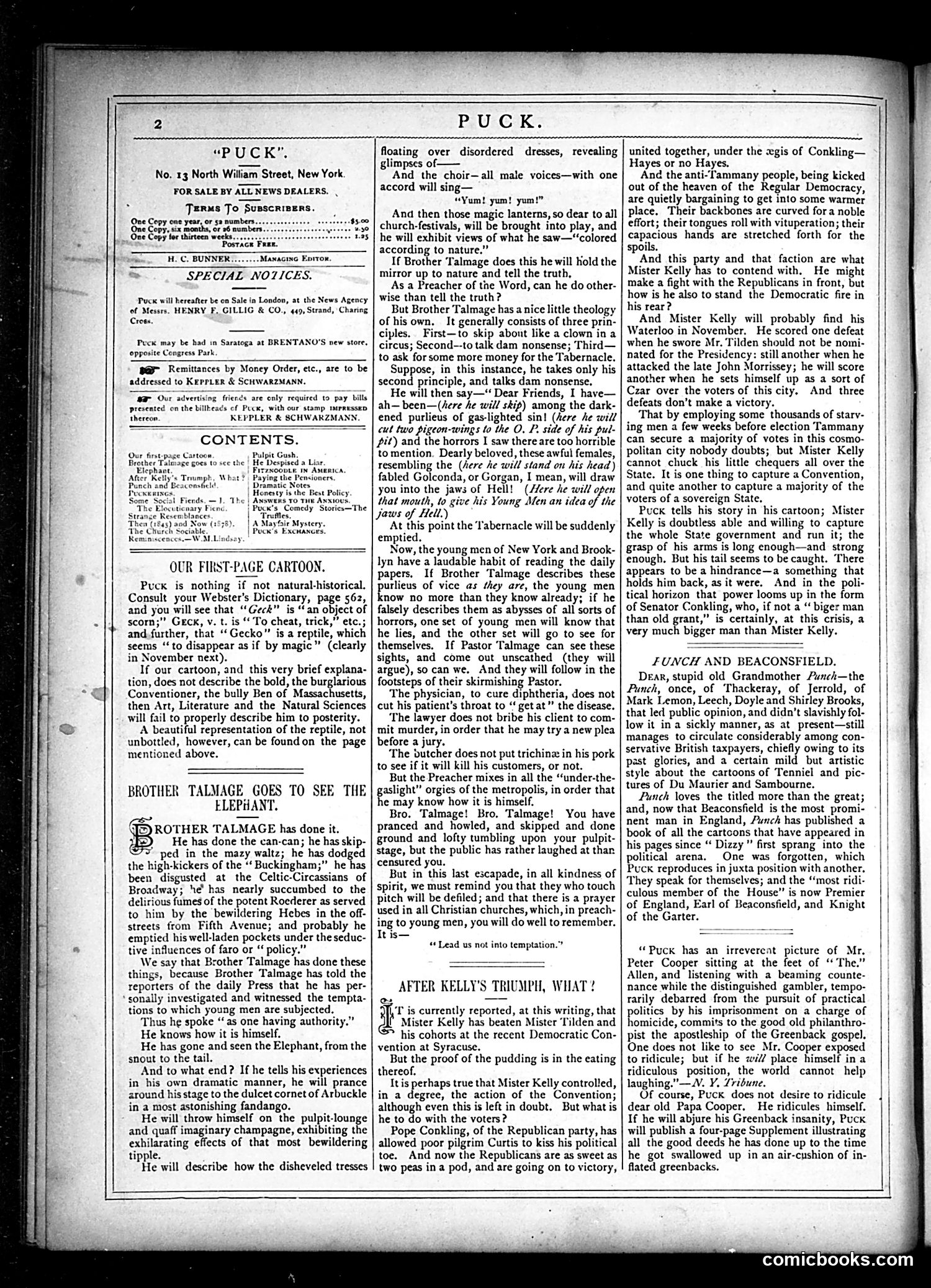
This page contains three satirical pieces about late 19th-century American politics and clergy: **"Brother Talmage Goes to See the Elephant"** mocks Rev. DeWitt Talmage, a prominent Brooklyn minister, for his theatrical preaching style and sensationalism. The piece satirizes him for adopting worldly entertainment tactics rather than genuine spiritual authority. **"After Kelly's Triumph, What?"** references Mister Kelly's recent victory at the Democratic Convention at Syracuse, discussing Republican responses. It alludes to Pope Cooking and Republican political maneuvering, suggesting uncertainty about the election's implications. The page also includes satirical commentary on contemporary religious hypocrisy and political posturing, typical of Puck's irreverent approach to public figures. The exact cartoons are difficult to discern clearly from the image quality, but the text indicates sharp criticism of religious and political leaders.
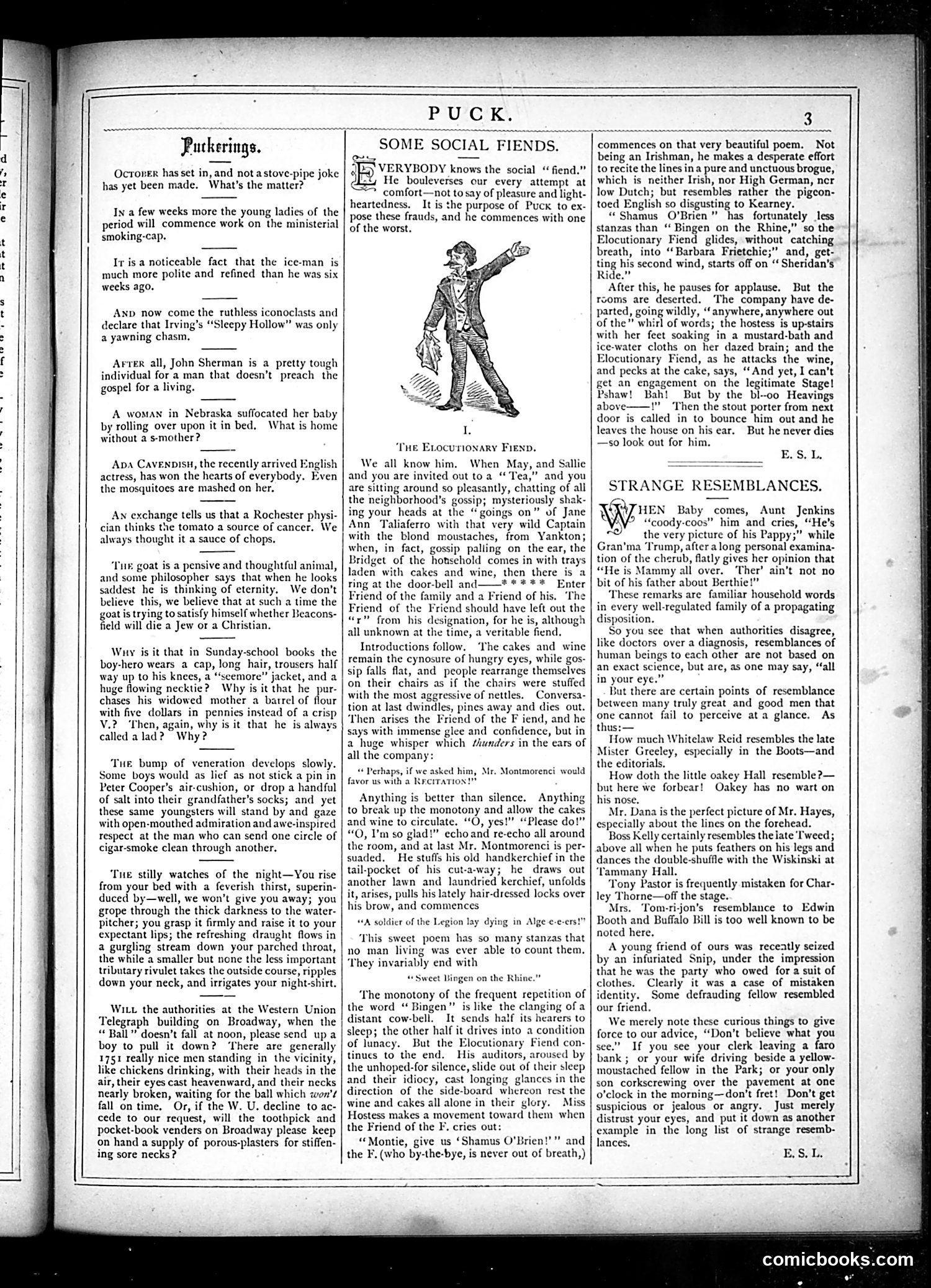
This page contains humorous commentary rather than political cartoons. The main illustrated article, "The Elocutionary Friend," satirizes a particular social type: the overly theatrical dinner guest who dominates conversation with dramatic recitations and affected mannerisms. The figure shown appears to be a Victorian-era gentleman in animated pose, likely mid-performance. The satire mocks affectation and pretentiousness in polite society—specifically targeting someone who shows off with bombastic speech and theatrical gestures at social gatherings. The accompanying text describes how such a "friend" exhausts hosts and other guests through relentless, self-aggrandizing performances. "Strange Resemblances" offers light observational humor about family likenesses and amusing coincidences among acquaintances. The content reflects typical Puck fare: gentle social satire targeting middle-class mannerisms and behavior.
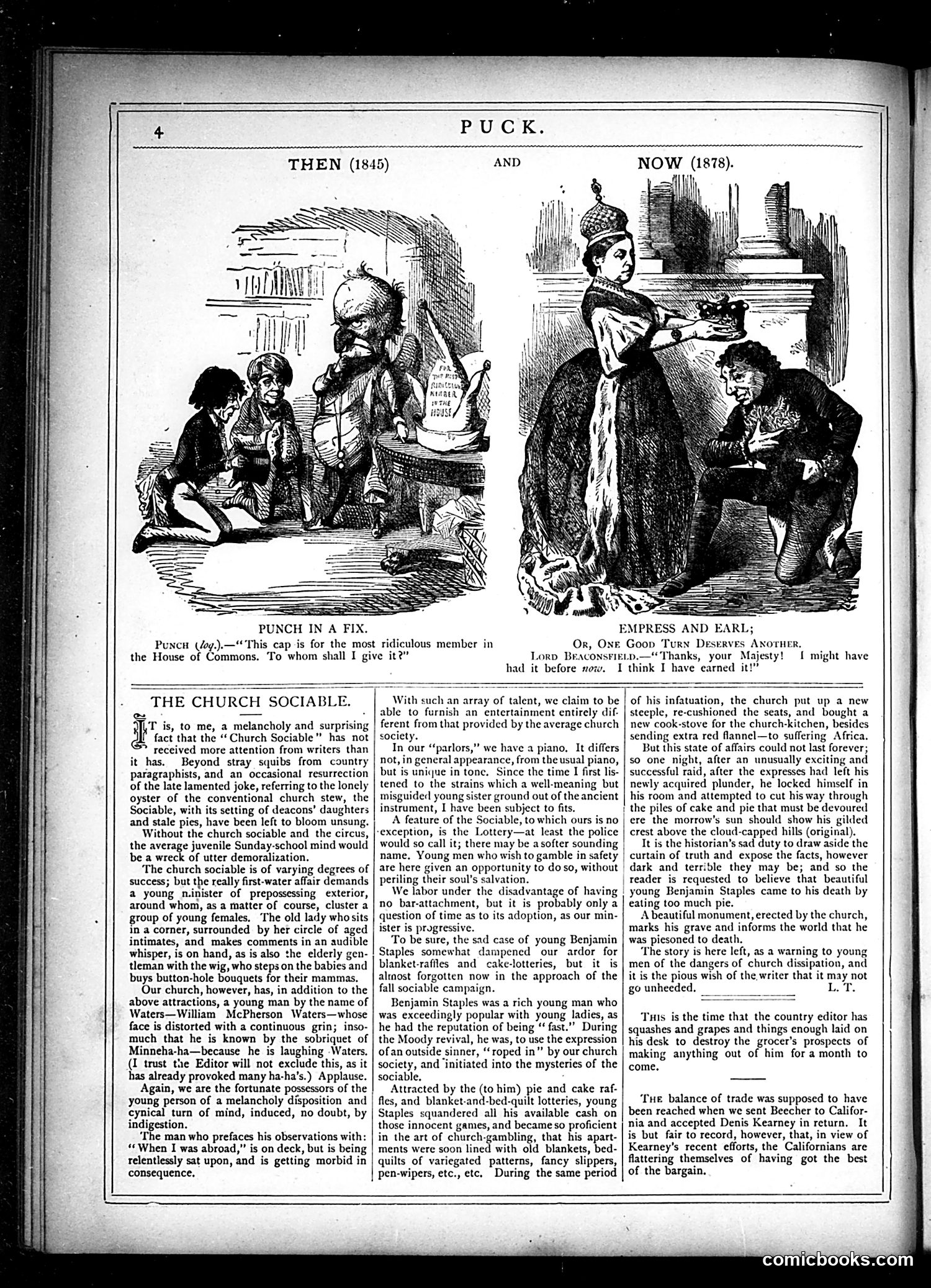
**Top Section - "Then (1845) and Now (1878)":** Two cartoons compare parliamentary figures across 33 years. The left shows "Punch in a Fix" with Commons members debating a ridiculously small cap. The right depicts an "Empress and Earl" scene, likely referencing British imperial politics and nobility of 1878. The satire appears to mock political pretension and the persistence of absurd debates. **"The Church Sociable" Article:** This lengthy piece criticizes church social functions and gambling activities (lotteries, card games) organized to raise funds. It specifically names Benjamin Staples as a young man who lost considerable money at church gambling events. The satire targets hypocrisy: churches condemning vice while profiting from it. References to "Moody revival" and church fundraising suggest commentary on Victorian institutional religion's contradictions.
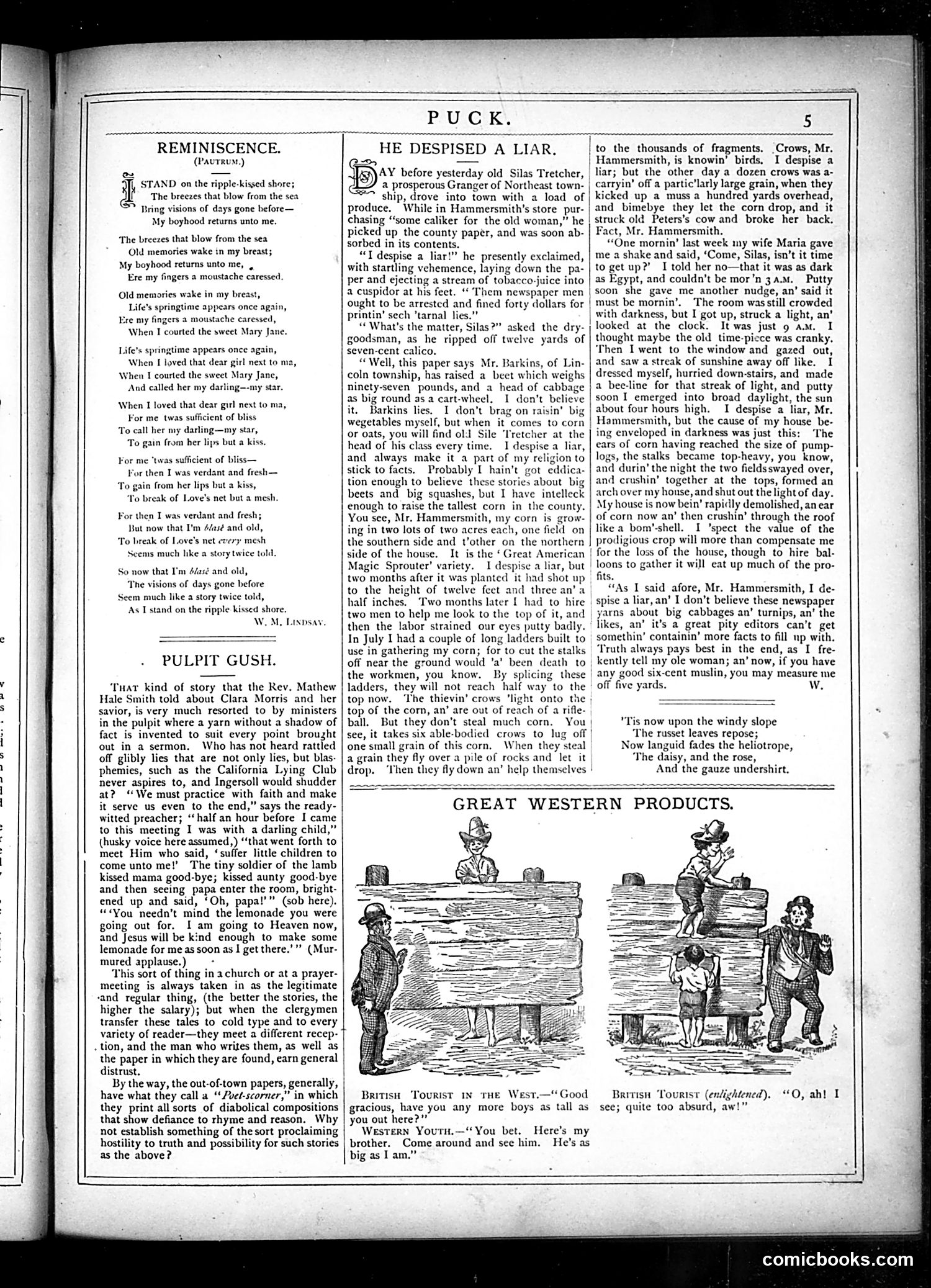
This page contains three distinct sections: a poem titled "Reminiscence," a prose piece called "Pulpit Gush," and a cartoon section labeled "Great Western Products." The cartoon depicts a British tourist encountering American frontier characters. The captions suggest satire about British perceptions of the American West—the tourist expresses amazement at seeing "boys as tall as trees," while a "Western Youth" boasts about his size. This appears to mock both British stereotypes about the Wild West's exaggerated scale and American frontier braggadocio. The accompanying text and poem focus on rural/agricultural themes and social commentary, though the specific references are unclear without additional historical context about contemporary issues Puck was addressing.
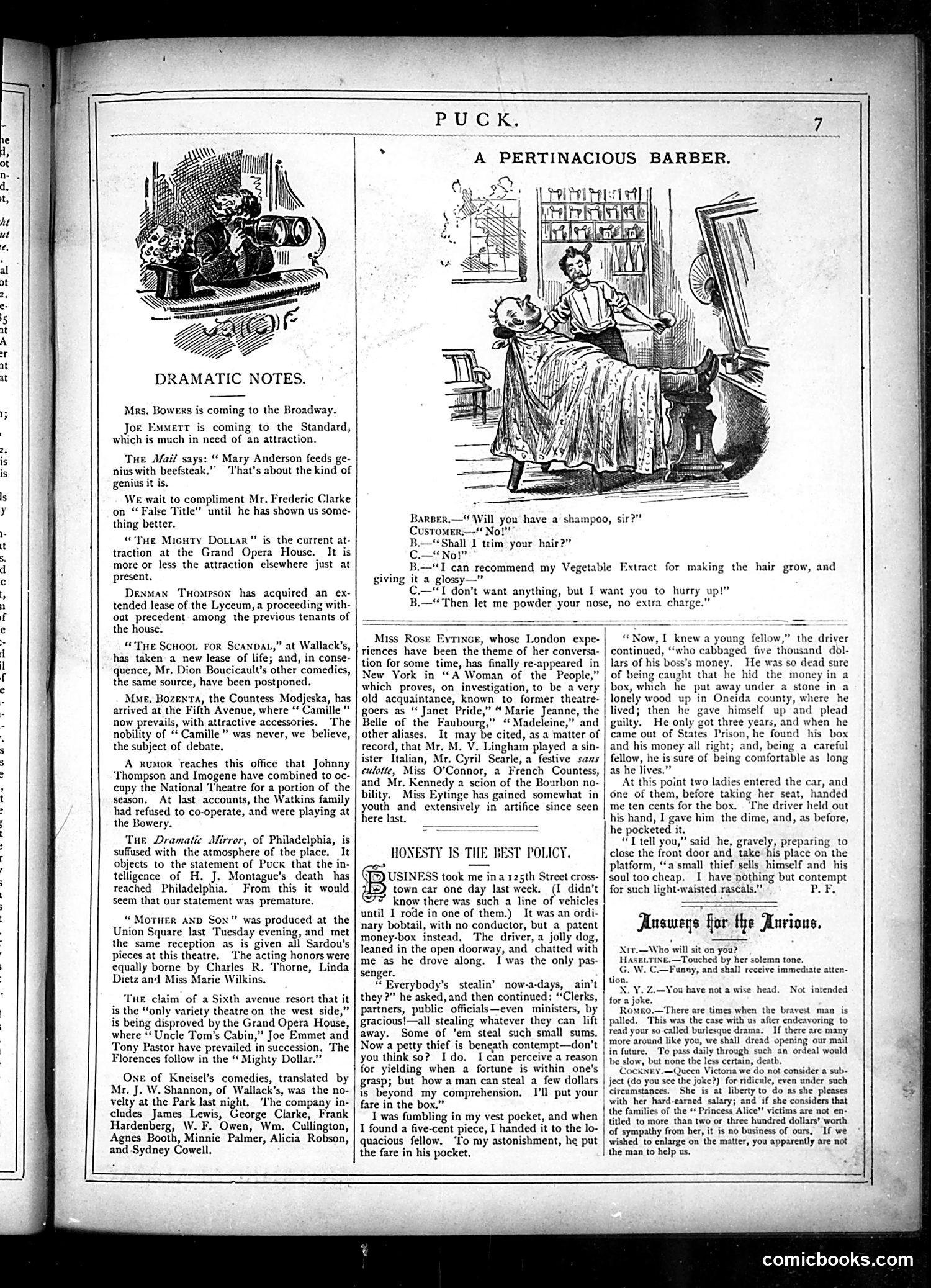
This cartoon satirizes an annoying barber who won't stop talking and won't listen to his customer's requests. The humor relies on the contrast between the barber's incessant chatter about hair tonics and treatments and the customer's repeated, frustrated requests to "hurry up" and "stop." The joke reflects a common social frustration—the talkative service provider who ignores client wishes. The barber keeps pushing unnecessary products (Vegetable Extract for hair growth) while the exasperated customer wants only a quick, simple haircut. The title "Pertinacious" (stubbornly persistent) perfectly captures the barber's refusal to recognize or respect the customer's obvious irritation and simple requests for silence and efficiency.
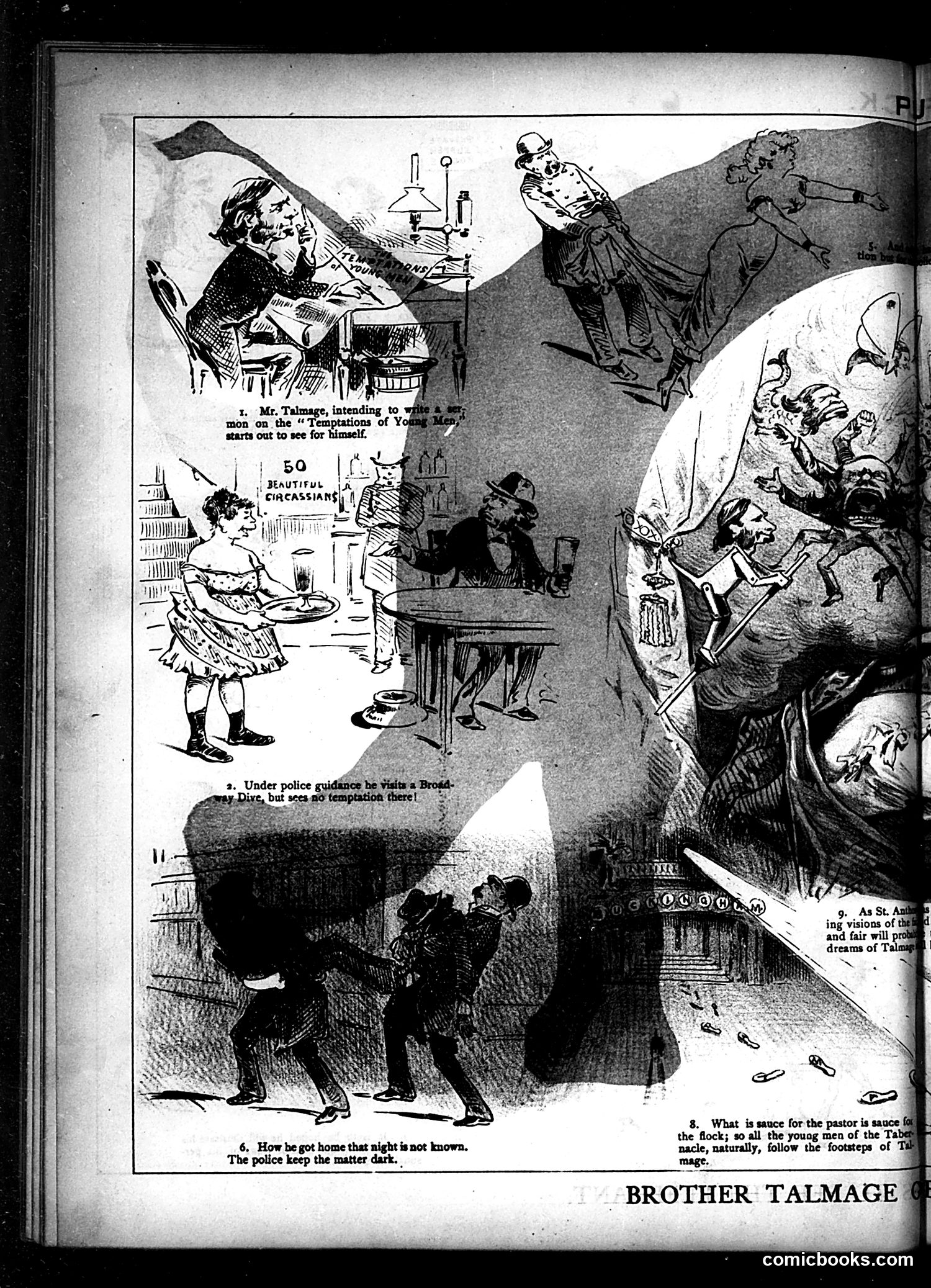
This appears to be a satirical comic sequence mocking a religious figure named Talmage (likely Rev. Thomas DeWitt Talmage, a prominent 19th-century minister). The six-panel narrative depicts: 1. Talmage writing about "Temptations of Young Men" 2. A young woman visiting a Broadway theater under police supervision 3. Unknown details (partially obscured) 4. Police involvement in covering up an incident 5. References to "beautiful cheekiness" and nighttime activities 6. St. Anthony's visions and moral hypocrisy The satire appears to mock Talmage's sermons condemning youthful vice while suggesting his own or his circle's involvement in questionable behavior. The juxtaposition of his pious moralizing against scenes of worldly temptation and police cover-ups creates the satirical point: moral hypocrisy among religious leaders.
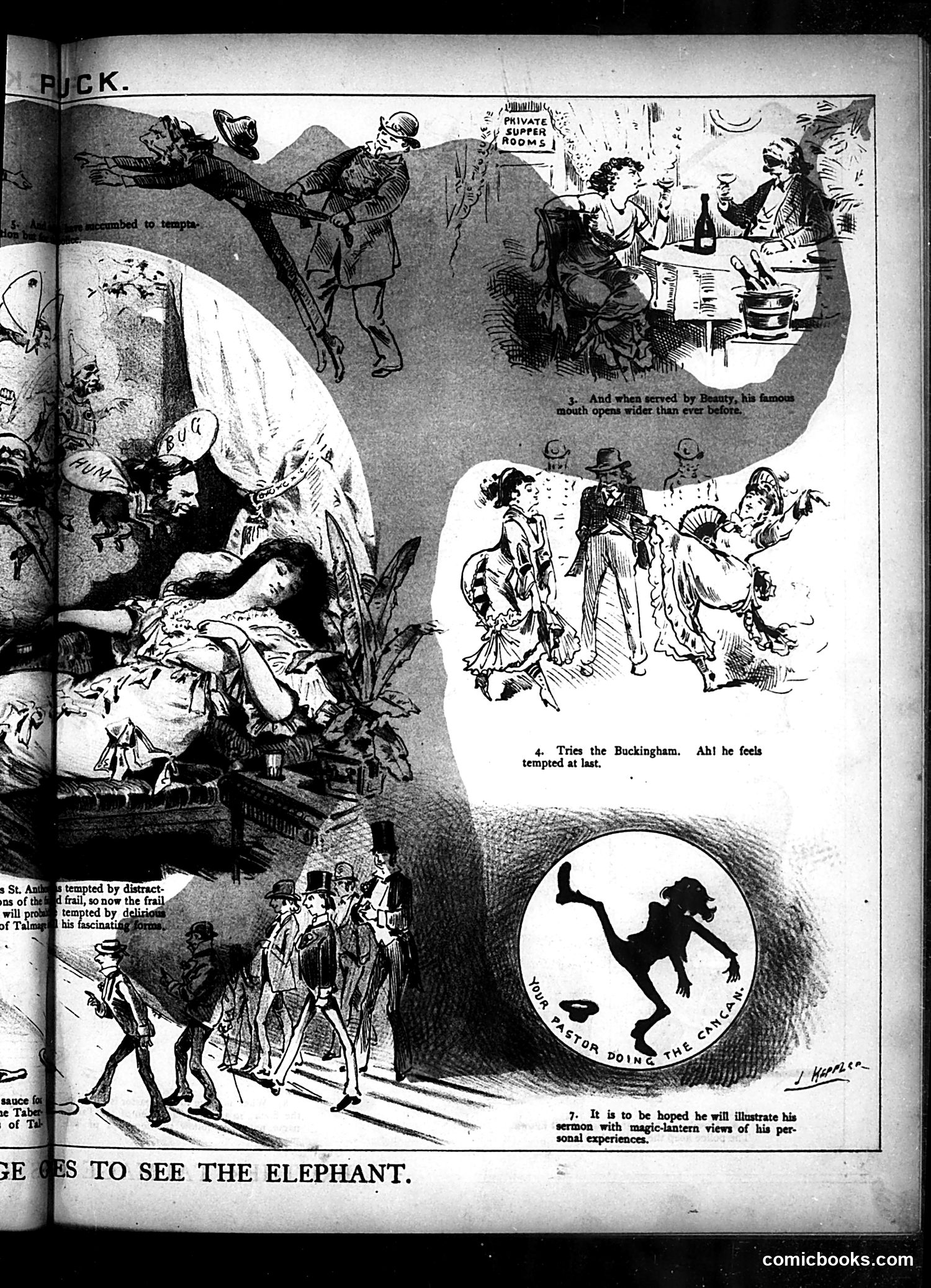
This page depicts a satirical story about a character named Beastly serving at a private supper room. The narrative follows his interactions with guests, culminating in him "trying the Buckingham" — apparently some kind of physical stunt or acrobatic feat that causes him to feel "tempted at last." The bottom section shows a "Pastor" character, with the final caption suggesting he will illustrate his sermon using "magic-lantern views of his personal experiences." The page appears to be a humorous serial narrative rather than political satire. Without clear identification of specific historical figures, the humor seems to rely on physical comedy and the social dynamics of servant life in upper-class settings. The exact references and full context remain unclear without additional publication information.
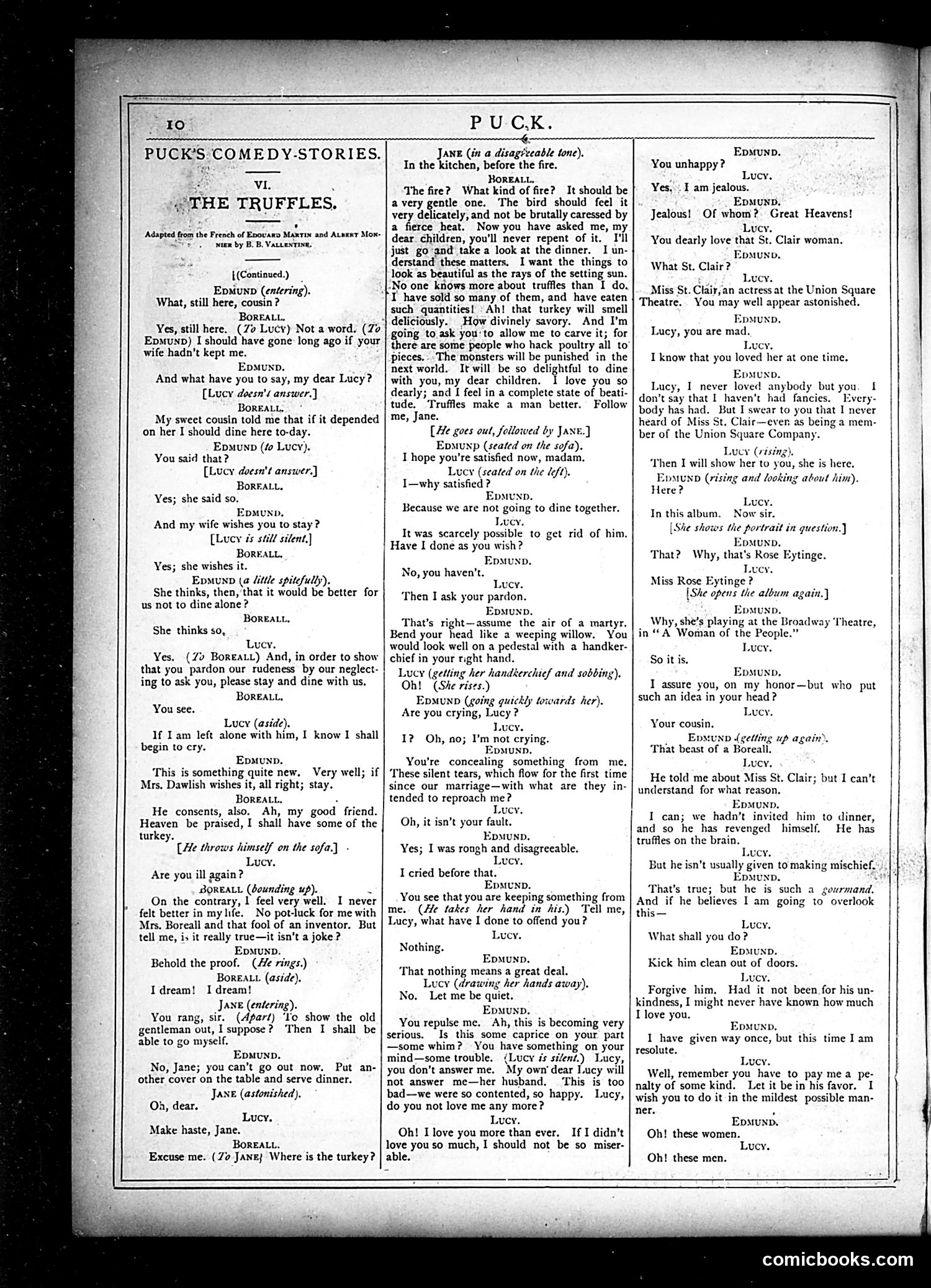
This page contains **"The Truffles," part VI of Puck's Comedy Stories**—a dramatic play dialogue, not a political cartoon. The scene depicts domestic conflict: Edmund and Lucy argue about her jealousy regarding Miss St. Clair, an actress. Edmund defends Miss St. Clair's character while Lucy accuses him of romantic interest. The dialogue explores themes of marital trust, misunderstanding, and social propriety (Miss St. Clair performs at the Broadway Theatre). This is **serialized fictional drama** rather than satire or political commentary. It's entertainment literature adapted from French sources, designed for Puck's readers as ongoing narrative fiction—common magazine content of the era alongside actual satirical cartoons.
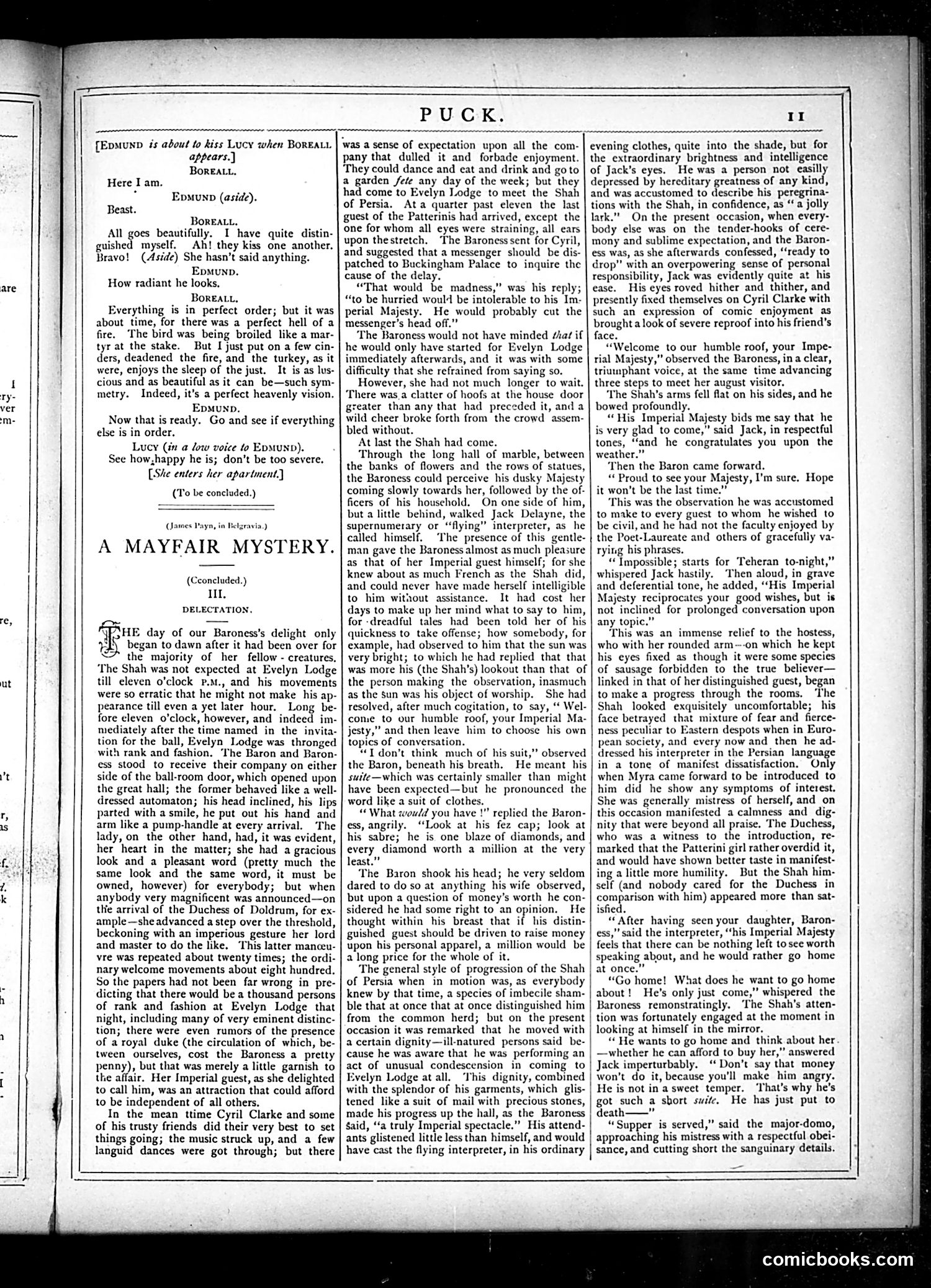
This page contains the conclusion of "A Mayfair Mystery," a serialized fictional story rather than a political cartoon. The narrative describes a visit by the Shah of Persia to a London baroness's home during a social gathering. The story satirizes British high society's obsequious treatment of foreign dignitaries. It mocks how the wealthy compete for prestige by hosting distinguished guests, depicting courtiers fawning over the Shah while he remains largely indifferent. The text humorously contrasts the guests' elaborate efforts to impress with the Shah's modest reactions and his preoccupation with returning home to think about his daughter. The satire targets vanity and social climbing among the British aristocracy rather than engaging with specific political events.
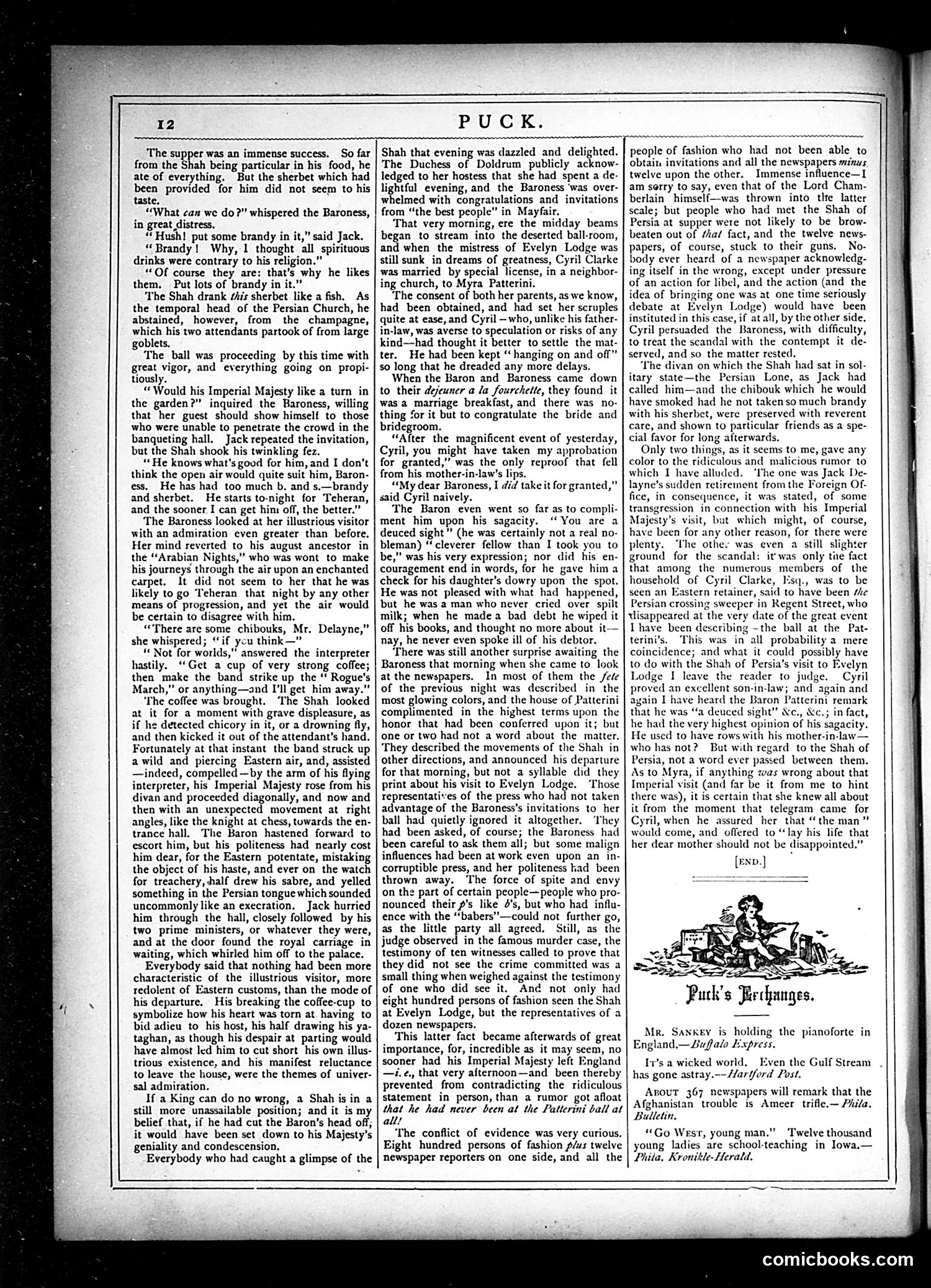
This page is primarily a **serialized fiction story** rather than political satire. The narrative concerns an Eastern potentate (the Shah) visiting England, with romantic complications involving aristocratic characters like Cyril Clarke and the Baroness. The small illustrated section titled **"Puck's Perchances"** at bottom contains brief social commentary, including a quip about Iowa schoolteachers and references to Gulf Stream weather. These appear to be miscellaneous satirical observations rather than focused political cartooning. The main content is entertainment-focused storytelling rather than the political cartoons Puck magazine is typically known for. Without seeing the accompanying illustrations throughout the text, the satirical intent remains unclear from this page alone.
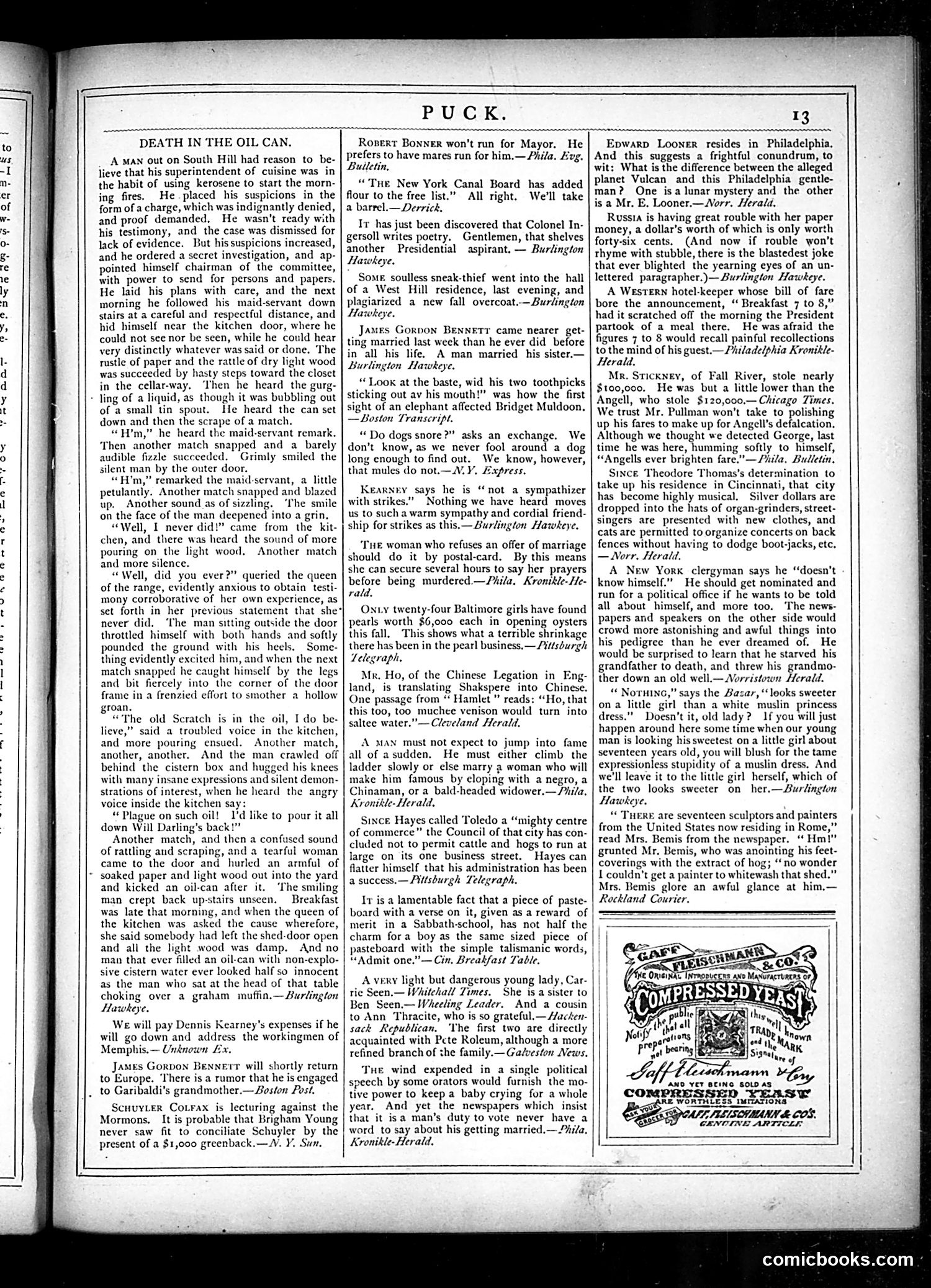
This page consists primarily of **short satirical news items and gossip** rather than political cartoons. The content includes: - Mockery of a superintendent who believed cuisine expertise qualified him for supervising prisons - Jabs at political figures (Colonel Ingersoll's poetry, Robert Bonner's mayoral ambitions) - Social satire targeting various groups: hotel-keepers, wealthy Philadelphia gentlemen, Chinese immigrants, and young women - Ridicule of absurd situations (pearls in oysters, a man filled with oil) The humor relies on **contemporary references** (Baltimore society, New York Canal Board, Cincinnati politics) that would be recognizable to 1880s readers but require historical context today. A **compressed yeast advertisement** appears at the bottom, typical of period magazine layouts. The satire targets **hypocrisy, incompetence, and social pretension** across urban American life.
This page is primarily advertising with minimal satirical content. The dominant advertisements include Arnold, Constable & Co. (clothing retailer), Apollinaris mineral water, Vichy springs water, and Anheuser-Busch beer. The only potentially political element is Anheuser-Busch's prominent advertisement claiming "THE GRAND GOLD MEDAL AWARDED TO ANHEUSER'S ST. LOUIS LAGER BEER" at the "WORLD'S EXPOSITION, PARIS 1878." This appears to be commercial boasting about winning a prestigious international competition—a common marketing tactic to establish product superiority and appeal to status-conscious consumers. The page functions mainly as a revenue vehicle for Puck magazine through paid advertisements rather than as a platform for satire or political commentary.
This page is primarily **advertising content** rather than political satire or comics. It contains commercial advertisements for 1878 products and services including: - **Le Moult, the Florist** (funeral designs) - **Isaac Smith's Umbrellas** - **Pachtmann & Moelich** (watches and jewelry) - **Herring's Safes** - **Vienna Coffee Pot** by Edward D. Bassford - **Louisiana State Lottery Co.** (offering a $30,000 capital prize) - **Puck's Almanac for 1878** (15 cents) There is one decorative illustration featuring a horse and rider with "Hungarian Wines" branding, but this is primarily marketing imagery rather than satirical commentary. The page represents typical 19th-century magazine revenue generation through advertisements rather than editorial content.
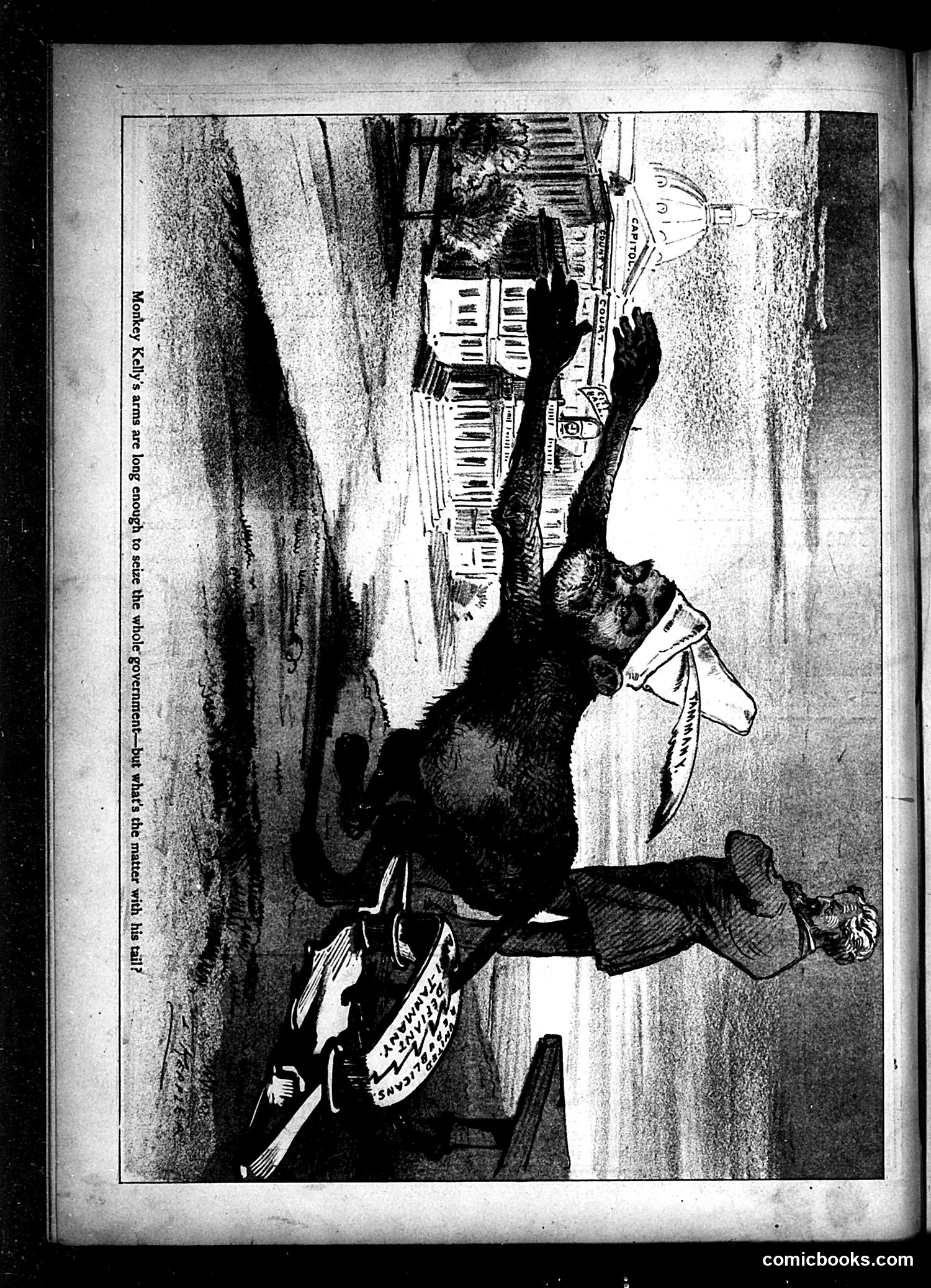
This page contains a political cartoon depicting a figure in formal attire riding a donkey. The image is oriented sideways on the page, requiring rotation to view properly. The caption on the left margin reads: "Makes a 'duty' same as long ago—Ride the male [Gouverneur?]—the mule of the male folk." The donkey appears to be the central satirical element, likely representing either a political figure or institution from the era. The formal dress of the rider and the reference to "duty" suggests commentary on political obligations or responsibilities. However, **without being able to clearly identify the specific historical context or the figure being caricatured, I cannot definitively explain what political event or person this cartoon satirizes.** The text quality and image orientation make complete interpretation difficult.