
Puck, 1878-10-02 · page 4 of 16
Puck — October 2, 1878 — page 4: what you’re looking at
What you’re looking at
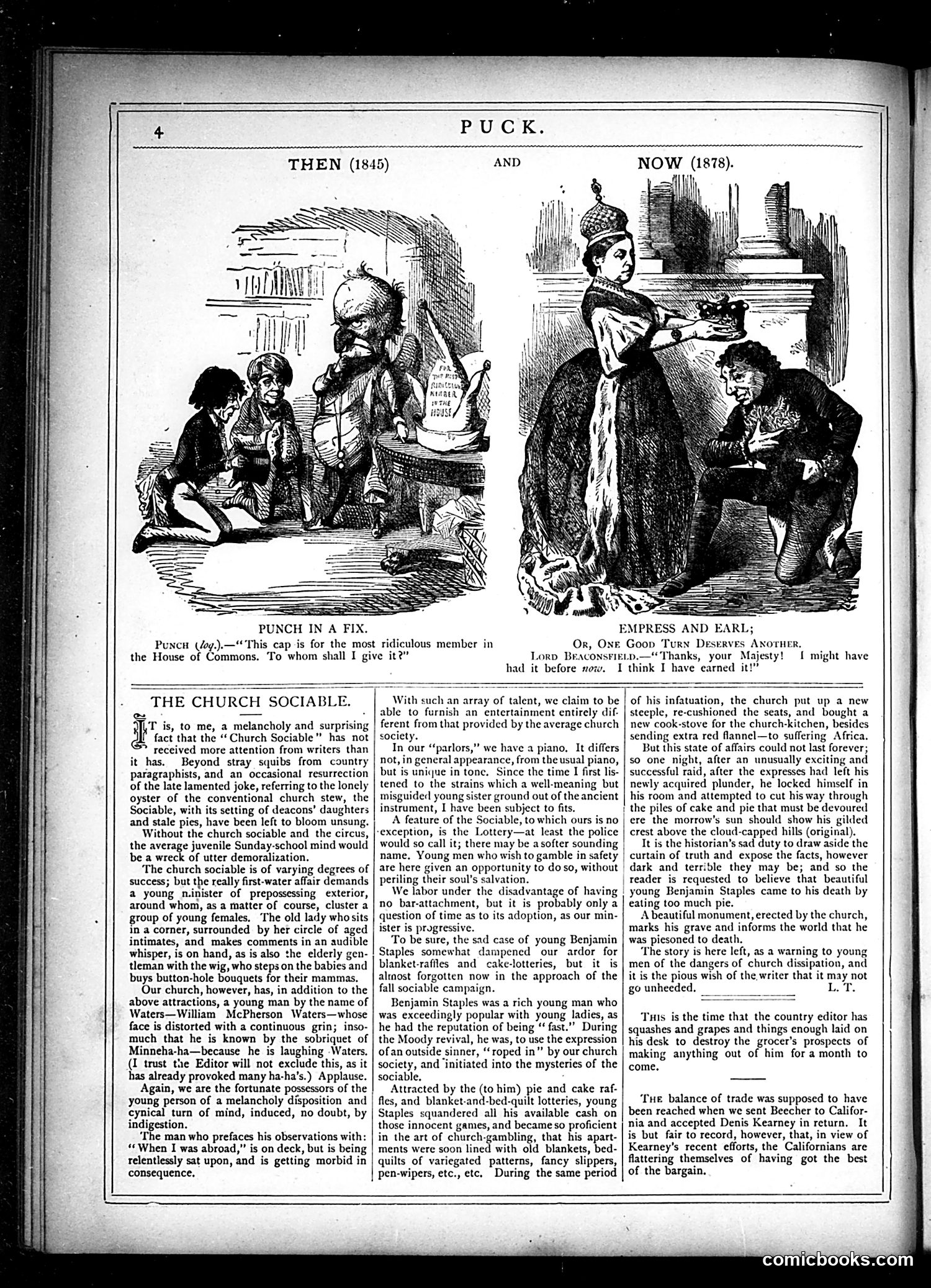
**Top Section - "Then (1845) and Now (1878)":** Two cartoons compare parliamentary figures across 33 years. The left shows "Punch in a Fix" with Commons members debating a ridiculously small cap. The right depicts an "Empress and Earl" scene, likely referencing British imperial politics and nobility of 1878. The satire appears to mock political pretension and the persistence of absurd debates. **"The Church Sociable" Article:** This lengthy piece criticizes church social functions and gambling activities (lotteries, card games) organized to raise funds. It specifically names Benjamin Staples as a young man who lost considerable money at church gambling events. The satire targets hypocrisy: churches condemning vice while profiting from it. References to "Moody revival" and church fundraising suggest commentary on Victorian institutional religion's contradictions.
📄 Transcribed text from this page (OCR, searchable)
Machine-transcribed from the original scan — historical spelling and the odd misread are preserved.
PUNCH IN A FIX. Puncu (/og.).—“This cap is for the most ridiculous member in To whom shall I give it?” the House of Commons. NOW (1878). Lorp Braco: had it before now. Or, OnE FIELD.—‘ Thanks, your Majesty! I think I have earned it!” EMPRESS AND Goop Turn Deserves ANOTHER, { might have THE CHURCH SOCIABLE. fact that the “‘ Church Sociable" has not eo by is, to me, a melancholy and surprising received more attention from writers than 4 it has. Beyond stray squibs from country paragraphists, and an occasional resurrection of the late lamented joke, referring to the lonely oyster of the conventional church stew, the Sociable, with its setting of deacons’ daughters and stale pies, have been left to bloom unsung. Without the church sociable and the circus, the the average juvenile Sunday-school mind would be a wreck of utter demoralization. ‘The church sociable is of varying degrees of success; but the really first-water affair demands a young n.inister of prepossessing exterior, around whom, as a matter of course, cluster a group of young females, ‘The old lady whosits in a corner, surrounded by her circle of aged intimates, and makes comments in an audible whisper, is on hand, as is also the elderly gen- tleman with the wig, who steps on the babies and buys button-hole bouquets for their mammas. Our church, however, has, in addition to the above attractions, a young man by the name of Waters—William McPherson Waters—whose face is distorted with a continuous grin; inso- much that he is known by the sobriquet of Minneha-ha—because he is laughing Waters. (I trust the Editor will not exclude this, as it has already provoked many ha-ha’s.) Applause. Again, we are the fortunate possessors of the | young person of a melancholy disposition and cynical turn of mind, induced, no doubt, by indigestion. ‘The man who prefaces his observations with: «When I was abroad,” is on deck, but is being relentlessly sat upon, and is getting morbid in consequence. With such an array of talent, we claim to be able to furnish an entertainment entirely dif- ferent from that provided by the average church society. In our “parlors,” we have a piano. It differs not, in general appearance, from the usual piano, but is unique in tone. Since the time I first lis- tened to the strains which a well-meaning but misguided young sister ground out of the ancient instrument, I have been subject to fits. A feature of the Sociable, to which ours is no exception, is the Lottery—at least the police would so call it; there may be a softer sounding name, Young men who wish to gamble in safety | are here given an opportunity to do so, without periling their soul's salvation. We labor under the disadvantage of having no bar-attachment, but it is probably only a question of time as to its adoption, as our min- ister is progressive. To be sure, the sad case of young Benjamin Staples somewhat dampened our ardor for blanket-raffles and cake-lotteries, but it is alrnost forgotten now in the approach of the fall sociable campaign. Benjamin Staples was a rich young man who was exceedingly popular with young ladies, as he had the reputation of being “fast.” During the Moody revival, he was, to use the expression ofan outsid er, roped i in” by our church society, and ‘initiated into the mysteries of the sociable, Attracted by the (to him) pie and cake raf- fles, and blanket-and-bed-quilt lotteries, young Staples squandered all his available cash on those innocent games, and became so proficient in the art of church-gambling, that his apart- ments were soon lined with old blankets, bed- quilts of variegated patterns, fancy slippers, pen-wipers, etc., etc, During the same period of his infatuation, the church put up a new steeple, re-cushioned the seats, and bought a new cook-stove for the church-kitchen, besides sending extra red flannel—to suffering Africa. But this state of affairs could not last forever; so one night, after an unusually exciting and successful raid, after the expresses had left his newly acquired plunder, he locked himself in his room and attempted to cut his way through the piles of cake and pie that must be devoured ere the morrow’s sun should show his gilded crest above the cloud-capped hills (original). It is the historian’s sad duty to draw aside the curtain of truth and expose the facts, however dark and terrible they may be; and so the reader is requested to believe that beautiful young Benjamin Staples came to his death by eating too much pie. A beautiful monument, erected by the church, marks his grave and informs the world that he was piesoned to death, ‘The story is here left, as a warning to young men of the dangers of church dissipation, and it is the pious wish of the. writer that it may not go unheeded, a Tuis is the time that the country editor has squashes and grapes and things enough laid on his desk to destroy the grocer’s prospects of making anything out of him for a month to come, ‘Tne balance of trade was supposed to have been reached when we sent Beecher to Califor- nia and accepted Denis Kearney in return. It is but fair to record, however, that, in view of Kearney's recent efforts, the Californians are flattering themselves of having got the best of the bargain,