
Puck, 1878-10-02 · page 6 of 16
Puck — October 2, 1878 — page 6: what you’re looking at
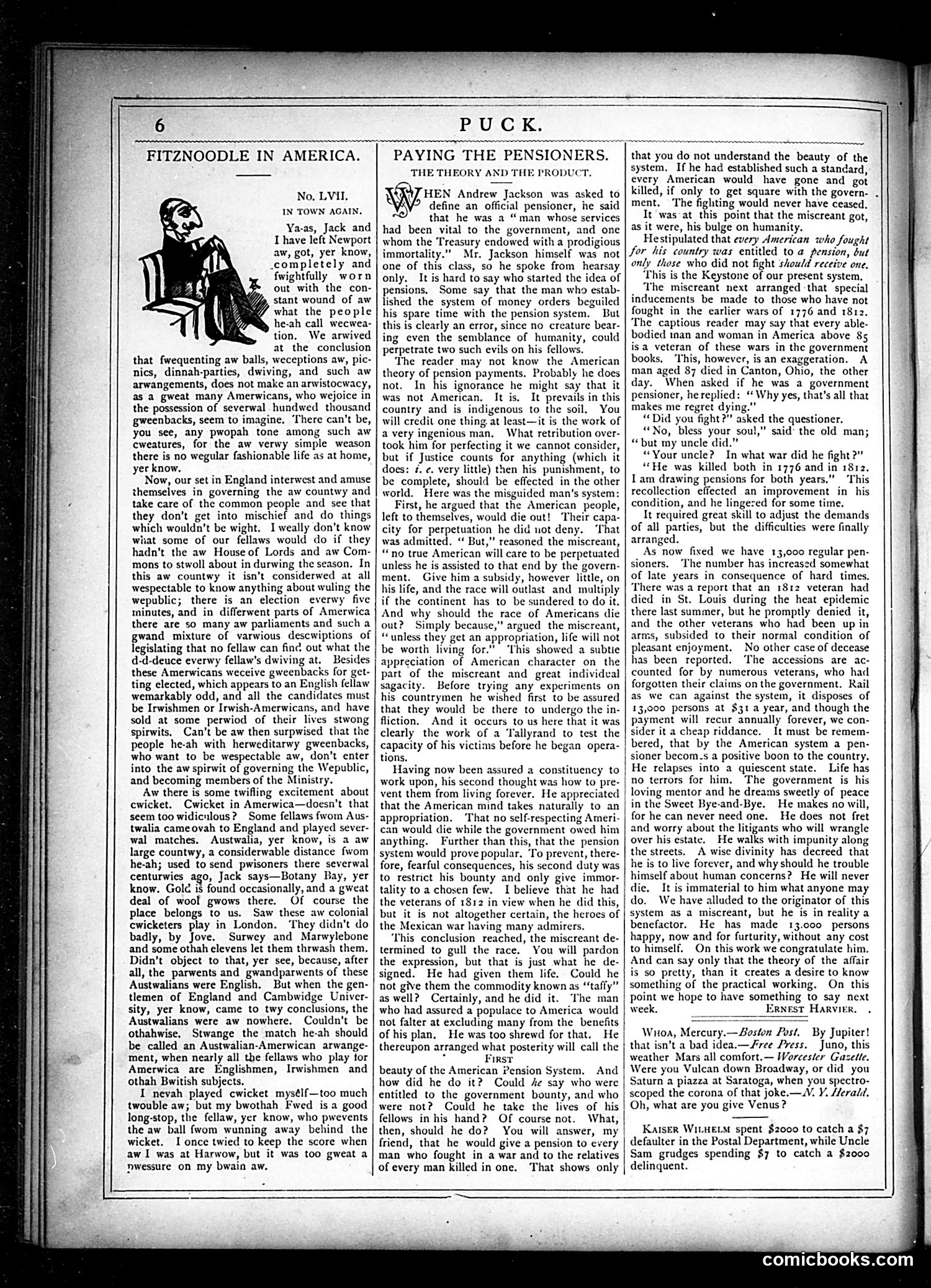
A restored page from Puck, 1878-10-02. Page through the whole issue in the reader above.
📄 Transcribed text from this page (OCR, searchable)
Machine-transcribed from the original scan — historical spelling and the odd misread are preserved.
FITZNOODLE IN AMERICA. No, LVII. IN TOWN AGAIN. Ya-as, Jack and Thave left Newport aw, got, yer know, .completely and fwightfully, worn out with the con- stant wound of aw what the people he-ah call weewea- tion, We arwived at the conclusion that fwequenting aw balls, weceptions aw, pic- nics, dinnah-parties, dwiving, and such aw arwangements, does not make an arwistocwacy, as a gweat many Amerwicans, who wejoice in the possession of severwal hundwed thousand gweenbacks, seem to imagine, ‘There can’t be, you see, any pwopah tone among such aw cweatures, for the aw verwy simple weason there is no wegular fashionable life as at home, yer know. Now, our set in England interwest and amuse themselves in governing the aw countwy and take care of the common people and. see that they don’t get into mischief and do things which wouldn’t be wight. I weally don’t know wiiat some of our fellaws would do if they hadn't the aw House of Lords and aw Com- mons to stwoll about in durwing the season. In this aw countwy it isn’t considerwed at all wespectable to know anything about wuling the wepublic; there is an election everwy five minutes, and in differwent parts of Amerwica there are so many aw parliaments and such a gwand mixture of varwious descwiptions of legislating that no fellaw can find out what the d-d-deuce everwy fellaw’s dwi Besides these Amerwicans weceive gw ting elected, which appears to an English fellaw wemarkably odd, and all the candidates must be Irwishmen or Irwish-Amerwicans, and have sold at some perwiod of their lives stwong spirwits. Can’t be aw then surpwised that the people he-ah with herweditarwy gweenbacks, who want to be wespectable aw, don’t enter into the aw spirwit of governing the Wepublic, and becoming members of the Ministry. Aw there is some twifling excitement about ewicket. Cwicket in Amerwica—doesn’t that seem too widiculous? Some fellaws fwom Aus- twalia cameovah to England and played sever- wal matches. Austwalia, yer know, is a aw large countwy, a considerwable distance fwom he-ah; used to send pwisoners there severwal centurwies ago, Jack says—Botany Bay, yer know. Gold is found occasionally, and a gweat deal of wool gwows there. Of course the place belongs to us. Saw these aw colonial ewicketers play in London. ‘They didn’t do badly, by Jove. Surwey and Marwylebone and some othah clevens let them thrwash them. Didn’t object to that, yer see, because, after all, the parwents and gwandparwents of these Austwalians were English. But when the gen- tlemen of England and Cambwidge Univer- sity, yer know, came to twy conclusions, the Austwalians were aw nowhere. Couldn’t be othahwise, Stwange the match he-ah should be called an Austwalian-Amerwican arwange- ment, when nearly all the fellaws who play tor Amerwica are Englishmen, Irwishmen and othah Bwitish subjects. I nevah played cwicket mysélf—too much twouble aw; but my bwothah Fwed is a good long-stop, the fellaw, yer know, who pwevents the aw ball fwom wunning away behind the wicket. I once twied to keep the score when aw I was at Harwow, but it was too gweat a Dwessure on my bwain aw. PAYING THE PENSIONERS. THE THEORY AND THE PRODUCT, THEN Andrew Jackson was asked to P define an official pensioner, he said that he was a “man whose services had been vital to the government, and one whom the Treasury endowed with a prodigious immortality.” Mr. Jackson himself was not one of this class, so he spoke from hearsay only, It is hard to say who started the idea of pensions, Some say that the man who estab- lished the system of money orders beguiled his spare time with the pension system. But this is clearly an error, since no creature bear- ing even the semblance of humanity, could perpetrate two such evils on his fellows. ‘The reader may not know the American theory of pension payments. Probably he does not. In his ignorance he might say that it was not American. It is. It prevails in this country and is indigenous to the soil. You will credit one thing. at least—it is the work of a very ingenious man, What retribution over- took him for perfecting it we cannot consider, but if Justice counts for anything (which it does: #. ¢. very little) then his punishment, to be complete, should be effected in the other world. Here was the misguided man’s system: First, he argued that the American people, left to themselves, would die out! Their capa- city for perpetuation he did not den: ‘That was admitted. ‘ But,” reasoned the miscreant, “no true American will care to be perpetuated unless he is assisted to that end by the govern- ment. Give him a subsidy, however little, on his life, and the race will outlast and multiply if the continent has to be sundered to do it. And why should the race of Americans die out? Simply because,” argued the miscreant, “unless they get an appropriation, life will not be worth living for.” ‘This showed a subtie appreciation of American character on the part of the miscreant and great individval sagacity. Before trying any experiments on his countrymen he wished first to be assured that they would be there to undergo the in- fliction. And it occurs to us here that it was clearly the work of a ‘Tallyrand to test the capacity of his victims before he began opera- tions. Having now been assured a constituency to work upon, his second thought was how to pre- vent them from living forever. He appreciated that the American mind takes naturally to an appropriation. ‘That no self-respecting Ameri- can would die while the government owed him anything. Further than this, that the pension system would prove popular. To prevent, there- fore, fearful consequences, his second duty was to restrict his bounty and only give immor- tality to a chosen few. I believe that he had the veterans of 1812 in view when he did this, but it is not altogether certain, the heroes of the Mexican war having many admirers. ‘This conclusion reached, the miscreant de- termined to gull the race. You will pardon the expression, but that is just what he de- signed. He had given them life. Could he not give them the commodity known as “taffy” as well? Certainly, and he did it. The man who had assured a populace to America would not falter at excluding many from the benefits of his plan, He was too shrewd for that. He thereupon arranged what posterity will call the . First beauty of the American Pension System. And how did he do it? Could Ae say who were entitled to the government bounty, and who were not? Could he take the lives of his fellows in his hand? Of course not. What, then, should he do? You will answer, my friend, that he would give a pension to every man who fought in a war and to the relatives of every man killed in one. That shows only that you do not understand the beauty of the system. If he had established such a standard, every American would have gone and got killed, if only to get square with the govern- ment. The fighting would never have ceased, It was at this point that the miscreant got, as it were, his bulge on humanity, Hestipulated that every American who fought Sor his country was entitled to a pension, but only those who did not fight should receive one, is is the Keystone of our present system. he miscreant next arranged that special inducements be made to those who have not fought in the earlier wars of 1776 and 1812 ‘The captious reader may say that every able- bodied inan and woman in America above 85 isa veteran of these wars in the government books. ‘This, however, is an exaggeration. A man aged 87 died in Canton, Ohio, the other day. When asked if he was a government pensioner, he replied: “Why yes, that’s all that makes me regret dying. “Did you fight?” asked the questioner. “No, bless your soul,” said: the old man; “but my uncle did.” “Your uncle? In what war did he fight?” “He was killed both in 1776 and in 1812. I am drawing pensions for both years.” ‘This recollection effected an improvement in his condition, and he lingezed for some time, It required great skill to adjust the demands of all parties, but the difficulties were finally arranged. As now fixed we have 13,000 regular pen- sioners. ‘The number has increased somewhat of late years in consequence of hard times. ‘There was a report that an 1812 veteran had dicd in St. Louis during the heat epidemic there last summer, but he promptly denied it, and the other veterans who had been up in arms, subsided to their normal condition of pleasant enjoyment. No other case of decease has been reported. The accessions are ac- counted for by numerous veterans, who had forgotten their claims on the government. Rail as we can against the system, it disposes of 13,000 persons at $31 a year, and though the payment will recur annually forever, we con- sider it a cheap riddance. It must be remem- bered, that by the American system a pen- sioner becom.s a positive boon to the country. | He relapses into a quiescent state. Life has no terrors for him. The government is his loving mentor and he dreams sweetly of peace in the Sweet Bye-and-Bye. He makes no will, | for he can never need one. He does not fret and worry about the litigants who will wrangle over his estate. He walks with impunity along the streets. A wise divinity has decreed that he is to live forever, and why should he trouble himself about human concerns? He will never die. It is immaterial to him what anyone may do. We have alluded to the originator of this system as a miscreant, but he is in reality a benefactor. He has made 13.000 persons happy, now and for furturity, without any cost to himself, On this work we congratulate him. And can say only that the theory of the affair is so pretty, than it creates a desire to know something of the practical working. On this | point we hope to have something to say next week. Ernest Harvier. Wuoa, Mercury.—Soston Post, By Jupiter! that isn’t a bad idea.—Free Press. Juno, this weather Mars all comfort.— Worcester Gaselle. Were you Vulcan down Broadway, or did you Saturn a piazza at Saratoga, when you spectro- scoped the corona of that joke.—W. Y. Herald. Oh, what are you give Venus? Kaiser WILH spent $2000 to catch a $7 defaulter in the Postal Department, while Uncle Sam grudges spending $7 to catch a $2000 delinquent. comicbooks.com