
Puck, 1878-10-02 · page 3 of 16
Puck — October 2, 1878 — page 3: what you’re looking at
What you’re looking at
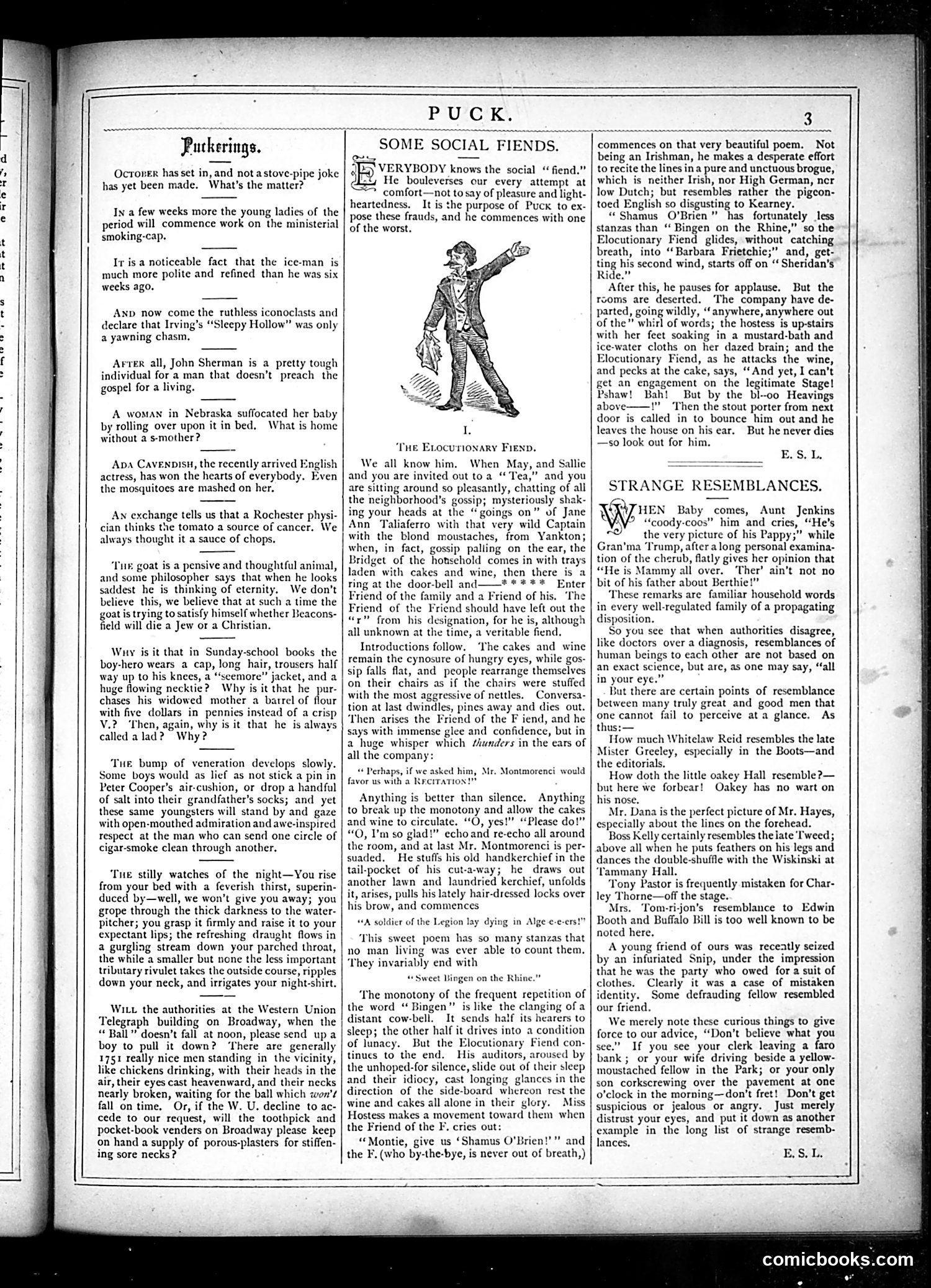
This page contains humorous commentary rather than political cartoons. The main illustrated article, "The Elocutionary Friend," satirizes a particular social type: the overly theatrical dinner guest who dominates conversation with dramatic recitations and affected mannerisms. The figure shown appears to be a Victorian-era gentleman in animated pose, likely mid-performance. The satire mocks affectation and pretentiousness in polite society—specifically targeting someone who shows off with bombastic speech and theatrical gestures at social gatherings. The accompanying text describes how such a "friend" exhausts hosts and other guests through relentless, self-aggrandizing performances. "Strange Resemblances" offers light observational humor about family likenesses and amusing coincidences among acquaintances. The content reflects typical Puck fare: gentle social satire targeting middle-class mannerisms and behavior.
📄 Transcribed text from this page (OCR, searchable)
Machine-transcribed from the original scan — historical spelling and the odd misread are preserved.
Packerings,. Ocroner has set in, and not astove-pipe joke has yet been made. What's the matter? Iv a few weeks more the young ladies of the period will commence work on the ministerial smoking-cap. Ir isa noticeable fact that the ice-man is much more polite and refined than he was six weeks ago. Anp now come the ruthless iconoclasts and declare that Irving’s “Sleepy Hollow” was only a yawning chasm. ArreR all, John Sherman is a pretty tough individual for a man that doesn’t preach the gospel for a living. A woman in Nebraska suffocated her baby by rolling over upon it in bed, What is home without a s-mother? Apa Cavenpisu, the recently arrived actress, has won the hearts of everybody. the mosquitoes are mashed on her, Av exchange tells us that a Rochester physi- cian thinks the tomato a source of cancer. We always thought it a sauce of chops, ‘Tue goat is a pensive and thoughtful animal, and some philosopher says that when he looks saddest he is thinking of eternity. We don’t believe this, we believe that at such a time the goat is trying to satisfy himself whether Beacons- field will die a Jew or a Christian. Wny is it that in Sunday-school books the Dboy-hero wears a cap, long hair, trousers half way up to his knees, a “seemore” jacket, and a huge flowing necktie? Why is it that he pur- chases his widowed mother a barrel of flour with five dollars in pennies instead of a crisp V.?. ‘Then, again, why is it that he is always called a lad? Why? Tur bump of veneration develops slowly. Some boys would as licf as not stick a pin in Peter Cooper’s air-cushion, or drop a handful of salt into their grandfather's socks; and yet these same youngsters will stand by and gaze with open-mouthed admiration and awe-inspired respect at the man who can send one circle of cigar-smoke clean through another. ‘Tue stilly watches of the night—You rise from your bed with a feverish thirst, superin- duced by—well, we won't give you away; you grope through the thick darkness to the water- pitcher; you grasp it firmly and raise it to your expectant lips; the refreshing draught flows in a gurgling stream down your parched throat, the while a smaller but none the less important tributary rivulet takes the outside course, ripples down your neck, and irrigates your night-shirt. Wit the authorities at the Western Union Telegraph building on Broadway, when the “ Ball” doesn’t fall at noon, please send up a boy to pull it down? ‘There are generally 1751 really nice men standing in the vicinity, like chickens drinking, with their heads in the air, their eyes cast heavenward, and their necks nearly broken, waiting for the ball which won't fall on time. Or, if the W. U. decline to ac- cede to our request, will the toothpick and pocket-book venders on Broadway please keep on hand a supply of porous-plasters for stiffen- ing sore necks? S. ews care aera ere knows the social “fiend.” UL He bouleverses our every attempt at > comfort—not to say of pleasure and light- heartedness. It is the purpose of Puck to ex- pose these frauds, and he commences with one of the worst. ‘THe . We all know him. When May, and Sallie and you are invited out toa “Tea,” and you are sitting around so pleasantly, chatting of all the neighborhood's gossip; mysteriously shak- ing your heads at the “goings on” of Jane Ann Taliaferro with that very wild Captain with the blond moustaches, from Yankton; when, in fact, gossip palling on the ear, the Bridget of the honsehold comes in with trays laden with cakes and wine, then there is a ring at the door-bell and: edad Friend of the family and a Friend of his. Friend of the Friend should have left out the “r” from his designation, for he is, although all unknown at the time, a veritable fiend, Introductions follow, ‘The cakes and wine remain the cynosure of hungry eyes, while gos- sip falls flat, and people rearrange themselves on their chairs as if the chairs were stuffed with the most aggressive of nettles. Conversa- tion at last dwindles, pines away and dies out. ‘Then arises the Friend of the F iend, and he says with immense glee and confidence, but in a huge whisper which shunders in the ears of all the company: “ Perhaps, if we asked him, Mr. Montmorenci would favor us with a RECITATION!" OCUTIONARY Anything is better than silence. Anything to break up the monotony and allow the cakes and wine to circulate. “O, yes!" ‘Please do!” “O, I'm so glad!” echoand re-echo all around the room, and at last Mr. Montmorenci is per- suaded. He stuffs his old handkerchief in the tail-pocket of his cut-a-way; he draws out another lawn and laundried kerchief, unfolds it, arises, pulls his lately hair-dressed locks over his brow, and commences “A soldier of the Legion lay dying in Alge-e-e-ers!” ‘This sweet poem has so many stanzas that no man living was ever able to count them. ‘They invariably end with «Sweet Dingen on the Rhine. ‘The monotony of the frequent repetition of the word “Bingen” is like the clanging of a distant cow-bell. It sends half its hearers to sleep; the other half it drives into a condition of lunacy. But the cutionary Fiend con- tinues to the end. His auditors, aroused by the unhoped-for silence, slide out of their sleep and their idiocy, cast longing glances in the direction of the side-board whereon rest the wine and cakes all alone in their glory. Miss Hostess makes a movement toward them when the Friend of the F. cries out: ““Montie, give us ‘Shamus O'Brien!’ and the F. (who by-the-bye, is never out of breath,) commences on that very beautiful poem. Not being an Irishman, he makes a desperate effort to recite the lines ina pure and unctuous brogue, which is neither Irish, nor High German, ner low Dutch; but resembles rather the pigcon- toed English so disgusting to Kearney. “Shamus O'Brien” has fortunately less stanzas than “ Bingen on the Rhine,” so the Elocutionary Fiend glides, without ‘catching breath, into ‘Barbara Frietchie;” and, get- ting his second wind, starts off on ‘Sheridan's Ride.” After this, he pauses for applause. But the rooms are deserted. The company have de- parted, going wildly, “anywhere, anywhere out of the” whirl of words; the hostess is up-stairs with her feet soaking in a mustard-bath and ice-water cloths on her dazed brain; and the Elocutionary Fiend, as he attacks the wine, and pecks at the cake, says, ‘And yet, I can’t get an engagement on the legitimate Stage! Pshaw! Bah! But by the bl-oo Heavings above: !" Then the stout porter from next door is called in to bounce him out and he leaves the house on his ear. But he never dies —so look out for him, E.S. L. STRANGE RESEMBLANCES. SHEN Baby comes, Aunt Jenkins ? “coody-coos” him and cries, “He's the very picture of his Pappy: Gran'ma Trump, after along personal examina- tion of the cherub, flatly gives her opinion that “He is Mammy all over. her’ ain’t not no bit of his father about Berthie!” ‘These remarks are familiar household words in every well-regulated family of a propagating disposition. So you see that when authorities disagree, like doctors over a diagnosis, resemblances of human beings to each other are not based on an exact science, but are, as one may say, “all in your eye.” But there are certain points of resemblance between many truly great and good men that one cannot fail to perceive ata glance. As thus:— How much Whitelaw Reid resembles the late Mister Greeley, especially in the Boots—and the editorials. How doth the little oakey Hall resemble ?— but here we forbear! Oakey has no wart on his nose. Mr. Dana is the perfect picture of Mr. Hayes, especially about the lines on the forehead. Boss Kelly certainly resembles the late ‘Tweed ; above all when he puts feathers on his legs and dances the double-shuffle with the Wiskinski at ‘Tammany Hall. Tony Pastor is frequently mistaken for Char- ley Thorne—off the stage. Mrs. Tom-ri-jon’s resemblance to Edwin Booth and Buffalo Bill is too well known to be noted here, A young friend of ours was receatly seized by an infuriated Snip, under the impression that he was the party who owed for a suit of cloth Clearly it was a case of mistaken identity. Some defrauding fellow resembled our friend. We merely note these curious things to give force to our advice, ‘Don’t believe what you see.” If you see your clerk leaving a faro bank ; or your wife driving beside a yellow- moustached fellow in the Park; or your only son corkscrewing over the pavement at one o'clock in the morning—don’t fret! Don’t get suspicious or jealous or angry. Just merely distrust your eyes, and put it down as another example in the long list of strange resemb- lances, comicbooks.com . °