
Puck, 1878-10-02 · page 11 of 16
Puck — October 2, 1878 — page 11: what you’re looking at
What you’re looking at
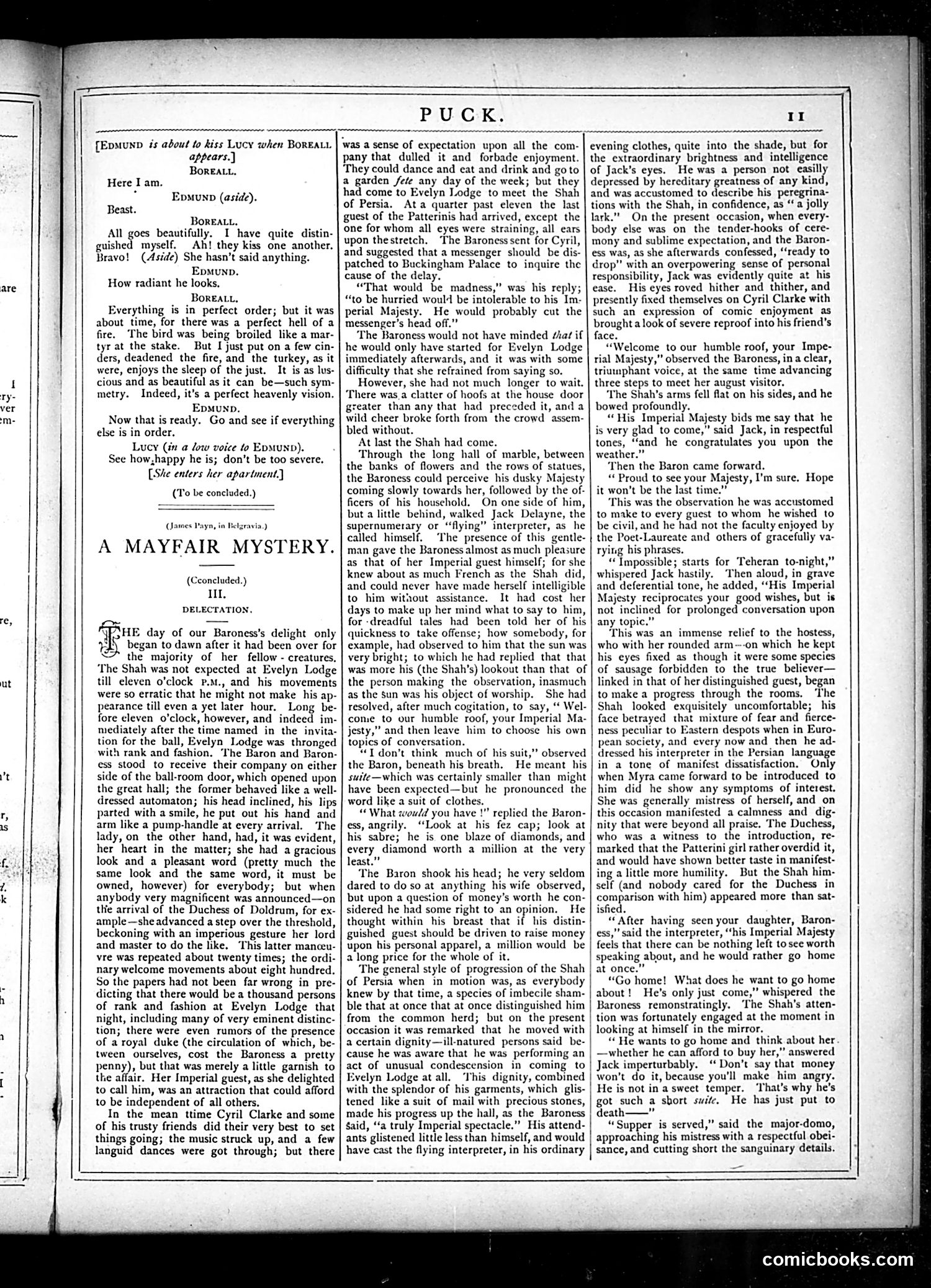
This page contains the conclusion of "A Mayfair Mystery," a serialized fictional story rather than a political cartoon. The narrative describes a visit by the Shah of Persia to a London baroness's home during a social gathering. The story satirizes British high society's obsequious treatment of foreign dignitaries. It mocks how the wealthy compete for prestige by hosting distinguished guests, depicting courtiers fawning over the Shah while he remains largely indifferent. The text humorously contrasts the guests' elaborate efforts to impress with the Shah's modest reactions and his preoccupation with returning home to think about his daughter. The satire targets vanity and social climbing among the British aristocracy rather than engaging with specific political events.
📄 Transcribed text from this page (OCR, searchable)
Machine-transcribed from the original scan — historical spelling and the odd misread are preserved.
are ry- ver m- re, ut PUCK. Ir [Epmunp is about to kiss Lucy when BorEALL appears.) Boreatt, Here Iam. Epaunp (aside). Beast. Borat. All soe beautifully. I have quite distin- guished myself. Ah! they kiss one another. Bravo! (Aside) She hasn’t said anything. EpMunp. How radiant he looks. Boreatt, Everything is in perfect order; but it was about time, for there was a perfect hell of a fire. The bird was being broiled like a mar- tyr at the stake. But I just put on a few cin- ders, deadened the fire, and the turkey, as it were, enjoys the sleep of the just. It is as lus- cious and as beautiful as it can be—such sym- metry. Indeed, it’s a perfect heavenly vision. EpMunb. Now that is ready. Go and see if everything else is in order. Lucy (sn @ low voice to EvMunv). See how,happy he is; don’t be too severe, [She enters her apartment] (To be concluded.) (James Payn, ia Hetgravia.) A MAYFAIR MYSTERY. (Cconcluded.) IIL. DELECTATION. NAHE day of our Baroness’s delight only wh began to dawn after it had been over for ‘* the majority of her fellow - creatures, ‘The Shah was not expected at Evelyn Lodge till eleven o'clock p.M., and his movements were so erratic that he might not make his ap- pearance till even a yet later hour. Long be- fore eleven o'clock, however, and indeed im- mediately after the time named in the invita- tion for the ball, Evelyn Lodge was thronged with rank and fashion. The Baron and Baron- ess stood to receive their company on either side of the ball-room door, which opened upon the great hall; the former behaved like a well- dressed automaton; his head inclined, his lips parted with a smile, he put out his hand and arm like a pump-handle at every arrival. The lady, on the other hand, had, it was evident, her heart in the matter; she had a gracious look and a pleasant word (pretty much the same look and the same word, it must be owned, however) for everybody; but when anybody very magnificent was announced—on the arrival of the Duchess of Doldrum, for ex- ample—she advanced a step over the threshold, beckoning with an imperious gesture her lord and master to do the like. This latter manceu- vre was repeated about twenty times; the ordi- nary welcome movements about eight hundred. So the papers had not been far wrong in pre- dicting that there would be a thousand persons of rank and fashion at Evelyn Lodge that night, including many of very eminent distinc- tion; there were even rumors of the presence of a royal duke (the circulation of which, be- tween ourselves, cost the Baroness a pretty penny), but that was merely a little garnish to the affair. Her Imperial guest, as she delighted to call him, was an attraction that could afford to be independent of all others. In the mean ttime Cyril Clarke and some of his trusty friends did their very best to set things going; the music struck up, and a few languid dances were got through; but there was a sense of expectation upon all the com- pany that dulled it and forbade enjoyment. ‘They could dance and eat and drink and go to a garden fefe any day of the week; but they had come to Evelyn Lodge to meet the Shah of Persia. Ata quarter past eleven the last guest of the Patterinis had arrived, except the one for whom all eyes were straining, all ears upon thestretch. The Baroness sent for Cyril, and suggested that a messenger should be dis- patched to Buckingham Palace to inquire the cause of the delay, “That would be madness,” was his reply; “to be hurried would be intolerable to his Im- perial Majesty. He would probably cut the messenger’s head off.” ‘The Baroness would not have minded shat if he would only have started for Evelyn Lodge immediately afterwards, and it was with some difficulty that she refrained from saying so. However, she had not much longer to wait. There was_a clatter of hoofs at the house door greater than any that had preceded it, and a wild cheer broke forth from the crowd assem- bled without. At last the Shah had come. Through the long hall of marble, between the banks of flowers and the rows of statues, the Baroness could perceive his dusky Majesty coming slowly towards her, followed by the of- ficers of his household. On one side of him, but a little behind, walked Jack Delayne, the supernumerary or “flying” interpreter, as he called himself. The presence of this gentle- man gave the Baroness almost as much pleasure as that of her Imperial guest himself; for she knew about as much French as the Shah did, and could never have made herself intelligible to him without assistance. It had cost her days to make up her mind what to say to him, for -dreadful tales had been told her of his quickness to take offense; how somebody, for example, had observed to him that the sun was very bright; to which he had replied that that was more his (the Shah's) lookout than that of the person making the observation, inasmuch as the sun was his object of worship. She had resolved, after much cogitation, to say, “ Wel- come to our humble roof, your Imperial Ma- jesty,” and then leave him to choose his own topics of conversation. “T don’t think much of his suit,” observed the Baron, beneath his breath. He meant his sutte—which was certainly smaller than might have been expected—but he pronounced the word like a suit of clothes. “What wou/d you have !" replied the Baron- ess, angrily. “Look at his fez cap; look at his sabre; he is one blaze of diamonds, and every diamond worth a million at the very least.”” The Baron shook his head; he very seldom dared to do so at anything his wife observed, but upon a question of money's worth he con- sidered he had some right to an opinion. He thought within his breast that if his distin- guished guest should be driven to raise money upon his personal apparel, a million would be a long price for the whole of it. ‘The general style of progression of the Shah of Persia when in motion was, as everybody knew by that time, a species of imbecile sham- ble that at once that at once distinguished him from the common herd; but on the present occasion it was remarked that he moved with a certain dignity—ill-natured persons said be- cause he was aware that he was performing an act of unusual condescension in coming to Evelyn Lodge at all. ‘This dignity, combined with the splendor of his garments, which glis- tened like a suit of mail with precious stones, made his progress up the hall, as the Baroness said, ‘a truly Imperial spectacle.” His attend- ants glistened little less than himself, and would have cast the flying interpreter, in his ordinary evening clothes, quite into the shade, but for the extraordinary brightness and intelligence of Jack's eyes. He was a person not easilly depressed by hereditary greatness of any kind, and was accustomed to describe his peregrina tions with the Shah, in confidence, as “a jolly lark.” On the present occasion, when every- body else was on the tender-hooks of cere- mony and sublime expectation, and the Baron- ess was, as she afterwards confessed, “ready to drop” with an overpowering sense of personal responsibility, Jack was evidently quite at his ease. His eyes roved hither and thither, and presently fixed themselves on Cyril Clarke with such an expression of comic enjoyment as brought a look of severe reproof into his friend's face. “Welcome to our humble roof, your Impe- rial Majesty,” observed the Baroness, ina clear, triumphant voice, at the same time advancing three steps to meet her august visitor. ‘The Shah's arms fell flat on his sides, and he bowed profoundly. “His Imperial Majesty bids me say that he is very glad to come,” said Jack, in respectful tones, ‘and he congratulates you upon the weather.” ‘Then the Baron came forward. “Proud to see your Majesty, I'm sure. Hope it won't be the last time.” ‘This was the observation he was accustomed to make to every guest to whom he wished to be civil, and he had not the faculty enjoyed by the Poet-Laureate and others of gracefully va- rying his phrases. “Impossible; starts for Teheran to-night,” whispered Jack hastily. ‘Then aloud, in grave and deferential tone, he added, “His Imperial Majesty reciprocates your good wishes, but is not inclined for prolonged conversation upon any topic.” This was an immense relief to the hostess, who with her rounded arm~-on which he kept his eyes fixed as though it were some species of sausage forbidden to the true believer— linked in that of her distinguished guest, began to make a progress through the rooms. The Shah looked exquisitely uncomfortable; his face betrayed that mixture of fear and fierce- ness peculiar to Eastern despots when in Euro- pean society, and every now and then he ad- | dressed his interpreter in the Persian language in a tone of manifest dissatisfaction, Only when Myra came forward to be introduced to him did he show any symptoms of interest. She was generally mistress of herself, and on this occasion manifested a calmness and nity that were beyond all praise. The Duchess, who was a witness to the introduction, re- marked that the Patterini girl rather overdid it, and would have shown better taste in manifest- ing a little more humility. But the Shah him- self (and nobody cared for the Duchess in comparison with him) appeared more than sat- isfied. “After having seen your daughter, Baron- ess,” said the interpreter, “his Imperial Majesty feels that there can be nothing left tosee worth speaking about, and he would rather go home at once.” “Go home! What does he want to go home about! He’s only just come,” whispered the Baroness remonstratingly. ‘The Shah's atten- | tion was fortunately engaged at the moment in | looking at himself in the mirror. ‘« He wants to go home and think about her | —whether he can afford to buy her,” answered Jack imperturbably. “Don't say that money | won't do it, because you'll make him angry. | He is not in'a sweet temper. ‘That's why he's got such a short swife. He has just put to death——”” “Supper is served,” said the major-domo, approaching his mistress with a respectful obei- sance, and cutting short the sanguinary details. comicbooks.com