
A complete issue · 16 pages · 1878
Puck — June 19, 1878
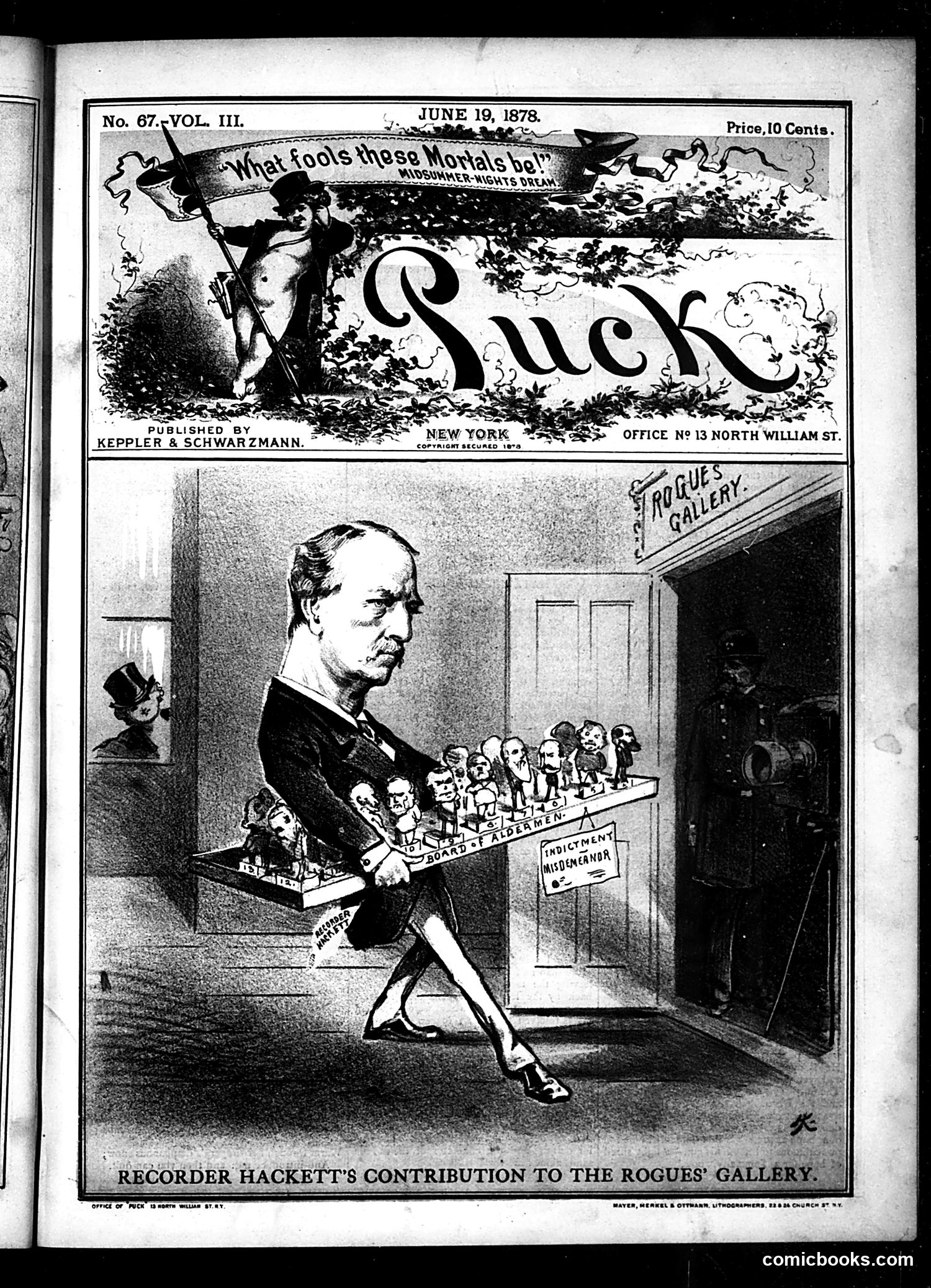
This 1878 *Puck* cartoon satirizes Recorder **James Hackett**, a New York City judicial official. The image depicts him as a devil-legged creature carrying a tray labeled "Board of Aldermen" and "Indictment" filled with tiny human figures—presumably corrupt politicians or aldermen. The satire suggests Hackett is literally manufacturing or parading criminals/rogues rather than legitimately prosecuting them. The "Rogues' Gallery" reference (a police collection of criminal mugshots) implies the Recorder himself is complicit in city corruption, perhaps by protecting guilty parties or by being surrounded by and enabling wrongdoing. The overall message: Hackett's judicial role produces only more rogues, not justice.
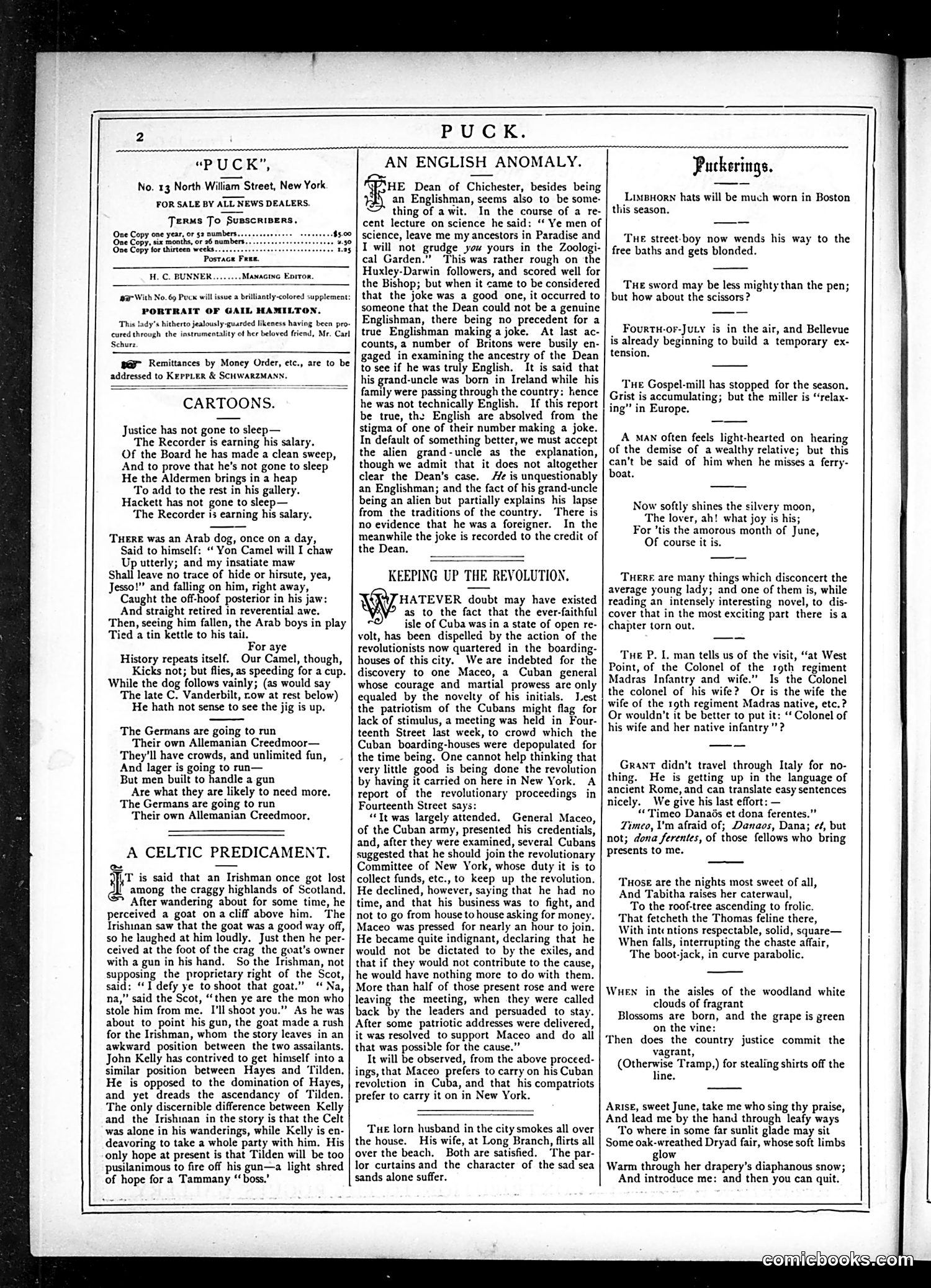
This page contains several satirical pieces rather than a single political cartoon. The main content includes: **"An English Anomaly"**: Satirizes the Dean of Chichester, who claimed descent from Huxley-Darwin (evolutionary science figures) yet was a clergyman. The joke mocks the contradiction between embracing scientific ancestry and maintaining traditional religious authority. **"Keeping Up the Revolution"**: Discusses Cuban revolutionary activity, referencing General Maceo and events in Fourteenth Street, New York, where Cuban exiles met. This appears to satirize the enthusiasm and organization of Cuban independence supporters in America. **"A Celtic Predicament"**: A humorous Irish anecdote about a man caught between two antagonists (Hayes and Tilden, likely political rivals), using physical comedy to mock political allegiances. The page also includes literary verse sections under "Puckerings" offering social commentary on contemporary life.
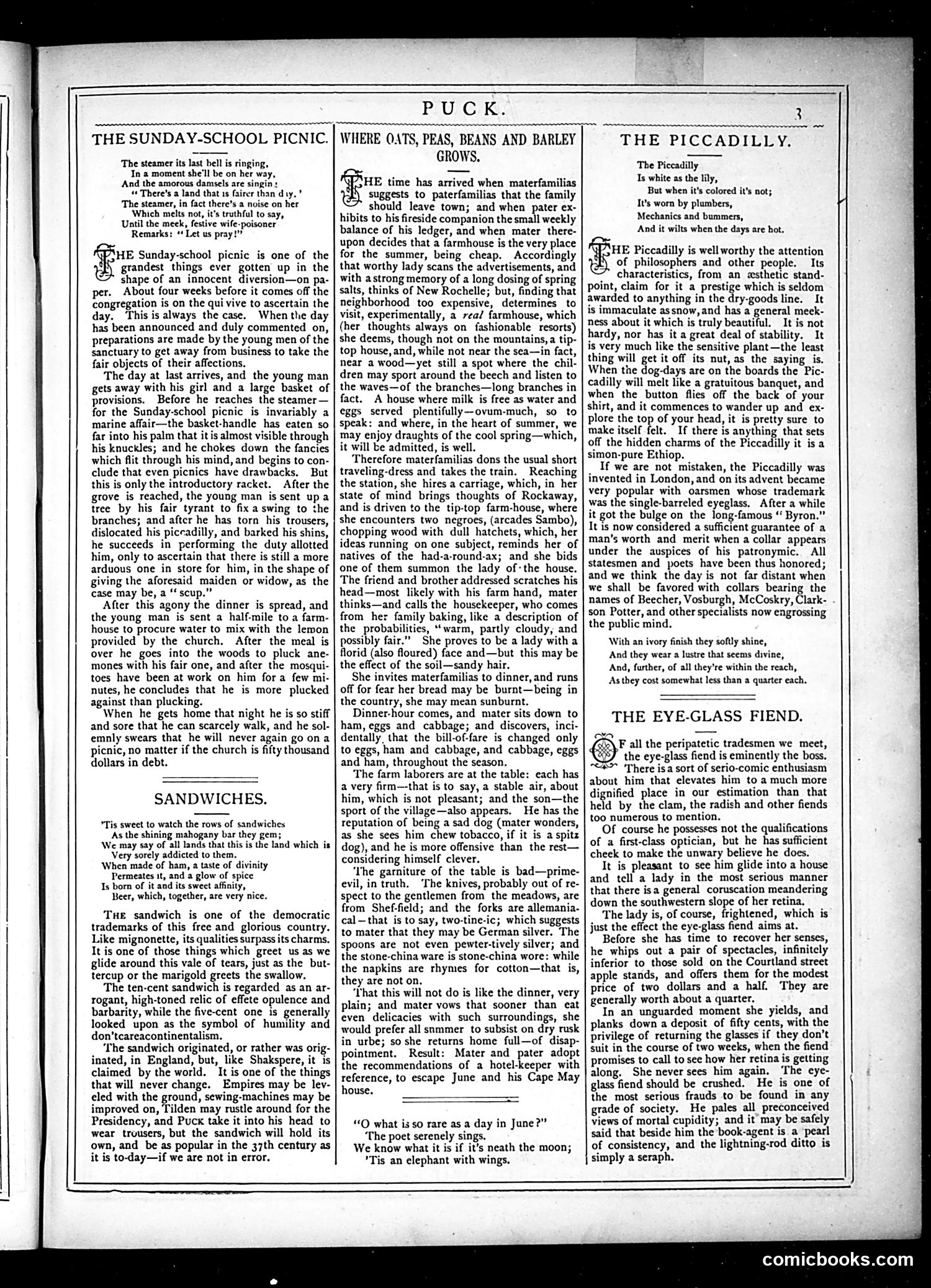
This page from Puck magazine contains three separate humorous articles rather than political cartoons: 1. **"The Sunday-School Picnic"** satirizes the chaos of organizing outings for children, mocking both the logistical difficulties and the pretensions of middle-class families attempting respectable leisure activities. 2. **"Sandwiches"** humorously celebrates sandwiches as democratic American food, contrasting their humble practicality with pretentious fine dining. It's social satire about class aspiration. 3. **"The Piccadilly"** and **"The Eye-Glass Fiend"** appear to be brief comic pieces mocking British affectations and social types—the piccadilly collar and the pretentious monocle-wearer—common targets of American satirical humor regarding British mannerisms. The page contains no identified caricatures of specific public figures. It focuses on satirizing everyday social behaviors and class-conscious aspirations of the era.
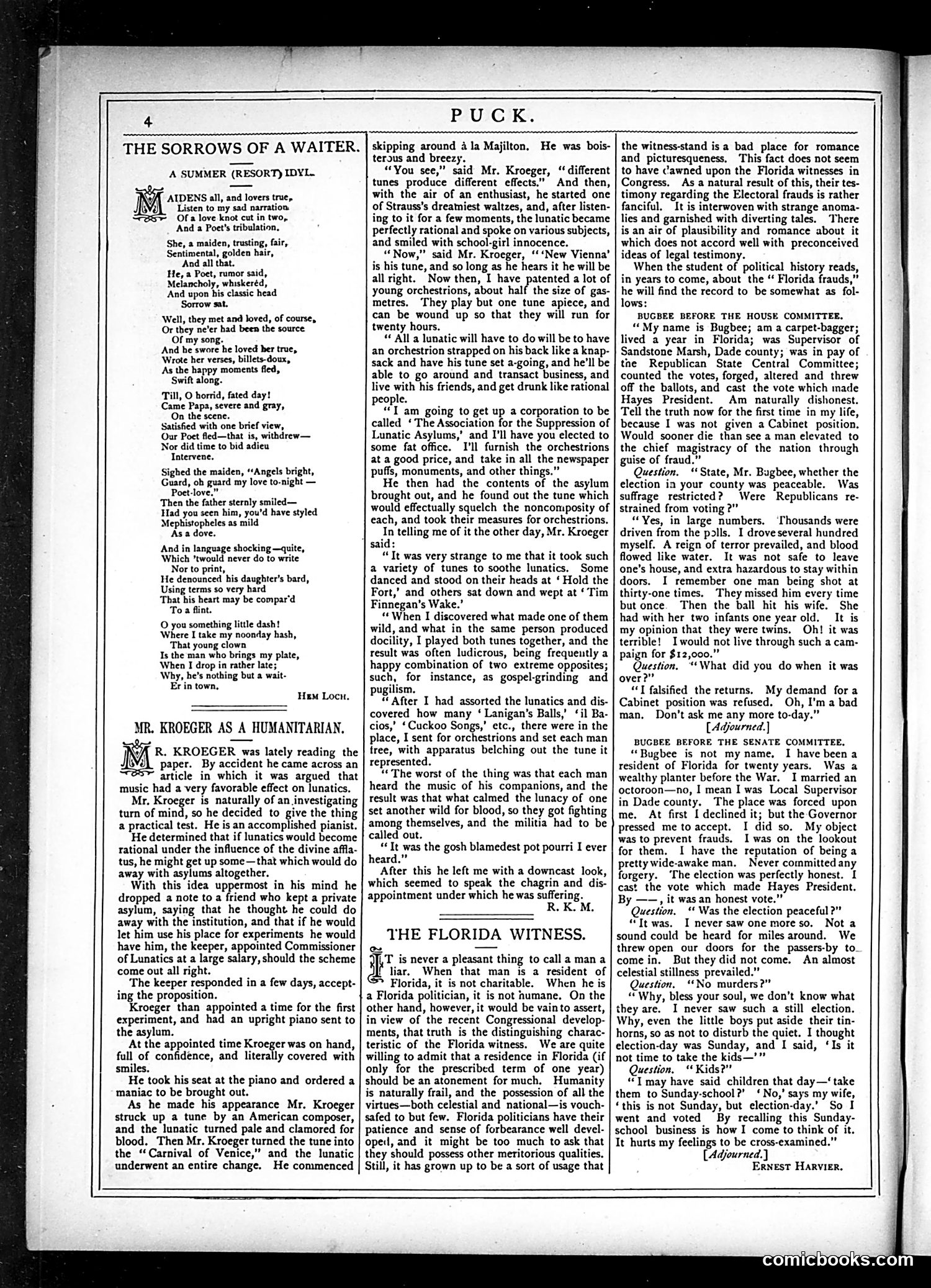
This page contains three separate articles with no visible cartoon illustrations. The content includes: 1. **"The Sorrows of a Waiter"** — A poem lamenting a waiter's difficult life, likely satirizing working conditions in the service industry. 2. **"Mr. Kroeger as a Humanitarian"** — An article about Mr. Kroeger's eccentric experiments with lunatics and orchestras, apparently mocking someone's misguided philanthropic efforts through absurdist humor. 3. **"The Florida Witness"** and **"Huggee Before the Senate Committee"** — Political pieces discussing Florida electoral fraud and a Cabinet position candidate being questioned, suggesting contemporary political scandals. Without visible illustrations, the satire relies entirely on written commentary. The magazine appears to target labor conditions, eccentric reformers, and political corruption of its era.
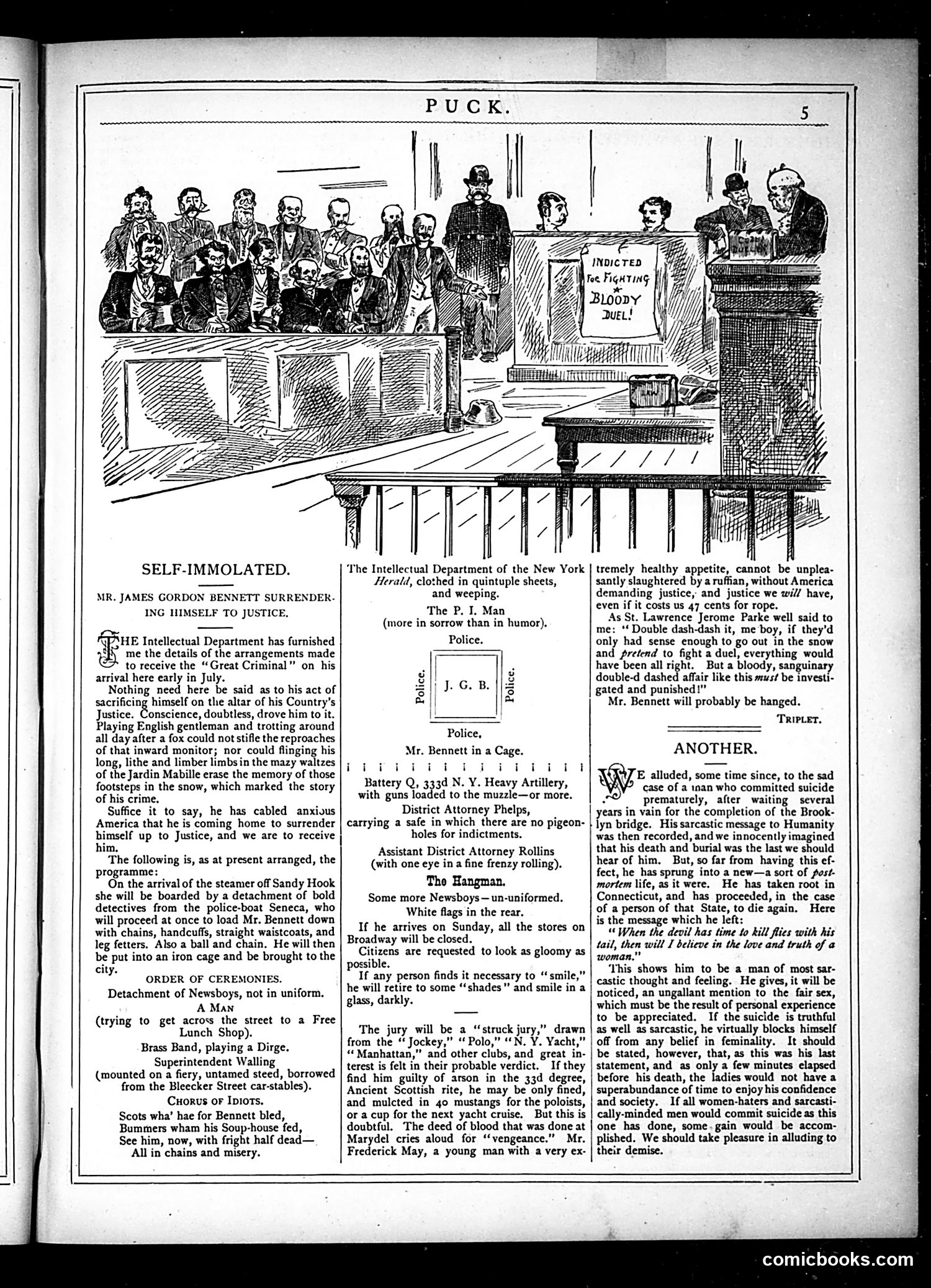
This cartoon depicts **James Gordon Bennett** (identified in the text) surrendering himself to justice, shown before what appears to be a judicial proceeding. The satire concerns Bennett's indictment for "fighting a bloody duel." The text references Bennett's involvement in a duel and his subsequent decision to turn himself in rather than flee. The accompanying commentary mocks the supposed heroism of his surrender, suggesting it's theater rather than genuine justice—a common Puck approach to prominent figures. The secondary articles discuss related social commentary about dueling culture and suicide, indicating this reflects broader American debates about honor, violence, and legal accountability among the wealthy and prominent. The specific historical duel referenced is unclear from this page alone, but the satire targets Bennett's attempt to control his public image through dramatic self-surrender.
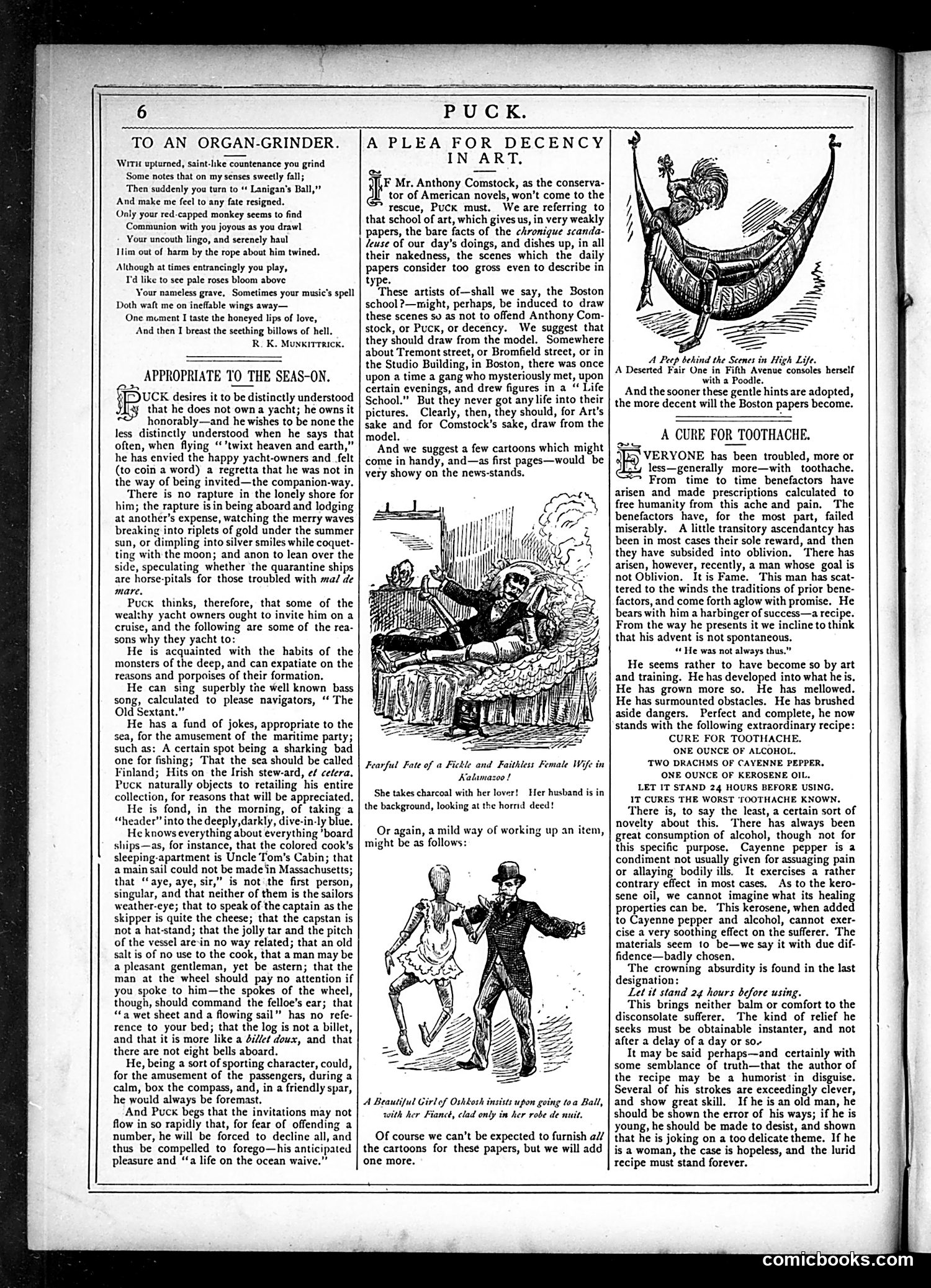
This page contains three separate articles and illustrations unrelated to each other. The top section, "A Plea for Decency in Art," criticizes Anthony Comstock, the prominent anti-obscenity crusader, for his conservatism. It suggests artists should draw from life models rather than sanitized sources, arguing that Comstock's standards are too restrictive for honest artistic representation. The middle illustration shows a couple in period dress, captioned "A Beautiful Girl of Oakham insists upon going to a Ball, and her Fond, clad only in her robe de nuit" — apparently a humorous domestic scene. The bottom section, "A Cure for Toothache," offers folk remedies including alcohol, cayenne pepper, and other preparations, presented in a mock-serious medical tone typical of Puck's satirical approach to dubious treatments.
This page contains a lengthy first-person narrative essay rather than a political cartoon. The author, H.C. Bunner, recounts his experiences as a showman involved with circus and entertainment ventures, particularly a "Ku-Klux Show." The piece satirizes post-Reconstruction era American entertainment and the Ku Klux Klan through dark humor. Bunner describes staging theatrical performances about the KKK's violence against Black Americans and Southern Republicans—presenting them as spectacle for Northern audiences. He critiques both the Klan's brutality and the public's appetite for sensationalized depictions of racial terror as entertainment. The narrative mocks how Americans consumed and commodified violence against marginalized groups, turning historical atrocities into profitable shows.
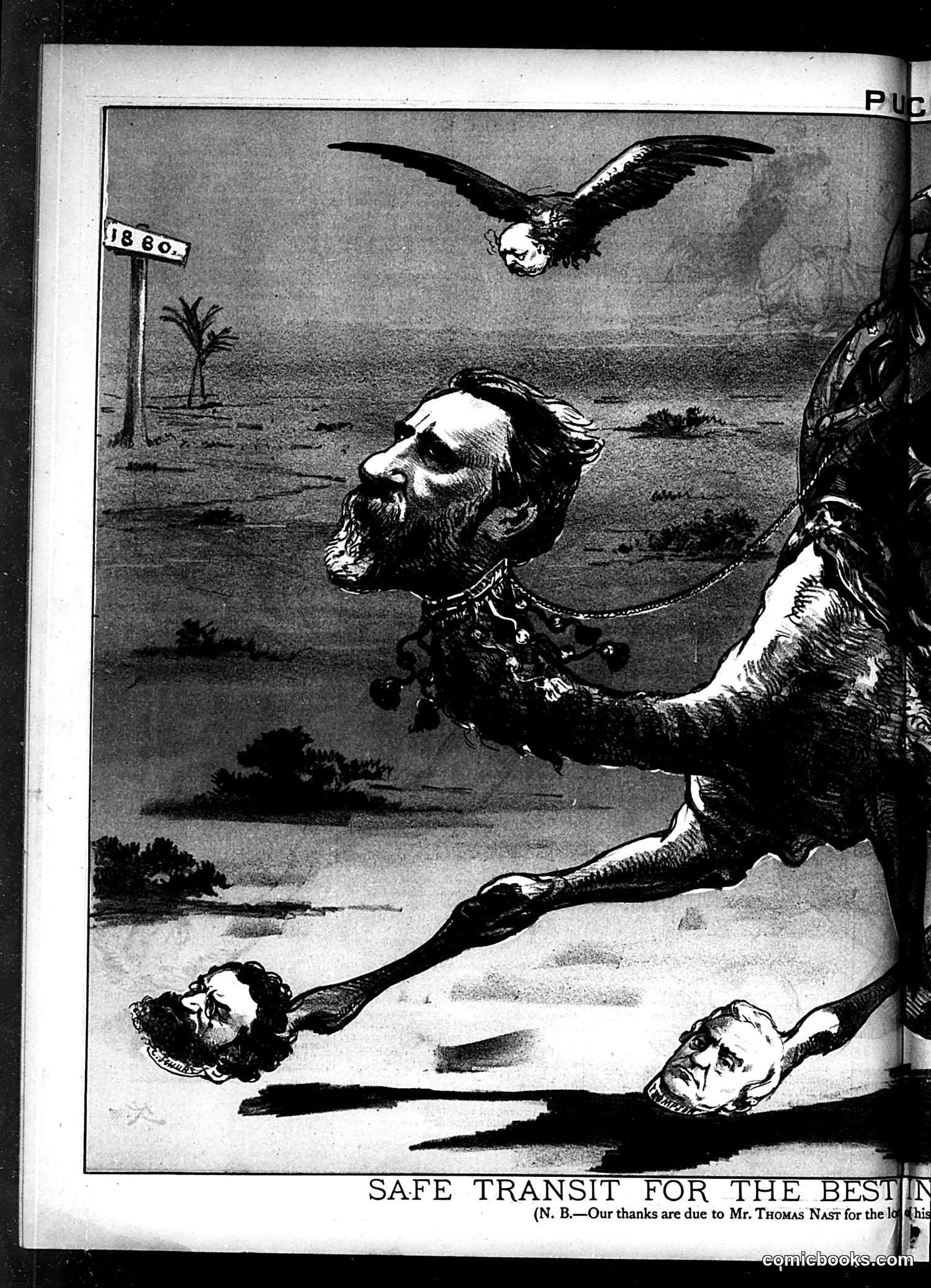
This Puck cartoon titled "Safe Transit for the Best In" satirizes colonial or imperial governance. The central bearded figure in military dress appears to be a colonial administrator or military leader, depicted as a demigod or mythological figure with an elongated body stretching across a barren landscape dotted with palm trees. He's manipulating smaller human heads (likely representing colonized peoples or political opponents) like puppets on strings. An eagle flies overhead, possibly symbolizing American imperial power. The caption suggests the cartoon critiques how colonial rulers claim to provide "safe transit" or governance while actually exercising absolute control over populations beneath them. The grotesque, exaggerated anatomy emphasizes the unnatural power dynamics at play.
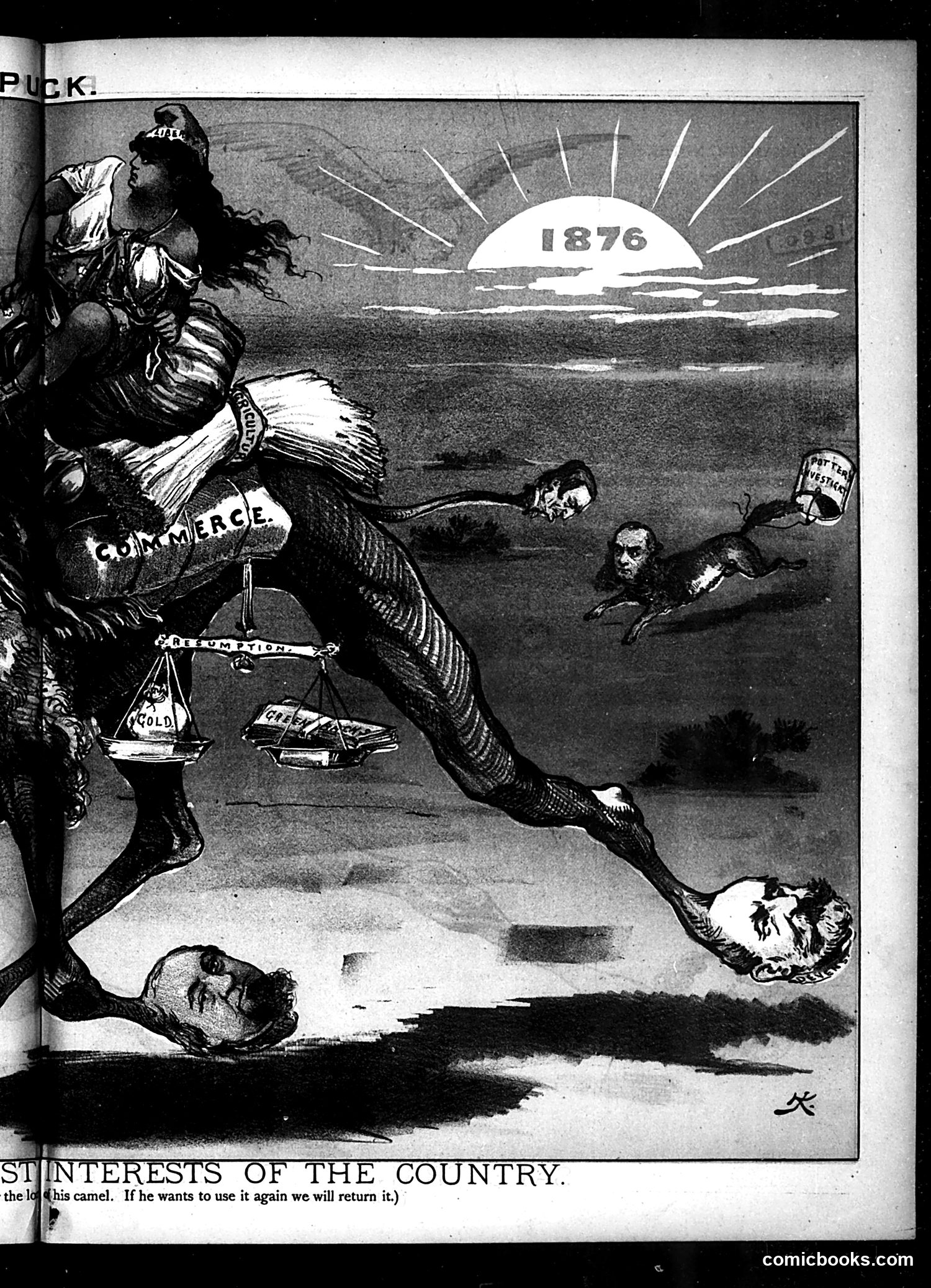
This 1876 political satire depicts **Commerce** (the large female figure on left, labeled with scales holding "GOLD" and "GREENBACKS") kicking away smaller male figures representing the interests of ordinary citizens. The rising sun marked "1876" suggests a new era or fresh start. The cartoon criticizes how **commercial interests prioritize profit over the common good**. The figures being kicked appear to represent workers or the general public being trampled by big business. The caption's parenthetical remark ("If he wants to use it again we will return it") sarcastically suggests Commerce merely borrows the country temporarily for its own purposes. This reflects Gilded Age anxieties about **unchecked corporate power** dominating American politics and society.
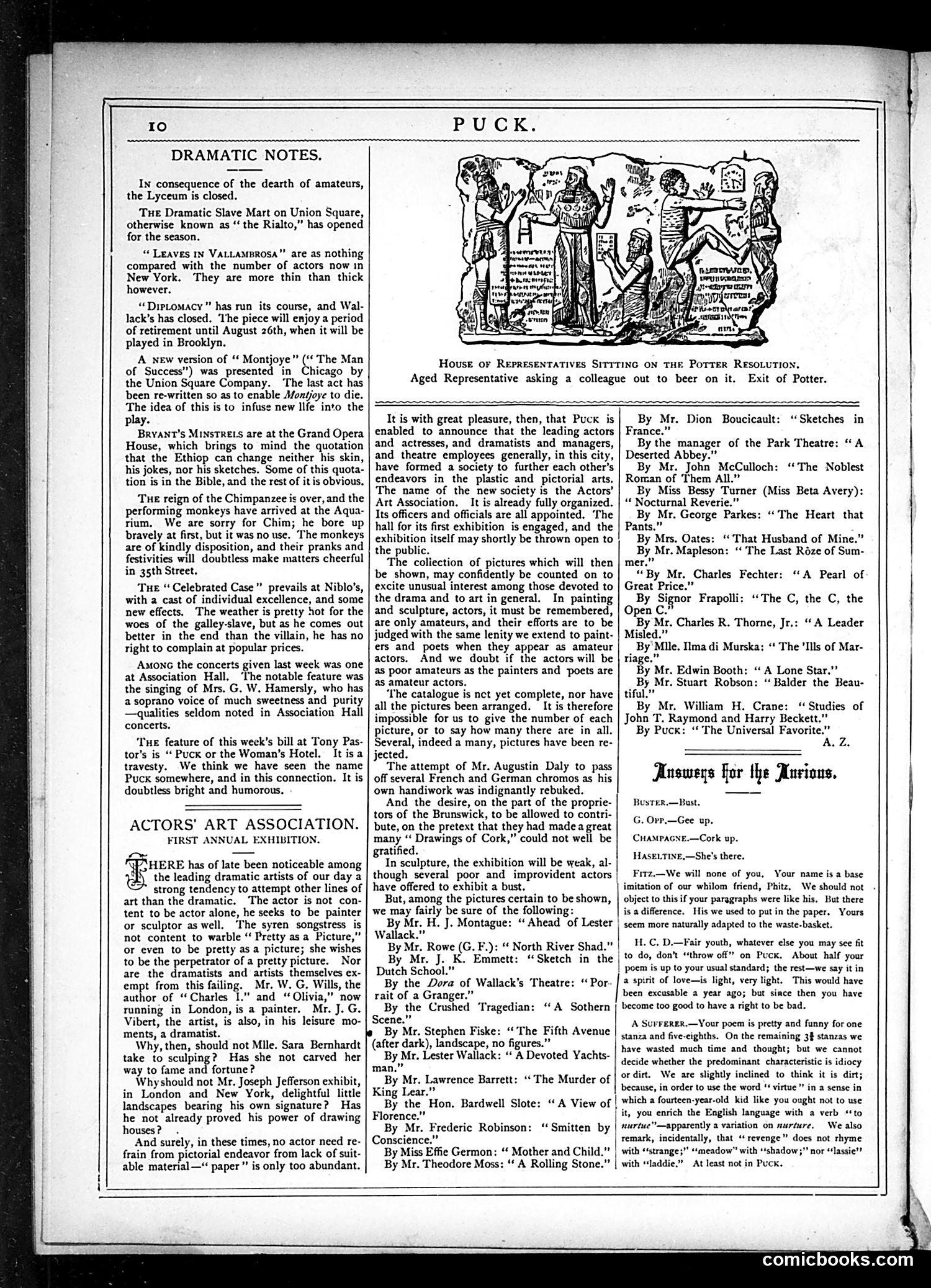
The main illustration depicts the **House of Representatives debating the Potter Resolution** — a congressional inquiry (likely the 1870s-80s). Aged representatives are shown arguing over beer, with one exiting labeled "Potter," suggesting satirical commentary on legislative debates fueled by alcohol rather than reason. Below is coverage of the **Actors' Art Association's first exhibition**, celebrating dramatic artists as legitimate visual artists. The text argues actors deserve respect comparable to painters and sculptors, challenging contemporary class prejudices that distinguished "high" visual arts from "low" theatrical performance. The page mixes political satire with cultural commentary, reflecting Puck's dual focus on governmental folly and social progress.
This page from Puck magazine contains a serialized short story titled "Mrs. Fitzgerald" by Irving Bacheller, rather than a political cartoon. The narrative focuses on a domestic drama involving Mary Fitzgerald and her husband Reginald, who has abandoned her and their marriage. The story deals with themes of infidelity, betrayal, and marital discord—common subjects in Victorian-era fiction. Reginald's letter justifies his departure by claiming Mary drove him to it through her behavior, while also revealing his own moral failings (gambling, drunkenness, theft). The piece appears designed to entertain Puck's readers with melodramatic relationship conflict rather than to satirize political or social institutions. This is serialized literature rather than satirical commentary.
This page contains a romantic poem/story titled "His First Love," illustrated with a small vignette showing a couple. The narrative is sentimental verse about a September meeting and eating together, establishing a romantic relationship that ultimately disappointed. The right column includes various brief satirical items and advertisements typical of Puck magazine. These include social commentary quotes on topics like Pennsylvania's attractions and observations about life ("Truth squashed to earth will get up again"). The main content is literary rather than political cartooning—this appears to be a romantic narrative section rather than satirical political commentary. The illustration is decorative rather than a substantive political cartoon with identifiable caricatures or specific contemporary references.
This page is primarily **text-based humor and satirical news items** rather than illustrated cartoons. The content consists of short, witty commentary on contemporary social and political topics, typical of Puck's satirical format. Key items include jabs at: - Hotel service inefficiencies ("The Cream of the Bucket") - Political partisan prejudice and silence on controversial issues - Police raids on establishments ("House of Blazes") - Judge Levi's questionable judicial practices - Civil service and monopoly concerns - Social observations about urban life (fishing, cooking mishaps, etc.) The humor relies on wordplay, irony, and commentary on everyday American life and politics. Without dated attribution or specific political figures clearly identified in the visible text, the precise historical references remain somewhat opaque to modern readers, though the satirical intent—mocking incompetence, hypocrisy, and social absurdities—is clear.
This is primarily an **advertising page** from Puck magazine, not a political cartoon. The page contains numerous commercial advertisements for products like Apollinaris mineral water, Hungarian wines, furniture, dental work, refrigerators, and banking services. These ads dominate the layout. The only editorial content appears to be a **poem excerpt** in the upper left, which references seeing "his father's head / First in the foreground" (attributed to *Fida, Mirror*). The meaning of this snippet is unclear without fuller context. Most notably, there's a **caricatured portrait** labeled "Hunyadi János" advertising "The Best Natural Aperient"—a Hungarian figure used to market mineral water, though the specific satirical point is not evident from this page alone. **This is essentially a commercial page with minimal satirical content.**
This is primarily an **advertising and announcement page** from Puck magazine (1878), not a political cartoon page. The main content announces Puck's new **General Designing Office**, highlighting that cartoonist **Joseph Keppler** (the magazine's distinguished cartoonist) is now available for commercial illustration work. The page emphasizes his services for "Theatrical Profession" seeking lithographic portraits. The rest comprises **period advertisements** for various products: Friedrichshall Bittwater (medicinal), Dunlap & Co. hats, Continental Champagne, printing inks, tailoring services, and the Puck Almanac for 1878. This reflects how 19th-century magazines funded themselves—mixing editorial announcements with paid advertising, often without clear visual distinction from content.
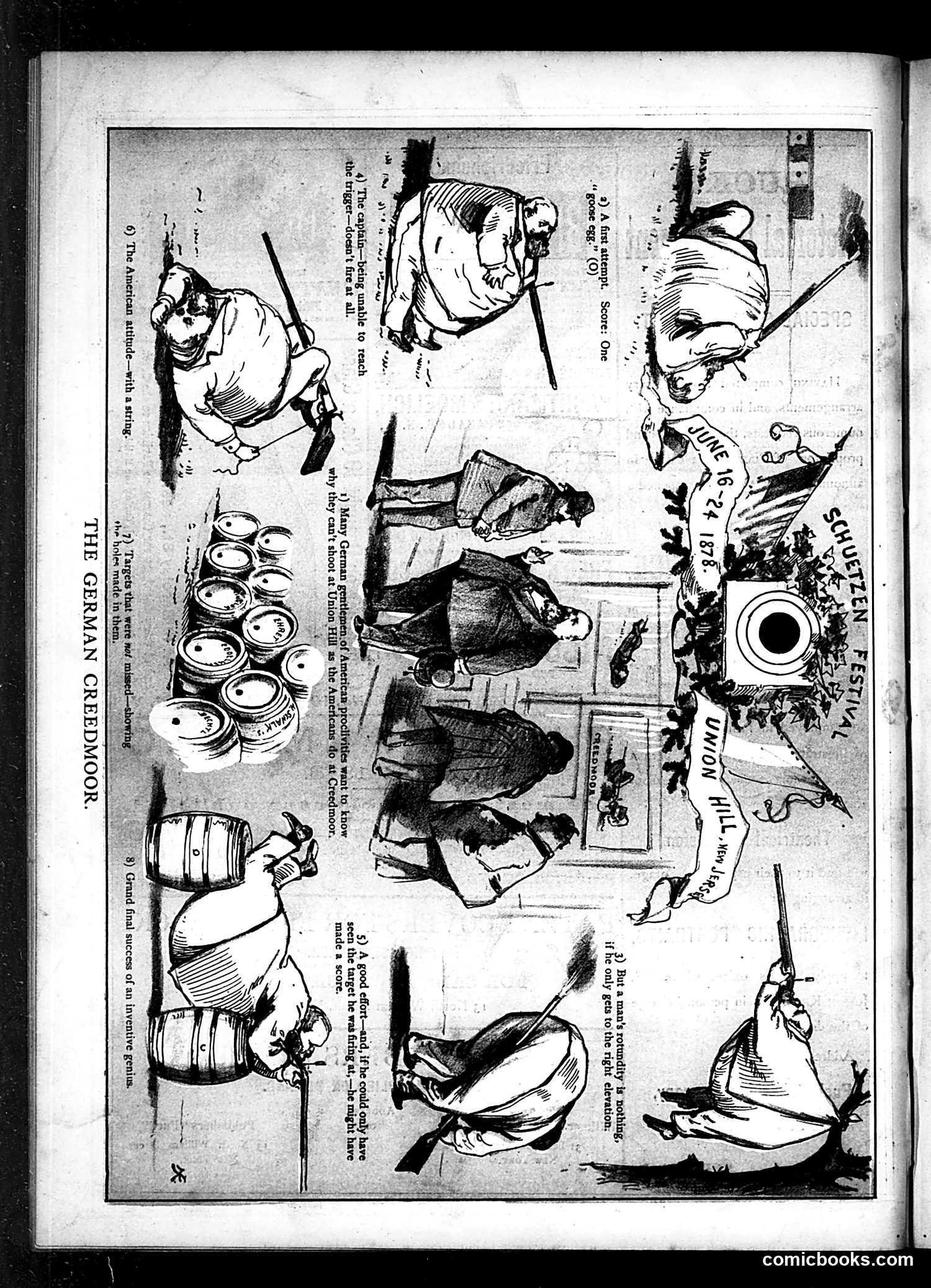
This Puck satire depicts Germany as a destructive force, shown as a grotesque figure operating a massive corkscrew that threatens to destabilize or "uncork" civilization. The central image shows German military aggression personified as a violent, consuming power. The surrounding vignettes appear to illustrate consequences of German militarism: soldiers, conflict scenes, and various figures in distress. References to "Squire's Festive Time" and "Noonhill" in captions suggest specific contemporary events or political figures, though details are unclear from the OCR. The overall message critiques German imperial ambitions and military expansion as dangerous and destabilizing to international order—likely from the pre-World War I or early WWI period when anti-German sentiment ran high in American publications.