
Puck, 1878-06-19 · page 4 of 16
Puck — June 19, 1878 — page 4: what you’re looking at
What you’re looking at
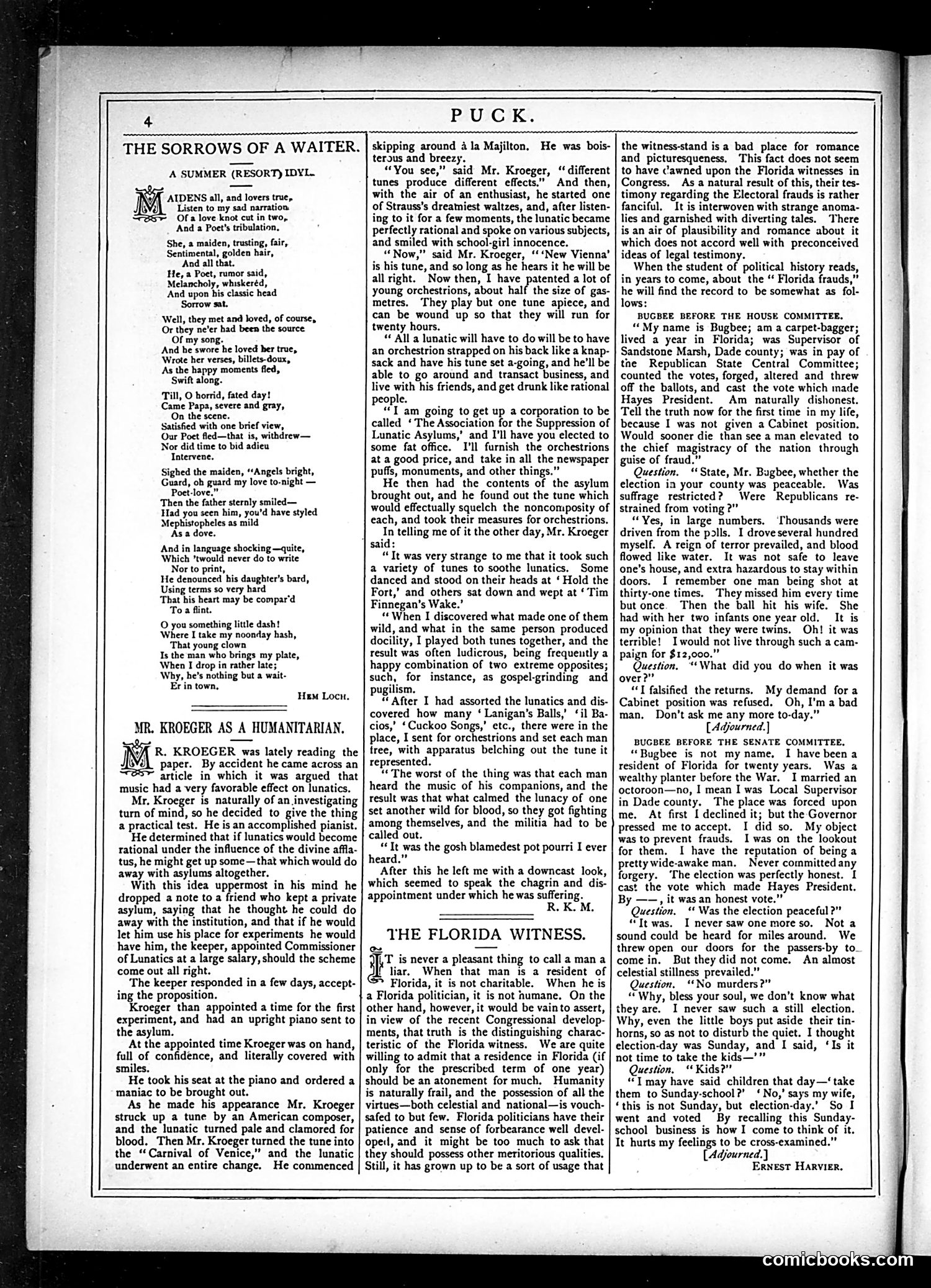
This page contains three separate articles with no visible cartoon illustrations. The content includes: 1. **"The Sorrows of a Waiter"** — A poem lamenting a waiter's difficult life, likely satirizing working conditions in the service industry. 2. **"Mr. Kroeger as a Humanitarian"** — An article about Mr. Kroeger's eccentric experiments with lunatics and orchestras, apparently mocking someone's misguided philanthropic efforts through absurdist humor. 3. **"The Florida Witness"** and **"Huggee Before the Senate Committee"** — Political pieces discussing Florida electoral fraud and a Cabinet position candidate being questioned, suggesting contemporary political scandals. Without visible illustrations, the satire relies entirely on written commentary. The magazine appears to target labor conditions, eccentric reformers, and political corruption of its era.
📄 Transcribed text from this page (OCR, searchable)
Machine-transcribed from the original scan — historical spelling and the odd misread are preserved.
4 PUCK. THE SORROWS OF A WAITER. A SUMMER (RESORT) IDYL. ALDENS all, and lovers true, Listen to my sad narration Of a love knot cut in two, And a Poet’s tribulation, She, a maiden, trusting, fair, Sentimental, golden hair, And all that. He, a Poet, rumor said, Melancholy, whiskeréd, And upon his classic head Sorrow sat. Well, they met and loved, of course, Or they ne'er had been the source Of my song. ‘And he swore he loved her true, Wrote her verses, billets-doux, As the happy moments fled, Swift along. Till, O horrid, fated day! Came Papa, severe and gray, On the scene. Satisfied with one brief view, Our Poet fled—that is, withdrew— Nor did time to bid adiew Intervene. Sighed the maiden, “Angels bright, Guard, ob guard my love to-night — Poet-love,” ‘Then the father sternly smiled— Had you seen him, you'd have styled Mephistopheles as mild As a dove. And in language shocking —quite, Which 'twould never do to write Nor to print, He denounced his daughter's bard, Using terms so very hard That his heart may be compar'd Toa flint. © you something little dash! ‘Where I take my noonday hash, ‘That young clown Is the man who brings my plate, When I drop in rather late; Why, he’s nothing but a wait- Er in town, Hem Locu. MR. KROEGER AS A HUMANITARIAN. M i R. KROEGER was lately reading the paper. By accident he came across an article in which it was argued that music had a very favorable effect on lunatics. Mr. Hrveget is naturally of an investigating turn of mind, so he decided to give the thing a practical test. He is an accomplished pianist. He determined that if lunatics would become rational under the influence of the divine affia- tus, he might get up some—that which would do away with asylums altogether. With this idea uppermost in his mind he dropped a note to a friend who kept a private asylum, saying that he thought he could do away with the institution, and that if he would let him use his place for experiments he would have him, the keeper, appointed Commissioner of Lunatics at a large salary, should the scheme come out all right. ‘The keeper responded in a few days, accept- ing the proposition. Kroeger than appointed a time for the first experiment, and had an upright piano sent to the asylum. At the appointed time ss hated on hand, full of confidence, and literally covered with smiles. He took his seat at the piano and ordered a maniac to be brought out. As he made his appearance Mr. Kroeger struck up a tune by an American composer, and the lunatic turned pale and clamored for blood. Then Mr. Kroeger turned the tune into the “Carnival of Venice,” and the lunatic underwent an entire change. He commenced skipping around 4 la Majilton. He was bois- terous and breezy. “You see," said Mr. Kroeger, “ different tunes produce different effects.” And then, with the air of an enthusiast, he started one of Strauss’s dreamiest waltzes, and, after listen- ing to it for a few moments, the lunatic became perfectly rational and spoke on various subjects, and smiled with school-girl innocence. “Now,” said Mr. Kroeger, ‘‘‘New Vienna’ is his tune, and so long as he hears it he will be all right. Now then, I have patented a lot of young orchestrions, about half the size of gas- metres. They play but one tune apiece, and can be wound up so that they will run for twenty hours. “ Alla lunatic will have to do will be to have an orchestrion strapped on his back like a knap- sack and have his tune set a-going, and he'll be able to go around and transact business, and live with his friends, and get drunk like rational people. “T am going to get up a corporation to be called ‘The Association for the Suppression of Lunatic Asylums,’ and I'll have you elected to some fat office. I'll furnish the orchestrions at a good price, and take in all the newspaper puffs, monuments, and other things.” He then had the contents of the asylum brought out, and he found out the tune which would effectually squelch the noncomposity of each, and took their measures for orchestrions, In telling me of it the other day, Mr. Kroeger said: “ Tt was very strange to me that it took such a variety of tunes to soothe lunatics. Some danced and stood on their heads at ‘ Hold the Fort,’ and others sat down and wept at ‘Tim Finnegan's Wake.’ «When I discovered what made one of them wild, and what in the same person produced docility, I played both tunes together, and the result was often ludicrous, being frequeutly a happy combination of two extreme opposites; such, for instance, as gospel-grinding and pugilism. “ After I had assorted the lunatics and dis- covered how many ‘Lanigan’s Balls, ‘il Ba- cios,’ ‘Cuckoo Songs,’ etc., there were in the place, I sent for orchestrions and set each man tree, with apparatus belching out the tune it represented. “The worst of the thing was that each man heard the music of his companions, and the result was that what calmed the lunacy of one set another wild for blood, so they got fighting among themselves, and the militia had to be called out. Tt was the gosh blamedest pot pourri I ever heard.” After this he left me with a downcast look, which seemed to speak the chagrin and dis- appointment under which he was suffering. R.K.M. THE FLORIDA WITNESS. [=4 bie is never a pleasant thing to call a man a liar, When that man is a resident of Florida, it is not charitable. When he is a Florida politician, it is not humane. On the other hand, however, it would be vain to assert, in view of the recent Congressional develop- ments, that truth is the distinguishing charac- teristic of the Florida witness. We are quite willing to admit that a residence in Florida (if only for the prescribed term of one year) should be an atonement for much, Humanity is naturally frail, and the possession of all the virtues—both celestial and national—is vouch- safed to but few. Florida politicians have their patience and sense of forbearance well devel- oped, and it might be too much to ask that they should possess other meritorious qualities. Still, it has grown up to be a sort of usage that the witness-stand is a bad place for romance and picturesqueness. This fact does not seem to have Cawned upon the Florida witnesses in Congress. As a natural result of this, their tes- timony regarding the Electoral frauds is rather fanciful. It is interwoven with strange anoma- lies and garnished with diverting tales. There is an air of plausibility and romance about it which does not accord well with preconceived ideas of legal sestnOny When the student of political history reads, in years to come, about the “ Florida frauds,” he will find the record to be somewhat as fol- lows: BUGBEE BEFORE THE HOUSE COMMITTEE. “My name is Bugbee; am a carpet-bagger; lived a year in Florida; was Supervisor of Sandstone Marsh, Dade county; was in pay of the Republican State Central Committee; counted the votes, forged, altered and threw off the ballots, and cast the vote which made Hayes President. Am naturally dishonest. Tell the truth now for the first time in my life, because I was not given a Cabinet position. Would sooner die than see a man elevated to the chief magistracy of the nation through guise of fraud.” Question. ‘State, Mr. Bugbee, whether the election in your county was peaceable. Was suffrage restricted? Were Republicans re- strained from voting 2” “Yes, in large numbers. ‘Thousands were driven from the polls. I drove several hundred myself. A reign of terror prevailed, and blood flowed like water. It was not safe to leave one’s house, and extra hazardous to stay within doors. I remember one man being shot at thirty-one times, They missed him every time but once. Then the ball hit his wife. She had with her two infants one year old, It is my opinion that they were twins. Oh! it was terrible! Iwould not live through such a cam- paign for $12,000.” Question. “What did you do when it was over?” “I falsified the returns. My demand fora Cabinet position was refused. Oh, I'm a bad man. Don't ask me any more to-day.” [Adjourned.] BUGBEE BEFORE THE SENATE COMMITTEE. “Bugbee is not my name, I have been a resident of Florida for twenty years. Was a wealthy planter before the War. I married an octoroon—no, I mean I was Local Supervisor in Dade county. The place was forced upon me. At first I declined it; but the Governor pressed me to accept. I did so. My object was to prevent frauds. Iwas on the lookout for them. I have the reputation of being a pretty wide-awake man. Never committed any forgery. ‘The election was perfectly honest. I cast the vote which made Hayes President. By ——, it was an honest vote.” Question. ‘* Was the election peaceful ?” “Tt was. I never saw one more so. Not a sound could be heard for miles around. We threw open our doors for the passers-by to. come in. But they did not come, An almost celestial stillness prevailed.” Question, ‘No murders?” «Why, bless your soul, we don’t know what they are. I never saw such a still election. Why, even the little boys pt aside their tin- horns, so as not to disturb the quiet. I thought election-day was Sunday, and I said, ‘Is it not time to take the kids—’”” Question, “Kids?” “Tmay have said children that day—‘ take them to Sunday-school?’ ‘No,’ says my wife, ‘this is not Sunday, but election-day.’ So I went and voted By recalling this Sunday- school business is how I come to think of it. It hurts my feelings to be cross-examined.” [Adjourned.] Ernest Harvier.