
Puck, 1878-06-19 · page 3 of 16
Puck — June 19, 1878 — page 3: what you’re looking at
What you’re looking at
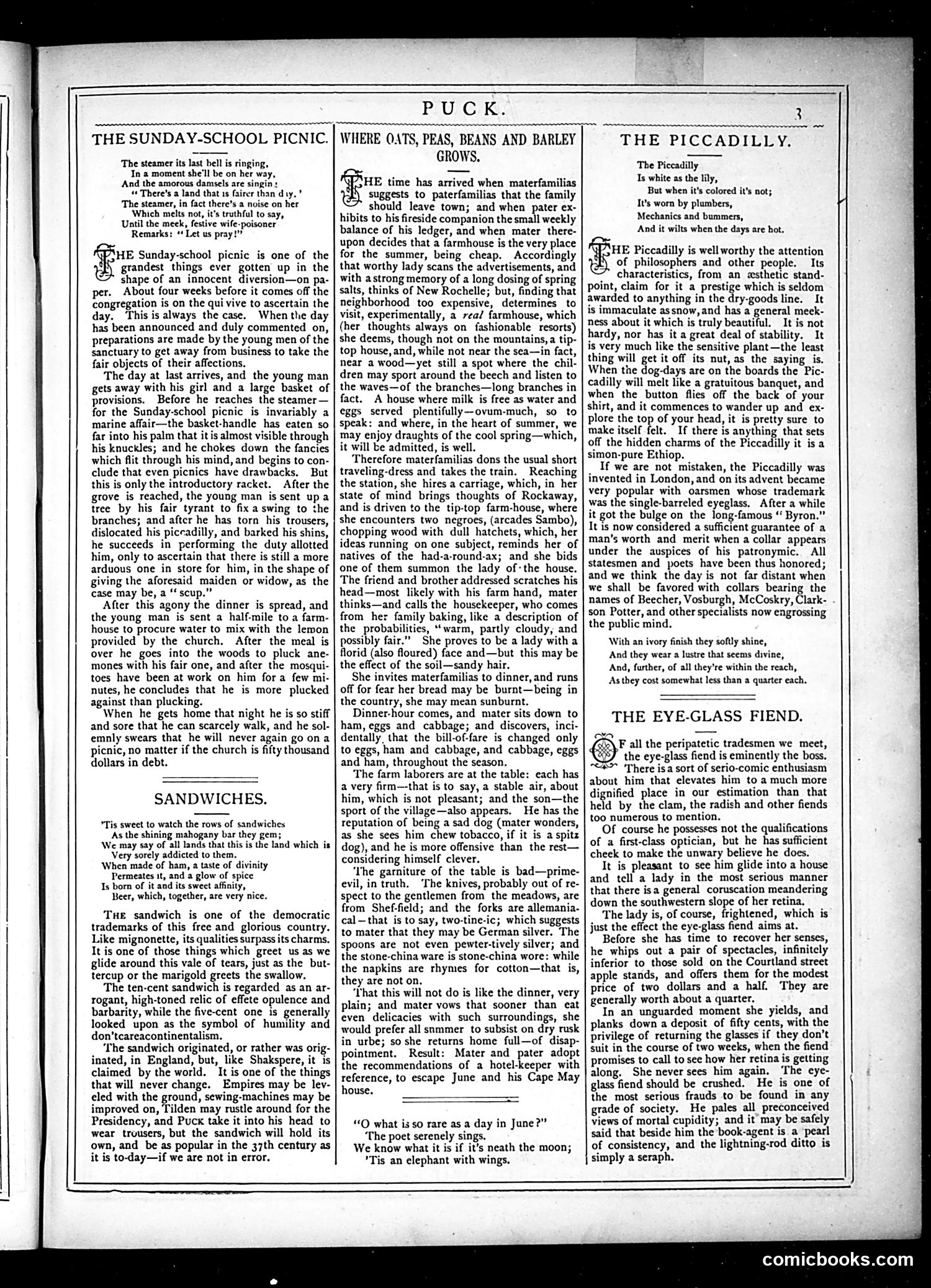
This page from Puck magazine contains three separate humorous articles rather than political cartoons: 1. **"The Sunday-School Picnic"** satirizes the chaos of organizing outings for children, mocking both the logistical difficulties and the pretensions of middle-class families attempting respectable leisure activities. 2. **"Sandwiches"** humorously celebrates sandwiches as democratic American food, contrasting their humble practicality with pretentious fine dining. It's social satire about class aspiration. 3. **"The Piccadilly"** and **"The Eye-Glass Fiend"** appear to be brief comic pieces mocking British affectations and social types—the piccadilly collar and the pretentious monocle-wearer—common targets of American satirical humor regarding British mannerisms. The page contains no identified caricatures of specific public figures. It focuses on satirizing everyday social behaviors and class-conscious aspirations of the era.
📄 Transcribed text from this page (OCR, searchable)
Machine-transcribed from the original scan — historical spelling and the odd misread are preserved.
PUCK. me 3 THE SUNDAY-SCHOOL PICNIC. The steamer its last bell is ringing, In a moment she'll be on her w: And the amorous damsels are singin: «There's a land that 1s fairer than diy,’ ‘The steamer, in fact there's a noise on her Which melts not, it's truthful to say, Until the meek, festive wife-poisoner Remarks: “Let us pray!” HE Sunday-school picnic is one of the grandest things ever gotten up in the shape of an innocent diversion—on pa- per. About four weeks before it comes off the congregation is on the qui vive to ascertain the day. This is always the case. When the day has been announced and duly commented on, preparations are made by the young men of the sanctuary to get away from business to take the fair objects of their affections. ‘The day at last arrives, and the young man gets away with his girl and a large basket of provisions. Before he reaches the steamer — for the Sunday-school picnic is invariably a marine affair—the basket-handle has eaten so far into his palm that it is almost visible through his knuckles; and he chokes down the fancies which flit through his mind, and begins to con- clude that even picnics have drawbacks. But this is only the introductory racket. After the grove is reached, the young man is sent up a tree by his fair tyrant to fix a swing to the branches; and aftcr he has torn his trousers, dislocated his piccadilly, and barked his shins, he succeeds in performing the duty allotted him, only to ascertain that there is still a more arduous one in store for him, in the shape of giving the aforesaid maiden or widow, as the case may be, a “ scup.” After this agony the dinner is spread, and the young man is sent a half-mile to a farm- house to procure water to mix with the lemon provided by the church. After the meal is over he goes into the woods to pluck ane- mones with his fair one, and after the mosqui- toes have been at work on him fora few mi- nutes, he concludes that he is more plucked against than plucking. When he gets home that night he is so stiff and sore that he can scarcely walk, and he sol- emnly swears that he will never again go on a picnic, no matter if the church is fifty thousand dollars in debt. SANDWICHES. "Tis sweet to watch the rows of sandwiches As the shining mahogany bar they gem; We may say of all lands that this is the land which is Very sorely addicted to them. When made of ham, a taste of divinity Permeates it, and a glow of spice Is born of it and its sweet affinity, Beer, which, together, are very nice. Tue sandwich is one of the democratic trademarks of this free and glorious country. Like mignonette, its qualities surpass its charms, It is one of those things which greet us as we glide around this vale of tears, just as the but- tercup or the marigold greets the swallow. The ten-cent sandwich is regarded as an ar- rogant, high-toned relic of effete opulence and barbarity, while the five-cent one is generally looked upon as the symbol of humility and don’tcareacontinentalism. ‘The sandwich originated, or rather was orig- inated, in England, but, like Shakspere, it is claimed by the world. It is one of the things that will never change. Empires may be lev- eled with the ground, sewing-machines may be improved on, Tilden may rustle around for the Presidency, and Puck take it into his head to wear trousers, but the sandwich will hold its own, and be as popular in the 37th century as it is to-day—if we are not in error. WHERE OATS, PEAS, BEANS AND BARLEY GROWS. HE time has arrived when materfamilias suggests to paterfamilias that the family should leave town; and when pater ex- hibits to his fireside companion the small weekly balance of his ledger, and when mater there- upon decides that a farmhouse is the very place for the summer, being cheap. Accordingly that worthy lady scans the advertisements, and with a strong memory of a long dosing of spring salts, thinks of New Rochelle; but, finding that neighborhood too expensive, determines to visit, experimentally, a rea/ farmhouse, which (her’ thoughts always on fashionable resorts) she deems, though not on the mountains, a tip- top house, and, while not near the sea—in fact, near a wood—yet still a spot where the chil- dren may sport around the beech and listen to the waves—of the branches—long branches in fact. A house where milk is free as water and eggs served plentifully—ovum-much, so to speak: and where, in the heart of summer, we may enjoy draughts of the cool spring—which, it will be admitted, is well. Therefore materfamilias dons the usual short traveling-dress and takes the train. Reaching the station, she hires a carriage, which, in her state of mind brings thoughts of Rockaway, and is driven to the tip-top farm-house, where she encounters two negroes, (arcades Sambo), chopping wood with dull hatchets, which, her ideas running on one subject, reminds her of natives of the had-a-round-ax; and she bids one of them summon the lady of-the house. The friend and brother addressed scratches his head—most likely with his farm hand, mater thinks—and calls the housekeeper, who comes from her family baking, like a description of the probabilities, “warm, partly cloudy, and possibly fair.” She proves to be a lady with a florid (also floured) face and—but this may be the effect of the soil—sandy hair. She invites materfamilias to dinner, and runs off for fear her bread may be burnt—being in the country, she may mean sunburnt. Dinner-hour comes, and mater sits down to ham, eggs and cabbage; and discovers, inci- dentally that the bill-of-fare is changed only to eggs, ham and cabbage, and cabbage, eggs and ham, throughout the season. ‘The farm laborers are at the table: each has a very firm—that is to say, a stable air, about him, which is not pleasant; and the son—the sport of the village—also appears. He has the reputation of being a sad dog (mater wonders, as she sees him chew tobacco, if it is a spitz dog), and he is more offensive than the rest— considering himself clever. ‘Ihe garniture of the table is bad—prime- evil, in truth. ‘The knives, probably out of re- spect to the gentlemen from the meadows, are from Shef-field; and the forks are allemania- cal—that is to say, two-tine-ic; which suggests to mater that they may be German silver. The spoons are not even pewter-tively silver; and the stone-china ware is stone-china wore: while the napkins are rhymes for cotton—that is, they are not on. ‘That this will not do is like the dinner, very plain; and mater vows that sooner than eat even delicacies with such surroundings, she would prefer all snmmer to subsist on dry rusk in urbe; so she returns home full—of disap- pointment. Result: Mater and pater adopt the recommendations of a hotel-keeper with reference, to escape June and his Cape May house. “O what is so rare as a day in June?” “The poet serenely sings. We know what it is if it’s neath the moon; 'Tis an elephant with wings. THE PICCADILLY. The Piccadilly Is white as the lily, But when it's colored it’s not; It’s worn by plumbers, Mechanics and bummers, And it wilts when the days are hot. HE Piccadilly is well worthy the attention Sf) of philosophers and other people. Its characteristics, from an esthetic stand- point, claim for it a prestige which is seldom awarded to anything in the dry-goods line. It is immaculate as snow, and has a general meek- ness about it which is truly beautiful. It is not hardy, nor has it a great deal of stability. It is very much like the sensitive plant—the least thing will get it off its nut, as the saying is. When the dog-days are on the boards the Pic- cadilly will melt like a gratuitous banquet, and when the button flies off the back of your shirt, and it commences to wander up and ex- plore the op of your head, it is pretty sure to make itself felt. If there is anything’ that sets off the hidden charms of the Piccadilly it is a simon-pure Ethiop. If we are not mistaken, the Piccadilly was invented in London, and on its advent became very popular with oarsmen whose trademark was the single-barreled eyeglass. After a while it got the bulge on the long-famous ‘‘ Byron.” It is now considered a sufficient guarantee of a man’s worth and merit when a collar appears under the auspices of his patronymic. All statesmen and poets have been thus honored; and we think the day is not far distant when we shall be favored with collars bearing the names of Beecher, Vosburgh, McCoskry, Clark- son Potter, and other specialists now engrossing the public mind. With an ivory finish they softly shine, And they wear a lustre that seems divine, And, further, of all they're within the reach, As they cost somewhat less than a quarter each, THE EYE-GLASS FIEND. (SNF all the peripatetic tradesmen we meet, the eye-glass fiend is eminently the boss. “<4 There isa sort of serio-comic enthusiasm about him that elevates him to a much more dignified place in our estimation than that held by the clam, the radish and other fiends too numerous to mention. Of course he possesses not the qualifications of a first-class optician, but he has sufficient cheek to make the unwary believe he does. It is pleasant to see him glide into a house and tell a lady in the most serious manner that there isa general coruscation meandering down the southwestern slope of her retina. The lady is, of course, frightened, which is just the effect the eye-glass fiend aims at. Before she has time to recover her senses, he whips out a pair of spectacles, infinitely inferior to those sold on the Courtland street apple stands, and offers them for the modest price of two dollars and a half. They are generally worth about a quarter, In an unguarded moment she yields, and planks down a deposit of fifty cents, with the privilege of returning the glasses if they don’t suit in the course of two weeks, when the fiend promises to call to see how her retina is getting along. She never sees him again. ‘The eye- glass fiend should be crushed. He is one of the most serious frauds to be found in any grade of society. He pales all preconceived views of mortal cupidity; and it’ may be safely said that beside him the book-agent is a ‘pearl of consistency, and the lightning-rod ditto is simply a seraph. comicbooks.com