
Puck, 1878-06-19 · page 2 of 16
Puck — June 19, 1878 — page 2: what you’re looking at
What you’re looking at
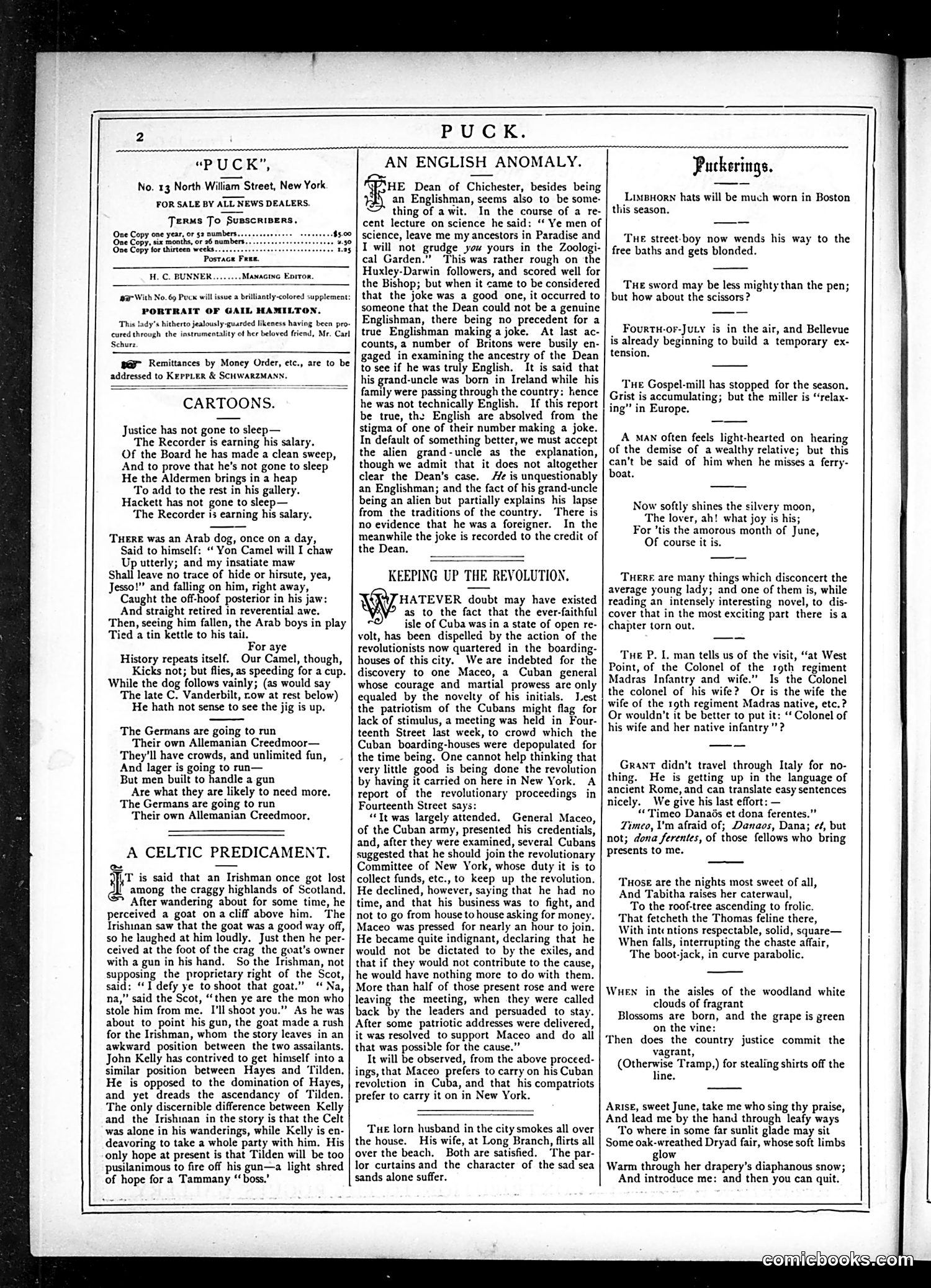
This page contains several satirical pieces rather than a single political cartoon. The main content includes: **"An English Anomaly"**: Satirizes the Dean of Chichester, who claimed descent from Huxley-Darwin (evolutionary science figures) yet was a clergyman. The joke mocks the contradiction between embracing scientific ancestry and maintaining traditional religious authority. **"Keeping Up the Revolution"**: Discusses Cuban revolutionary activity, referencing General Maceo and events in Fourteenth Street, New York, where Cuban exiles met. This appears to satirize the enthusiasm and organization of Cuban independence supporters in America. **"A Celtic Predicament"**: A humorous Irish anecdote about a man caught between two antagonists (Hayes and Tilden, likely political rivals), using physical comedy to mock political allegiances. The page also includes literary verse sections under "Puckerings" offering social commentary on contemporary life.
📄 Transcribed text from this page (OCR, searchable)
Machine-transcribed from the original scan — historical spelling and the odd misread are preserved.
PUCK. “PUCK”, No. 13 North William Street, New York FOR SALE BY ALL NEWS DEALERS. Terms To SUBSCRIBERS. One Copy one year, or $2 numbers. ‘One Copy, six months, or 26 num One Copy for thirteen weeks.. Postace Faas. H. C. BUNNER. Ba With No. 69 Puck will issue a brilliantly-colored supplement: PORTRAIT OF GAIL HAMILTON. ‘This lady's hitherto jealously-guarded likeness having been pro- cured through the instrumentality of her beloved friend, Mr. Carl Schurz BaF Remittances by Money Order, etc., are to be addressed to Kerrier & SCHWARZMANN. CARTOONS. Justice has not gone to sleep— The Recorder is earning his salary. Of the Board he has made a clean sweep, And to prove that he’s not gone to sleep He the Aldermen brings in a heap To add to the rest in his gallery. Hackett has not gone to sleep— The Recorder is earning his salary. ‘THERE was an Arab dog, once on a day, Said to himself: “ Yon Camel will I chaw Up utterly; and my insatiate maw Shall leave no trace of hide or hirsute, yea, Jesso!"” and falling on him, right away, Caught the off-hoof posterior in his jaw: And straight retired in reverential awe. Then, seeing him fallen, the Arab boys in play Tied a tin kettle to his tail. For aye History repeats itself. Our Camel, though, Kicks not; but flies, as speeding for a cup. While the dog follows vainly; (as would say The late C. Vanderbilt, row at rest below) He hath not sense to see the jig is up. The Germans are going to run Their own Allemanian Creedmoor— They'll have crowds, and unlimited fun, And lager is going to run— But men built to handle a gun Are what they are likely to need more. The Germans are going to run Their own Allemanian Creedmoor. A CELTIC PREDICAMENT. ee (i is said that an Irishman once got lost among the craggy highlands of Scotland. After wandering about for some time, he perceived a goat onacliff above him. The Irishinan saw that the goat was a good way off, so he laughed at him loudly. Just then he per- ceived at the foot of the crag the goat’s owner with a gun in his hand. So the Irishman, not supposing the proprietary right of the Scot, said: “I defy ye to shoot that goat.” ‘ Na, na,” said the Scot, “then ye are the mon who stole him from me. I'll shoot you.” As he was about to point his gun, the goat made a rush for the Irishman, whom the story leaves in an awkward position between the two assailants. John Kelly has contrived to get himself into a similar position between Hayes and ‘Tilden. He is opposed to the domination of Hayes, and yet dreads the ascendancy of Tilden. The only discernible difference between Kelly and the Irishinan in the story is that the Celt was alone in his wanderings, while Kelly is en- deavoring to take a whole party with him. His only hope at present is that Tilden will be too pusilanimous to fire off his gun—a light shred of hope for a Tammany ‘boss.’ AN ENGLISH ANOMALY. HE Dean of Chichester, besides being an Englishman, seems also to be some- thing of awit. In the course of a re- cent lecture on science he said: ‘ Ye men of science, leave me my ancestors in Paradise and I will not grudge you yours in the Zoologi- cal Garden.” This was rather rough on the Huxley-Darwin followers, and scored well for the Bishop; but when it came to be considered that the joke was a good one, it occurred to someone that the Dean could not be a genuine Englishman, there being no precedent for a true Englishman making a joke. At last ac- counts, a number of Britons were busily en- gaged in examining the ancestry of the Dean to see if he was truly English. It is said that his grand-uncle was born in Ireland while his family were passing through the country: hence he was not technically English. If this report be true, the English are absolved from the stigma of one of their number making a joke. In default of something better, we must accept the alien grand-uncle as the explanation, though we admit that it does not altogether clear the Dean’s case. He is unquestionably an Englishman; and the fact of his grand-uncle being an alien but partially explains his lapse from the traditions of the country. There is no evidence that he was a foreigner. In the meanwhile the joke is recorded to the credit of the Dean. KEEPING UP THE REVOLUTION. HATEVER doubt may have existed as to the fact that the ever-faithful isle of Cuba was in a state of open re- volt, has been dispelled by the action of the revolutionists now quartered in the boarding- houses of this city. Weare indebted for the discovery to one Maceo, a Cuban general whose courage and martial prowess are only equaled by the novelty of his initials. Lest the patriotism of the Cubans might flag for lack of stimulus, a meeting was held in Four- teenth Street last week, to crowd which the Cuban boarding-houses were depopulated for the time being. One cannot help thinking that very little good is being done the revolution by having it carried on here in New York. A report of the revolutionary proceedings in Fourteenth Street says: “Tt was largely attended. General Maceo, of the Cuban army, presented his credentials, and, after they were examined, several Cubans suggested that he should join the revolutionary Committee of New York, whose duty it is to collect funds, etc., to keep up the revolution. He declined, however, saying that he had no time, and that his business was to fight, and not to go from house to house asking for money. Maceo was pressed for nearly an hour to join. He became quite indignant, declaring that he would not be dictated to by the exiles, and that if they would not contribute to the cause, he would have nothing more to do with them. More than half of those present rose and were leaving the meeting, when they were called back by the leaders and persuaded to stay. After some patriotic addresses were delivered, it was resolved to support Maceo and do all that was possidle for the cause.” It will be observed, from the above proceed- ings, that Maceo prefers to carry on his Cuban revolution in Cuba, and that his compatriots prefer to carry it on in New York. Tue lorn husband in the city smokes all over the house. His wife, at Long Branch, flirts all over the beach, Both are satisfied. ‘The par- lor curtains and the character of the sad sea sands alone suffer. Puckerings. Limsuorn hats will be much worn in Boston this season. Tue street-boy now wends his way to the free baths and gets blonded. Tue sword may be less mighty than the pen; but how about the scissors? Fourtu-or-Juty is in the air, and Bellevue is already beginning to build a temporary ex- tension, 41é Gospel-mill has stopped for the season, Grist is accumulating; but the miller is “relax- ing” in Europe. A Maw often feels light-hearted on hearing of the demise of a wealthy relative; but this can’t be said of him when he misses a ferry- boat. Now softly shines the silvery moon, ‘The lover, ah! what joy is his; For ’tis the amorous month of June, Of course it is. THERE are many things which disconcert the average young lady; and one of them is, while reading an intensely interesting novel, to dis- cover that in the most exciting part there isa chapter torn out. Tue P. I. man tells us of the visit, “at West Point, of the Colonel of the roth regiment Madras Infantry and wife.” Is the Colonel the colonel of his wife? Or is the wife the wife of the r9th regiment Madras native, etc.? Or wouldn’t it be better to put it: ‘Colonel of his wife and her native infantry"? Grant didn’t travel through Italy for no- thing. He is getting up in the language of ancient Rome, and can translate easy sentences nicely. We give his last effort: — “Timeo Danaés et dona ferentes.” Timeo, I'm afraid of; Danaos, Dana; ef, but not; dona ferentes, of those fellows who bring presents to me. ‘Tuose are the nights most sweet of all, And Tabitha raises her caterwaul, To the roof-tree ascending to frolic. That fetcheth the Thomas feline there, With intentions respectable, solid, square— When falls, interrupting the chaste affair, The boot-jack, in curve parabolic. Wuen in the aisles of the woodland white clouds of fragrant Blossoms are born, and the grape is green on the vine: Then does the country justice commit the vagrant, (Otherwise Tramp,) for stealing shirts off the line. ARISE, sweet June, take me who sing thy praise, And lead me by the hand through leafy ways To where in some far sunlit glade may sit Some oak-wreathed Dryad fair, whose soft limbs glow Warm through her drapery’s diaphanous snow; And introduce me: and then you can quit.