
Puck, 1878-06-19 · page 11 of 16
Puck — June 19, 1878 — page 11: what you’re looking at
What you’re looking at
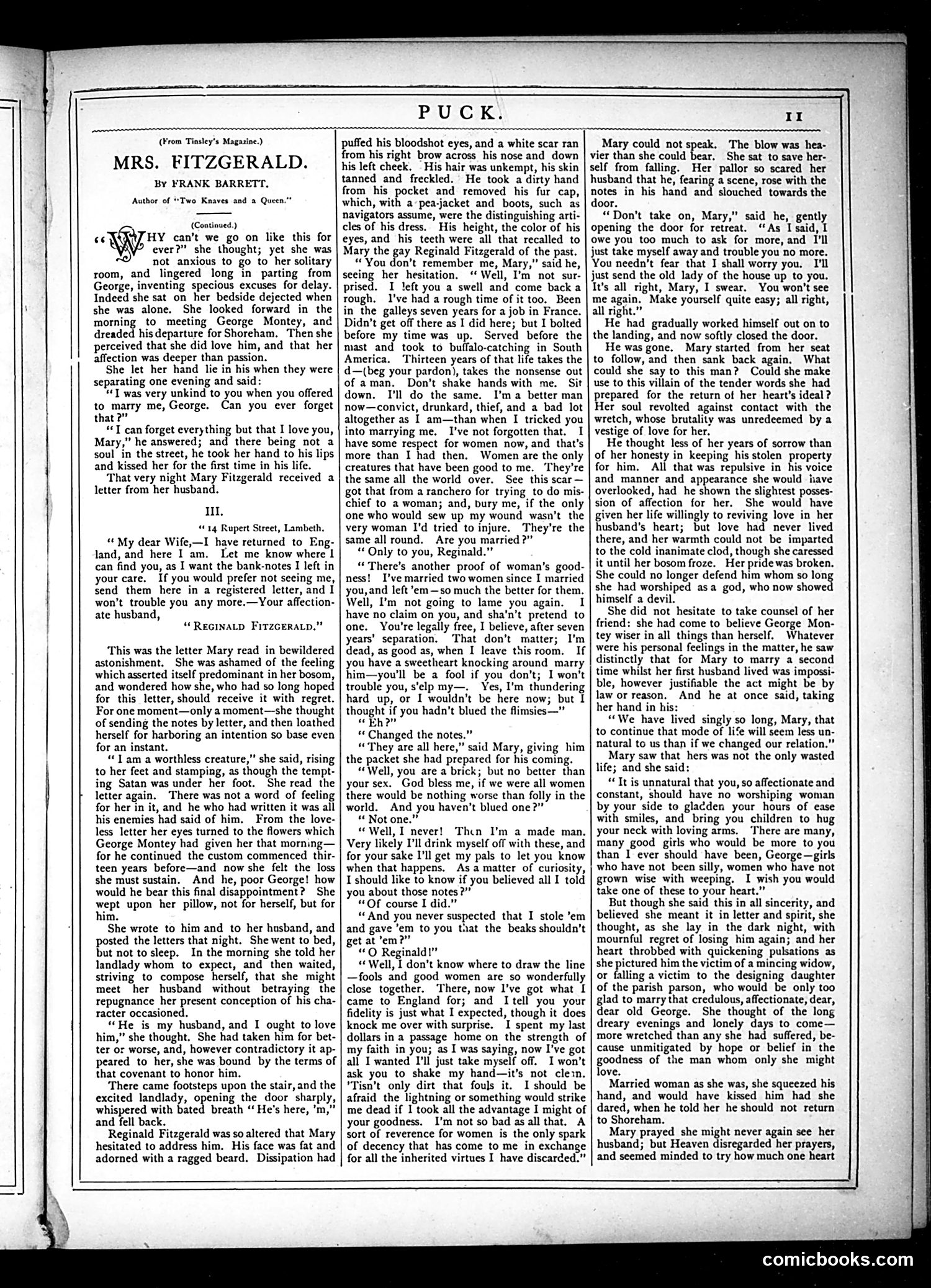
This page from Puck magazine contains a serialized short story titled "Mrs. Fitzgerald" by Irving Bacheller, rather than a political cartoon. The narrative focuses on a domestic drama involving Mary Fitzgerald and her husband Reginald, who has abandoned her and their marriage. The story deals with themes of infidelity, betrayal, and marital discord—common subjects in Victorian-era fiction. Reginald's letter justifies his departure by claiming Mary drove him to it through her behavior, while also revealing his own moral failings (gambling, drunkenness, theft). The piece appears designed to entertain Puck's readers with melodramatic relationship conflict rather than to satirize political or social institutions. This is serialized literature rather than satirical commentary.
📄 Transcribed text from this page (OCR, searchable)
Machine-transcribed from the original scan — historical spelling and the odd misread are preserved.
PUCK. Il (From Tiasley’s Magazine.) MRS. FITZGERALD. By FRANK BARRETT, Author of *Two Knaves and a Queen.” (Continued. «J ATHY can't we go on like this for ever?” she thought; yet she was not anxious to go to her solitary room, and lingered long in parting from George, inventing specious excuses for delay. Indeed she sat on her bedside dejected when she was alone. She looked forward in the morning to meeting George Montey, and dreaded his departure for Shoreham. Then she perceived that she did love him, and that her affection was deeper than passion. She let her hand lie in his when they were separating one evening and said: “«] was very unkind to you when you offered to marry me, George. Can you ever forget that?” *T can forget everything but that I love you, Mary,” he answered; and there being not 2 soul in the street, he took her hand to his lips and kissed her for the first time in his life. ‘That very night Mary Fitzgerald received a letter from her husband. Hl. “14 Rupert Street, Lambeth, “ My dear Wife,—I have returned to Eng- land, and here I am. Let me know where | can find you, as I want the bank-notes I left in your care, If you would prefer not secing me, send them here in a registered letter, and I won’t trouble you any more.—Your affection- ate husband, “REGINALD FitzGERALp.” This was the letter Mary read_in bewildered astonishment. She was ashamed of the feeling which asserted itself predominant in her bosom, and wondered how she, who had so long hoped for this letter, should receive it with regret. For one moment—only a moment—she thought of sending the notes by letter, and then loathed herself for harboring an intention so base even for an instant. “Tam a worthless creature,” she said, rising to her feet and stamping, as though the tempt- ing Satan was under her foot. She read the letter again. There was not a word of feeling for her in it, and he who had written it was all his enemies had said of him. From the love- less letter her eyes turned to the flowers which George Montey had given her that morning— for he continued the custom commenced thir- teen years before—and now she felt the loss she must sustain. And he, poor George! how would he bear this final disappointment? She wept upon her pillow, not for herself, but for him. She wrote to him and to her husband, and posted the letters that night. She went to bed, but not to sleep. In the morning she told her landlady whom to expect, and then waited, striving to compose herself, that she might meet her husband without betraying the repugnance her present conception of his cha- racter occasioned. “He is my husband, and I ought to love him,” she thought. She had taken him for bet- ter or worse, and, however contradictory it ap- peared to her, she was bound by the terms of that covenant to honor him. There came footsteps upon the stair, and the excited landlady, opening the door sharply, whispered with bated breath “He's here, 'm,” and fell back. Reginald Fitzgerald was so altered that Mary hesitated to address him. His face was fat and adorned with a ragged beard. Dissipation had puffed his bloodshot eyes, and a white scar ran from his right brow across his nose and down his left cheek. “His hair was unkempt, his skin tanned and freckled. He took a dirty hand from his pocket and removed his fur cap, which, with a-pea-jacket and boots, such as navigators assume, were the distinguishing arti- cles of his dress. His height, the color of his eyes, and his teeth were all that recalled to Mary the gay Reginald Fitzgerald of the past. “You don’t remember me, Mary,” said he, seeing her hesitation. ‘Well, I'm not sur- prised. I eft you a swell and come back a rough. l've had a rough time of it too, Been in the galleys seven years for a job in France. Didn't get off there as I did here; but I bolted before my time was up. Served before the mast and took to buffalo-catching in South America. Thirteen years of that life takes the d—(beg your pardon), takes the nonsense out of aman. Don't shake hands with me. Sit down. I'll do the same. I'ma better man now—convict, drunkard, thief, and a bad lot altogether as I am—than when I tricked you into marrying me. I've not forgotten that. I have some respect for women now, and that’s more than I had then. Women are the only creatures that have been good to me. ‘They're the same all the world over. See this scar— got that from a ranchero for trying to do mis- chief to a woman; and, bury me, if the only one who would sew up my wound wasn’t the very woman I'd tried to injure. ‘They're the same all round. Are you married?” “ Only to you, Reginald.” “There’s another proof of woman's good- ness! I’ve married two women since I married you, and left ’em—so much the better for them. Well, I’m not going to lame you again. I have no claim on you, and sha’n’t pretend to one. You're legaily free, I believe, after seven years’ separation, That don’t matter; I'm dead, as good as, when I leave this room. If you have a sweetheart knocking around marry him—you'll be a fool if you don’t; I won't trouble you, s’elp my—. Yes, I’m thundering hard up, or I wouldn't be here now; but I thought if you hadn't blued the flimsies—” “Eh?” ‘Changed the notes.” “They are all here,” said Mary, giving him the packet she had prepared for his coming. “Well, you are a brick; but no better than your sex. God bless me, if we were all women there would be nothing worse than folly in the world. And you haven't blued one?” « Not one.” “Well, I never! Thon I'm a made man. Very likely I'll drink myself off with these, and for your sake I'll get my pals to let you know when that happens. As a matter of curiosity, I should like to know if you believed all I told you about those notes ?” “Of course I did.” “And you never suspected that I stole ’em and gave 'em to you that the beaks shouldn’t get at ’em?” “© Reginald!” “Well, I don’t know where to draw the line —fools and good women are so wonderfully close together. There, now I’ve got what I came to England for; and I tell you your fidelity is just what I expected, though it does knock me over with surprise. I spent my last dollars in a passage home on the strength of my faith in you; as I was saying, now I've got ali I wanted I'll just take myself off. I won’t ask you to shake my hand—it’s not clein. 'Tisn’t only dirt that fouls it. I should be afraid the lightning or something would strike me dead if I took all the advantage I might of your goodness. I’m not so bad as all that. A sort of reverence for women is the only spark of decency that has come to me in exchange for all the inherited virtues I have discarded.” Mary could not speak. The blow was hea- vier than she could bear. She sat to save her- self from falling. Her pallor so scared her husband that he, fearing a scene, rose with the notes in his hand and slouched towards the door. “Don't take on, Mary,” said he, gently opening the door for retreat. “As I said, I owe you too much to ask for more, and I'll just take myself away and trouble you no more. You needn’t fear that I shall worry you. just send the old lady of the house up to you, It’s all right, Mary, I swear. You won't see me again. Make yourself quite easy; all right, all right.” He had gradually worked himself out on to the landing, and now softly closed the door. He was gone. Mary started from her seat to follow, and then sank back again. What could she say to this man? Could she make use to this villain of the tender words she had prepared for the return of her heart’s ideal? Her soul revolted against contact with the wretch, whose brutality was unredeemed by a vestige of love for her. He thought less of her years of sorrow than of her honesty in keeping his stolen property for him. All that was repulsive in his voice and manner and appearance she would lave overlooked, had he shown the slightest posses- sion of affection for her. She would have given her life willingly to reviving love in her husband's heart; but love had never lived there, and her warmth could not be imparted to the cold inanimate clod, though she caressed it until her bosom froze. Her pride was broken. She could no longer defend him whom so lon; she had worshiped asa god, who now showe himself a devil. She did not hesitate to take counsel of her friend: she had come to believe George Mon- tey wiser in all things than herself. Whatever were his personal feelings in the matter, he saw distinctly that for Mary to marry a second time whilst her first husband lived was impossi- ble, however justifiable the act might be by law or reason. And he at once said, taking her hand in his: “We have lived singly so long, Mary, that to continue that mode of life will seem less un- natural to us than if we changed our relation.” Mary saw that hers was not the only wasted life; and she said: “Tt is unnatural that you, so affectionate and constant, should have no worshiping woman by your side to glacden your hours of ease with smiles, and bring you children to hug your neck with loving arms. ‘There are many, many good girls who would be more to you than I ever should have been, George—girls who have not been silly, women who have not grown wise with weeping. I wish you would take one of these to your heart.” But though she said this in all sincerity, and believed she meant it in letter and spirit, she thought, as she lay in the dark night, with mournful regret of losing him again; and her heart throbbed with quickening pulsations as she pictured him the victim of a mincing widow, or falling a victim to the designing daughter of the parish parson, who would be only too glad to marry that credulous, affectionate, dear, dear old George. She thought of the long dreary evenings and lonely days to come— more wretched than any she had suffered, be- cause unmitigated by hope or belief in the goodness of the man whom only she might love. Married woman as she was, she squeezed his hand, and would have kissed him had she dared, when he told her he should not return to Shoreham. Mary prayed she might never again see her husband; but Heaven disregarded her prayers, and seemed minded to try how much one heart comicbooks.com