
A complete issue · 16 pages · 1878
Puck — January 30, 1878
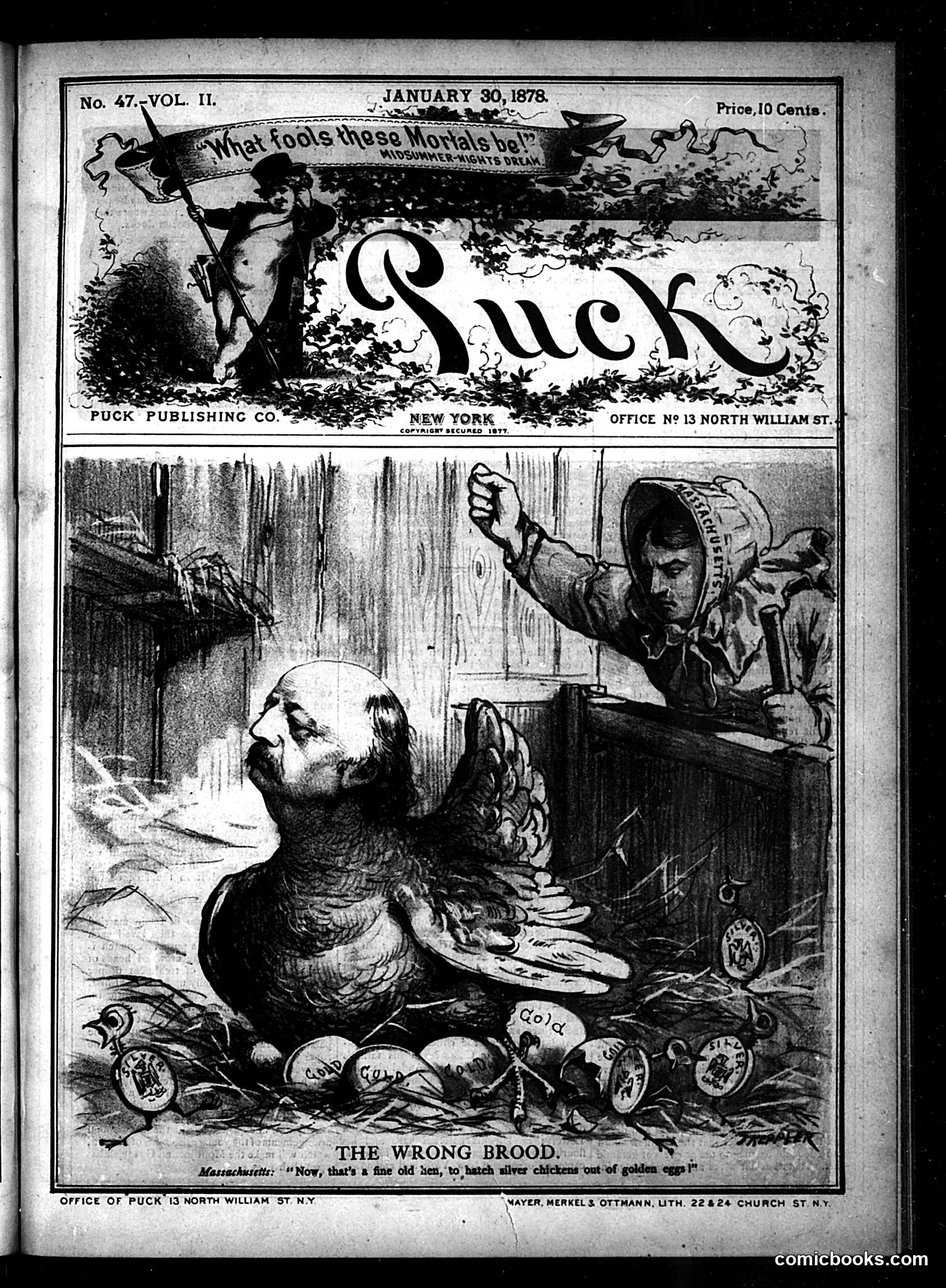
This January 1878 Puck cartoon satirizes financial speculation and greed. A bald, corpulent man (likely representing a wealthy speculator or banker) sits surrounded by golden eggs labeled "GOLD." A figure above—possibly representing labor, the working class, or honest enterprise—wields an axe menacingly. The caption "The Wrong Brood" suggests the cartoon criticizes how the wealthy "hatch" or accumulate riches through speculation rather than legitimate work. The goose that lays golden eggs is a classic fable about sustainable prosperity; this cartoon implies the speculator possesses the *wrong* source of wealth—one that's vulnerable or deserves destruction. The threatening figure above represents society's judgment against such parasitic accumulation.
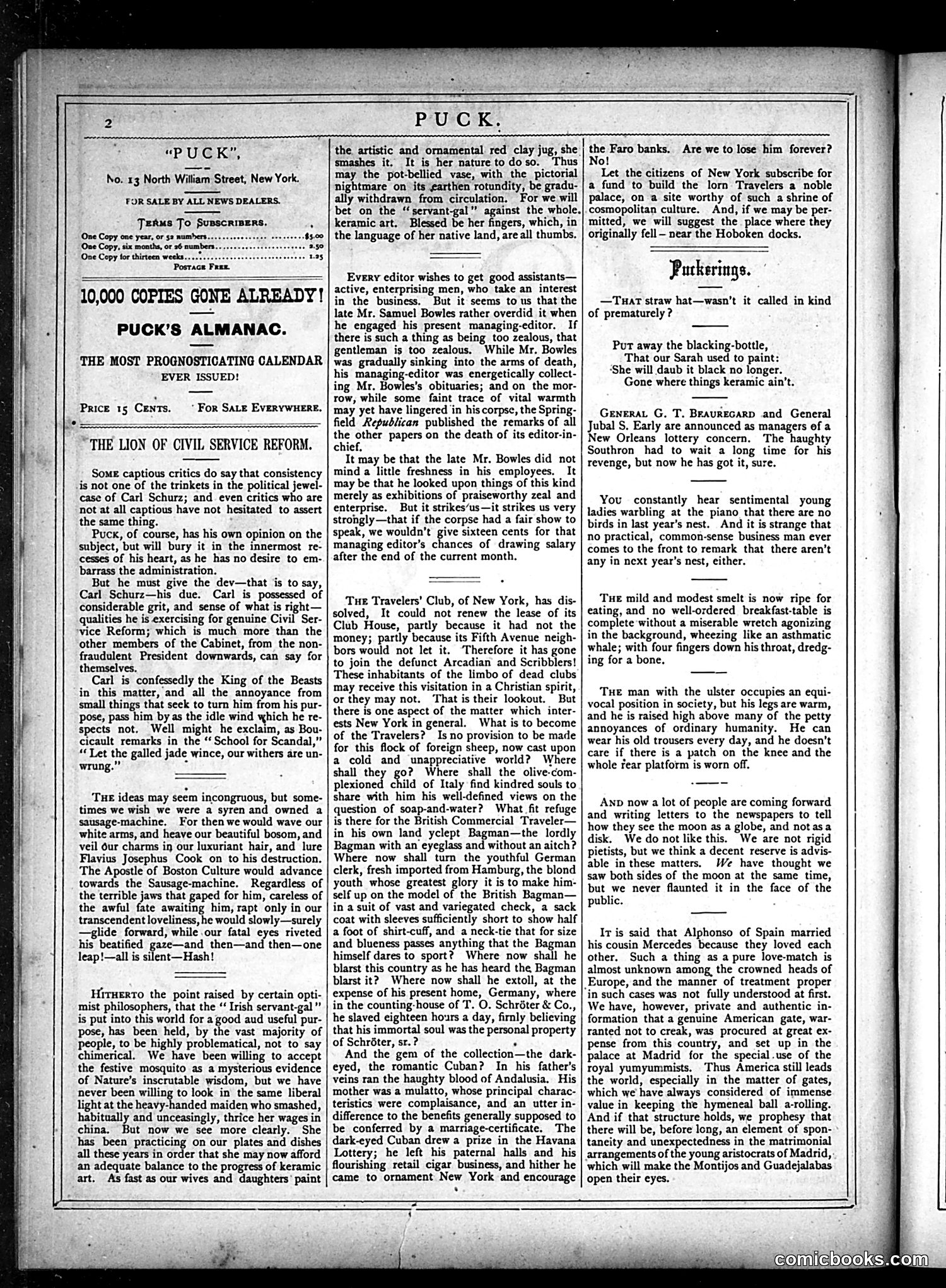
This page is primarily **editorial commentary and advertising** rather than cartoon content. The main article, "The Lion of Civil Service Reform," discusses **Carl Schurz**, a prominent political figure whom Puck accuses of inconsistency. The text sarcastically compares Schurz to various animals and criticizes his approach to civil service reform—suggesting he's all bluster without substance. Additional brief satirical pieces mock various targets: Samuel Bowles (editor), the Travelers' Club of New York, and references to sentimental young ladies at pianos. A final piece humorously discusses **Alphonso of Spain** marrying his cousin, satirizing European aristocratic marriage customs as bizarre compared to American practices. The page reflects Puck's characteristic style of political criticism mixed with social satire.
This page contains a humorous essay titled "That Masquerade Ball" by someone claiming not to dance, describing social chaos at a fancy ball event. The narrator recounts awkward encounters: dancing with a blonde woman, an encounter with an "orange outang" (a racist caricature of a Black man) who grabbed a woman, finding lost items on the floor, and general social mishaps involving the "creature" and various attendees. The essay reflects late 19th-century racist attitudes through its dehumanizing language and caricature. The "Answer for the Curious" advice column at right addresses miscellaneous reader questions about etiquette and personal matters. **No specific political figures or dated events appear identifiable in this text alone.** The content primarily reflects period social attitudes and convention-breaking behavior at formal events.
This page contains two distinct pieces: **"Smith Takes a Little Trip"** (left column): A humorous first-person account of a rail journey through New Jersey and the Northeast. The narrator describes mundane observations—wheat fields, small towns, hotels—in tedious detail, poking fun at travelers who bore others with trivial travel stories. The satire targets people who mistake ordinary experiences for exciting adventures. **"Her Ways: A Sermon to the Sluggard"** (right column): A moralistic piece addressing lazy people, using biblical language ("Go to the ant, thou sluggard"). It advocates industry and self-discipline, warning against idleness. This reflects period-typical Puck commentary on social virtue and work ethic, likely directed at readers perceived as unmotivated or frivolous. Both pieces employ humor to critique human behavior and social attitudes of their era.
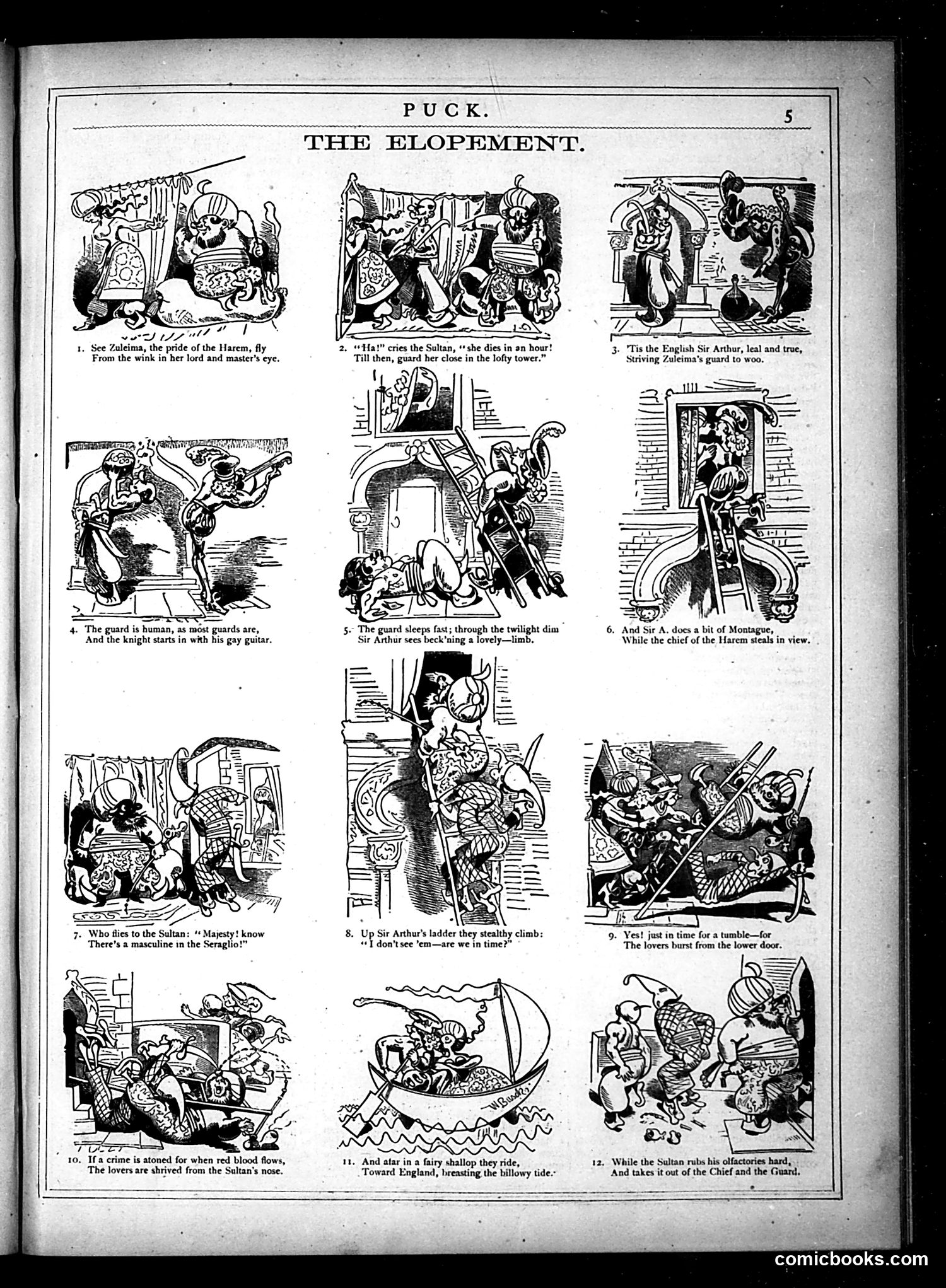
This is a 12-panel satirical narrative about an elopement involving a Harem, a Sultan, and Sir Arthur (likely a British military figure). The story depicts a romantic escape: a woman (Zaleima, "pride of the Harem") flees with her lover, a British knight. The satire plays on Victorian-era anxieties about: - **Imperial romance**: A British officer seducing an Ottoman official's concubine - **Oriental exoticism**: The exotic "Harem" setting contrasts with buttoned-up British propriety - **Military honor**: Sir Arthur's martial dignity undermined by a love scandal The humor escalates through comedic chaos—guards sleeping on duty, failed pursuits, and the lovers' narrow escapes—mocking both Ottoman ineffectiveness and British romantic scandal. The final panels suggest their successful flight to England.
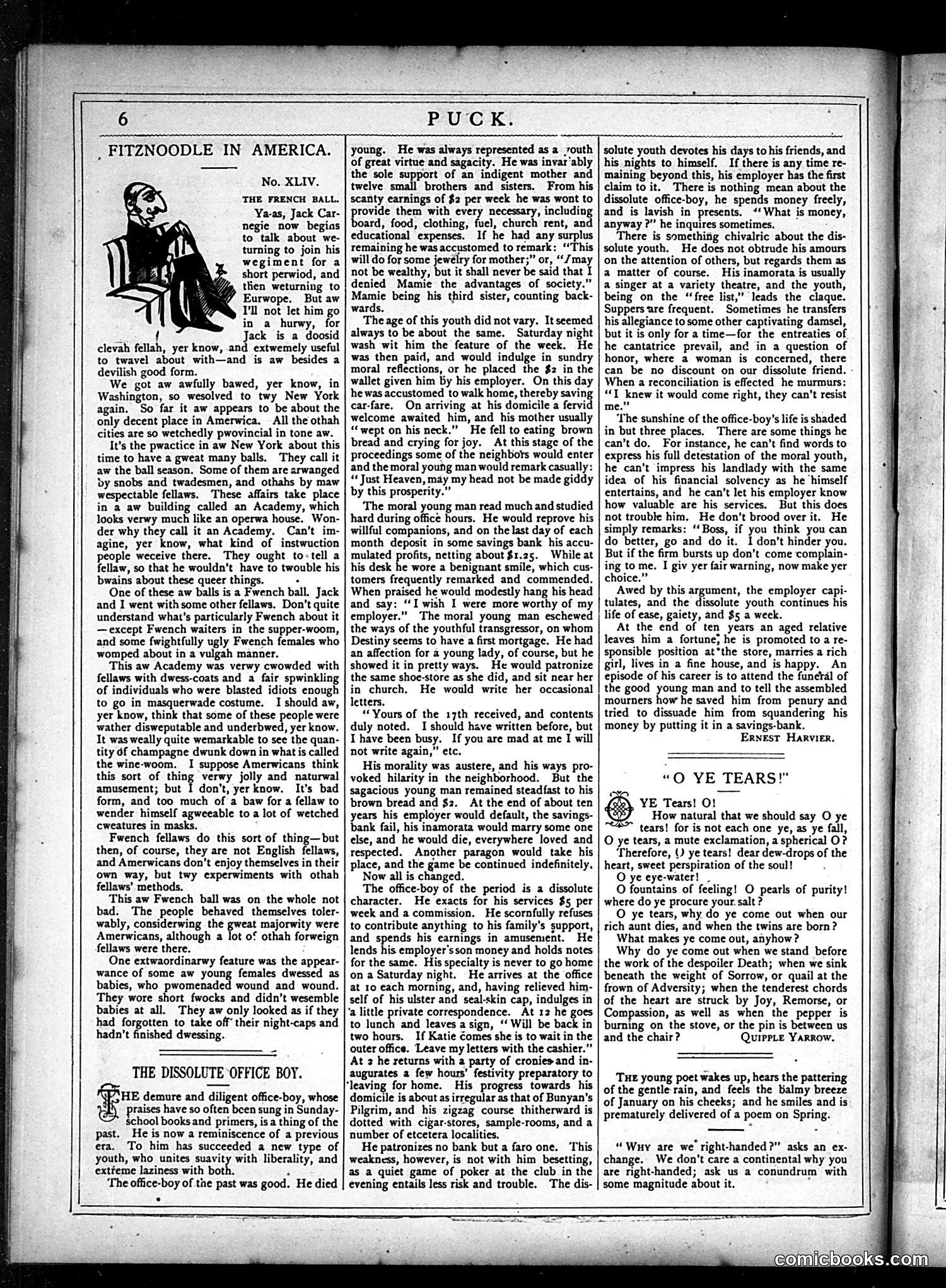
This page contains two separate satirical pieces rather than a single cartoon. **"Fitznoodle in America" (No. XLIV)**: A serialized story mocking a young French immigrant to America. The illustration shows a French dandy in exaggerated costume. The satire targets pretentious European immigrants who arrive in America with affected manners and limited means, yet maintain aristocratic pretensions while working mundane jobs. The narrative ridicules his affectations, moral superiority, and failed attempts at romance. **"The Dissolute Office Boy"**: A companion piece satirizing a different social type—the urban American youth who lacks discipline and squanders money in vice rather than self-improvement, contrasting with the French character above. Both pieces use character types to satirize contemporary social anxieties about immigration, class aspiration, and moral degeneracy in Gilded Age America.
This page primarily contains text rather than cartoons. The main content is Chapter XXV of "Puck's History of the United States," which satirically recounts McClellan's Civil War military campaign and his political ambitions. The satire mocks General McClellan's cautious tactics, his failure to decisively engage Lee's forces, and his subsequent political aspirations. The page also includes "Puck's Essential Oil of Congress," satirizing contemporary Congressional debates about whiskey taxes and Treasury raids—typical 1870s political humor targeting ineffective legislation. Additionally, there are theatrical reviews under "Dramatic Notes," discussing stage productions and performances of the era. This is primarily a text-heavy page mixing historical satire with contemporary political commentary and entertainment reviews.
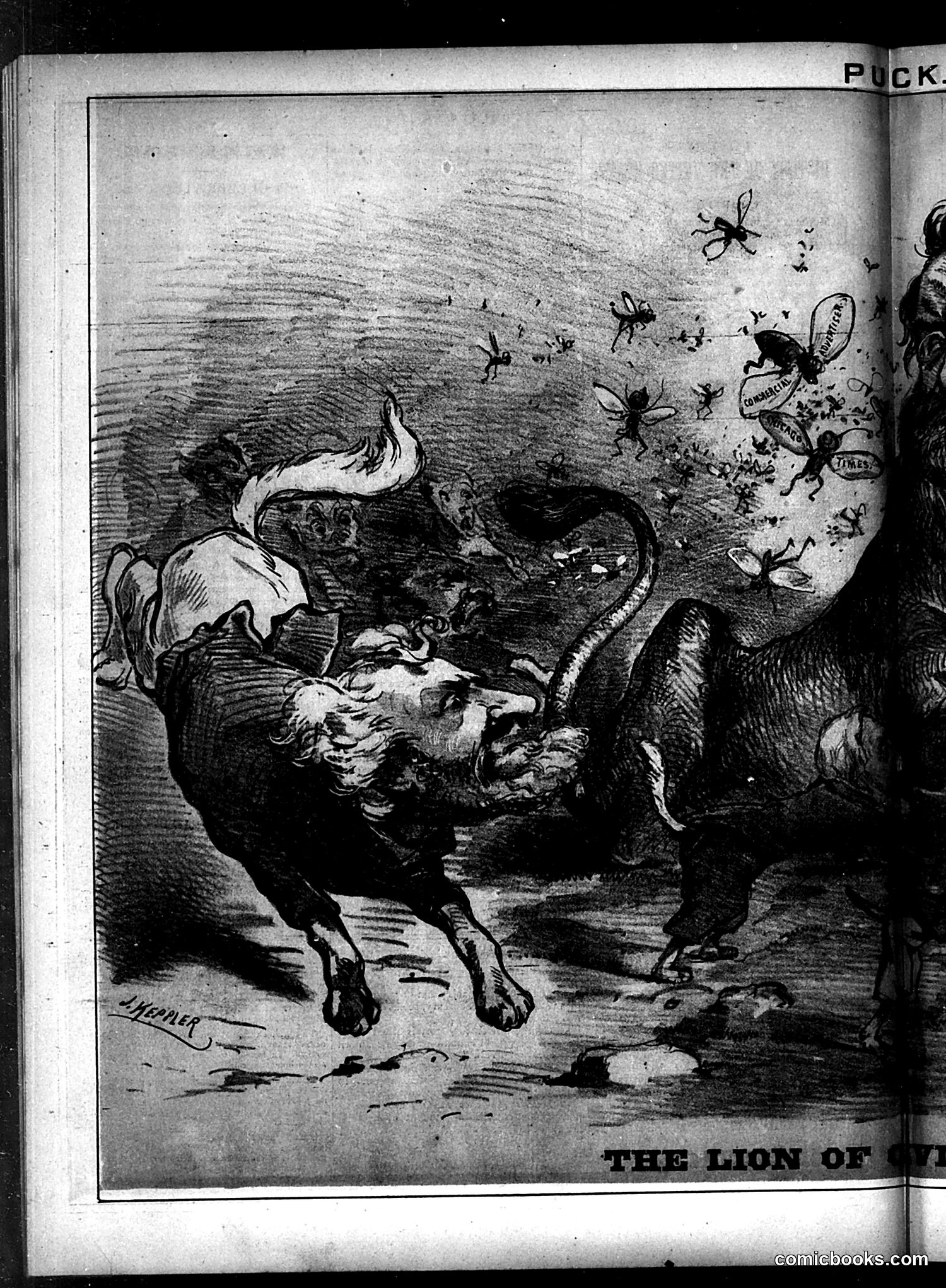
This engraving depicts a large lion being attacked by smaller animals (dogs, insects, and flying creatures). The caption reads "THE LION OF..." (text cut off), suggesting the lion represents a powerful entity under assault. The style and composition indicate this is a political allegory—the lion likely represents a nation or leader, while the smaller creatures represent weaker adversaries or internal threats. The swarm of attackers suggests the subject is overwhelmed or besieged from multiple directions. Without the complete caption or publication date visible, I cannot definitively identify which historical figure or nation the lion represents. However, this appears to be satirizing a powerful entity facing unexpected challenges from seemingly insignificant opposition—a common Puck magazine trope for mocking political leaders or nations experiencing embarrassing defeats or difficulties.
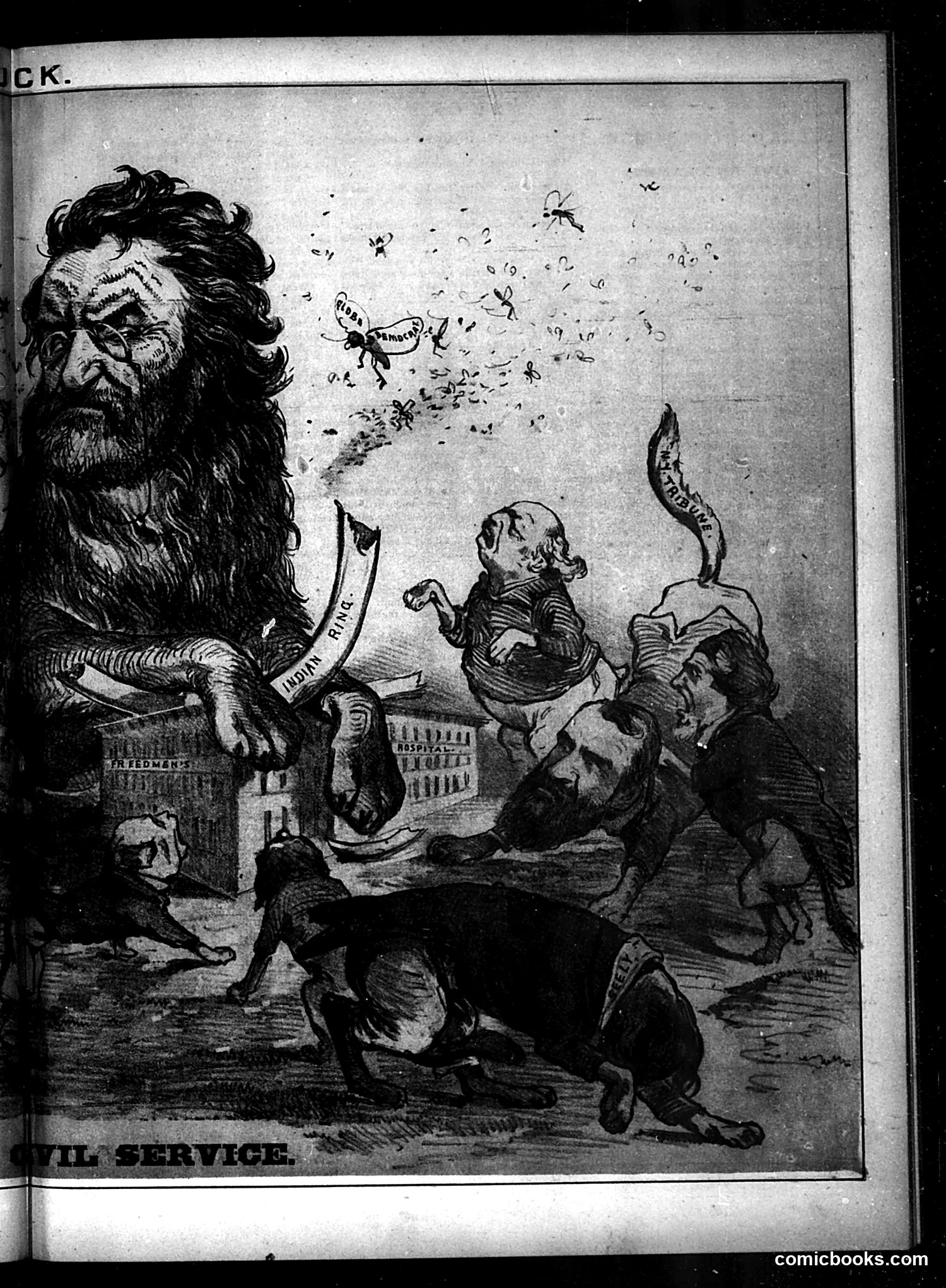
This political cartoon depicts a large bearded figure (appearing to represent a powerful authority or institution) blowing disease-carrying insects or parasites toward smaller, vulnerable figures below. The giant figure holds what appears to be a document labeled "FRIEDRICH'S" or similar, suggesting a business or industrial entity. The satire critiques how those in power spread harm—likely disease, poor working conditions, or exploitation—downward to ordinary citizens or workers. The insects symbolize the toxic consequences of negligent or malicious policies. The title "ILL SERVICE" puns on "disservice," emphasizing that this power structure causes actual illness and harm rather than serving the public good. This reflects late 19th-century American concerns about industrial exploitation and public health dangers.
This page contains "Love and Lambs," a serialized comedy story adapted from French. The text is dialogue-heavy, depicting romantic complications involving characters named Sylvia, Jack, Mr. Smith, and others discussing love, misunderstanding, and social propriety. The story appears to be a domestic comedy of manners rather than political satire. It centers on romantic entanglements and emotional misunderstandings—Jack's affection for Sylvia, Mr. Smith's involvement, and questions about whether various characters truly love one another or are deceiving themselves. Without visible illustrations on this page, it functions as prose fiction. The humor derives from typical Victorian/early-20th-century romantic comedy tropes: miscommunication, class considerations, and the tension between what characters say and what they feel. This represents Puck's literary content rather than its signature satirical cartooning.
This page is primarily **serialized fiction rather than political satire or cartoon**. It continues a story titled "A Fool for Love" (visible in the text: "A Fool for love one!"). The narrative involves characters named Gabrielle, Mr. Smith, Miss Hardinge, and Sylvia engaged in a romantic plot centered around a mysterious letter written in Italian. The story plays on comedy of misunderstanding—characters debate whether the letter is romantic, joke about translation, and create dramatic tension around its contents and authorship. This represents **Puck's literary fiction content** rather than its famous satirical cartoons. The humor derives from domestic romantic complications rather than political or social commentary. No identifiable real figures or events appear to be referenced.
This page contains the continuation of a serialized story titled "The Duel in Herne Wood," extracted from "The Case of Mr. Lionel Varleigh" by William Collins. The text is a Victorian-era narrative about a gentleman named Mr. Varleigh involved in a duel and various social entanglements. There is no political satire or caricature visible on this page—it's straightforward fiction serialization, a common feature in Puck magazine alongside its satirical cartoons. The story involves matters of honor, secret engagements, fencing instruction, and social propriety typical of 19th-century melodrama. Without seeing accompanying illustrations on this particular page, the content appears to be purely literary rather than satirical commentary.
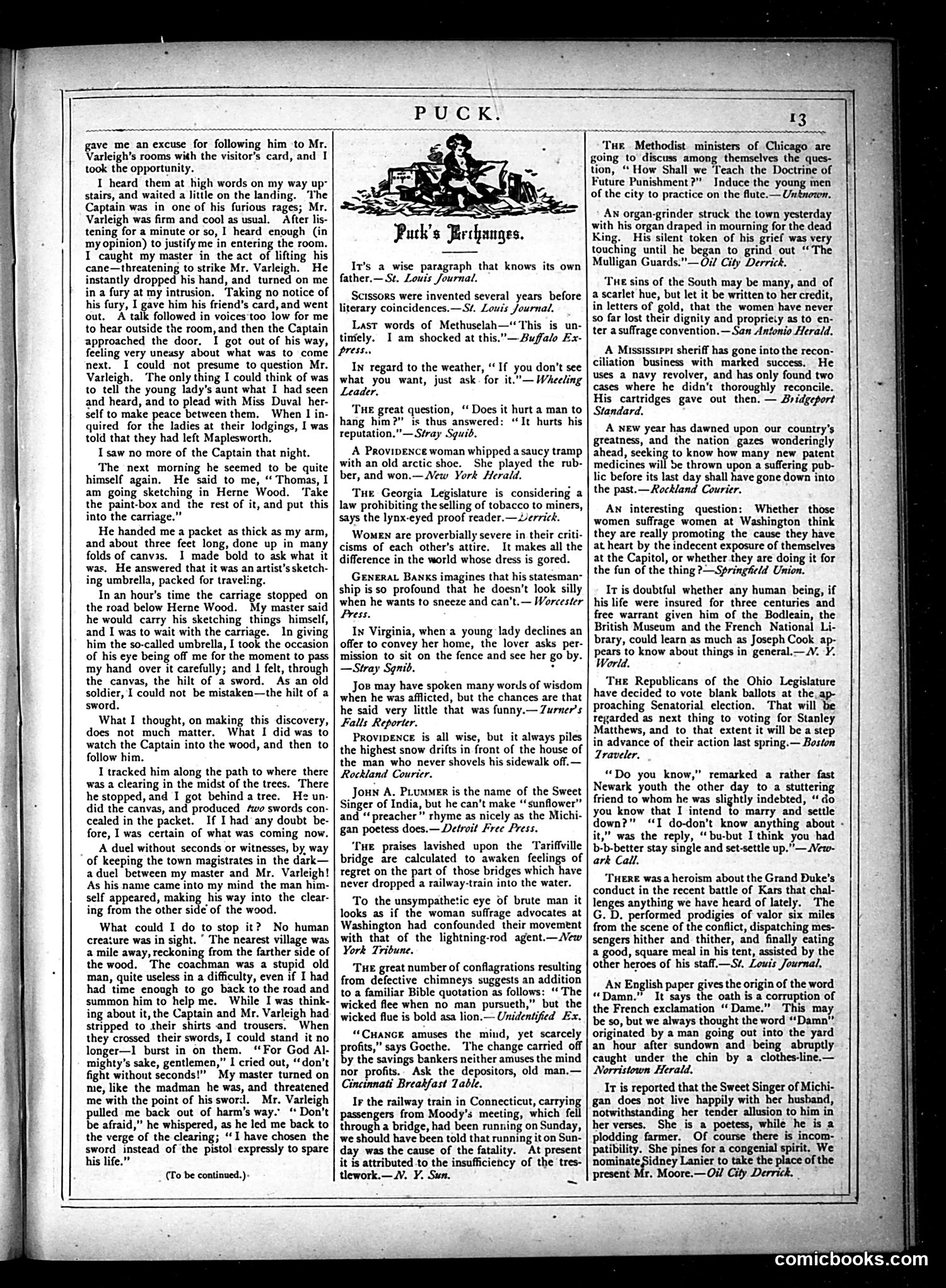
The main cartoon depicts a chaotic scene of someone being thrown from or struggling in a carriage. Based on the accompanying text narrative, this illustrates an anecdote about the artist's encounter with Captain Valeigh, a temperamental man who became enraged when the narrator followed him to Mr. Valeigh's rooms. The captain's violent reaction—dropping the narrator, then attempting to strike him with a sword—forms the story's climax. The satire appears to mock aristocratic volatility and masculine pride through this physical farce. The detailed first-person account treats the near-fatal sword encounter as comedic misadventure, characteristic of Puck's style of turning contemporary social embarrassments into humorous cautionary tales about proper conduct.
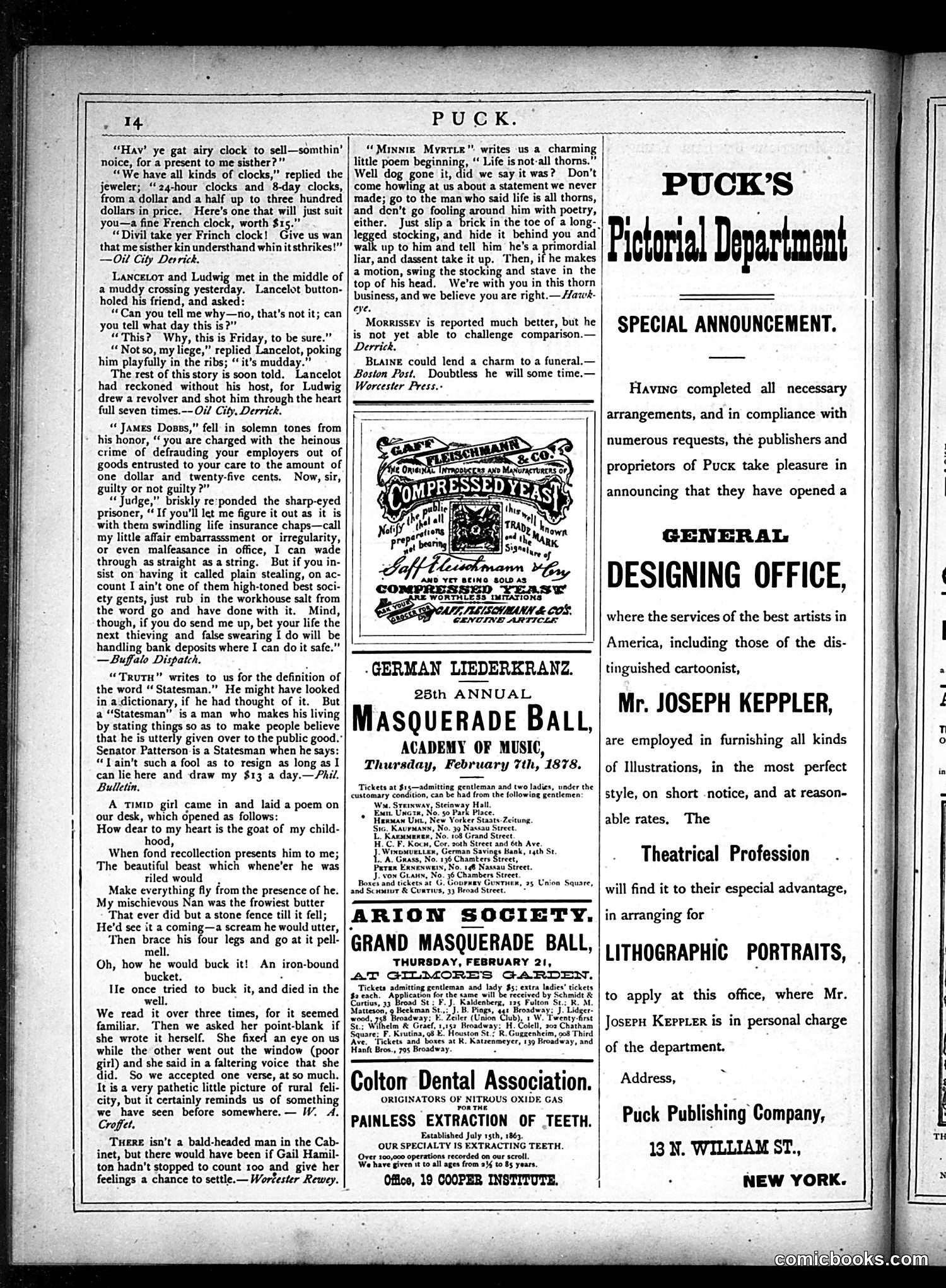
This page is primarily **advertising and announcements** rather than political satire. The main content includes: 1. **Puck's Pictorial Department announcement** - promoting a newly opened "General Designing Office" employing cartoonist **Joseph Keppler** to provide illustrations and lithographic portraits for theatrical professionals and others, at reasonable rates. 2. **Social event advertisements** - notices for the German Liederkranz's 25th Annual Masquerade Ball (February 7, 1878) and the Arion Society's Grand Masquerade Ball (February 21), both major New York cultural events. 3. **Dental advertisement** - Colton Dental Association promoting painless tooth extraction using nitrous oxide gas. The page reflects 1878 New York's social and commercial landscape rather than containing political commentary or satire.
This is primarily an **advertising page** from Puck magazine, not a satirical cartoon page. The advertisements promote various New York businesses and services typical of 1878, including: - Portrait studios (Kurtz, Allory) - Printing and lithography companies - A tailor (Nicoll) - Theater venues (Aberle's Trivoli, Volks-Garden-Theatre) - Wine merchants (Hungarian wines) - A bookbinder and pamphlet service The only notable illustration is a decorative label for "Hungarian Wines" featuring a horseman and ornate heraldic design. The page includes an "In Memoriam Brigham Young" note and announces Puck's 1878 Almanac availability. It's essentially a revenue-generating classified ads section rather than editorial content with satirical intent.
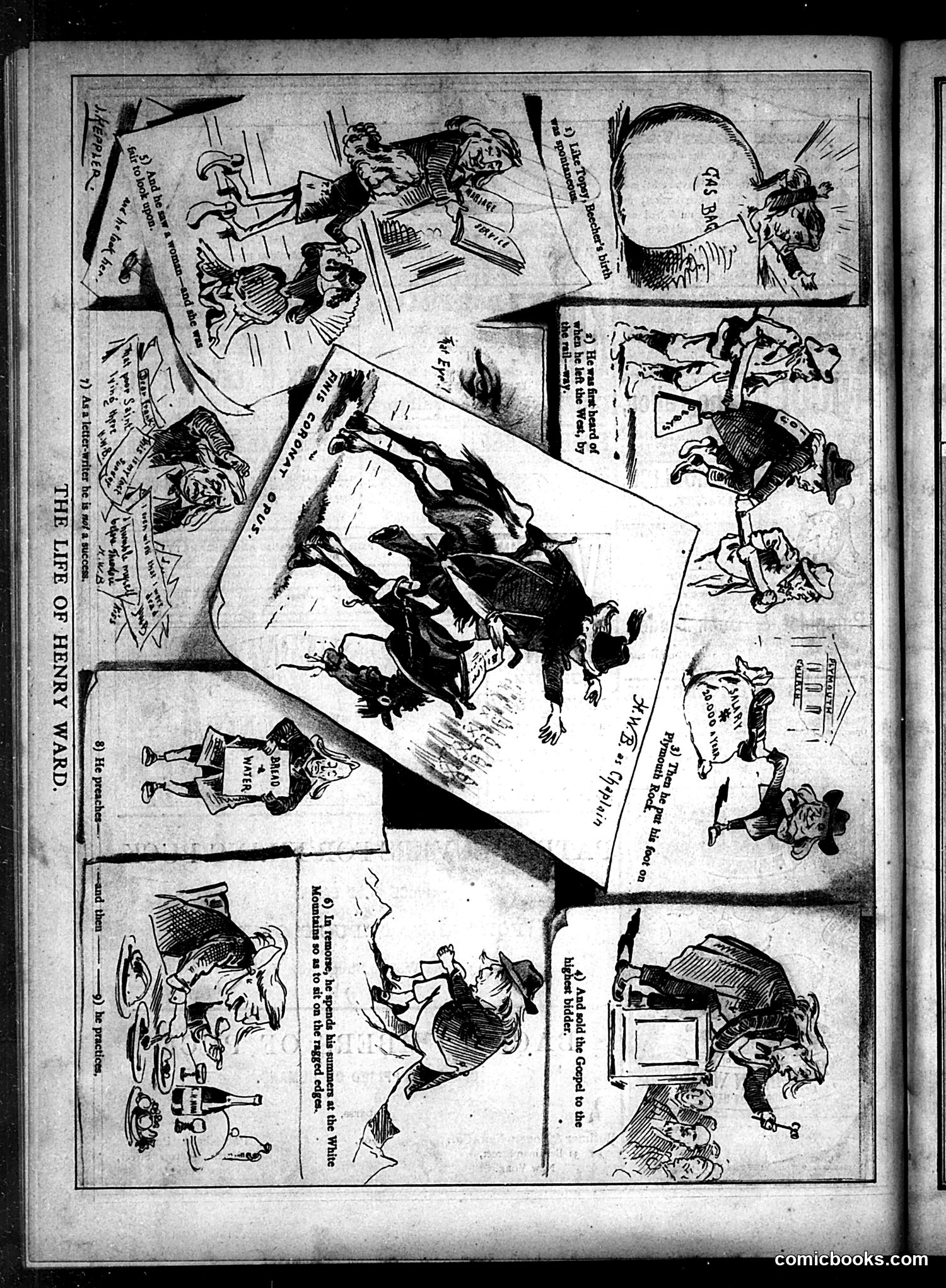
I can see this is a page from Puck magazine titled "THE LIFE OF HENRY WARD," but the OCR text provided contains only the title and no body text. The page displays multiple comic panels arranged around a central large illustration showing a figure in dark clothing. The panels appear to depict various scenes with caricatured characters in exaggerated poses and expressions, typical of 19th-century satirical illustration. Without legible OCR text for the individual panels or caption text, I cannot reliably identify the specific political figures, events, or satirical points being made. The artwork suggests commentary on a public figure named Henry Ward, likely Henry Ward Beecher (a prominent 19th-century clergyman), but I cannot confirm the specific narrative or criticism being depicted without readable accompanying text.