
Puck, 1878-01-30 · page 7 of 16
Puck — January 30, 1878 — page 7: what you’re looking at
What you’re looking at
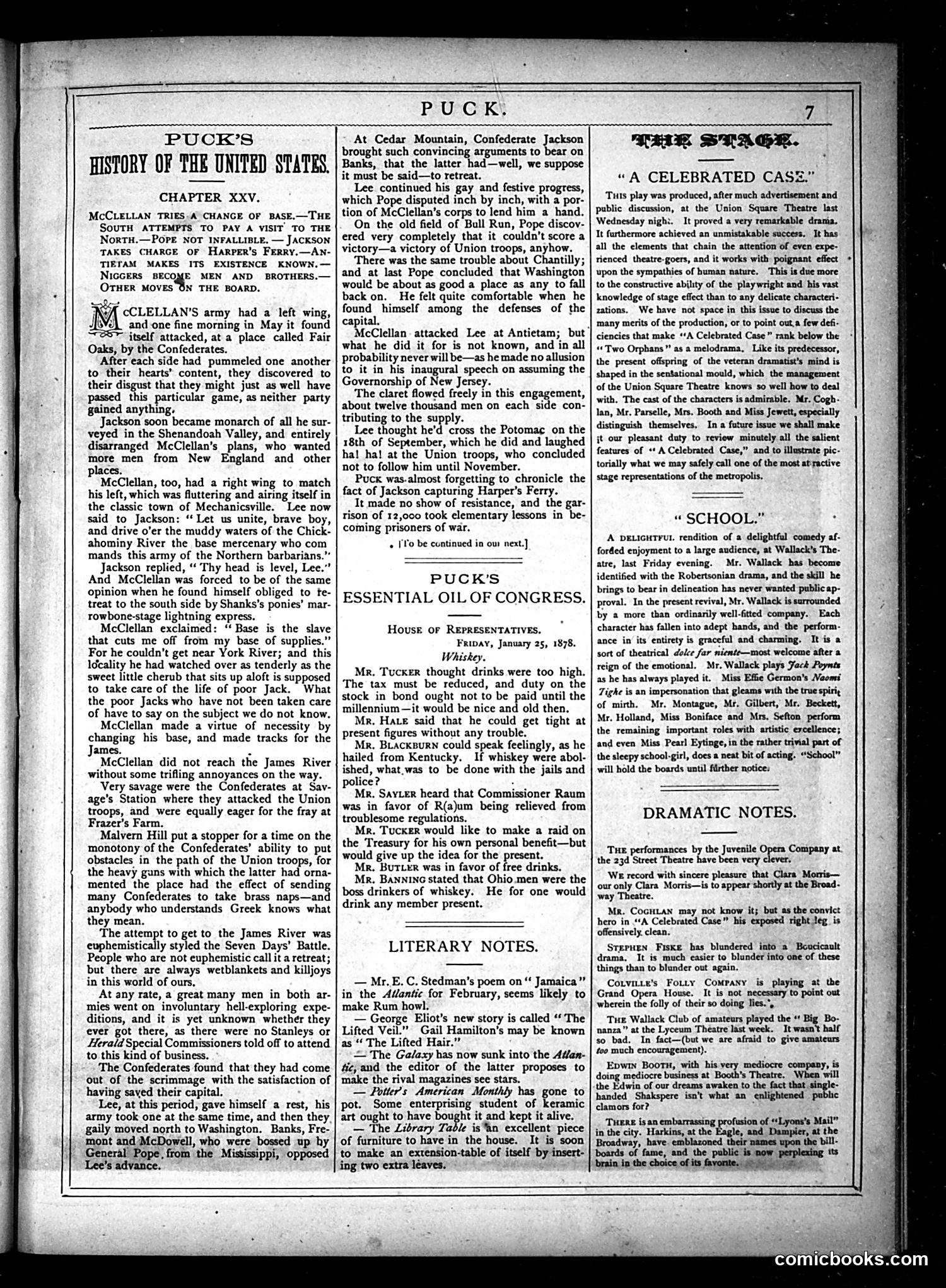
This page primarily contains text rather than cartoons. The main content is Chapter XXV of "Puck's History of the United States," which satirically recounts McClellan's Civil War military campaign and his political ambitions. The satire mocks General McClellan's cautious tactics, his failure to decisively engage Lee's forces, and his subsequent political aspirations. The page also includes "Puck's Essential Oil of Congress," satirizing contemporary Congressional debates about whiskey taxes and Treasury raids—typical 1870s political humor targeting ineffective legislation. Additionally, there are theatrical reviews under "Dramatic Notes," discussing stage productions and performances of the era. This is primarily a text-heavy page mixing historical satire with contemporary political commentary and entertainment reviews.
📄 Transcribed text from this page (OCR, searchable)
Machine-transcribed from the original scan — historical spelling and the odd misread are preserved.
PUCK. PUCK’S HISTORY OF THE UNITED STATES. CHAPTER XXV. MCCLELLAN TRIES.A CHANGE OF BASE.—THE SouTH ATTEMPTS TO PAY A VISIT TO THE NorTH.—PoPE NOT INFALLIBLE. — JACKSON TAKES CHARGE OF Harper's Ferry.—An- TIETAM MAKES ITS EXISTENCE KNOWN.— NIGGERS BECOME MEN AND BROTHERS.— Orner Moves ON THE BOARD. { CCLELLAN'S army had a left wing, and one fine morning in May it found itself attacked, at a place called Fair Outs, by the Confederates. After each side had pummeled one another to their hearts’ content, they discovered to their disgust that they might just as well have this particular game, as neither party gained anything, Jackson soon became monarch of all he sur- veyed in the Shenandoah Valley, and entirely disarranged McClellan’s plans, who wanted more men from New England and other places. McClellan, too, had a right wing to match his left, which was fluttering and airing itself in the classic town of Mechanicsville. Lee now said to Jackson: ‘‘ Let us unite, brave boy, and drive o'er the muddy waters of the Chick- ahominy River the base mercenary who com mands this army of the Northern barbarians.” Jackson replied, “ Thy head is level, Lee.” And McClellan was forced to be of the same opinion when he found himself obliged to te- treat to the south side by Shanks’s ponies’ mar- rowbone-stage lightning express. McClellan exclaimed: ‘“ Base is the slave that cuts me off from my base of supplies.” For he couldn’t get near York River; and this Idcality he had watched over as tenderly as the sweet little cherub that sits up aloft is supposed to take care of the life of poor Jack. What the poor Jacks who have not been taken care of have to say on the subject we do not know. McClellan made a virtue of necessity by changing his base, and made tracks for the James. . McClellan did not reach the James River without some trifling annoyances on the way. Very savage were the Confederates at Sav- age’s Station where they attacked the Union troops, and were equally eager for the fray at Frazer's Farm. Malvern Hill put a stopper for a time on the monotony of the Confederates’ ability to put obstacles in the path of the Union troops, for the heavy guns with which the latter had orna- mented the place had the effect of sending many Confederates to take brass naps—and anybody who understands Greek knows what they mean. The attempt to get to the James River was euphemistically styled the Seven Days’ Battle. People who are not euphemistic call it a retreat; but there are always wetblankets and killjoys in this world of ours. At any rate, a great many men in both ar- mies went on involuntary hell-exploring expe- ditions, and it is yet unknown whether they ever got there, as there were no Stanleys or Herald Special Commissioners told off to attend to this kind of business. The Confederates found that they had come out of the scrimmage with the satisfaction of having sayed their capital. Lee, at this period, gave himself a rest, his army took one at the same time, and then they. gaily moved north to Washington. Banks, Fre- mont and McDowell, who were bossed up hy Ceoetd Pope, from ‘the Mississippi, opposed ’s advance. At Cedar Mountain, Confederate Jackson brought such convincing arguments to on Banks, that the latter had—well, we suppose it must be said—to retreat. Lee continued his gay and festive progress, which Pope disputed inch by inch, with a por- tion of McClellan’s corps to lend him a hand. On the old field of Bull Run, Pope discov- ered very completely that it couldn't score a victory—a victory of Union troops, anyhow. There was the same trouble about Chantilly; and at last Pope concluded that Washington would be about as good a place as any to fall back on. He felt quite comfortable when he found himself among the defenses of the capital. McClellan. attacked Lee at Antietam; but | what he did it for is not known, and in all probability never will be—as he made no allusion to it in his inaugural speech on assuming the Governorship of New Jersey. ‘The claret flowed freely in this engagement, about twelve thousand men on each side con- tributing to the supply. Lee thought he’d cross the Potomac on the 18th of September, which he did and laughed hal ha! at the Union troops, who concluded not to follow him until November. Puck was.almost forgetting to chronicle the fact of Jackson capturing Harper's Ferry. It made no show of resistance, and the gar- rison of 12,000 took elementary lessons in be- coming prisoners of war. « [To be continued in ou: next.] PUCK’'S ESSENTIAL OIL OF CONGRESS. House or REPRESENTATIVES. Frivay, January 25, 1878. Whiskey. Mr. Tucker thought drinks were too high. The tax must be reduced, and duty on the stock in bond ought not to be paid until the millennium —it would be nice and old then, Mr. Hate said that he could get tight at present figures without any trouble. Mr. BLacksurn could speak feelingly, as he hailed from Kentucky. If whiskey were abol- vollee whee, was to be done with the jails and ice PMR, Sayer heard that Commissioner Raum was in favor of R(a)jum being relieved from troublesome regulations. Mr. Tucker would like to make a raid on the Treasury for his own personal benefit—but would give up the idea for the present. Mr. Butver was in favor of free drinks. Mr. Bannino stated that Ohio.men were the boss drinkers of whiskey. He for one would drink any member present. LITERARY NOTES. — Mr. E. C. Stedman's poem on “ Jamaica” in the AWantic for February, seems likely to make Rum howl. — George Eliot's new story is called “The Lifted Veil.” Gail Hamilton’s may be known as “‘ The Lifted Hair.” = The Ga/axy has now sunk into the Adan- ic, and the editor of the latter proposes to make the rival magazines see stars. — Potters American Monthly has gone to pot. Some enterprising student of keramic art ought to have bought it and kept it alive. — The Library Table is"an excellent piece of furniture to have in the house. It is soon to make an extension-table of itself by insert- ing two extra léaves. TRIR STAGR. “A CELEBRATED CASS.” Tuts play was produced, after much advertisement and public discussion, at the Union Square Theatre last Wednesday nigh:. It proved a very remarkable drama. It furthermore achieved an unmistakable success. It has all the elements that chain the attention of even expe- rienced theatre-goers, and it works with poignant effect * upon the sympathies of human nature. This is due more to the constructive abjlity of the playwright and his vast knowledge of stage effect than to any delicate characteri- zations. We have not space in this issue to discuss the many merits of the production, or to point outa few defi- ciencies that make ““A Celebrated Case” rank below the “Two Orphans” as a melodrama. Like its predecessor, the present offspring of the veteran dramatist’s mind is shaped in the senfational mould, which the management of the Union Square Theatre knows so well how to deal with, The cast of the characters is admirable, Mr. Cogh- lan, Mr. Parselle, Mrs, Booth and Miss Jewett, especially distinguish themselves, In a future issue we shall make it our pleasant duty to review minutely all the salient features of “A Celebrated Case,” and to illustrate pic- torially what we may safely call one of the most at ractive stage representations of the metropolis, “ SCHOOL.” : A DELIGHTFUL. rendition of a delightful comedy af- forded enjoyment to a large audience, at Wallack’s The- atre, last Friday evening. Mr. Wallack has become identified with the Robertsonian drama, and the skill he brings to bear in delineation has never wanted publicap- proval. In the present revival, Mr. Wallack is surrounded by a more than ordinarily well-fitted company. Each character has fallen into adept hands, and the perform- ance in its entirety is graceful and charming. It is a sort of theatrical dolce far niente—most welcome after a reign of the emotional. Mr. Wallack plays Yack Poynts as he has always played it. Miss Effie Germon's Naomi Tighe is an impersonation that gleams with the true spirig of mirth. Mr. Montague, Mr. Gilbert, Mr. Beckett, Mr. Holland, Miss Boniface and Mrs. Sefton perform the remaining important roles with artistic excellence; and even Miss Pearl Eytinge, in the rather trivial part of the sleepy school-girl, does a neat bit of acting. “School” will hold the boards until filrther notice: DRAMATIC NOTES. ‘Tux performances by the Juvenile Conipany at. the 23d Street Theatre have been peal Re We record with sincere pleasure that Clara Morris— our only Clara Morris—is to appear shortly at the Broad- way Theatre. Mr. CocHLAN may not know it; but as the convict hero in "A Celebrated Case™ his exposed rightseg. is offensively clean. Sreruen Fiske has blundered into a’ Boucicault drama, It is much easier to blunder into one of these things than to blunder out again. Couviie’s FoLty ComPaxy is playing at the Grand Opera House. It is not necessary to point out wherein the folly of their so doing lies.", Tue Wallack Club of amateurs played the “* Big Bo- nanza” at the Lyceum Theatre last week. It wasnt half so bad. In fact—(but we are afraid to give amateurs foo much encouragement). Epwin Boot, with his very mediocre company, is doing mediocre business at "s Theatre. | When will the Edwin of our dreams awaken to the fact that handed Shakspere isn't what an pelea clamors for? ‘Ture isan embarrassing. in the city. Harkins, at the’ Broadway, have. emblazoned their boards of fame, and the public is now Santa ts brain in the choice of its favonte.. 5 ey fusion of +] Mail”