
Puck, 1878-01-30 · page 4 of 16
Puck — January 30, 1878 — page 4: what you’re looking at
What you’re looking at
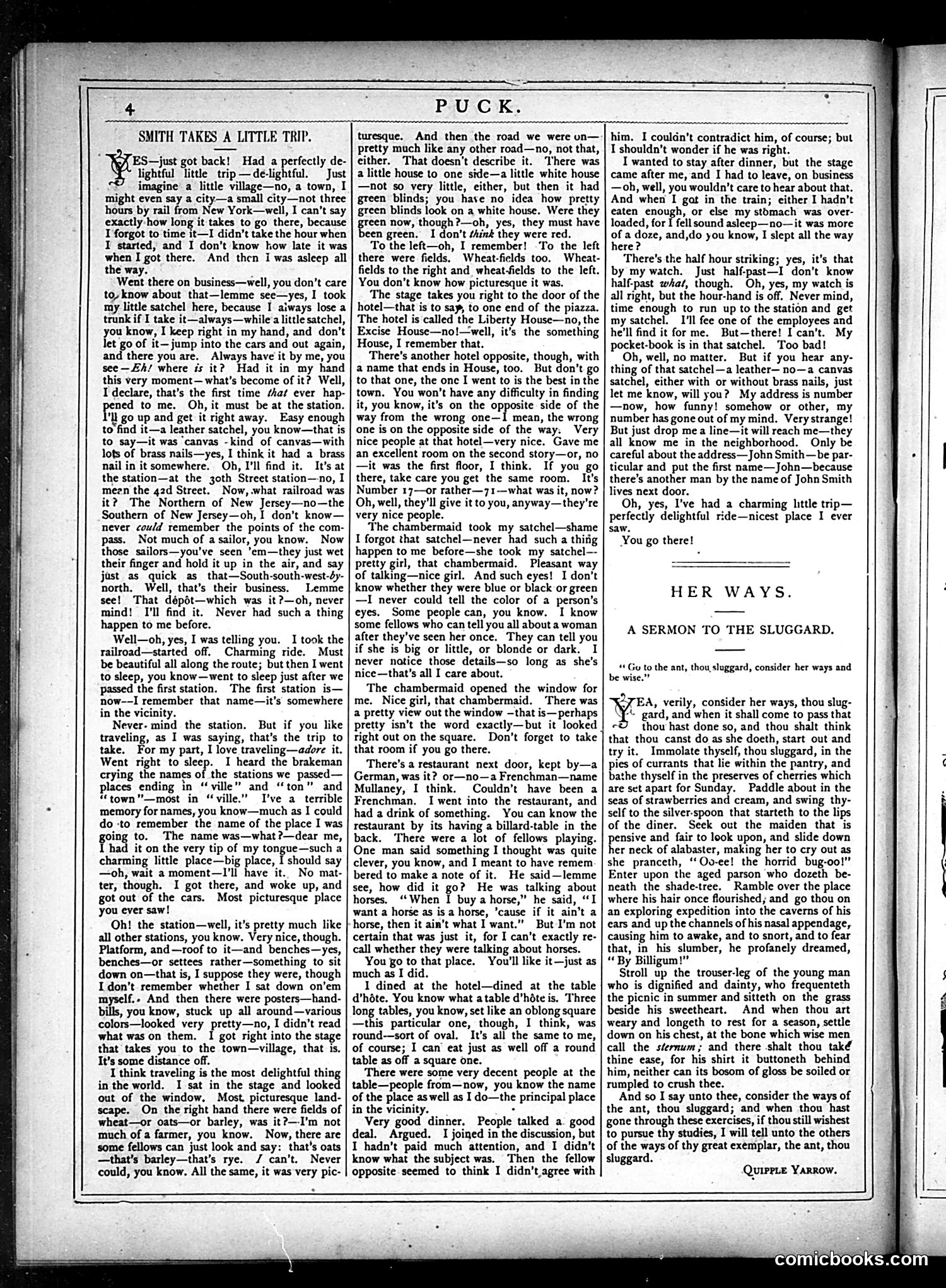
This page contains two distinct pieces: **"Smith Takes a Little Trip"** (left column): A humorous first-person account of a rail journey through New Jersey and the Northeast. The narrator describes mundane observations—wheat fields, small towns, hotels—in tedious detail, poking fun at travelers who bore others with trivial travel stories. The satire targets people who mistake ordinary experiences for exciting adventures. **"Her Ways: A Sermon to the Sluggard"** (right column): A moralistic piece addressing lazy people, using biblical language ("Go to the ant, thou sluggard"). It advocates industry and self-discipline, warning against idleness. This reflects period-typical Puck commentary on social virtue and work ethic, likely directed at readers perceived as unmotivated or frivolous. Both pieces employ humor to critique human behavior and social attitudes of their era.
📄 Transcribed text from this page (OCR, searchable)
Machine-transcribed from the original scan — historical spelling and the odd misread are preserved.
PUCK. SMITH TAKES A LITTLE TRIP. ES—just got back! Had a perfectly de- lightful little trip—de-lightful. Just *’ imagine a little village—no, a town, I might even say a city—a small city—not three hours by rail from New York—well, I can’t say exactly:-how long it takes to go there, because I forgot to time it—I didn’t take the hour when I started, and I don’t know how late it was when I got there. And then I was asleep all the way. Went there on business—well, you don’t care to, know about that—lemme see—yes, I took my little satchel here, because I aiways lose a trunk if I take it—always—while’a little satchel, you know, I keep right in my hand, and don't let go of it—jump into the cars and out again, and there you are. Always have it by me, you see —Zh/ where és it? Had it in my hand this very moment— what's become of it? Well, I declare, that’s the first time ‘haf ever hap- ned to me. Oh, it must be at the station. "It go up and get it right away. Easy enough to‘find it—a leather satchel, you know—that is to say—it was ‘canvas -kind of canvas—with lots of brass nails—yes, I think it had a brass nail in it somewhere. Oh, I’ll find it. It’s at the station—at the goth Street station—no, I meen the 42d Street. Now, what railroad was it? The Northern of New Jersey—no—the Southern of New Jersey—oh, I don’t know— never could remember the points of the com- pass. Not much of asailor, you know. Now those sailors—you've seen 'em—they just wet their finger and hold it up in the air, and say jast as quick as that—South-south-west-dy- north. Well, that’s their business. Lemme see! That dépét—which was it ?—oh, never mind! I'll find it. Never had such a thing happen to me before. Well—oh, yes, I was telling you. I took the railroad—started off. Charming ride. Must be beautiful all along the route; but then I went to sleep, you know—went to sleep just after we passed the first station. The first station is— now--I remember that name—it’s somewhere in the vicinity. Never- mind the station, But if you like traveling, as I was saying, that’s the trip to take. For my part, I love traveling—adore it. Went right to sleep. I heard the brakeman erying the names of the stations we passed— places ending in “ville” and “ton” and “town”—most in “ville.” I’ve a terrible memory for names, you know—much as I could do -to remember the name of the place I was soing to. The name was—what?—dear me, fad it on the very tip of my tongue—such a should say —oh, wait a moment—I'll have it.. No mat- ter, though. I got there, and woke up, and got out of the cars. Most picturesque place you ever saw! Oh! the station—well, it’s pretty much like all other stations, you know. Very nice, though. Platform, and—roof to it—and benches—yes, benches—or settees rather—something to sit down on—that is, I suppose they were, though I don’t remember whether I sat down on’em myself,. And then there were posters—hand- bills, you know, stuck up all around—various colors—looked very pretty—no, I didn’t read what was on them. I got right into the stage that takes you to the town—village, that is. It’s some distance off. I think traveling is the most delightful fing in the world. I sat in the stage and looke out of the window. Most, picturesque land- scape. On the right hand there were fields of wheat—or oats—or barley, was it?—-I'm not much of a farmer, you know. Now, there are some fellows can just look and say: that's oats —that’s barley—that’s rye. / can’t. Never could, you know. All the same, it was very pic- charming little place—big pect turesque. And then the road we were un— pretty much like any other road—no, not that, cither. That doesn’t describe it. There was a little house to one side—a little white house —not so very little, either, but then it had green blinds; you hase no idea how pretty green blinds look on a white house. Were they een now, though?—oh, yes, they must have een green. I don’t ¢hink they were red. To the left—oh, I remember! To the left there were fields. Wheat-fields too. Wheat- fields to the right and wheat-fields to the left. You don’t know how picturesque it was. The stage takes you right to the door of the hotel—that is to say, to one end of the piazza. The hotel is called the Liberty House—no, the Excise House—no!—well, it’s the something House, I remember that. There's another hotel opposite, though, with a name that ends in House, too. But don’t go to that one, the one I went to is the best in the town. You won't have any difficulty in finding it, you know, it’s on the opposite side of the way from the wrong one—I mean, the wrong one is on the opposite side of the way. Very nice people at that hotel—very nice. Gave me an excellent room on the second story—or, no —it was the first floor, I think. If you go there, take care you get the same room. It's Number 17—or rather—71—Wwhat was it, now? Oh, well, they'll give it to you, anyway—they’re very nice people. ‘The chambermaid took my satchel—shame I forgot that satchel—never had such a thing happen to me before—she took my satchel—- pretty girl, that chambermaid. Pleasant way of talking—nice girl. And such eyes! I don’t know whether they were blue or black or green —I never could tell the color of a person’s eyes. Some people can, you know. I know some fellows who can tell you all about a woman after they've seen her once. They can tell you if she is big or little, or blonde or dark. I never natice those details—so long as she’s nice—that’s all I care about. The chambermaid opened the window for me. Nice girl, that chambermaid. There was a pretty view out the window —that is—perhaps pretty isn’t the word exactly—but it looked tight out on the square. Don’t forget to take that room if you go there. There’s a restaurant next door, kept by—a German, was it? or—no—a Frenchman—name Mullaney, I think, Couldn’t have been a Frenchman. I went into the restaurant, and had a drink of something. You can know the restaurant by its having a billard-table in the back. There were a lot of fellows playing. One man said something I thought was quite clever, you know, and I meant to have remem bered to make a note of it. He said—lemme see, how did it go? He was talking about horses. ‘When I buy a horse,” he said, “I want a horse as is a horse, ‘cause if it ain’t a horse, then it ain't what I want.” But I’m not certain that was just it, for I can’t exactly re- call whether they were talking about horses. You go to that place. You'll like it—just as much as I did. I dined at the hotel—dined at the table d’héte. You know what atable d’hdte is. Three long tables, you know, set like an oblong square —this particular one, though, I think, was round—sort of oval. It’s all the same to me, of course; I can eat just as well off a round table as off a square one. There were some very decent people at the table—people from—now, you know the name of the place aswell as I do—the principal place in the vicinity. . Very good dinner. People talked a. good deal. “Argued. I joined in the discussion, but I hadn’t paid much attention, and I didn’t know what the subject was. Then the fellow opposite seemed to think I didn’t agree with him. I couldn't contradict him, of course; but T shouldn’t wonder if he was right. I wanted to stay after dinner, but the stage came after me, and I had to leave, on business —ohb, well, you wouldn’t care to hear about that. And when I got in the train; either I hadn't eaten Wage or else my stomach was over- loaded, for I fell sound asleep—no—it was more of a doze, and,do you know, I slept all the way here? ‘There's the half hour striking; yes, it’s that by my watch. Just half-past—I don’t know half-past what, though. Oh, yes, my watch is all right, but the hour-hand is off. Never mind, time enough to run up to the station and get my satchel. I'll fee one of the employees and he'll find it for me. But—there! I can’t. My pocket-book is in that satchel. Too bad! Oh, well, no matter. But if you hear any- thing of that satchel—a leather— no—a canvas satchel, either with or without brass nails, just let me know, will you? My address is number —now, how funny! somehow or other, my number has gone out of my mind. Very strange! But just drop mea line—it will reach me—they all know me in the neighborhood. Only be careful about the address—John Smith—be par- ticular and put the first name—John—because there’s another man by the name of John Smith lives next door. Oh, yes, I've had a charming little trip— perfectly delightful ride—nicest place I ever saw. You go there! HER WAYS. A SERMON TO THE SLUGGARD. «Go to the ant, thou sluggard, consider her ways and be wise.” gard, and when it shall come to pass that ie thou hast done so, and thou shalt think that thou canst do as she doeth, start out and try it. Immolate thyself, thou sluggard, in the pies of currants that lie within the pantry, and bathe thyself in the preserves of cherries which are set apart for Sunday. Paddle about in the seas of strawberries and cream, and swing thy- self to the silver-spoon that starteth to the lips of the diner. Seek out the maiden that is ensive and fair to look upon, and slide down her neck of alabaster, making her to cry out as she pranceth, ‘*Oo-ee! the horrid bug-oo!” Enter upon the aged parson who dozeth be- neath the shade-tree. Ramble over the place where his hair once flourished; and go thou on an exploring expedition into the caverns of his ears and up the channels of his nasal appendage, causing him to awake, and to snort, and to fear that, in his slumber, he profanely dreamed, “By Billigum!” Stroll up the trouser-leg of the young man who is dignified and dainty, who frequenteth the picnic in summer and sitteth on the grass beside his sweetheart. And when thou art weary and longeth to rest for a season, settle down on his chest, at the bone which wise men call the sfernum; and there shalt thou také thine ease, for his shirt it buttoneth behind him, neither can its bosom of gloss be soiled or rumpled to crush thee. And so I say unto thee, consider the ways of the ant, thou sluggard; and when thou hast gone through these exercises, if thou still wishest to pursue thy studies, I will tell unto the others of the ways of thy great exemplar, the ant, thou sluggard. ‘A, verily, consider her ways, thou slug- QuiprLe YARROW.