
Puck, 1878-01-30 · page 3 of 16
Puck — January 30, 1878 — page 3: what you’re looking at
What you’re looking at
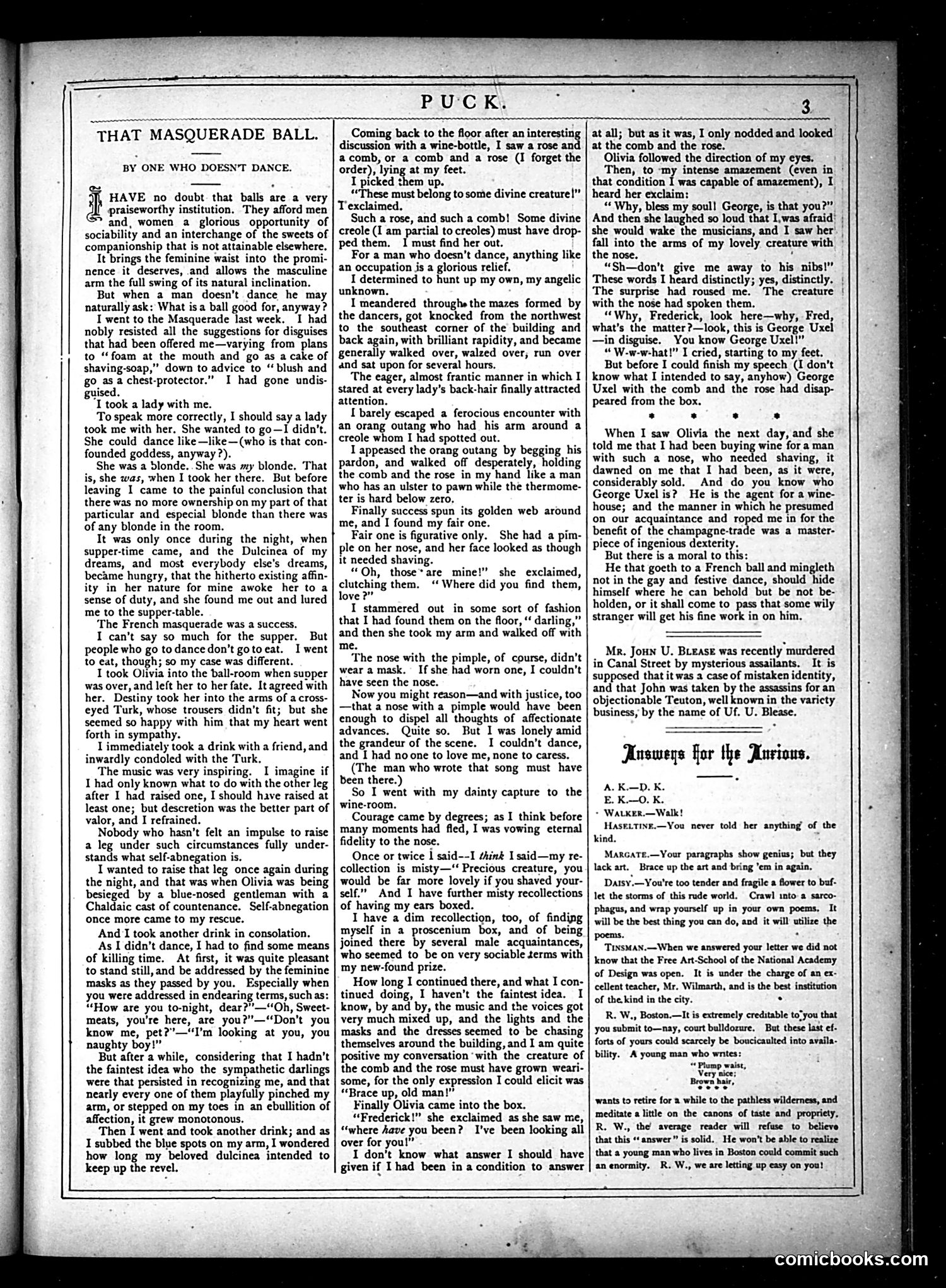
This page contains a humorous essay titled "That Masquerade Ball" by someone claiming not to dance, describing social chaos at a fancy ball event. The narrator recounts awkward encounters: dancing with a blonde woman, an encounter with an "orange outang" (a racist caricature of a Black man) who grabbed a woman, finding lost items on the floor, and general social mishaps involving the "creature" and various attendees. The essay reflects late 19th-century racist attitudes through its dehumanizing language and caricature. The "Answer for the Curious" advice column at right addresses miscellaneous reader questions about etiquette and personal matters. **No specific political figures or dated events appear identifiable in this text alone.** The content primarily reflects period social attitudes and convention-breaking behavior at formal events.
📄 Transcribed text from this page (OCR, searchable)
Machine-transcribed from the original scan — historical spelling and the odd misread are preserved.
PUCK. THAT “MASQUERADE BALL. HAVE no doubt that balls are a very d praiseworthy institution. They afford men and, women a glorious opportunity of sociability and an interchange of the sweets of companionship that is not attainable elsewhere. It brings the feminine waist into the promi- nence it deserves, and allows the masculine arm the full swing of its natural inclination. But when a man doesn’t dance he may naturally ask: What is a ball good for, anyway ? I went to the Masquerade last week. I had nobly resisted all the suggestions for disguises that had been offered me—varying from plans to ‘foam at the mouth and go as a cake of shaving-soap,” down to advice to “blush and go as achest-protector.” I had gone undis- guised. ‘I took a lady with me. To speak more correctly, I should say a lady took me with her. She wanted to go—I didn't. She could dance like—like—(who is that con- founded goddess, anyway ?). She was a dlonde..She was my blonde. That is, she was, when I took her there. But before leaving I came to the painful conclusion that there was no more ownership on my part of that particular and especial blonde than there was of any blonde in the room. It was only once during the night, when supper-time came, and the Dulcinea of my dreams, and most everybody else’s dreams, became hungry, that the hitherto existing affin- ity in her nature for mine awoke her to a sense of duty, and she found me out and lured me to the supper-table. ‘The French masquerade was a success. I can’t say so much for the supper. But people who go todancedon’t gotoecat. I went to eat, though; so my case was different. I took Olivia into the ball-room when supper was over, and left her to her fate. It agreed with her. Destiny took her into the arms of a cross- eyed Turk, whose trousers didn’t fit; but she seemed so happy with him that my heart went forth in sympathy. 1 immediately took a drink with a friend, and inwardly condoled with the Turk. ‘The music was very inspiring. I imagine if I had only known what to do with the other leg after I had raised one, I should have raised at least one; but descretion was the better part of valor, and I refrained. Nobody who hasn’t felt an impulse to raise a leg under such circumstances fully under- stands what self-abnegation is. I wanted to raise that leg once again during the night, and that was when Olivia was being besieged by a blue-nosed gentleman with a Chaldaic cast of countenance. Self-abnegation once more came to my rescue. And ‘I took another drink in consolation. As I didn’t dance, I had to find some means of killing time. At first, it was quite pleasant to stand still, and be addressed by the feminine masks as they passed by you. Especially when you were addressed in endearing terms, such as: “How are you to-night, dear?”’—“Oh, Sweet- meats, you're here, are you?”—“Don't you know me, pet?”—“I’m looking at you, you naughty boy!” But after a while, considering that I hadn’t the faintest idea who the sympathetic darlings were that persisted in recognizing me, and that nearly every one of them playfully pinched my arm, or stepped on my toes in an ebullition of affection, it grew monotonous. Then I went and took another drink; and as I subbed the blue spots on my arm, I wondered how long my beloved dulcinea intended to keep up the revel. BY ONE WHO DOESN’T DANCE. Coming back to the floor after an interestin, discussion with a wine-bottle, I saw a rose an acomb, or a comb and a rose (I forget the order), “lyin, at my feet. I picked them up. “These must belong to some divine creature!” Texclaimed. Such a rose, and such a comb! Some divine creole (I am partial to creoles) must have drop- ped them. 1 must find her out. For a man who doesn’t dance, anything like an occupation is a glorious relief, I determined to hunt up my own, my angelic unknown. I meandered throughs the mazes formed by the dancers, got knocked from the northwest to the southeast corner of the building and back again, with brilliant rapidity, and became generally walked over, walzed over; run over and sat upon for several hours. ‘The eager, almost frantic manner in which I stared at every lady’s back-hair finally attracted attention. I barely escaped a ferocious encounter with an orang outang who had his arm around a creole whom I had spotted out. I appeased the orang outang by begging his pardon, and walked off desperately, holding the comb and the rose in my hand like a man who has an ulster to pawn while the thermome- ter is hard below zero, Finally success spun its golden web around me, and I found my fair one. Fair one is figurative only. She had a pim- ple on her nose, and her face looked as though it needed shaving. “Oh, those*are mine!” she exclaimed, clutching them. ‘ Where did you find them, love ?” I stammered out in some sort of fashion that I had found them on the floor, ‘‘ darling,” and then she took my arm and walked off with me. ‘The nose with the pimple, of course, didn’t wear a mask. If she had worn one, I couldn't have seen the nose. Now you might reason—and with justice, too —that a nose with a pimple would have been enough to dispel all thoughts of affectionate advances. Quite so. But I was lonely amid the grandeur of the scene. I couldn’t dance, and I had noone to love me, none to caress. (The man who wrote that song must have been there.) So I went with my dainty capture to the wine-room. Courage came by degrees; as I think before many moments had fled, I was vowing eternal fidelity to the nose. Once or twice 1 said--I ¢hink I said—my re- collection is misty—‘‘ Precious creature, you would be far more lovely if you shaved your- self.” And I have further misty recollections of having my ears boxed. I have a dim recollection, too, of finding myself in a proscenium box, and of being joined there by several male acquaintances, who seemed to be on very sociable terms with my new-found prize. How long I continued there, and what I con- tinued doing, I haven’t the faintest idea. I know, by and by, the music and the voices got very much mixed up, and the lights and the masks and the dresses seemed to be chasing themselves around the building, and I am quite positive my conversation ‘with the creature of the comb and the rose must have grown weari- some, for the only expression I could elicit was “Brace up, old man!” Finally Olivia came into the box. “Frederick!” she exclaimed as she saw me, “where have you been? I've been looking all over for you!” I don’t know what answer I should have given if had been in a condition to answer at all; but as it was, I only nodded and looked at the comb and the rose. Olivia followed the direction of my eyes. Then, to my intense amazement (even in © that condition I was capable of amazement), I heard her exclaim: “‘ Why, bless my soul! George, is that you?” And then she laughed so loud that I,was afraid’ ; she would wake the musicians, and I saw her’ | fall into the arms of my lovely. creature with the nose. “Sh—don't give me away to his nibs!” These words I heard distinctly; yes, distinctly. The surprise had roused me. The creature with the nose had spoken them. “Why, Frederick, look here—why, Fred, what's the matter?—look, this is George Uxel —in disguise. You know George Uxell” “ W-w-w-hat!” I cried, starting to my feet. But before I could finish my speech (I don’t know what I intended to say, anyhow) ee Uxel with the comb and the rose had disap- peared from the box. . . . * When I saw Olivia the next day, and she told me that I had been buying wine for a man with such a nose, who needed shaving, it dawned on me that I had been, as it were, considerably sold. And do you know who George Uxel is? He is the agent for a wine- house; and the manner in which he presumed on our acquaintance and roped me in for the benefit of the champagne-trade was a master- piece of ingenious dexterity. But there is a moral to this: He that goeth to a French ball and mingleth not in the gay and festive dance, should hide himself where he can behold but be not be- holden, or it shall come to pass that some wily stranger will get his fine work in on him. Mr. Joun U. BLeasE was recently murdered in Canal Street by mysterious assailants. It is supposed that it was a case of mistaken identity, and that John was taken by the assassins for an objectionable Teuton, well known in the varicty business, by the name of Uf. U. Blease. Answers for the Anvions. A. K.—D. K. Walk! You never told her anything of the Maxcate.—Your paragraphs show genius; but they lack art. Brace up the art and bring ’em in again, Daisy.—You're too tender and fragile a flower to buf- let the storms of this rude world. Crawl into: sarco- phagus, and wrap yourself up in your own poems, It will be the best thing you can do, and it will utilize the poems. : TINSMAN.—When we answered your letter we did not know that the Free Art-School of the National Academy of Design was open. It is under the charge of an ex- cellent teacher, Mr. Wilmarth, and is the best institution of the.kind in the city. . R. W,, Boston.—It is extremely creditable toyou that you submit to—nay, court bulldozure. But these last ef- forts of yours could scarcely be boucicaulted into availa- bility. A young man who wnt + Plump wi wants to retire for a while to the pathless wilderness, and meditate a little on the canons of taste and propriety. R. W., the average reader will refuse to believe that this ““ answer” is solid. He won't be able to realize that a young man who lives in Boston could commit such an enormity. R. W., we are letting up easy on you!