
Puck, 1878-01-30 · page 2 of 16
Puck — January 30, 1878 — page 2: what you’re looking at
What you’re looking at
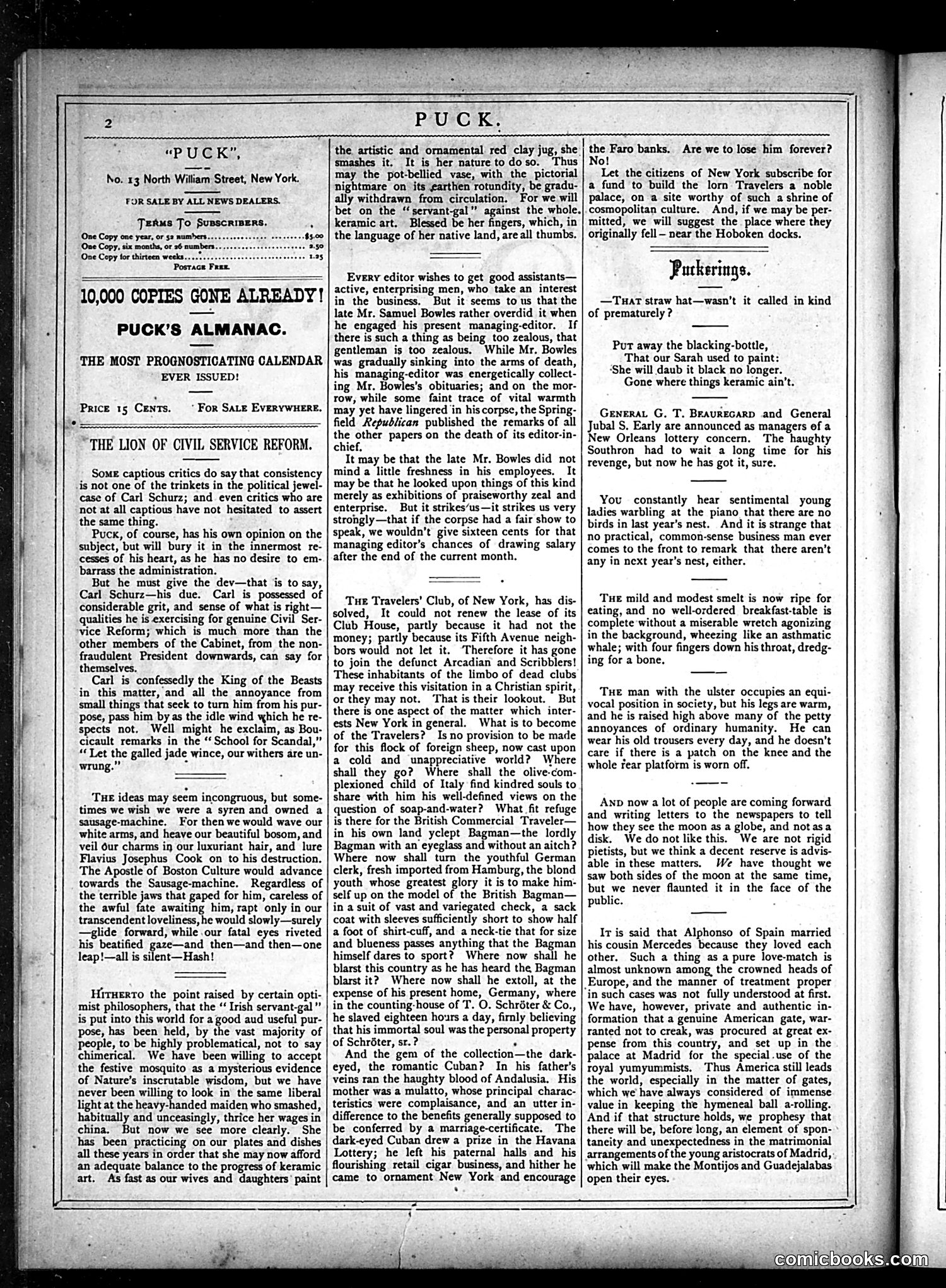
This page is primarily **editorial commentary and advertising** rather than cartoon content. The main article, "The Lion of Civil Service Reform," discusses **Carl Schurz**, a prominent political figure whom Puck accuses of inconsistency. The text sarcastically compares Schurz to various animals and criticizes his approach to civil service reform—suggesting he's all bluster without substance. Additional brief satirical pieces mock various targets: Samuel Bowles (editor), the Travelers' Club of New York, and references to sentimental young ladies at pianos. A final piece humorously discusses **Alphonso of Spain** marrying his cousin, satirizing European aristocratic marriage customs as bizarre compared to American practices. The page reflects Puck's characteristic style of political criticism mixed with social satire.
📄 Transcribed text from this page (OCR, searchable)
Machine-transcribed from the original scan — historical spelling and the odd misread are preserved.
PUCK. “PUCK”, ho. 13 North Wiliam Street, New York. FOR SALE BY ALL NEWS DEALERS. Tzhus To SunscrieR: ‘One Copy one year, or 52 numbers ‘One Copy, six months, (One Copy for thirteen weeks, ARE. 10,000 COPIES GONE ALREADY! PUCK’S ALMANAC. THE MOST PROGNOSTICATING CALENDAR EVER ISSUED! PrIce 15 Cents. * For Sate Evervwuerr. “THE LION OF CIVIL SERVICE REFORM. Some captious critics do say that consistency is not one of the trinkets in the political jewel- case of Carl Schurz; and even critics who are not at all captious have not hesitated to assert the same thing. Puck, of course, has his own opinion on the subject, but will bury it in the innermost re- cesses of his heart, as he has no desire to em- barrass the administration. But he must give the dev—that is to say, Carl Schurz—his due. Carl is of considerable grit, and sense of what is right— qualities he is exercising for genuine Civil Ser- vice Reform; which is much more than the other members of the Cabinet, from the non- fraudulent President downwards, can say for themselves. Carl is confessedly the King of the Beasts in this matter, and all the annoyance from small things that seek to turn him from his pur- pose, pass him by as the idle wind which he re- spects not, Well might he exclaim, as Bou- cicault remarks in the ‘School for Scandal,” “Let the galled jade wince, our withers are un- wrung.” z ‘Tue ideas may seem incongruous, but some- times we wish we were a syren and owned a sausage-machine. For then we would wave our white arms, and heave our beautiful bosom, and veil Our charms in our luxuriant hair, and lure Flavius Josephus Cook on to his destruction. The Apostle of Boston Culture would advance towards the Sausage-machine. Regardless of the terrible jaws that gaped for him, careless of the awful fate awaiting him, rapt only in our transcendent loveliness, he would slowly—surely lide forward, while our fatal eyes riveted his beatified gaze—and then—and then—one leap!—all is silent—Hash! Hirnerto the point raised by certain opti- mist philosophers, that the “ Irish servant-gal"” is put into this world for a good aud useful pur- pose, has been held, by the vast majority of people, to be highly problematical, not to say chimerical. We have been willing to accept the festive mosquito as a mysterious evidence of Nature’s inscrutable wisdom, but we have never been willing to look in the same liberal light at the heavy-handed maiden who smashed, habitually and unceasingly, thrice her wages in china. But now we see more clearly. She has been practicing on our plates and dishes all these years in order that she may now afford an adequate balance to the progress of keramic art. As fast as our wives and daughters’ paint the artistic and ornamental red clay jug, she smashes it. It is her nature todoso. Thus may the pot-bellied vase, with the pictorial nightmare on its earthen rotundity, be gradu- ally withdrawn from circulation. For we will bet on the ‘servant-gal’’ against the whole. keramic art. Blessed be her fingers, which, in the language of her native land, are all thumbs. Every editor wishes to get good assistants— active, enterprising men, who take an interest in the business. But it seems to us that the late Mr. Samuel Bowles rather overdid it when he engaged his present managing-editor. If there is such a thing as being too zealous, that gentleman is too zealous. While Mr. Bowles was gradually sinking into the arms of death, his managing-editor was energetically collect- ing Mr. Bowles's obituaries; and on the mor- row, while some faint trace of vital warmth may yet have lingered in his corpse, the Spring- field Republican published the remarks of all the other papers on the death of its editor-in- chief, It may be that the late Mr. Bowles did not mind a little freshness in his employees. It may be that he looked upon things of this kind merely as exhibitions of praiseworthy zeal and enterprise. But it strikes’us—it strikes us very strongly—that if the corpse had a fair show to speak, we wouldn't give sixteen cents for that managing editor’s chances of drawing salary after the end of the current month, Tue Travelers’ Club, of New York, has dis- solved, It could not renew the lease of its Club House, partly because it had not the money; partly because its Fifth Avenue neigh- bors would not let it. Therefore it has gone to join the defunct Arcadian and Scribblers! These inhabitants of the limbo of dead clubs may receive this visitation in a Christian spirit, or they may not. That is their lookout. But there is one aspect of the matter which inter- ests New York in general. What is to become of the Travelers? Is no provision to be made for this flock of foreign sheep, now cast upon a cold and unappreciative world? Where shall they go? Where shall the olive-com- plexioned child of Italy find kindred souls to share with him his well-defined views on the question of soap-and-water? What fit refuge is there for the British Commercial Traveler— in his own land yclept Bagman—the lordly Bagman with an eyeglass and without an aitch? Where now shall turn the youthful German clerk, fresh imported from Hamburg, the blond youth whose greatest glory it is to make him- self up on the model of the British Bagman— in a suit of vast and variegated check, a sack coat with sleeves sufficiently short to show half a foot of shirt-cuff, and a neck-tie that for size and blueness passes anything that the Bagman himself dares to sport? Where now shall he blarst this country as he has heard the Bagman Dlarst it? Where now shall he extoll, at the expense of his present home, Germany, where in the counting-house of T. O. Schréter & Co., he slaved eighteen hours a day, firnly believing that his immortal soul was the personal property of Schrdter, sr.? . And the gem of the collection—the dark- eyed, the romantic Cuban? In his father’s veins ran the haughty blood of Andalusia. His mother was a mulatto, whose principal charac- teristics were complaisance, and an utter in- difference to the benefits generally supposed to be conferred by a marriage-certificate. The dark-eyed Cuban drew a prize in the Havana Lottery; he left his paternal halls and his flourishing retail cigar business, and hither he came to ornament New York and encourage | the Faro banks. Are we to lose him forever? jo! Let the citizens of New York subscribe for a fund to build the lorn Travelers a noble palace, on a site worthy of such a shrine of cosmopolitan culture. And, if we may be per- mitted, we will suggest the place where they originally fell— near the Hoboken docks. Parkerings. f —Tuat straw hat—wasn’t it called in kind of prematurely ? Pur away the blacking-bottle, ‘That our Sarah used to paint: ‘She will daub it black no longer. Gone where things keramic ain't. Generat G. T. Braurecarp and General Jubal S. Early are announced as managers ef a New Orleans lottery concern. The haughty Southron had to wait a long time for his revenge, but now he has got it, sure. You constantly hear sentimental young ladies warbling at the piano that there are no birds in last year’s nest. And it is strange that no practical, common-sense business man ever comes to the front to remark that there aren't any in next year’s nest, either. Tue mild and modest smelt is now ripe for eating, and no well-ordered breakfast-table is complete without a miserable wretch agonizing in the background, wheezing like an asthmatic whale; with four fingers down his throat, dredg- ing for a bone. ‘Tue man with the ulster occupies an equi- vocal position in society, but his legs are warm, and he is raised high above many of the petty annoyances of ordinary humanity. He can wear his old trousers every day, and he doesn't care if there is a patch on the knee and the whole fear platform is worn off. Ap now a lot of people are coming forward and writing letters to the newspapers to tell how they see the moon as a globe, and not asa disk. We do not like this. We are not rigid pietists, but we think a decent reserve is advis- able in these matters, We have thought we saw both sides of the moon at the same time, but we never flaunted it in the face of the public. In is said that Alphonso of Spain married his cousin Mercedes because they loved each other, Such a thing as a pure love-match is almost unknown among the crowned heads of Europe, and the manner of treatment proper in such cases was not fully understood at first. We have, however, private and authentic in- formation that a genuine American gate, war- ranted not to creak, was procured at great ex- pense from this country, and set up in the palace at Madrid for the special.use of the royal yumyummists. Thus America still leads the world, especially in the matter of gates, which we have always considered of immense value in keeping the hymeneal ball a-rolling. And if that structure holds, we prophesy that there will be, before long, an element of spon- taneity and unexpectedness in the matrimonial arrangements of the young aristocrats of Madrid, which will make the Montijos and Guadejalabas open their eyes.