
Puck, 1878-01-30 · page 6 of 16
Puck — January 30, 1878 — page 6: what you’re looking at
What you’re looking at
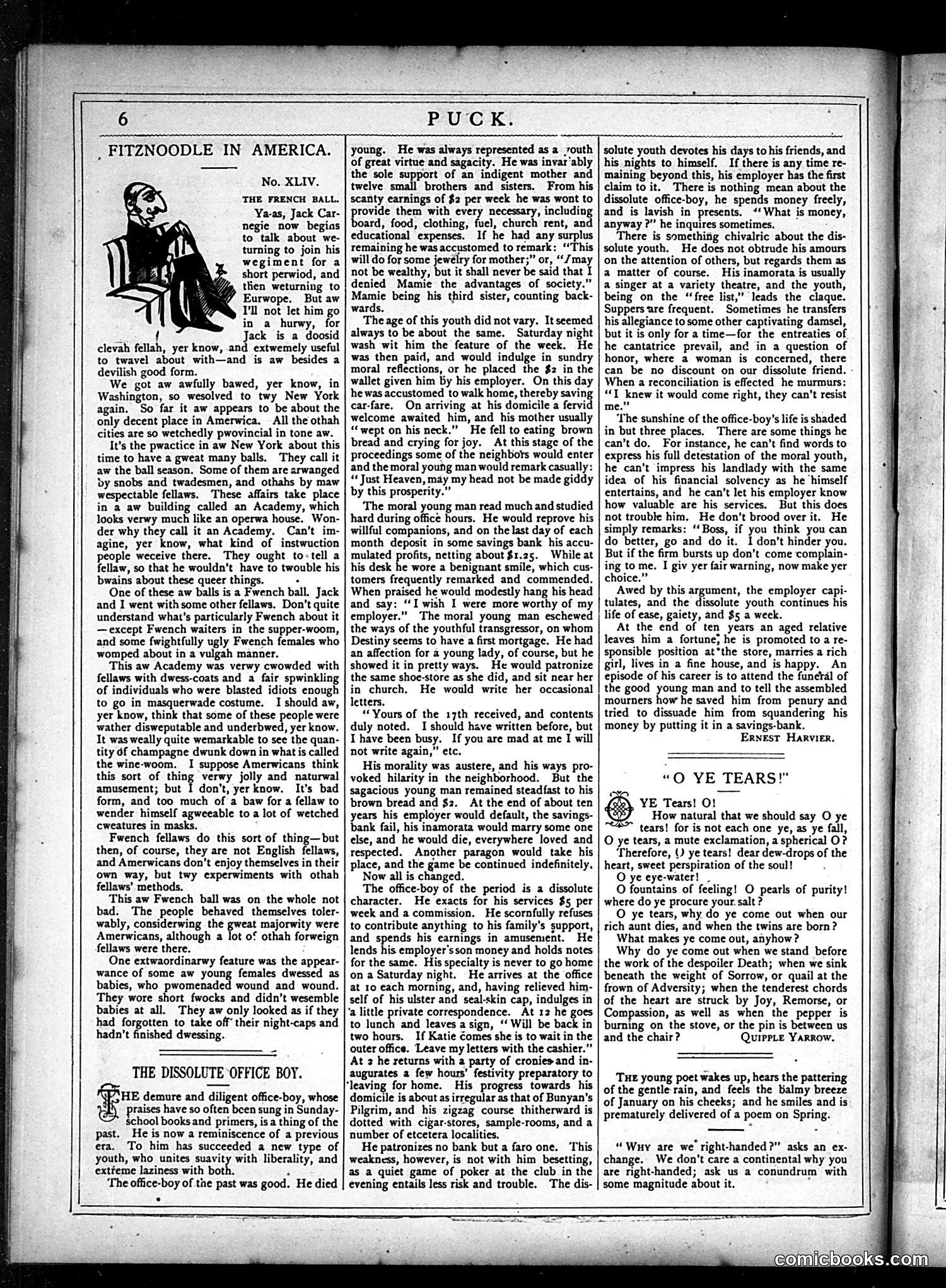
This page contains two separate satirical pieces rather than a single cartoon. **"Fitznoodle in America" (No. XLIV)**: A serialized story mocking a young French immigrant to America. The illustration shows a French dandy in exaggerated costume. The satire targets pretentious European immigrants who arrive in America with affected manners and limited means, yet maintain aristocratic pretensions while working mundane jobs. The narrative ridicules his affectations, moral superiority, and failed attempts at romance. **"The Dissolute Office Boy"**: A companion piece satirizing a different social type—the urban American youth who lacks discipline and squanders money in vice rather than self-improvement, contrasting with the French character above. Both pieces use character types to satirize contemporary social anxieties about immigration, class aspiration, and moral degeneracy in Gilded Age America.
📄 Transcribed text from this page (OCR, searchable)
Machine-transcribed from the original scan — historical spelling and the odd misread are preserved.
PUCK. _ FITZNOODLE IN AMERICA. No. XLIV. THE FRENCH BALL. Ya-as, Jack Car- negic now begias to talk about we- turning to join his wegiment for a short perwiod, and then weturning to Eurwope. But aw V'll not let him go in a hurwy, for : Jack is a doosid clevah fellah, yer know, and extwemely useful to twavel about with—and is aw besides a devilish good form. We got aw awfully bawed, yer know, in Washington, so wesolved to twy New York again. So far it aw appears to be about the only decent place in Amerwica. All the othah cities are so wetchedly pwovincial in tone aw. It’s the pwactice in aw New York about this time to have a gweat many balls. They call it aw the ball season. Some of them are arwanged by snobs and twadesmen, and othahs by maw wespectable fellaws. These affairs take place in a aw building called an Academy, which looks verwy much like an operwa house. Won- der why they call it an Academy. Can’t im- agine, yer know, what kind of instwuction people weceive there. They ought to-tell a fellaw, so that he wouldn't have to twouble his bwains about these queer things. . One of these aw balls is a Fwench ball. Jack and I went with some other fellaws. Don't quite understand what's particularly Fwench about it —except Fwench waiters in the supper-woom, and some fwightfully ugly Fwench females who womped about in a vulgah manner. This aw Academy was verwy cwowded with fellaws with dwess-coats and a fair spwinkling of individuals who were blasted idiots enough to go in masquerwade costume. I should aw, yer know, think that some of these people were wather disweputable and underbwed, yer know. It was weally quite wemarkable to see the quan- tity df champagne dwunk down in what is called the wine-woom. I suppose Amerwicans think this sort of thing verwy jolly and naturwal amusement; but I don’t, yer know. It’s bad form, and too much of a baw for a fellaw to wender himself agweeable to a lot of wetched cweatures in masks. Fwench fellaws do this sort of thing—but then, of course, they are not English fellaws, and Amerwicans don’t enjoy themselves in their own way, but twy experwiments with othah fellaws’ methods. This aw Fwench ball was on the whole not bad. The people behaved themselves toler- wably, considerwing the great majorwity were Amerwicans, although a lot of othah forweign fellaws were there. One extwaordinarwy feature was the appear- wance of some aw young females dwessed as babies, who pwomenaded wound and wound. They wore short fwocks and didn’t wesemble babies at all. They aw only looked as if they had forgotten to take off’ their night-caps and hadn't finished dwessing. THE DISSOLUTE OFFICE BOY. HE demure and diligent office-boy, whose raises have so often bcen sung in Sunday- school books and primers, is a thing of the past. He is now a reminiscence of a previous era. To him has succeeded a new type of youth, who unites sayy, with liberality, and extfeme laziness with both. ‘ ‘The office-boy of the past was good. He died young. He was always represented as a routh of great virtue and sagacity. He was invar‘ably the sole support of an indigent mother and twelve small. brothers and sisters. From his scanty earnings of $2 per week he was wont to piece them with every necessary, including ard, food, clothing, fuel, church rent, and educational e: If he had any surplus remaining he was accustomed to remark: ‘This will do for some jewélry for mother;” or, ““/may not be wealthy, but it shall never be said that I denied Mamie the advantages of society.” Mamie being his third sister, counting back- wards, The age of this youth did not vary. It seemed always to be about the same. Saturday night wash wit him the feature of the week. He was then paid, and would indulge in sundry moral reflections, or he placed the $2 in the wallet given him by his employer. On this day he was accustomed to walk home, thereby saving car-fare. On arriving at his domicile a fervid welcome awaited him, and his mother usually ‘wept on his neck.” He fell to eating brown bread and crying for joy. At this stage of the proceedings some of the neighbots would enter and the moral young man would remark casually: “Just Heaven, may my head not be made giddy by this prosperity.” The moral young man read much and studied hard during office hours. He would reprove his willful companions, and on the last day of each month deposit in some savings bank his accu- mulated profits, netting about $1.25. While at his desk he wore a benignant smile, which cus- tomers frequently remarked and commended. When praised he would modestly hang his head and say: “I wish I were more worthy of my employer.” The moral young man eschewed the ways of the youthful transgressor, on whom Destiny seems to have a first mortgage. He had an affection for a young lady, of course, but he showed it in pretty ways. He would patronize the same shoe-store as she did, and sit near her in church, He would write her occasional letters. “Yours of the 17th received, and contents duly noted. I should have written before, but I have been busy. If you are mad at me I will not write again,” etc. His morality was austere, and his ways pro- voked hilarity in the neighborhood. But the sagacious young man remained steadfast to his brown bread and $2. At the end of about ten years his employer would default, the savings- bank fail, his inamorata would marry some one else, and he would die, everywhere loved and respected. Another paragon would take his place, and the game be continued indefinitely, Now all is changed. The office-boy of the period is a dissolute character. He exacts for his services $5 per week and a commission. He scornfully refuses to contribute anything to his family’s support, and spends his earnings in amusement. He lends his employer'sson money and holds notes for the same. His specialty is never to go home on a Saturday night. He arrives at the office at 10 each morning, and, having relieved him- self of his ulster and seal-skin cap, indulges in ‘a little private correspondence. At 12 he goes to Tanck and leaves a sign, ‘‘ Will be back in two hours. If Katie Comes she is to wait in the outer office. Leave my letters with the cashier.” At 2 he returns with a party of cronies and in- augurates a few hours’ festivity preparatory to "leaving for home. His progress towards his domicile is about as irregular as that of Bunyan’s Pilgrim, and his zigzag course thitherward is dotted with cigar-stores, sample-rooms, and a number of etcetera localities, He patronizes no bank but a faro one. This weakness, however, is not with him besetting, as a quiet game of poker at the club in the evening entails less risk and trouble. The dis- solute youth devotes his days to his friends, and his nights to himself. If there is any time re- maining beyond this, his employer has the first claim to it. There is nothing mean about the dissolute office-boy, he spends money freely, and is lavish in presents. ‘What is money, anyway ?”” he inquires sometimes. There is something chivalric about the dis- solute youth. He does not obtrude his amours on the attention of others, but regards them as a matter of course. His inamorata is usually a singer at a variety theatre, and the youth, being on the ‘“‘free list,” leads the claque. Suppers are frequent. Sometimes he transfers his allegiance to some other captivating damsel, but it is only for a time—for the entreaties of he cantatrice prevail, and in a question of honor, where a woman is concerned, there can be no discount on our dissolute friend. When a reconciliation is effected he murmurs: “I knew it would come right, they can’t resist me.” ‘The sunshine of the office-boy’s life is shaded in but three places. There are some things he can’t do. For instance, he can’t find words to express his full detestation of the moral youth, he can’t impress his landlady with the same idea of his financial solvency as he himself entertains, and he can’t let his employer know how valuable are his services. But this does not trouble him. He don’t brood over it. He simply remarks: ‘Boss, if you think you can do better, go and do it. I don’t hinder you. But if the firm bursts up don’t come complain- ing to me. I giv yer fair warning, now make yer choice.” Awed by this argument, the employer capi- tulates, and the Gissolute youth continues his life of ease, gaiety, and $5 a week. At the end of ten years an aged relative leaves him a fortune; he is promoted to a re- sponsible position at ‘the store, marries a rich gitl, lives in a fine house, and ‘is happy. An episode of his career is to attend the funeral of the good young man and to tell the assembled mourners how he saved him from penury and tried to dissuade him from squandering his money by putting it in a savings-bank. Ernest HARvIER. © How natural that we should say O ye tears! for is not each one ye, as ye fall, O ye tears, a mute exclamation, a spherical O? ‘Therefore, () ye tears! dear dew-drops of the heart, sweet perspiration of the soul! O ye eye-water! | O fountains of feeling! O pearls of purity! where do ye procure your. salt ? O ye tears, why do ye come out when our rich aunt dies, and when the twins are born? What makes ye come out, anyhow? Why do ye come out when we stand before the work of the despoiler Death; when we sink beneath the weight of Sorrow, or quail at the frown of Adversity; when the tenderest chords of the heart are struck by Joy, Remorse, or Compassion, as well as when the pepper is burning on the stove, or the pin is between us and the chair? QuiprLe Yarrow. “O YE TEARS!" YE Tears! O! THE young poet wakes up, hears the pattering of the gentle rain, and feels the balmy breeze of January on his cheeks; and he smiles and is prematurely delivered of a poem on Spring. “Wuy are we’ right-handed?” asks an ex- change. We don't care a continental why you are right-handed; ask us a conundrum with some magnitude about it.