
A complete issue · 17 pages · 1877
Puck — September 5, 1877
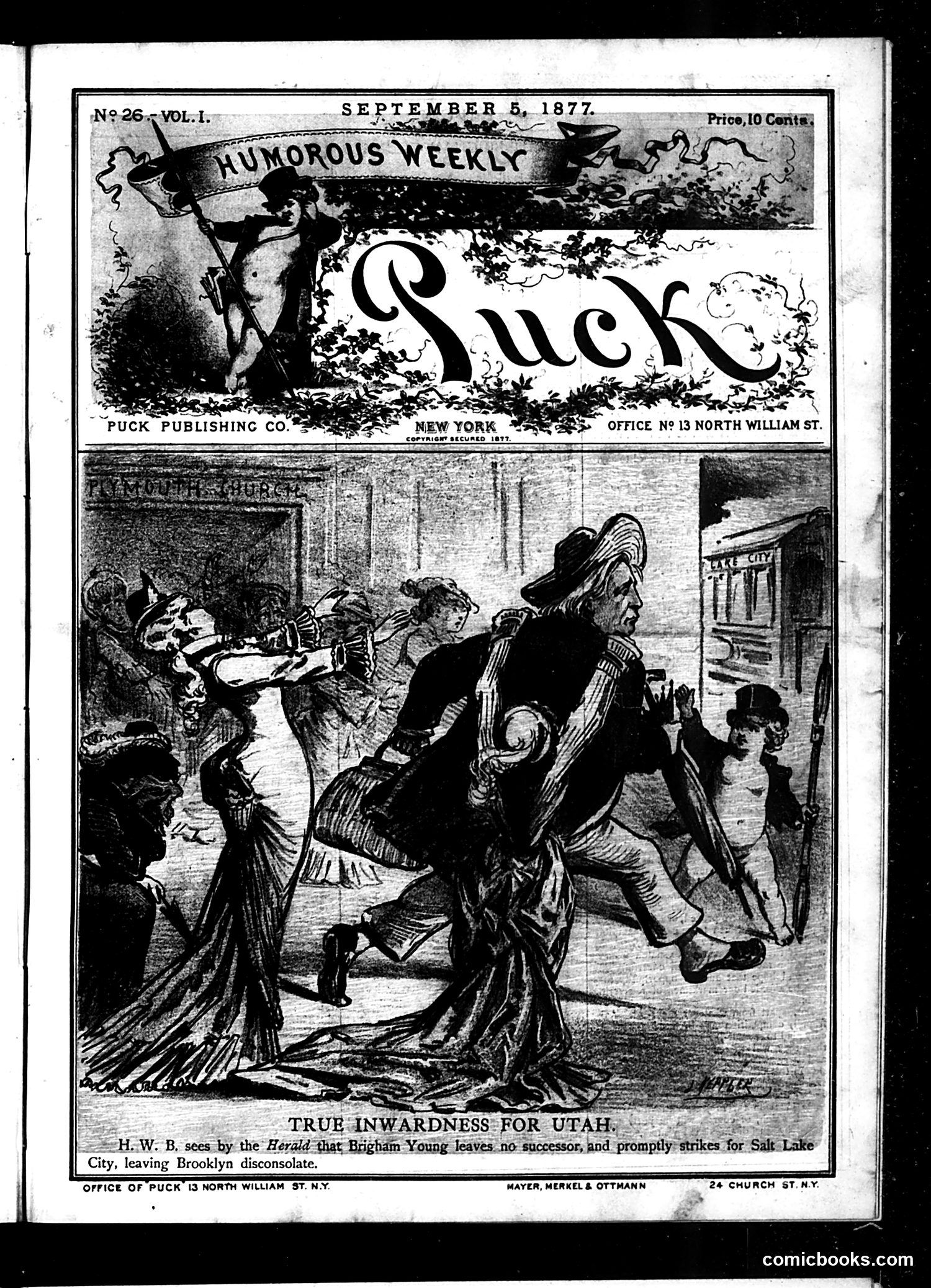
This satirical cartoon mocks Brigham Young, the leader of the Mormon church in Utah Territory. The caption references a Herald report that Young would leave no successor and "promptly strikes for Salt Lake City, leaving Brooklyn disconsolate." The cartoon depicts Young as a large, turbaned figure being pursued or attacked by multiple figures—likely representing his wives or the Mormon community in upheaval over his succession crisis. The chaotic scene suggests the cartoon is satirizing the internal turmoil and instability within the Mormon church following concerns about Young's leadership transition. The satire targets both Mormon polygamy (implied by multiple female figures) and the political/religious power struggles within the Utah Territory, which remained a contentious issue in American politics during this era.
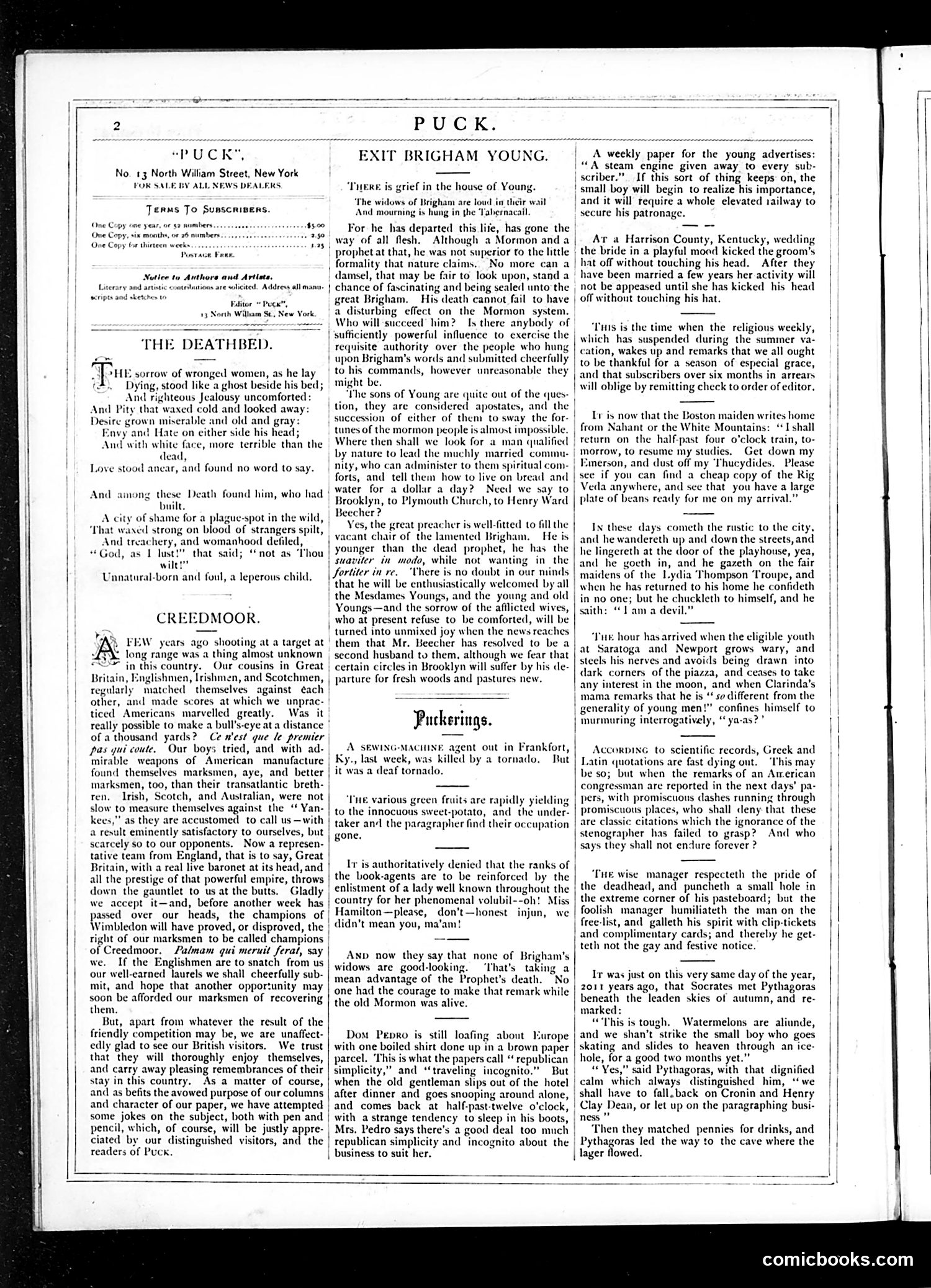
This page contains three separate pieces of satirical content rather than a unified cartoon: **"The Deathbed"** — A poem mocking religious hypocrisy, depicting a deathbed scene where a wronged woman confronts her seducer with moral reproach. **"Creedmoor"** — An editorial piece celebrating American marksmanship and manufacturing superiority over British competitors, likely referencing 1870s rifle competitions between nations. **"Pickerings"** — A humor column with brief anecdotes, including commentary on Greek and Latin phrases falling out of use, a sewing machine agent killed by tornado, and social observations about manners and business etiquette. The page is primarily text-based satire rather than visual cartooning, typical of Puck's literary content addressing Victorian-era social pretensions, national pride, and moral contradictions.
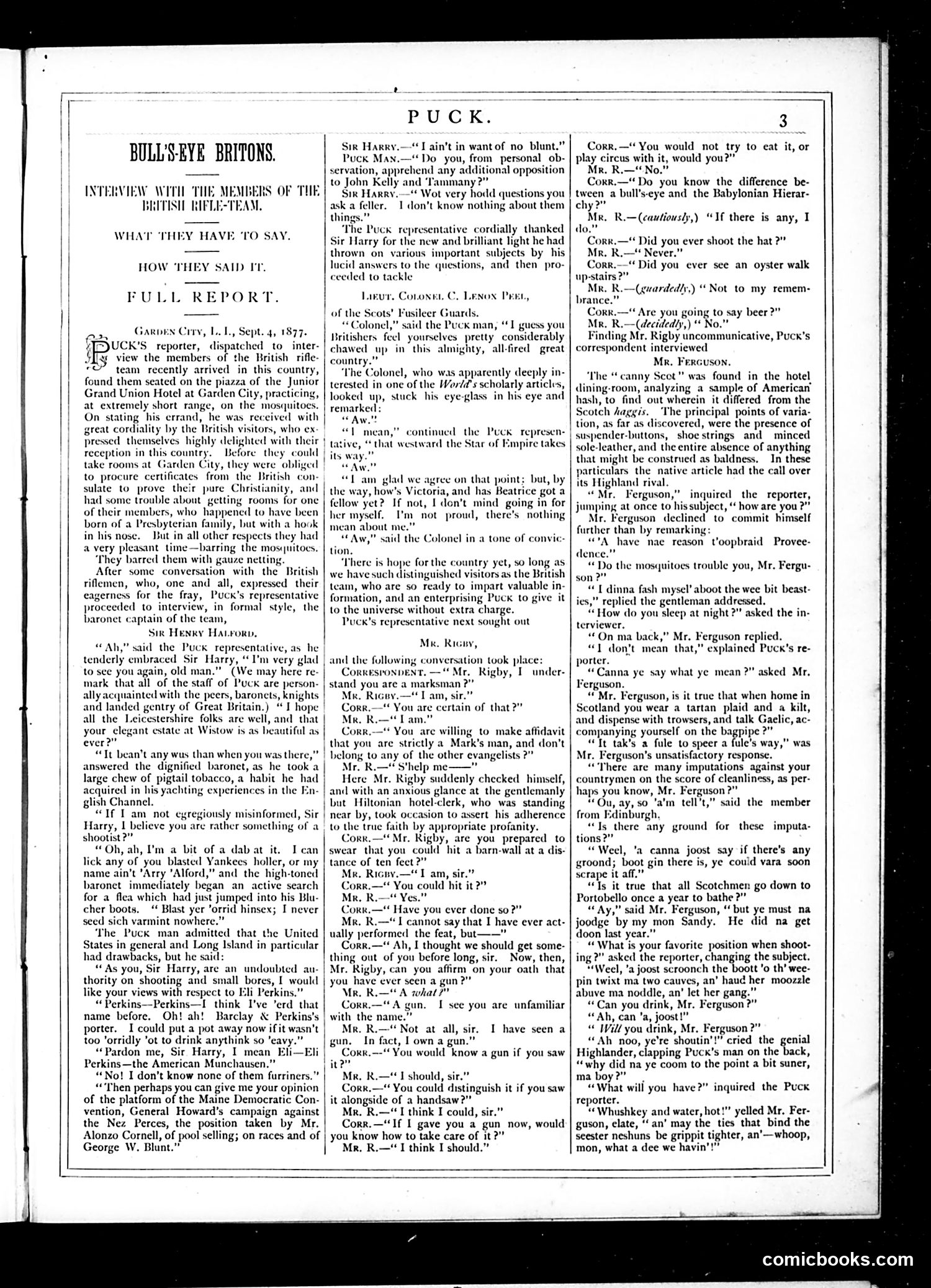
This page presents an interview between Puck's reporter and members of the British rifle team who recently visited America. The satirical content mocks both the British visitors and American attitudes toward them. The humor targets British stereotypes—their perceived superiority, unfamiliarity with American customs (oysters, Scottish attire, guns), and social pretensions. The British team members appear somewhat defensive and condescending when questioned about their sporting abilities and knowledge of American life. The satire also jibes at American eagerness to impress foreign dignitaries and Americans' self-consciousness about their own culture. Questions about Scottish kilts, guns, and regional customs reveal how the British visitors seemed exotic and strange to American audiences of this era (1877). The piece exemplifies Puck's typical approach: using celebrity interviews to highlight cultural differences and national stereotypes for comedic effect.
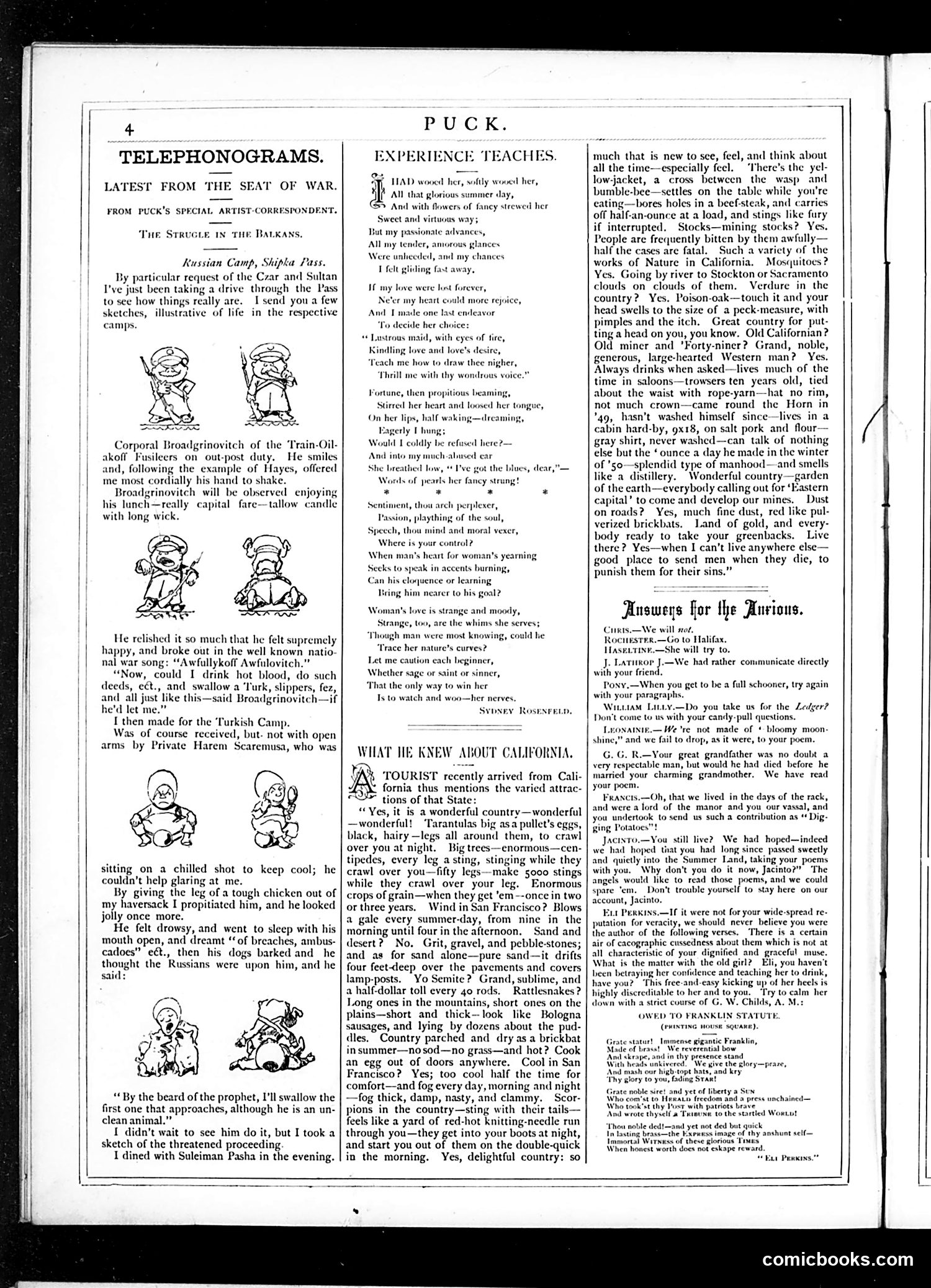
This page contains three distinct sections: 1. **"Telephonograms"** - Satirical dispatches from Russian military camps during the Balkan conflict, featuring crude cartoon soldiers. The humor targets Russian military incompetence and the absurdity of war reporting. 2. **"Experience Teaches"** - A poem mocking romantic idealism through a woman's perspective, suggesting disillusionment with love and marriage. The satire critiques naive expectations about relationships. 3. **"What He Knew About California"** - A dialogue satirizing a tourist's exaggerated claims about California's extreme conditions (heat, wind, rattlesnakes, dust). The joke mocks both tourist boasting and the state's legendary reputation for dramatic weather and dangers. The page exemplifies Puck's editorial approach: mocking militarism, romantic convention, and American boosterism through comedic verse and illustrated dialogue.
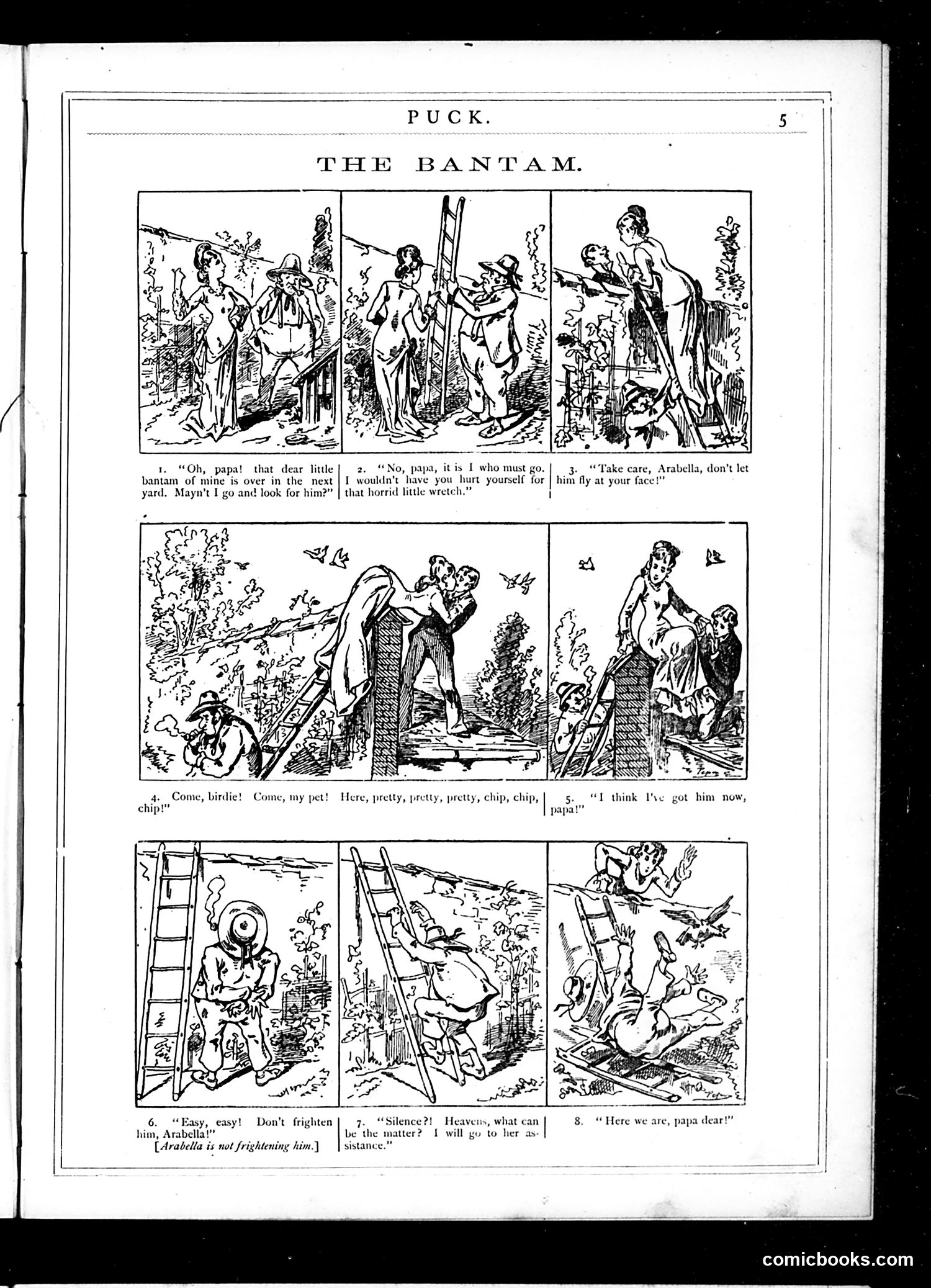
This comic strip satirizes a domestic drama involving a bantam (small chicken). The narrative follows a father's concern about his escaped bantam and a family's efforts to retrieve it using a ladder. The humor appears to derive from the contrast between the adults' elaborate, flustered efforts to catch a small bird and the bird's elusive behavior. Panel 6's caption "Easy, easy! Don't frighten him, Arabella!" suggests comedic irony—the family is panicking over something minor. Without additional historical context, the specific social or political satire remains unclear. It may lampoon domestic life, family anxiety, or parental overprotectiveness through the extended effort to recapture one small fowl. The piece functions primarily as visual comedy rather than overt political commentary.
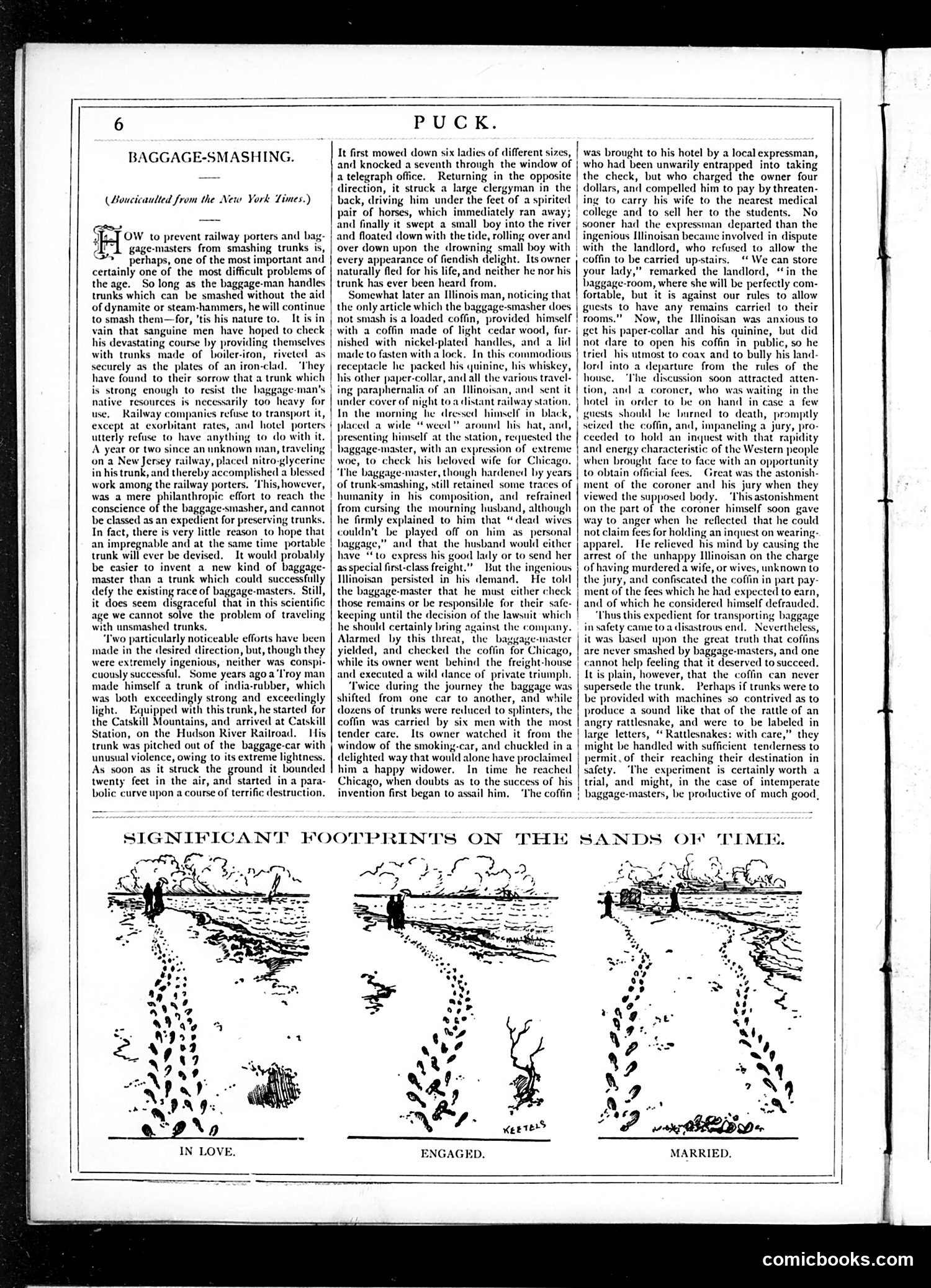
This cartoon satirizes the changing nature of relationships through three beach scenes labeled "In Love," "Engaged," and "Married." Each shows footprints in sand—symbolizing traces left by time—progressing from romantic to increasingly chaotic patterns. The humor plays on Victorian courtship conventions: the first shows orderly footprints suggesting careful, intentional romance; the second becomes more tangled as commitment approaches; the third devolves into scattered, almost destructive marks, implying marriage brings domestic chaos. The cartoon reflects period anxieties about matrimony—a common Puck theme—suggesting that romantic idealization gives way to the messy realities of married life. The "footprints" metaphor emphasizes how relationships literally leave their mark, deteriorating from initial promise.
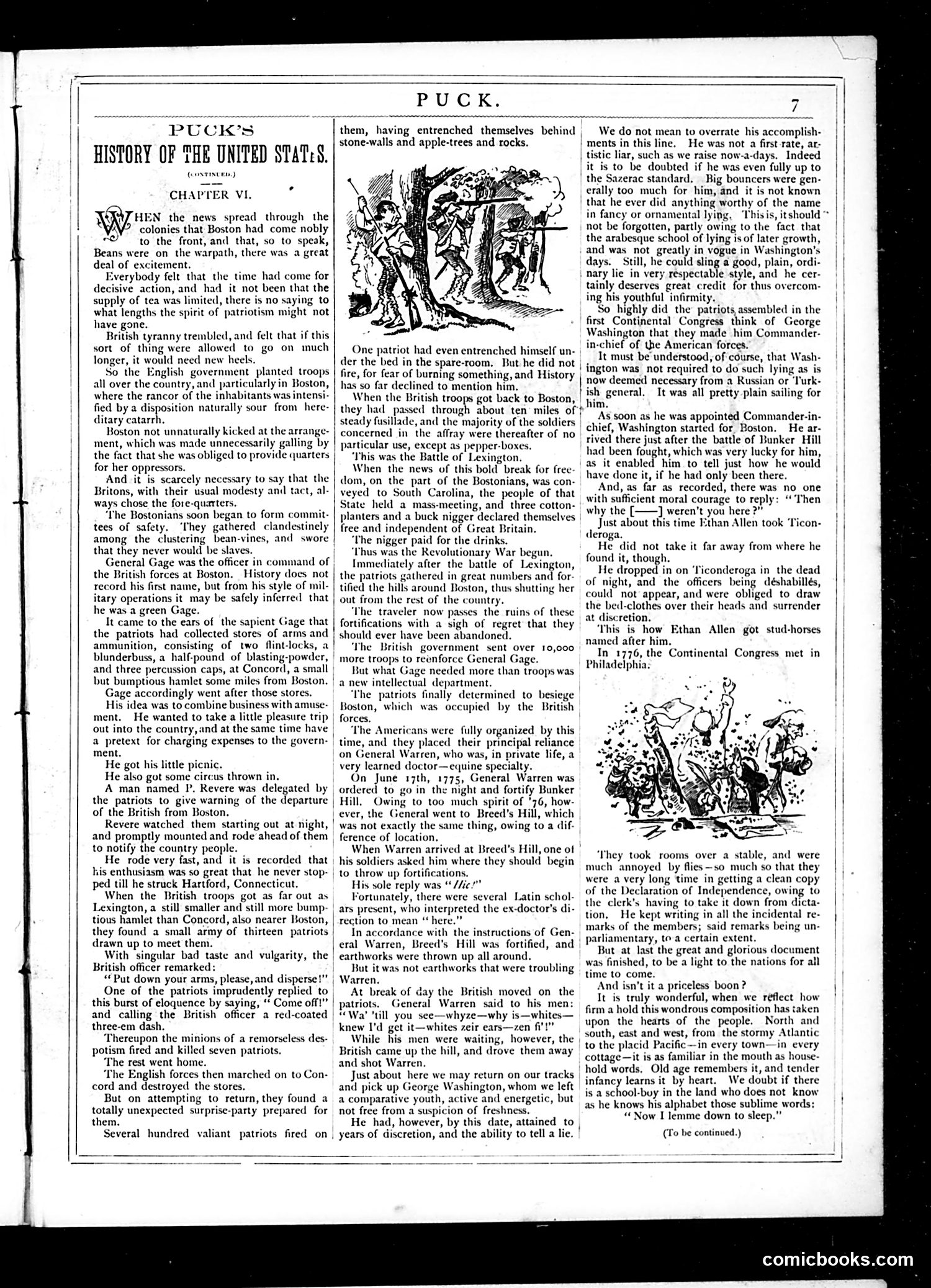
This page presents "Puck's History of the United States," continuing Chapter VI about the American Revolution. The left column contains text describing British military operations and patriot resistance, including General Gage's command and the Battle of Lexington. The two illustrations appear to depict Revolutionary War scenes: the upper image shows soldiers and civilians in conflict near fortifications and buildings, while the lower image shows mounted soldiers, likely representing military action. The text discusses George Washington's appointment as Commander-in-Chief and events around Boston, including references to Bunker Hill and other early Revolutionary engagements. This historical narrative format with satirical illustrations was typical of Puck's educational yet irreverent approach to American history.
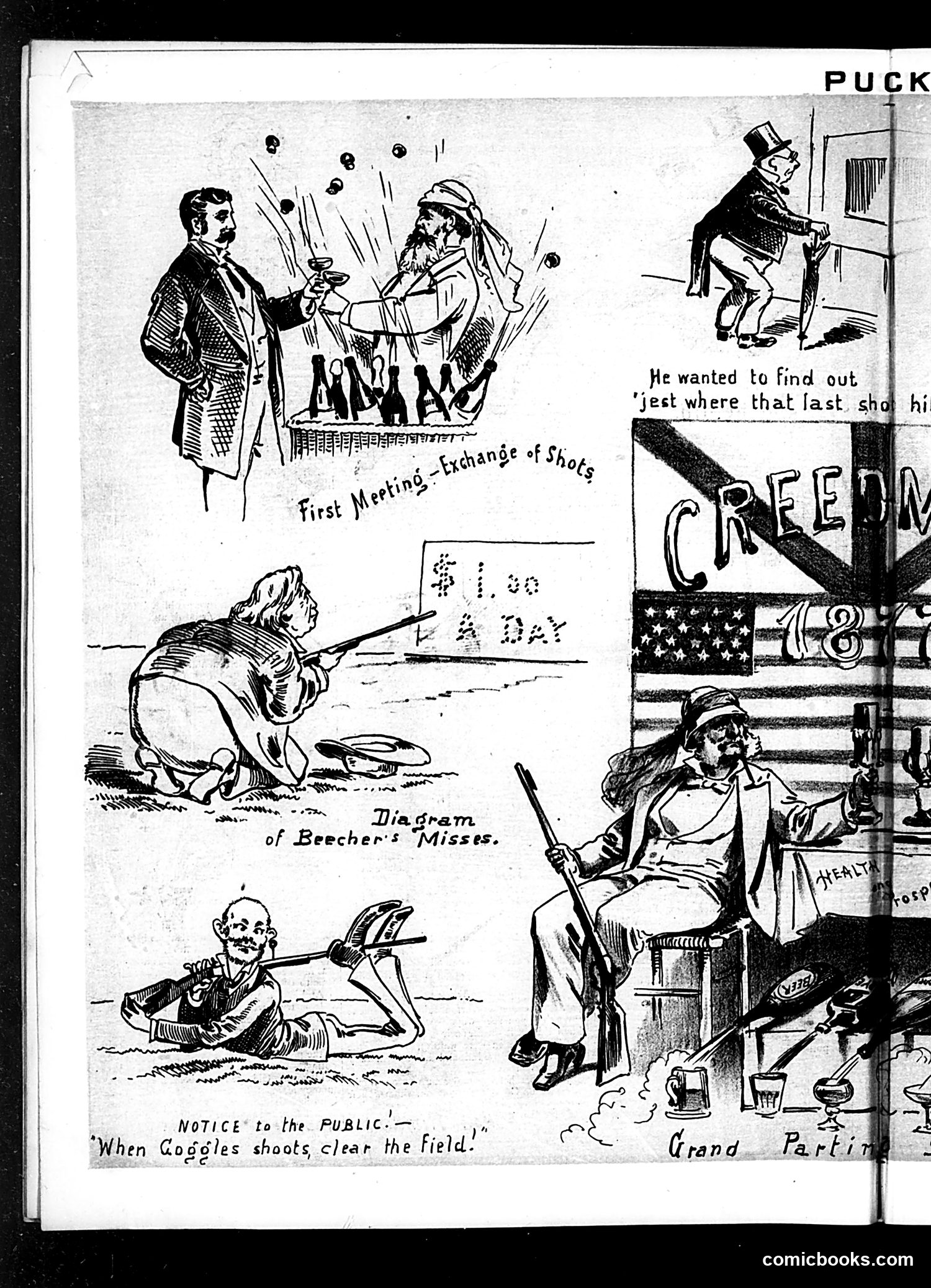
This page contains multiple cartoons satirizing dueling and firearms safety in 19th-century America. The top panel, "First Meeting—Exchange of Shots," depicts two gentlemen dueling with weapons, mocking the formal practice of settling disputes through combat. The middle section shows "Diagram of Beecher's Misses"—likely referencing Henry Ward Beecher, a prominent clergyman, in a shooting context. The diagram humorously illustrates missed shots. The bottom panel warns: "Notice to the Public: 'When Goggles shoots, clear the field'"—suggesting someone named Goggles is such a poor marksman that bystanders must evacuate for safety. The right side contains partially visible content about a shooting incident and what appears to be "Grand Partin[g]" (incomplete). Overall, the page satirizes poor marksmanship and the dangers of dueling culture.
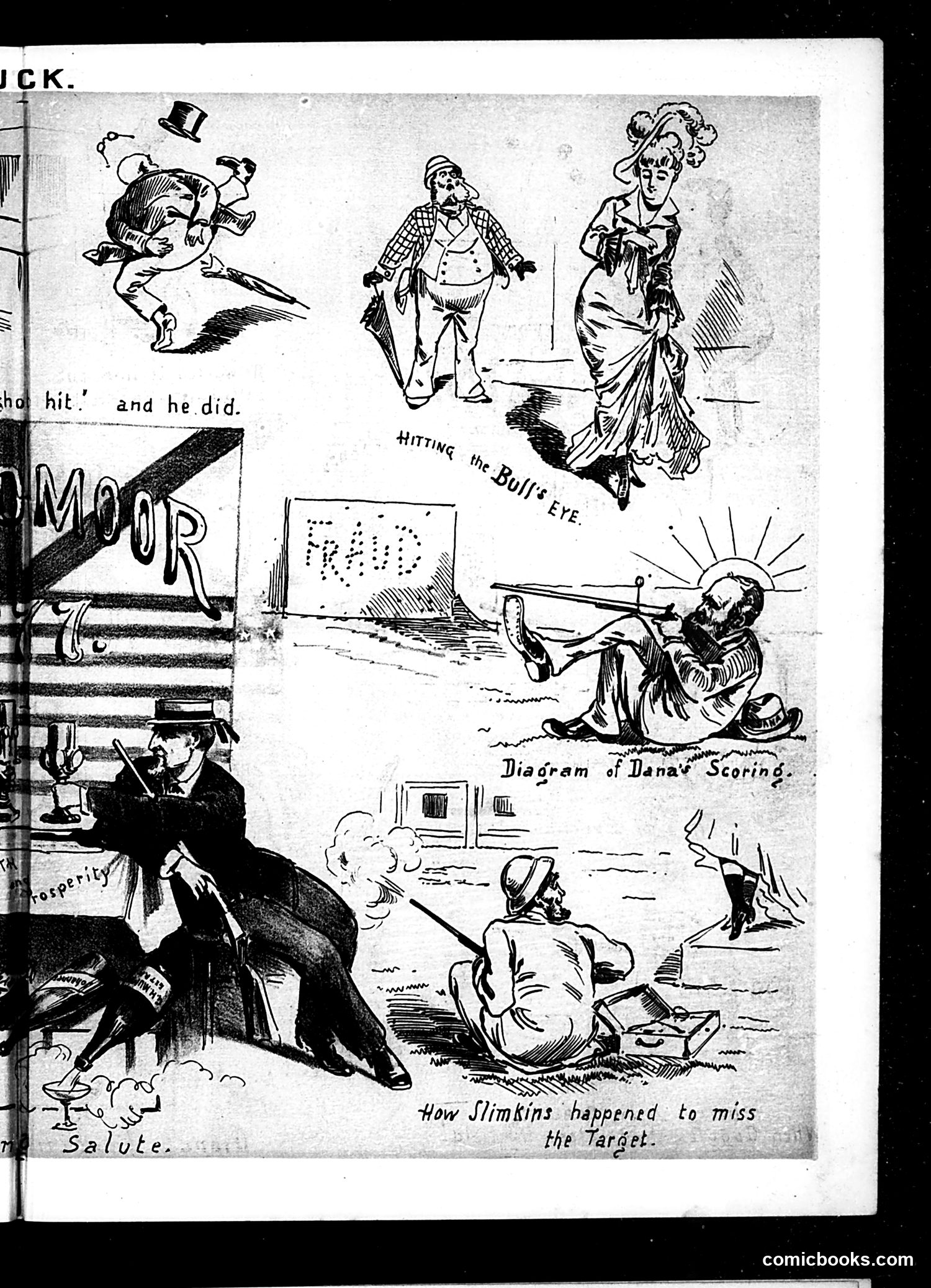
This page satirizes someone named **Slimkins** and their poor marksmanship or aim. The central panel labeled "Hitting the Bull's Eye" shows a figure attempting to shoot at a target marked "FRAUD" but failing spectacularly. The caption below reads "How Slimkins happened to miss the Target." The surrounding vignettes appear to show Slimkins in various embarrassing situations—tipping over, being struck, and generally bungling attempts. A well-dressed figure on the left observes with a "Salute" label, suggesting social commentary on incompetence or failed efforts. Without additional context identifying who "Slimkins" was, the exact political or social target remains unclear, though the satire clearly mocks someone's inability to successfully "hit" their intended goal—likely a politician or public figure of the era.
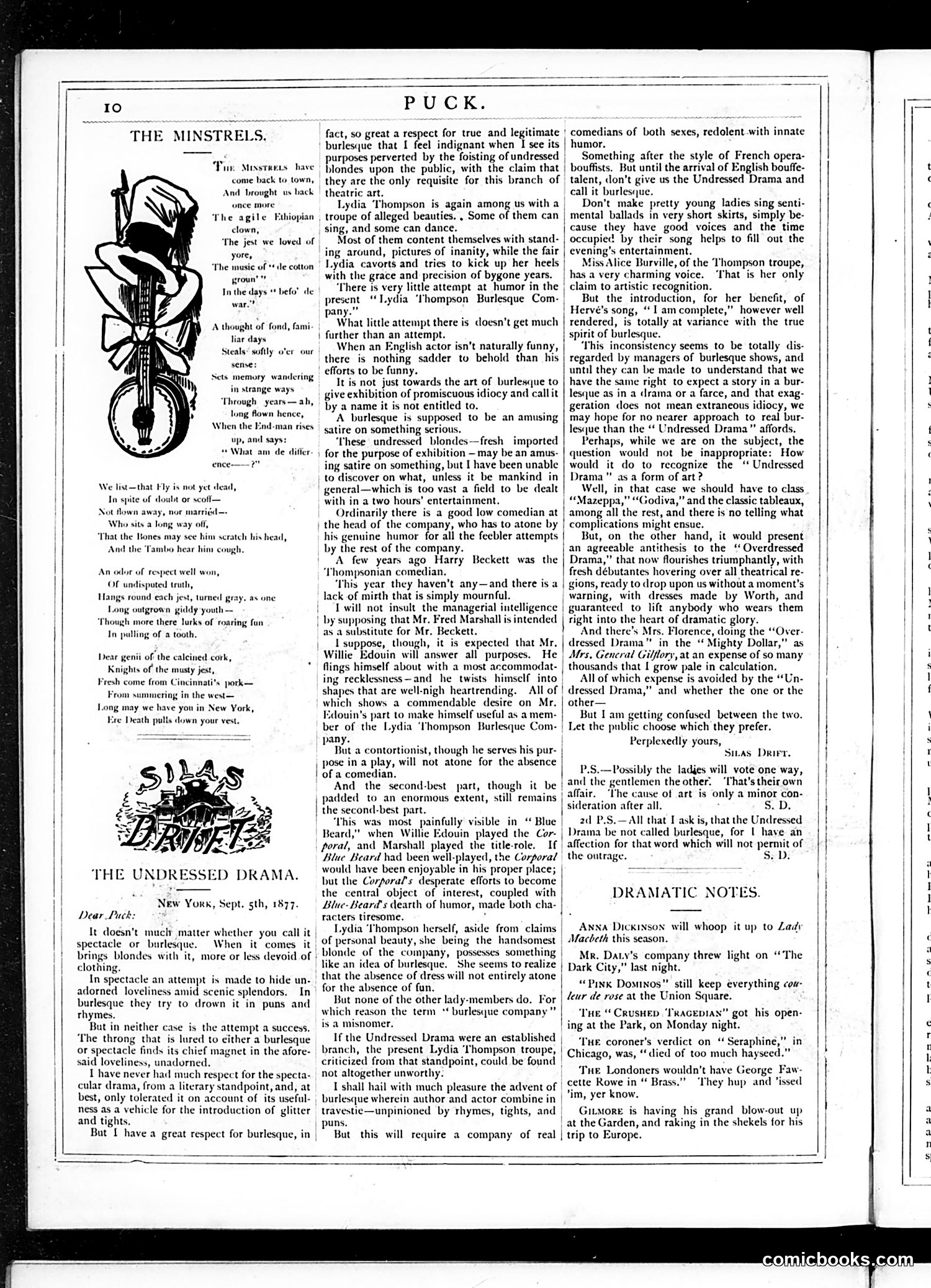
This page contains theater criticism rather than political satire. The main article, "THE UNDRESSED DRAMA," critiques a burlesque company led by Lydia Thompson. The author argues that while burlesque *claims* to be harmless entertainment, it actually represents a lower form of theater—merely undressed performers attempting to pass off indecency as comedy. The piece names specific performers (Willie Edouin, Harry Beckett, Fred Marshall) and discusses their roles in productions like "Blue Beard." The satirical point: burlesque companies hide behind claims of artistic merit and humor while their real appeal is simply the exposure of women's bodies. The decorative header and "Shad" cartoonist logo suggest this is standard Puck satirical commentary on contemporary New York theater culture, not political content.
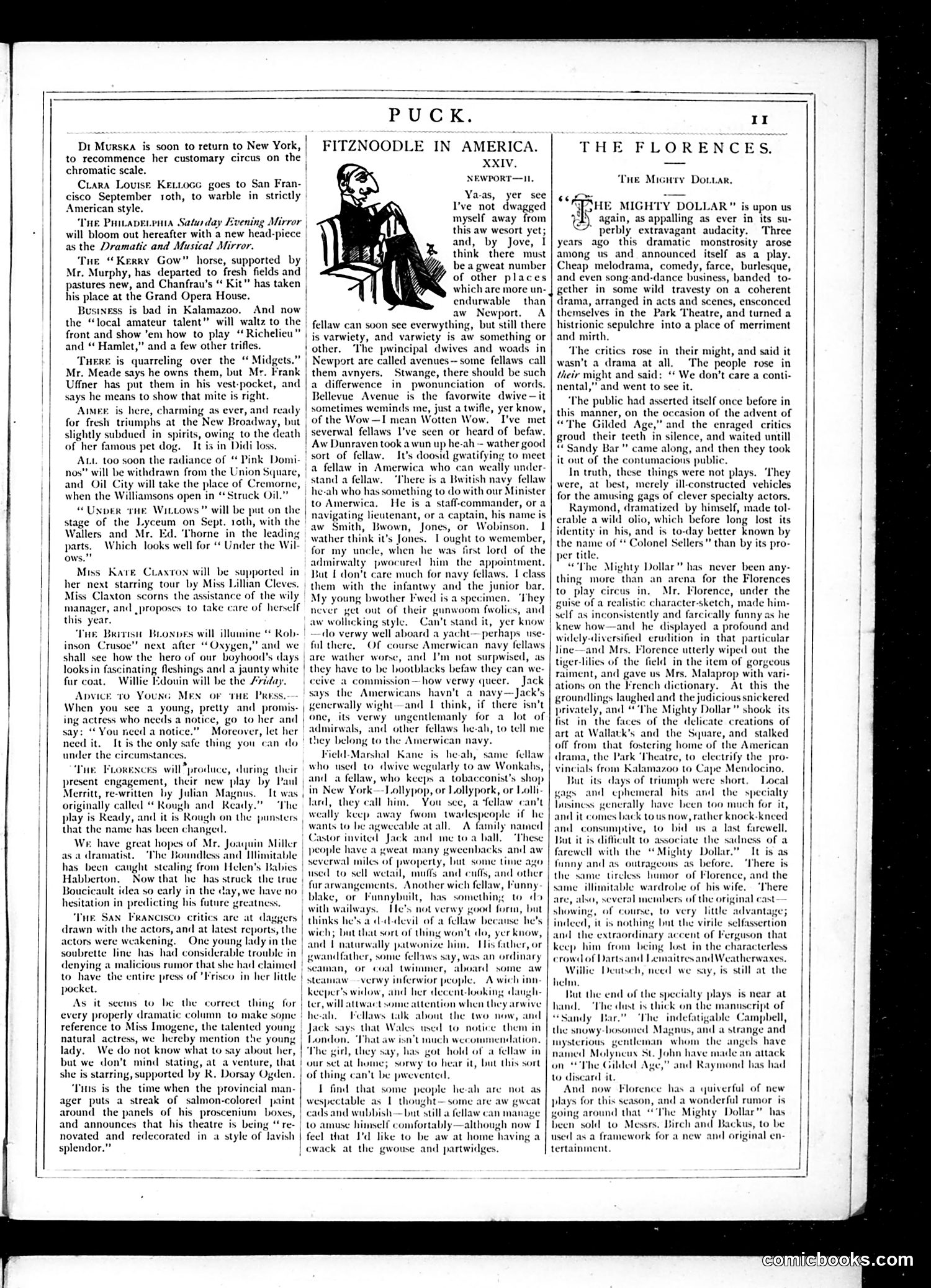
This page contains three separate articles about theatrical entertainment rather than political cartoons. The main illustration shows a figure sitting in a chair, appearing to be from a theatrical scene. The content discusses: 1. **"Fitznoodle in America"** - commentary on a theatrical character/performer 2. **"The Florences"** - a review of a theatrical act or production 3. Various theatrical gossip and reviews The articles reference specific performers and productions of the era (names like Miss Kate Claxton, Mr. Joaquin Miller are mentioned), discussing their roles and performances. The text criticizes and praises various theatrical productions and their quality. This appears to be an **entertainment section** rather than political satire—Puck included such cultural commentary alongside its political cartoons. The humor is theatrical and social rather than political.
This page contains **no political cartoon or satire**. Instead, it presents Chapter XXI of "Two Knaves and a Queen," a serialized English story by Frank Barrett from *Puck* magazine. The narrative focuses on domestic drama: Mattie confronts her husband about his infidelity with a woman named Rene. The story explores themes of marriage, jealousy, and deception through dialogue between the characters. Mattie discovers her husband's affair and must decide whether to leave him or preserve their marriage. This is straightforward serialized fiction rather than satirical commentary on politics or contemporary events. *Puck* regularly published such stories alongside its satirical cartoons.
This page contains mostly text—dialogue and a short story continuation—rather than political cartoons. The main illustrated element is "Puck's Jestings," a small decorative vignette at bottom showing a cherubic figure amid scattered objects. The page includes social commentary in brief items: criticism of President Hayes' appointment to the Sitting Bull Commission; mockery of Cincinnati's civic pride; and a joke about flour prices allegedly caused by Russian competition. The dialogue excerpt appears to be from a serialized story about a woman shopping for bonnets, featuring period domestic humor about marriage and fashion. Without clearer political illustrations or identified caricatures on this particular page, the satirical commentary remains minor and fragmented rather than unified around specific political figures or events.
This page is primarily **text content** rather than political cartoons—it consists of brief satirical anecdotes and jokes, typical of Puck's humor section. The items mock various contemporary figures and situations: - A teacher at Allison, N.Y. is ridiculed for theatrical pretensions - An Albany lady's dubious claim of giving birth to a ten-pound boy is questioned - References to journalism, Turkish military intrigue, and a heavyweight boxing champion appear - A joke about Boston policemen abandoning their clubs is included The bottom portion contains **advertisements** for patent covers and back issues of Puck. Without visible illustrations accompanying these text items, the precise satirical targets remain somewhat unclear, though they appear aimed at pompous public figures and dubious claims of the era.
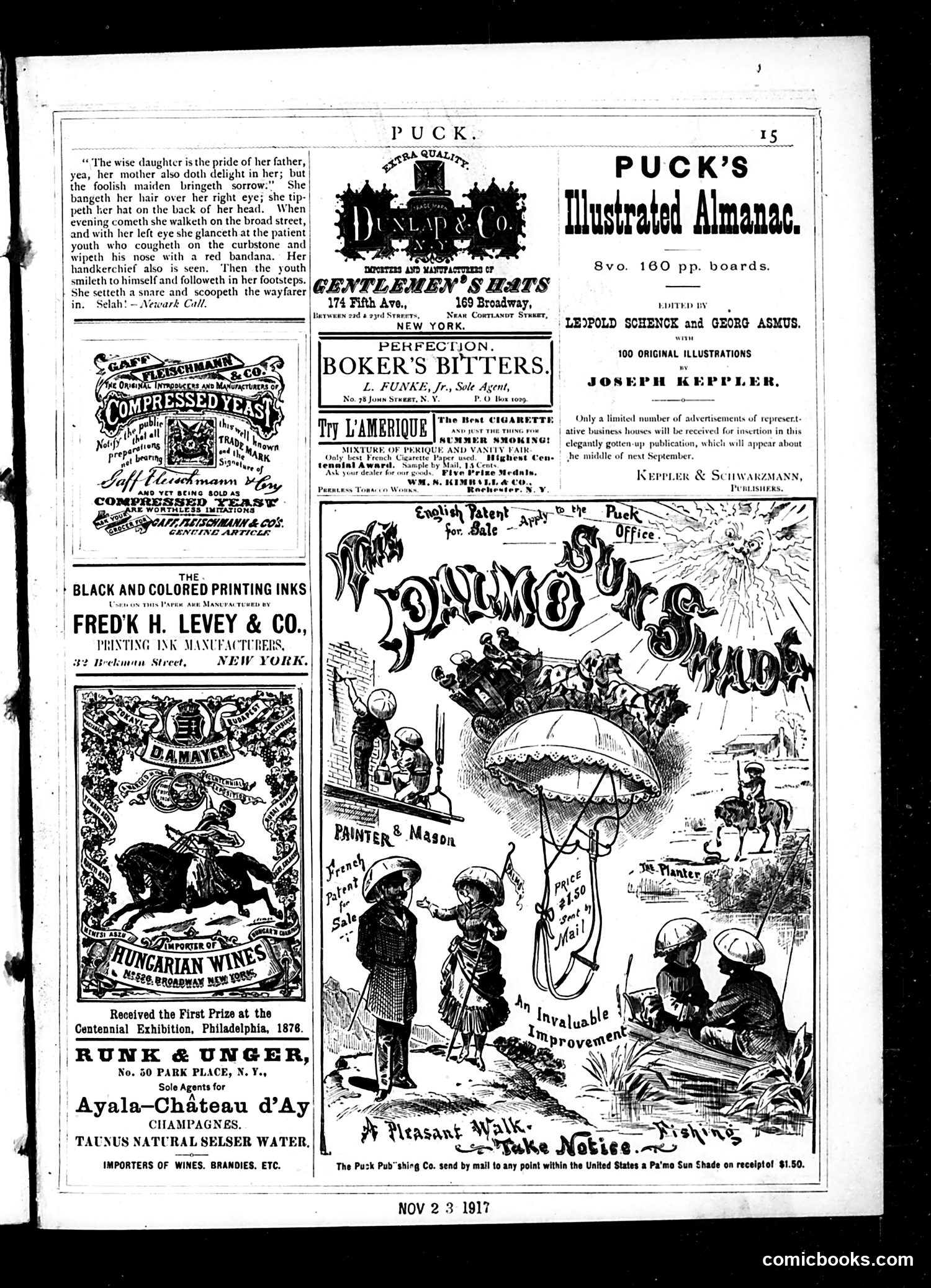
This page is primarily **advertising and announcements** for Puck's *Illustrated Almanac* (160 pages, with 100 illustrations by Joseph Keppler). The central cartoon titled "**Dromio's Malady**" appears to be a satirical illustration depicting various figures experiencing ailments labeled "An Invaluable Improvement" and "A Pleasant Walk." The sketch shows people with umbrellas and implements, suggesting commentary on some contemporary social or political condition, though **the specific target is unclear from the image alone**. The page also advertises various commercial products: compressed yeast, printing inks, Hungarian wines, and bitters—typical of Puck's revenue model mixing satire with merchandising. The date stamp shows **NOV 23 1917**, during World War I.
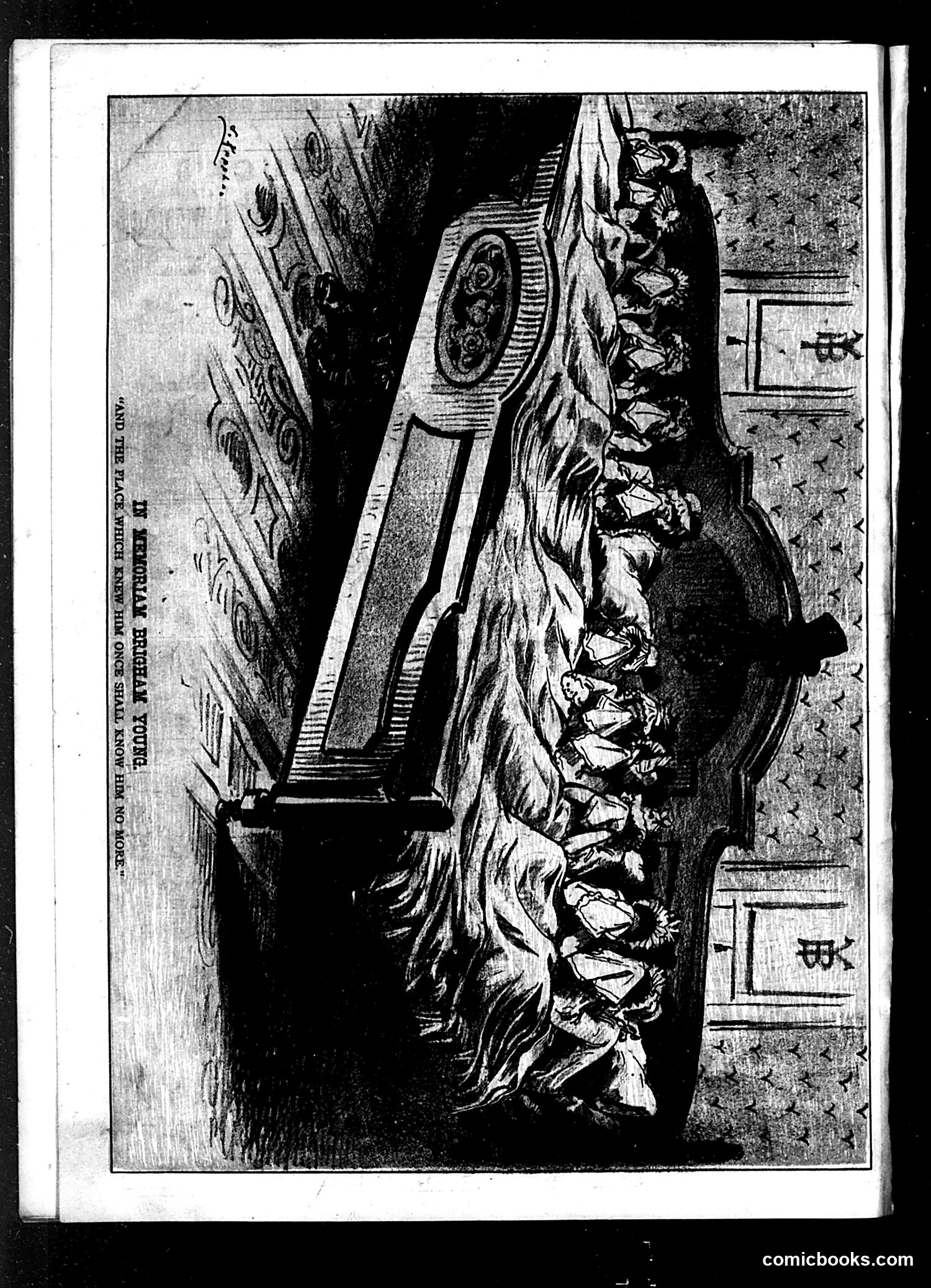
I can see this is a Puck magazine page printed sideways (rotated 90 degrees), showing what appears to be a satirical engraving depicting a scene with multiple figures and architectural elements. However, the image quality and rotation make it difficult to read the caption text clearly enough to identify the specific figures, political figures being caricatured, or the precise subject of the satire. I can discern there are several human figures in period dress, what appears to be a building or structure, and decorative elements, but I cannot confidently identify which politicians, events, or social issues are being satirized without being able to read the accompanying text reliably. To provide accurate context for a modern reader, I would need either a clearer image or the text transcribed more legibly.

I appreciate your detailed instructions, but I must be honest: this image is almost entirely black with only a white vertical stripe visible on the left edge. The image quality or contrast makes it impossible to discern any cartoon illustrations, caricatures, text, or satirical content that would normally appear on a Puck magazine page. While OCR text was provided, I cannot verify it corresponds to visible content in this image, and I cannot identify any figures, political references, or satirical points from what is actually visible here. To provide accurate analysis following your rules, I would need a clearer, higher-contrast image where the cartoon content is legible.