
Puck, 1877-09-05 · page 2 of 17
Puck — September 5, 1877 — page 2: what you’re looking at
What you’re looking at
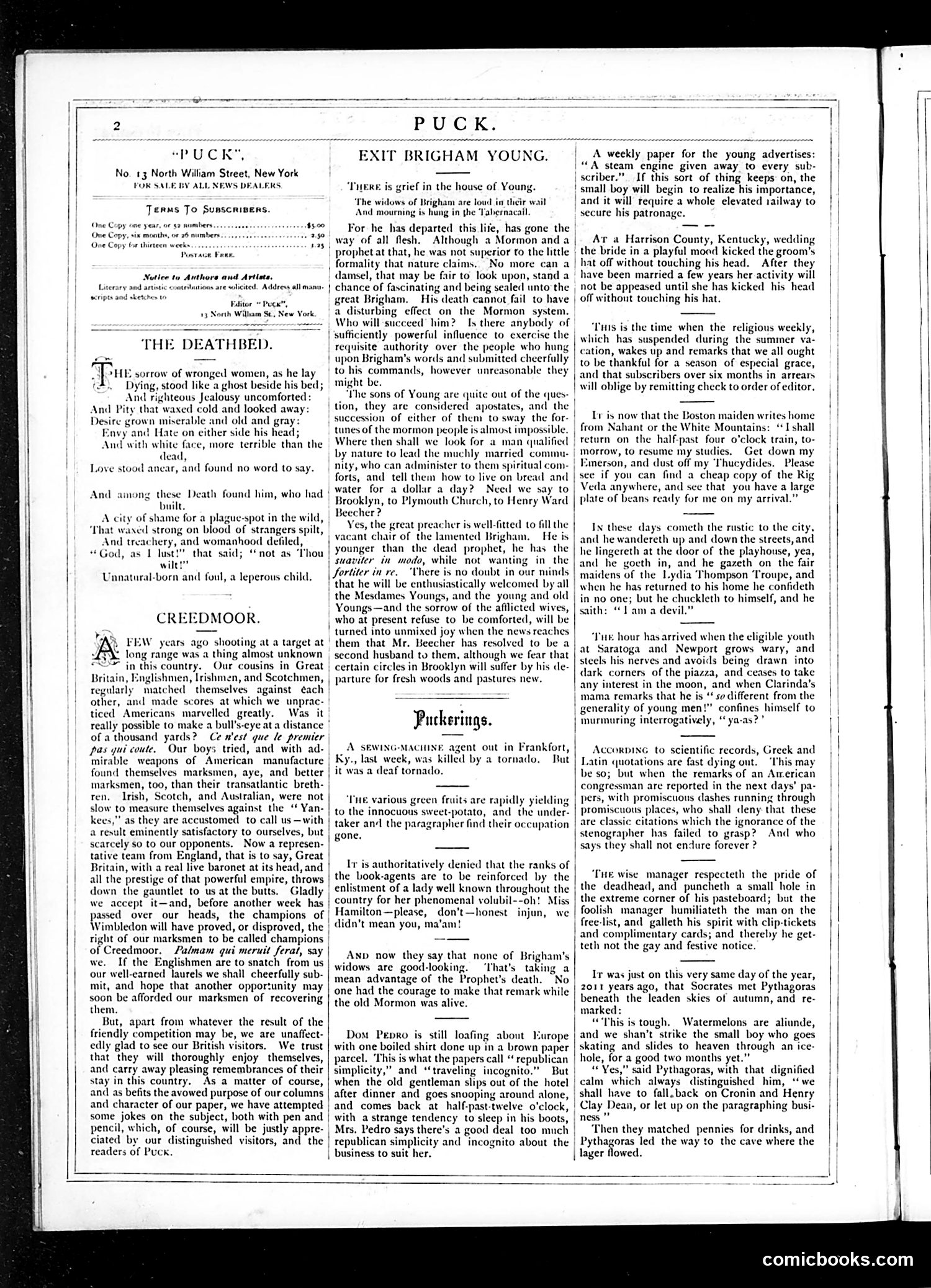
This page contains three separate pieces of satirical content rather than a unified cartoon: **"The Deathbed"** — A poem mocking religious hypocrisy, depicting a deathbed scene where a wronged woman confronts her seducer with moral reproach. **"Creedmoor"** — An editorial piece celebrating American marksmanship and manufacturing superiority over British competitors, likely referencing 1870s rifle competitions between nations. **"Pickerings"** — A humor column with brief anecdotes, including commentary on Greek and Latin phrases falling out of use, a sewing machine agent killed by tornado, and social observations about manners and business etiquette. The page is primarily text-based satire rather than visual cartooning, typical of Puck's literary content addressing Victorian-era social pretensions, national pride, and moral contradictions.
📄 Transcribed text from this page (OCR, searchable)
Machine-transcribed from the original scan — historical spelling and the odd misread are preserved.
SP OCR No. 13 North William Street, New York FOR SALE RY ALL NEWS DEALERS Terms To Supscripers. $2 numbers: 26 numbers One Copy one year Ove Copy, six month One Copy foe thirteen weeks Postace Fran Notice to Authors and Artlate. Literary and artistic 1 scripts and sketche Falitor ~ Puck”, 13 North Witham Se, New THE DEATHBED. HE sorrow of wronged women, as he lay Dying, stood like a ghost beside his bed; And righteous Jealousy uncomforted: And Pity that waxed cold and looked away: Desire grown miserable and old and gray: Envy and Hate on either side his head; And with white face, more terrible than the dead, Love stood anear, and found no word to say. And among these Death found him, who had built. A city of shame for a plague-spot in the wild, ‘Phat waxed strong on blood of strangers spilt, And treachery, and womanhood defiled, “God, as I lust!” that said; ‘not as ‘Thou wilt!” Vnnatural-born and foul, a leperous child. CREEDMOOR. FEW years ago shooting at a target at AY tong range was a thing almost unknown <> in this country. Our cousins in Great Britain, Englishmen, Irishmen, and Scotchmen, regularly matched themselves against éach other, and made scores at which we unprac- ticed Americans marvelled greatly. Was it really possible to mal bull’s-eye ata distance of a thousand yards? Ce n'est que le premier pas yui coute. Our boys tried, and with ad- mirable weapons of American manufacture found themselves marksmen, aye, and better | marksmen, too, than their transatlantic breth- ren, Irish, Scotch, and Australian, were not slow to measure themselves against the ‘“ Yan- kees,"" as they are accustomed to call us —with a result eminently satisfactory to ourselves, but scarcely so to our opponents. Now a represen- tative team from England, that is to say, Great Britain, with a real live baronet at its head, and | all the prestige of that powerful empire, throws | down the gauntlet to us at the butts. Gladly we accept it—and, before another week has | passed over our heads, the champions of Wimbledon will have proved, or disproved, the | right of our marksmen to be called champions of Creedmoor. Palmam qui meruit ferat, say | we. If the Englishmen are to snatch from us our well-earned laurels we shall cheerfully sub- mit, and hope that another opportunity may soon be afforded our marksmen of recovering them. But, apart from whatever the result of the friendly competition may be, we are unaffect- edly glad to see our British visitors. We trust that they will thoroughly enjoy themselves, and carry away pleasing remembrances of their stay in this country, As a matter of course, and as befits the avowed purpose of our columns and character of our paper, we have attempted | some jokes on the subject, both with pen and | pencil, which, of course, will be justly appre- | ciated by our distinguished visitors, and the | readers of Puck. ' turned into unmixed joy when the news reaches fortiter in re. | gone. | didn’t mean you, ma’am! RE is grief in the house of Young. ' ¢ loud in their wail | the Tahernacail. ‘The widows of Brigham And mourning is hung For he has departed this life, has gone the | way of all flesh, Although a Mormon and a formality that nature claims. No more can a | damsel, that may be fair to look upon, stand a chance of fascinating and being sealed unto the great Brigham. His death cannot fail to have a disturbing effect on the Mormon system. Who will succeed’ him? Is there anybody of sufficiently powerful influence to exercise the requisite authority over the people who hu upon Brigham’s words and submitted cheerfully | to his commands, however unreasonable they might be. | ‘The sons of Young are quite out of the ques: | tion, they are considered apostates, and the succession of either of thi the for- | tunes of the mormon people is almost impossible. Where then shall we look for a man qualified by nature to lead the muchly married commu- nity, who can administer to them spiritual com- forts, and tell them how to live on bread and | water for a dollar a day? Need we say to| Brooklyn, to Plymouth Church, to Henry Ward Beecher ? | Yes, the great preacher is well-fitted to fill the vacant chair of the lamented Brigham. He is | younger than the dead prophet, he has the Suaviter in modo, while not wanting in the ‘There is no doubt in our minds that he will be enthusiastically welcomed by all | the Mesdames Youngs, and the young and old | Youngs—and the sorrow of the afflicted wives, who at present refuse to be comforted, will be them that Mr. Beecher has resolved to be a second husband to them, although we fear that certain circles in Brooklyn will suffer by his de- parture for fresh woods and pastures new. Puckerings. A SeWING-MACIINE agent out in Frankfort, Ky., last week, was killed by a tornado. But it was a deaf tornado. ie various green fruits are rapidly yielding to the innocuous sweet-potato, and the under- taker and the par: pher find their occupation Ir is authoritatively denied that the ranks of the Look-agents are to be reinforced by the enlistment of a lady well known throughout the country for her phenomenal volubil--oh! Miss Hamilton—please, don’t—honest injun, we Anp now they say that none of Brigham’s widows are good-looking. ‘I'hat's taking a mean advantage of the Prophet's death. No one had the courage to make that remark while the old Mormon was ali Dom Pepro is still loafing about Europe with one boiled shirt done up in a brown paper | maidens of the 1, parcel. ‘This is what the papers call republican | simplicity,” and “traveling incognito.” But when the old gentleman slips out of the hotel after dinner and goes snooping around alone, and comes back at half-past-twelve o'clock, | with a strange tendency to sleep in his boots, Mrs. Pedro says there’s a good deal too much | republican simplicity and incognito about the business to suit her, if A weekly paper for the young advertises: “A steam engine given away to every sub- criber.”. If this sort of thing keeps on, the small boy will begin to realize his importance, and it will require a whole elevated 1ailway to secure his patronage. Ar a Harrison County, Kentucky, weddin | prophet at that, he was not superior fo the little ; the bride in a playful mood kicked the groom’s hat off without touching his head. After they have been married a few years her activity will not be appeased until she has kicked his head off without touching his hat. ‘Tus is the time when the religious weekly, which has suspended during the summer va- cation, wakes up and remarks that we all ought to be thankful for a season of especial grace, and that subscribers over six months in arrears will oblige by remitting check to order of editor. Tr is now that the Boston maiden writes home from Nahant or the White Mountains: “I shall return on the half-past four o'clock train, to- morrow, to resume my studies, Get down my Emerson, and dust off my Thucydides. Please see if you can find a cheap copy of the Rig Veda anywhere, and sce that you have a large plate of beans ready for me on my arrival.” In these days cometh the rustic to the city, and he wandereth up and down the streets, and he lingereth at the door of the playhouse, yea, and he goeth in, and he gazeth on the fair lia Thompson Troupe, and when he has returned to his home he confideth in no one; but he chuckleth to himself, and he saith: “1am a devil. ‘Tur hour has arrived when the eligible youth at Saratoga and Newport grows wary, and steels his nerves and avoids being drawn into dark corners of the piazza, and ceases to take any interest in the moon, and when Clarinda’s mama remarks that he is ‘‘ so different from the generality of young men!” confines himself to murmuring interrogatively, “ ya-as?* ACCORDING to scientific records, Greek and Latin quotations are fast dying out. ‘This may be so; but when the remarks of an American congressman are reported in the next days’ pa- pers, with promiscuous dashes running through promiscuous places, who shall deny that these are classic citations which the ignorance of the stenographer has failed to grasp? And who says they shall not endure forever ? ‘Tue wise manager respecteth the pride of the deadhead, and puncheth a small hole in the extreme corner of his pasteboard; but the foolish manager humiliateth the man on the free-list, and galleth his spirit with clip-tickets and complimentary cards; and thereby he get- | teth not the gay and festive notice. Tr was just on this very same day of the year, 2011 years ago, that Socrates met Pythagoras beneath the leaden skies of autumn, and re- marked: “This is tough. Watermelons are aliunde, and we shan’t strike the small boy who goes skating and slides to heaven through an ice- hole, for a good two months yet.’ Yes," said Pythagoras, with that dignified calm which always distinguished him, ‘we shall have to fall.back on Cronin and Henry Clay Deaa, or let up on the paragraphing busi- ness " ‘Then they matched pennies for drinks, and Pythagoras led the way to the cave where the lager flowed. comicbooks.com