
Puck, 1877-09-05 · page 7 of 17
Puck — September 5, 1877 — page 7: what you’re looking at
What you’re looking at
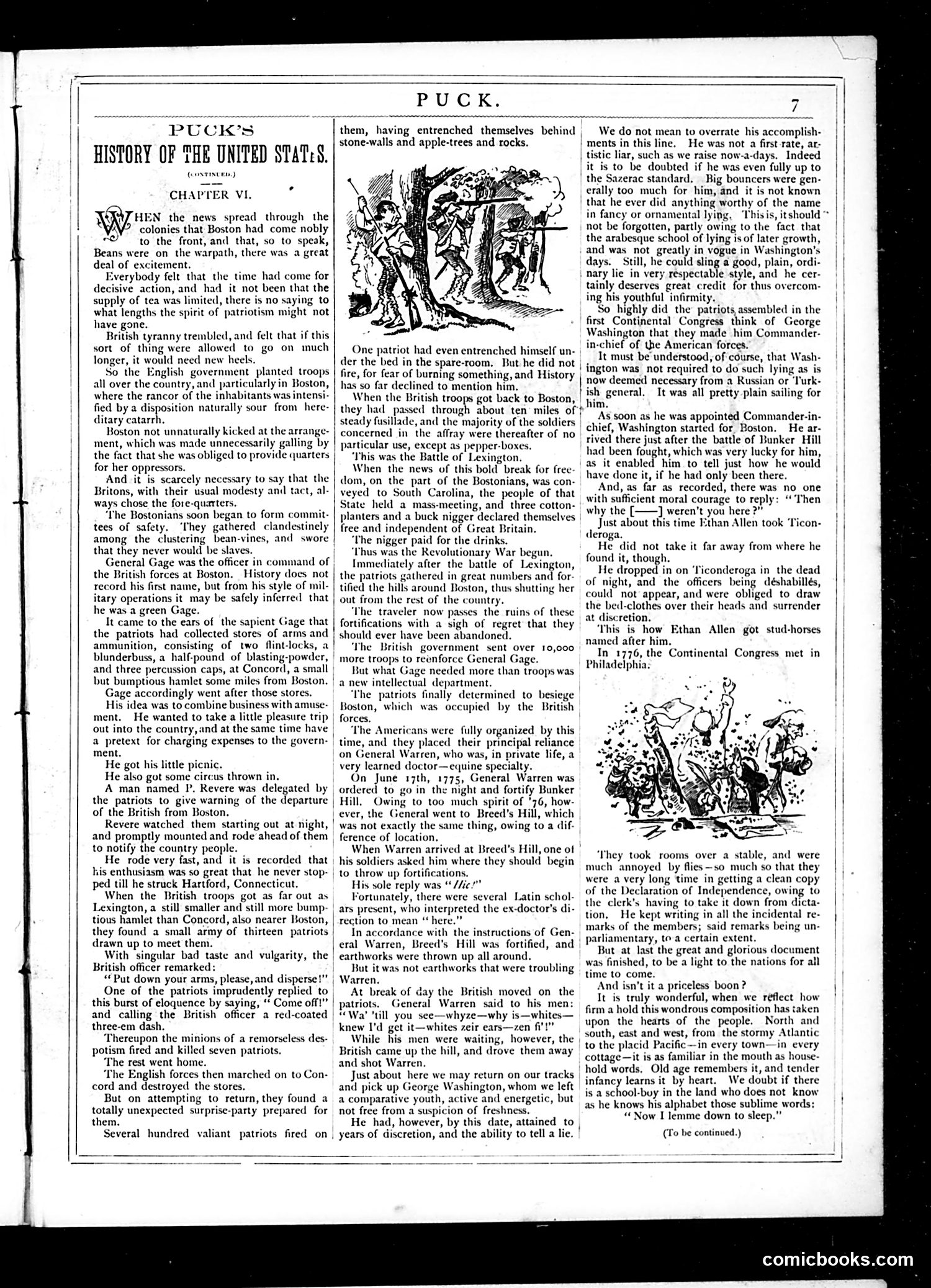
This page presents "Puck's History of the United States," continuing Chapter VI about the American Revolution. The left column contains text describing British military operations and patriot resistance, including General Gage's command and the Battle of Lexington. The two illustrations appear to depict Revolutionary War scenes: the upper image shows soldiers and civilians in conflict near fortifications and buildings, while the lower image shows mounted soldiers, likely representing military action. The text discusses George Washington's appointment as Commander-in-Chief and events around Boston, including references to Bunker Hill and other early Revolutionary engagements. This historical narrative format with satirical illustrations was typical of Puck's educational yet irreverent approach to American history.
📄 Transcribed text from this page (OCR, searchable)
Machine-transcribed from the original scan — historical spelling and the odd misread are preserved.
PUCK’S HISTORY OF THE UNITED STATsS. Goytiscen) CHAPTER VI. GAT HEN the news spread through the (NP colonies that Boston had come nobly °’” to the front, and that, so to speak, Beans were on the warpath, there was a great deal of excitement. verybody felt that the time had come for decisive action, and had it not been that the supply of tea was limited, there is no saying to what lengths the spirit of patriotism might not have gone. British tyranny trembled, and felt that if this sort of thing were allowed to go on much longer, it would need new heels. $o the English government planted troops all over the country, and particularly in Boston, where the rancor of the inhabitants was intensi- fied by a disposition naturally sour from here- ditary catarrh, Boston not unnaturally kicked at the arrange- ment, which was made unnecessarily galling by the fact that she was obliged to provide quarters | for her oppressors. And it is scarcely necessary to say that the Britons, with their usual modesty and tact, al- ways chose the fore-quarters. ‘The Bostonians soon began to form commit- tees of safety. ‘They gathered clandestinely among the clustering bean-vines, and swore that they never would be slaves. General Gage was the officer in command of the British forces at Boston. History docs not | record his first name, but from his style of mil- | itary operations it may be safely inferred that | he was a green Gage. | It came to the ears of the sapient Gage that the patriots had collected stores of arms and | ammunition, consisting of two flint-locks, a | blunderbuss, a half-pound of blasting-powder, and three percussion caps, at Concord, a small but bumptious hamlet some miles from Boston, | Gage accordingly went after those stores. His idea was to combine business with amuse- ment. He wanted to take a little pleasure trip out into the country, and at the same time have | a pretext for charging expenses to the govern- ment, He got his little picnic. He also got some circus thrown in. A man named P. Revere was delegated by the patriots to give warning of the departure | of the British from Boston. Revere watched them starting out at night, | and promptly mounted and rode ahead of them to notify the country people. He rode very fast, and it is recorded that his enthusiasm was so great that he never stop- ped till he struck Hartford, Connecticut. When the British troops got as far out as Lexington, a still smaller and still more bump: tious hamlet than Concord, also nearer Boston, | they found a small army of thirteen patriots drawn up to meet them. | With singular bad taste and vulgarity, the British officer remarked: “Put down your arms, please,and disperse!” One of the patriots imprudently replied to this burst of eloquence by saying, “ Come off!” | and calling the British officer a red-coated three-em dash. Thereupon the minions of a remorseless des- potism fired and killed seven patriots. ‘The rest went home. ‘The English forces then marched on to Con- cord and destroyed the stores. But on attempting to return, they found a totally unexpected surprise-party prepared for them. Several hundred valiant patriots fired on | PUCK. them, having entrenched themselves behind stone-walls and apple-trees and rocks. One patriot had even entrenched himself un- der the bed in the spare-room, But he did not fire, for fear of burning something, and History has so far declined to mention him. When the British troops got back to Boston, they had passed through about ten’ miles of} steady fusillade, and the majority of the soldiers concerned in the affray were thereafter of no particular use, except as pepper-boxes. ‘This was the Battle of Lexington. When the news of this bold break for free- dom, on the part of the Bostonians, was con- veyed to South Carolina, the people of that State held a mass-meeting, and three cotton- planters and a buck nigger declared themselves free and independent of Great Britain. “The nigger paid for the drinks. “Thus was the Revolutionary War begun. Immediately after the battle of Lexington, the patriots gathered in great numbers and for- tified the hills around Boston, thus shutting her out from the rest of the country, ‘The traveler now passes the ruins of these fortifications with a sigh of regret that they should ever have been abandoned. ‘The British government sent over 10,000 more troops to reunforce General Gage. But what Gage needed more than troops was a new intellectual department. ‘rhe patriots finally determined to besiege Boston, which was occupied by the British forces. The Americans were fully organized. by this time, and the: d_ their principal reliance on General Warren, who was, in private life, a very learned doctor—equine specialty, On June 17th, 1775, General Warren was ordered to go in the night and fortify Bunker Hill, Owing to too much spirit of '76, how- ever, the General went to Breed’s Hill, which was not exactly the same thing, owing to a dif. ference of location, When Warren arrived at Breed’s Hill, one of his soldiers asked him where they should begin to throw up fortifications. His sole reply was “//ic!” Fortunately, there were several Latin schol ars present, who interpreted the ex-doctor’s di- rection to mean “here,” In accordance with the instructions of Gen- eral Warren, Breed’s Hill was fortified, and earthworks were thrown up all around. But it was not earthworks that were troubling Warren, At break of day the British moved on the patriots. General Warren said to his men: ‘Wa’ ‘till you: see—whyze—why is—whites— knew I'd get it—whites zeir ears—zen fi!” While his men were waiting, however, the British came up the hill, and drove them away and shot Warren. Just about here we may return on our tracks and pick up George Washington, whom we left a comparative youth, active and energetic, but not free from a suspicion of freshness. He had, however, by this date, attained to , years of discretion, and the ability to tell a lic. We do not mean to overrate his accomplish- ments in this line. He was not a first-rate, ar- tistic liar, such as we raise now-a-days. Indeed it is to be doubted if he was even fully up to the Sazerac standard. _ Big bouncers were gen- erally too much for him, and it is not known that he ever did anything worthy of the name in fancy or ornamental lying, ‘Th not be forgotten, partly owing to the fact that the arabesque school of lying is of later growth, and was not greatly in vogue in Washington’s days. Still, he could sling a good, plain, ordi- nary lie in very respectable style, and he cer- tainly deserves great credit for thus overcom- ing his youthful infirmity. So highly did the: patriots assembled in the first Continental Congress think of George Washington that they made him Commander- in-chief of the American forces. It must be understood, of course, that Wash- ington was not required to do such lying as is now deemed necessary from a Russian or ‘Turk- ish gencral. It was all pretty plain sailing for him. As soon as he was appointed Commander-in- chief, Washington started for Boston. He ar- rived there just after the battle of Bunker Hill had been fought, which was very lucky for him, as it enabled him to tell just how he would have done it, if he had only been there. And, as far as recorded, there was no one with sufficient moral courage to reply: “ ‘Then why the [—] weren't you here ?” Just about this time Ethan Allen took ‘Ticon- deroga. He did not take it far away from where he found it, though. He dropped in on ‘Ticonderoga in the dead of night, and the officers being déshabillés, could’ not appear, and were obliged to draw the bed-clothes over their heads and surrender at discretion. ‘This is how Ethan Allen got stud-horses named after him. In 1776, the Continental Congress met in Philadelphia: ‘They took rooms over a stable, and were much annoyed by flies—so much so that they were avery long time in getting a clean copy of the Declaration of Independence, owing to the clerk's having to take it down from dicta- tion, He kept writing in all the incidental re- marks of the members; said remarks being un- parliamentary, to a certain extent, But at last the great and glorious document was finished, to be a light to the nations for all time to come. And isn’t it a priceless boon ? It is truly wonderful, when we réflect how firm a hold this wondrous composition has taken upon the hearts of the people. North and south, east and west, from the stormy Atlantic to the placid Pacific—-in every town—in every cottage—it is as familiar in the mouth as house- hold words. Old age remembers it, and tender infancy learns it by heart. We doubt if there is a school-buy in the land who does not know as he knows his alphabet those sublime words: “Now I lemme down to sleep.” (To be continued.) , itshould * comicbooks.com