
Puck, 1877-09-05 · page 13 of 17
Puck — September 5, 1877 — page 13: what you’re looking at
What you’re looking at
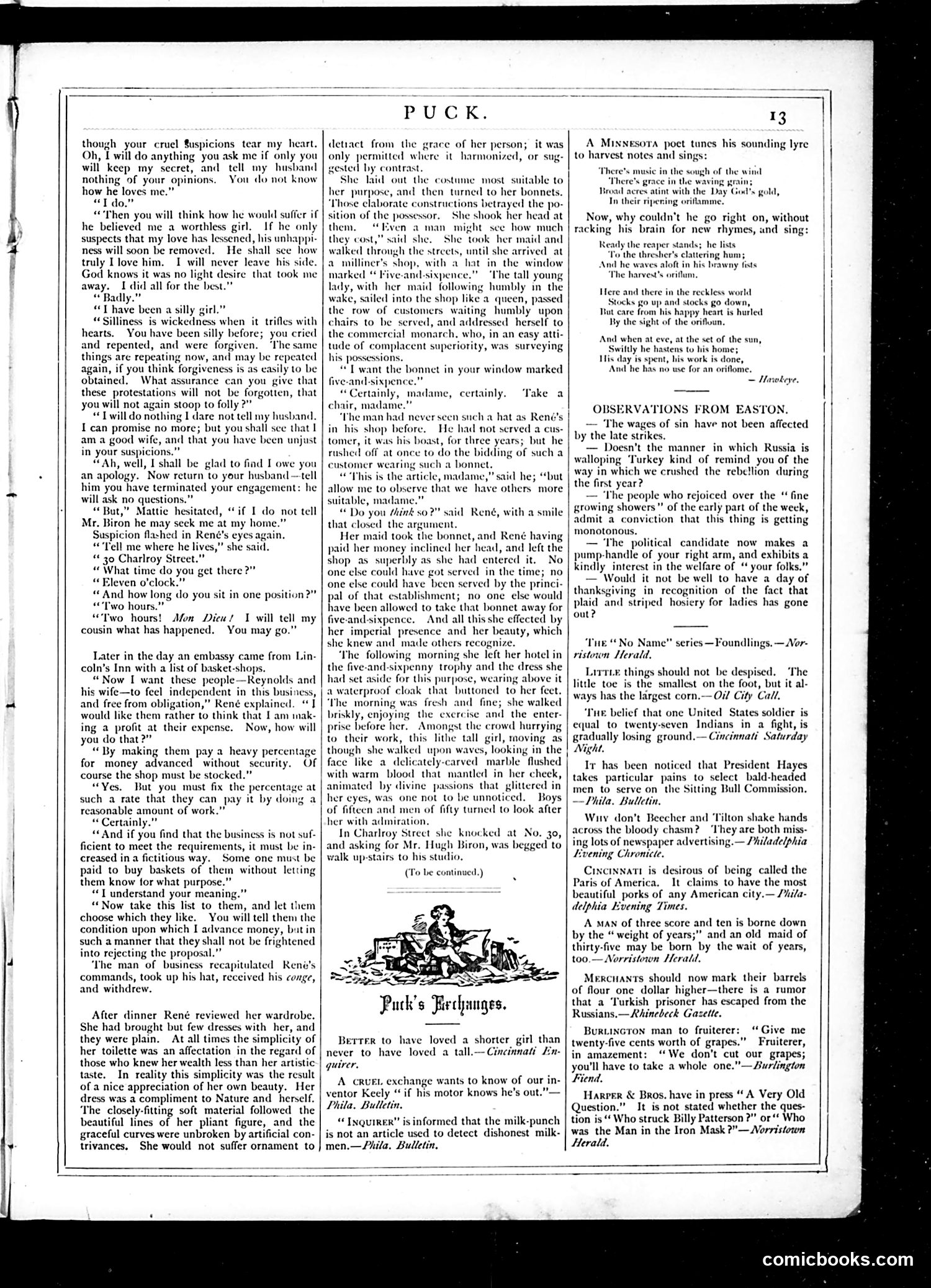
This page contains mostly text—dialogue and a short story continuation—rather than political cartoons. The main illustrated element is "Puck's Jestings," a small decorative vignette at bottom showing a cherubic figure amid scattered objects. The page includes social commentary in brief items: criticism of President Hayes' appointment to the Sitting Bull Commission; mockery of Cincinnati's civic pride; and a joke about flour prices allegedly caused by Russian competition. The dialogue excerpt appears to be from a serialized story about a woman shopping for bonnets, featuring period domestic humor about marriage and fashion. Without clearer political illustrations or identified caricatures on this particular page, the satirical commentary remains minor and fragmented rather than unified around specific political figures or events.
📄 Transcribed text from this page (OCR, searchable)
Machine-transcribed from the original scan — historical spelling and the odd misread are preserved.
a though your cruel Suspicions tear my heart. Oh, will do anything you ask me if only you will keep my secret, and tell my husband nothing of your opinions. You do not know how he loves me.”” “T do.” “Then you will think how he would suffer if he believed me a worthless girl. If he only suspects that my love has lessened, his unhappi- ness will soon be removed. He shall sce how truly I love him. I will never leave his side. God knows it was no light desire that took me away. I did all for the best.” “ Badly." “T have been a silly girl.” “Silliness is wickedness when it trifles with hearts. You have been silly before; you cried and repented, and were forgiven. ‘The same things are repeating now, and may be repeated again, if you think forgiveness is as easily to be obtained, What assurance can you give that these protestations will not be forgotten, that you will not again stoop to folly 2” “ Twill do nothing I dare not el my husband. I can promise no more; but you shall see that | am a good wife, and that yoit have been unjust in your suspicions.” “Ah, well, I shall be glad to find I owe you an apology. Now return to your husband —tell him you have terminated your engagement: he will ask no questions. “But,” Mattie hesitated, Mr. Biron he may seck me at my home Suspicion flashed in René’s eyes again. “Tell me where he lives,” she said. “ 30 Charlroy Street.” “What time do you get there ?” “Eleven o'clock. « And how long do you sit in one position?” “Two hours.”” “Two hours! Afon cousin what has happened. “if I do not tell Dieu! J will tell my You may go.” Later in the day an embassy came from Lin- coln’s Inn with a list of basket-shops. “Now I want these people—Reynolds and his wife—to feel independent in this business, and free from obligation,” René explained. “1 would like them rather to think that Iam mak- ing a profit at their expense. Now, how will you do that?” “By making them pay a heavy percentage for money advanced without security. Of course the shop must be stocked. “Yes, But you must fix the percentage at such a rate that they can pay it by doing a reasonable amount of work.” “ Certainly.” “And if you find that the business is not suf- ficient to meet the requirements, it must be in- creased in a fictitious way. Some one must be paid to buy baskets of them without letting them know for what purpose.” “T understand your meaning. “Now take this list to them, and let them choose which they like. You will tell them th condition upon which I advance money, but in such a manner that they shall not be frightened into rejecting the proposal.” ‘The man of business recapitulated René commands, took up his hat, received his conge, and withdrew. After dinner René reviewed her wardrobe. She had brought but few dresses with her, and they were plain. At all times the simplicity of her toilette was an affectation in the regard of those who knew her wealth less than her artistic taste. In reality this simplicity was the result of a nice appreciation of her own beauty. Her dress was a compliment to Nature and herself. ‘The closely-fitting soft material followed the beautiful lines of her pliant figure, and the graceful curves were unbroken by artificial con- trivances, She would not suffer ornament to detiact from the grace of her person; it was only permitted where it harmonized, or sug- gested by contrast. She laid out the costu most suitable to her purpose, and then turned to her bonnets. ‘Those claborate constructions betrayed the po- sition of th She shook her head at them. Even a man might see how much they cost,” said she. She took her maid and walked through the streets, until she arrived at a milliner’s shop, with a hat in the window marked “ Five-and-sixpence.” ‘The tall young lady, with her maid following humbly in the wake, sailed into the shop like a queen, passed the row of customers waiting humbly upon chairs to be served, and addressed herself to the commercial monarch. who, in an easy atti- tude of complacent superiority, was surveying his possessions. “TL want the bonnet in your window marked nd-sixpence.” “Certainly, madame, certa chair, madame.” ‘The man had never seen such a hat as René’s in his shop before. He had not served a cus- tomer, it was his boast, for three years; but he rushed off at once to do the bidding of such a customer wearing such a bonnet “This is the article, madame,” said he; “but allow me to observe that we have others more suitable, madame.” “Do you fink so?” said René, with a smile that closed the argument. Her maid took the bonnet, and René having paid her money inclined her head, and left the shop as superbly as she had entered it. No one else could have got served in the time; no one else could have been served by the princi- pal of that establishment; no one else would have been allowed to take that bonnet away for five-and-sixpence. And all this she effected by her imperial presence and her beauty, which she knew and made oth recognize. ‘The following morning she left her hotel in the five-and-sixpenny trophy and the dress she had set aside for this purpose, wearing above it a waterproof cloak that buttoned to her feet. ‘The morning was fresh and fine; she walked briskly, enjoying the exercise and the enter- prise before her. Amongst the crowd hurrying to their work, this lithe tall girl, moving as though she walked upon waves, looking in the face like a delicately-carved marble flushed with warm blood that mantled in her cheek, animated by divine passions that glittered in her eyes, was one not to be unnoticed. Boys of fifteen and men of fifty turned to look after her with admiration, In Charlroy Street she knocked at No. 30, and asking for Mr. Hugh Biron, was begged to walk up-stairs to his studio, vossessor. five inly. ‘Take a (To be continued.) Puck's Hechanges. Berrer to have loved a shorter girl than never to have loved a tall.—Cincinnati quirer, A. cRvEL exchange wants to know of our in- ventor Keely “ if his motor knows he’s out.”"— Phila, Bulletin. Inquirer” is informed that the milk-punch is not an article used to detect dishonest milk- men.—Sihila, Bulletin, NESOTA poct tunes his sounding lyre to harvest notes and sings: ‘There's music in the sough of the wind ‘There’s grace in the waving Hrroadd acres atint with the Day ¢ In their ripening orilamme. Now, why couldn't he go right on, without racking his brain for new rhymes, and sing: Ready the reaper stands; he lists ‘o the thresher's clattering hum; Vhe waves aloft in his brawny fists ‘The harvest’s oritlum, Here and there in the reckless world Stocks go up and stocks go d Tiat care from his happy heart is hurled By the sight of the orifloun, And when at eve, at the set of the sun, Swiltly he hastens to his home; His day is spent, his work is done, And he has no use for an oriflome. — Hawkeye. OBSERVATIONS FROM EASTON. — The wages of sin have not been affected by the late strikes, — Doesn't the manner in which Russia is walloping ‘Turkey kind of remind you of the way in which we crushed the rebellion during the first year? he people who rejoiced over the “ fine growing showers” of the early part of the week, admit a conviction that this thing is getting monotonous. — The political candidate now makes a pump-handle of your right arm, and exhibits a kindly interest in the welfare of “ your folks.” — Would it not be well to have a day of thanksgiving in recognition of the fact that plaid and striped hosiery for ladies has gone out? ‘Tne “No Name” series—Foundlings. —Nor- ristown Herald. Lirtie things should not be despised. ‘The little toe is the smallest on the foot, but it al- ways has the largest corn.— Oil City Call. ‘Tne belief that one United States soldier is equal to twenty-seven Indians in a fight, is gradually losing ground.— Cincinnati Saturday Night. Ir has been noticed that President Hayes takes particular pains to select bald-headed men to serve on the Sitting Bull Commission. —Phila, Bulletin. Why don't Beecher and ‘Tilton shake hands across the bloody chasm? ‘They are both miss- ing lots of newspaper advertising. — Philadelphia Evening Chronicle. Cincinnati is desirous of being called the Paris of America, It claims to have the most beautiful porks of any American city.— /%ila- delphia Evening Times. A Man of three score and ten is borne down by the “weight of years; and an old maid of thirty-five may be born by the wait of years, too.— Norristown Herald, Mercuants should now mark their barrels of flour one dollar higher—there is a rumor that a Turkish prisoner has escaped from the Russians.—Khinebeck Gazelle. BuRtincTon man to fruiterer: “Give me twenty-five cents worth of grapes.” Fruiterer, in amazement: “We don't cut our grapes; you'll have to take a whole one."—Surlington Fiend. Harper & Bros. have in press “A Very Old Question.” It is not stated whether the ques- tion is “ Who struck Billy Patterson ?” or‘ Who was the Man in the Iron Mask ?”—Norristown Herald. | comicbooks.com