
Puck, 1877-09-05 · page 3 of 17
Puck — September 5, 1877 — page 3: what you’re looking at
What you’re looking at
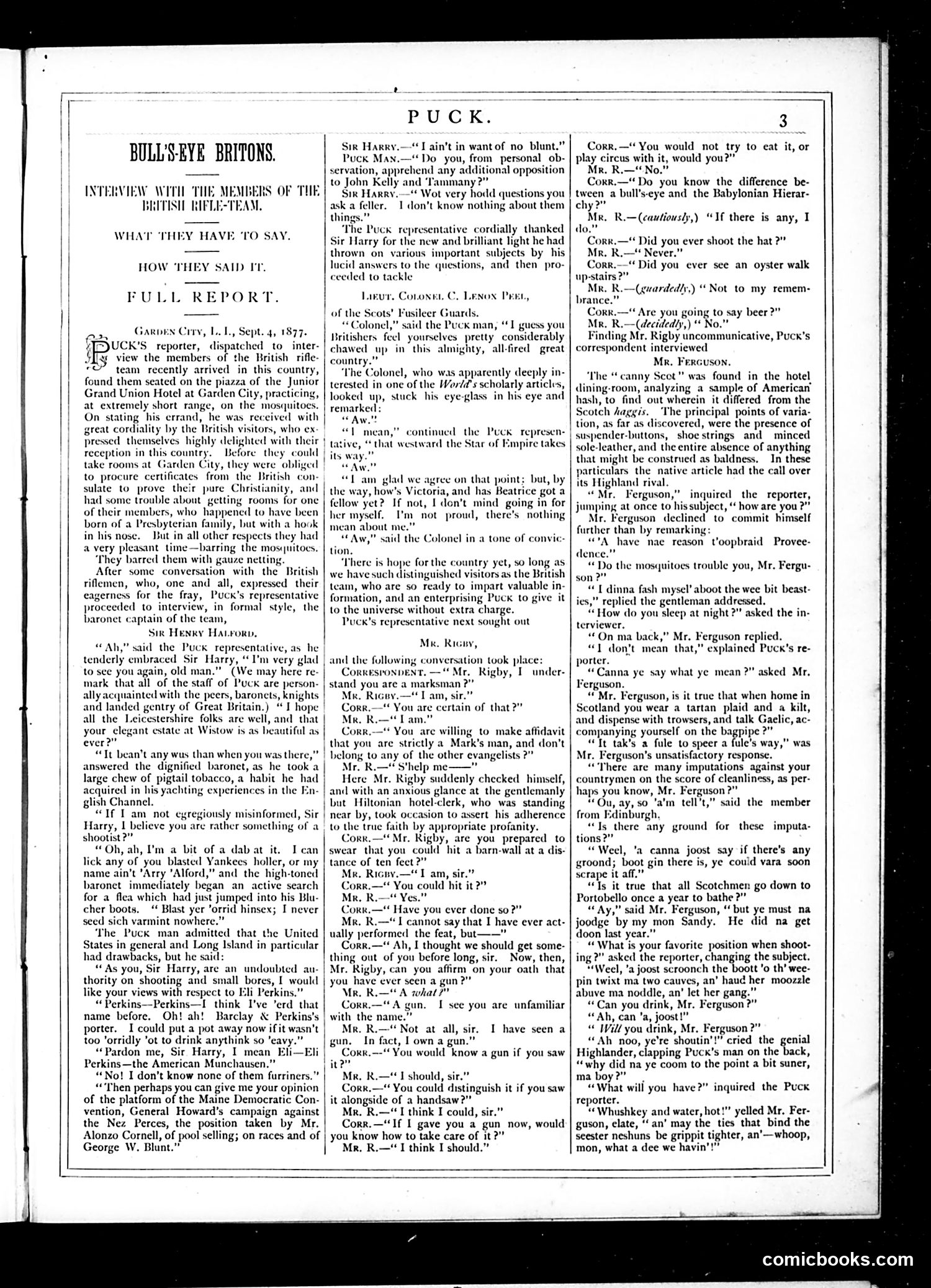
This page presents an interview between Puck's reporter and members of the British rifle team who recently visited America. The satirical content mocks both the British visitors and American attitudes toward them. The humor targets British stereotypes—their perceived superiority, unfamiliarity with American customs (oysters, Scottish attire, guns), and social pretensions. The British team members appear somewhat defensive and condescending when questioned about their sporting abilities and knowledge of American life. The satire also jibes at American eagerness to impress foreign dignitaries and Americans' self-consciousness about their own culture. Questions about Scottish kilts, guns, and regional customs reveal how the British visitors seemed exotic and strange to American audiences of this era (1877). The piece exemplifies Puck's typical approach: using celebrity interviews to highlight cultural differences and national stereotypes for comedic effect.
📄 Transcribed text from this page (OCR, searchable)
Machine-transcribed from the original scan — historical spelling and the odd misread are preserved.
BULLSEYE BRITONS. STEW WITH THE MEMBERS OF BRITISH RIFLE-TEAM. y HAVE THE WHAT THE TO SAY. HOW THEY SAID IT. FULL REPORT. Garven Crry, L. 1, Sept. 4, 1877 4 reporter, dispatched to inter- SIEy view the members of the British rifle: | team recently arrived in this country, found them seated on the piazza of the Junior Grand Union Hotel at Garden City, practicing at extremel hort range, on the mosquitoes. | errand, he ed with great cordiality by the British pressed themselves highly del reception in this country. Before they could take rooms at rden City, they were ‘obliged | to procure certificates from the British con: sulate to prove their pure Christianity, and had some trouble about getting rooms for one of their members, who happened to have been born of a Presbyterian family, but with a hook in his nose. But in all other respects they had a very pleasant time—barring the mosyuitoes. ‘They barred them with gauze netting. After some conversation with the British riflemen, who, one and all, expressed. their eagerness for the fray, Puc representative proceeded to interview, in formal style, the baronet captain of the team, Sin Henry Hasrorv, “Ah,” said the Puck representative, as he tenderly embraced Sir Harry, “I'm very glad to see you again, old man.” (We may here re mark that all of the staff of Puck are person- ally acquainted with the peers, baroncts, knights and landed gentry of Great Britain.) “I hope | all the I hire folks are well, and that | your clegant estate at Wistow is as beautiful as ever?" “Tt bean’t any wus than when you was there,"”” answered the dignified baronet, as he took a large chew of pigtail tobacco, a habit he had | acquired in his yachting experiences in the En- glish Channel. “If Tam not egregiously misinformed, Sir Harry, I believe you are rather something of a shootist ?”” “Oh, ah, I'm a bit of a dab at it. can lick any of you blasted Yankees holler, or my name ain't 'Arry 'Alford,” and the high-toned baronet immediately began an active search for a fica which had just jumped into his Blu- cher boots. Blast yer ’orrid hinsex; I never seed sich varmint nowhers The Puck man admitted that the United States in general and Long Island in particular had drawbacks, but he said: “As you, Sit Harry, are an undoubted au- thority on shooting and small bores, I would | like your views with respect to Eli P rkins.”” “ Perkins—Perkins—I think I've 'erd that name before. Oh! ah! Barclay & Perkins's porter. I could put a pot away now ifit wasn’t | too 'orridly ‘ot to drink anythink so 'eavy.’ “Pardon me, Sir Harry, I mean E Perkins—the American Munchausen.” | “No! I don’t know none of them furriners.” | “Then perhaps you can give me your opinion of the platform of the Maine Democratic Con- vention, General Howard’s campaign against the Nez Perces, the position taken by Mr. | Alonzo Cornell, of pool selling; on races and of George W. Blunt.” | gun. j ive PUCK. Sir Harry.—‘I ain't in want of no blunt.” Puck May.—“Do you, from personal ob- servation, apprehend any additional opposition to John Kelly and ‘Tammany ?” Sin Harry.“ Wot very hodd questions you ask a feller. 1 don’t know nothing about them things.” ‘The Puck representative cordially thanked it Harry for the new and brilliant light he had thrown on various important subjects by his lucid answers to the questions, and then pro- ceeded to tackle lanur. of the Scots’ Fusileer Guards. “Colonel,” said the Puck man, ‘1 guess you Britishers feel yourselves pretty considerably chawed up in’ this almighty, all-fired great country.” ‘The Colonel, who was apparently deeply in- terested in one of the Word/d's scholarly articles, looked up, stuck his eye-glass in his eye and remarkec “Aw “1 mean,” tative, “ that westward the $ | its way. “Aw.” “Tam glad we agree on that point; but, by the way, how's Victoria, and has Beatrice got a fellow yet? If not, I don’t mind going in for her myself. I'm not proud, there's nothing mean about me.” “Aw,” said the Colonel in a tone of convic- tion ‘There is hope forthe country yet, so long as we have such distinguished visitors as the British team, who are so ready to impart valuable in- formation, and an enterprising Puck to give it to the universe without extra charge. Puck's representative next sought out Coronet C. LENOX PREL, continued the Puck represen- ar of Empire takes Mk. Ricny, | and the fullowing conversation took place: Corkesvonpent. —“ Mr. under- stand you are a marksman ?”” Mr. Riguy.—‘ I am, sir.” Corr.—** You certain of that?” Mr. R Lam. Corr You are willing to make affidavit that you are strictly a Mark's man, and don't Lelong to any of the other evangelists ?” Mr. R.—“S'help me—" Here Mr. Rigby suddenly checked himself, Rigby, I | and with an anxious glance at the gentlemanly but Hiltonian hotel-clerk, who was standing near by, took occasion to assert his adherence to the true faith by appropriate profanity. Corr.— Mr. Rigby, are you prepared to swear that you could hit a barn-wall at a dis- tance of ten fect?” Mr. Ricny,— I am, sir.”” You could hit it?” “Yes.” Have you ever done so Mr. R.—I cannot say that I have ever act- ually performed the feat, but——" Corr.—“ Ah, I thought we should get some- thing out of you before long, sir. Now, then, Mr. Rigby, can you affirm on your oath that you have ever seen a gun 2” Mr. R.—“* A what?" Corr.—"A gun. I see you are unfamiliar with the nam Mr. R.—‘ Not at all, sir. In fact, I own a gun.” Corr.—* You would know a gun if you saw I have seen a Mr. R.—‘‘ I should, sir. Corr.—* You could distinguish it if you saw it alongside of a handsaw?” Mr. R.—“ I think I could, sir. Corr.—‘If I gave you a gun now, would you know how to take care of it?” Mr. R.—‘‘I think I should.” 3 Corr.—‘* You would not try to eat it, or play circus with it, would you?” Mr. R.—‘‘ No.” Corr.—“ Do you know the difference be- tween a bull’s-eye and the Babylonian Hierar- chy? Mr, do.” Corr.—* Did you ever shoot the hat ?”” Mr. R.— Corr.“ Did you ever see an oyster walk upstairs?” Mr. R.—(gwardediv,) “Not to my remem- brance.” Cork.—“ Are you going to say beer?” Mr. R.—(decidedly,) “ No.” Finding Mr. Rigby uncommunicative, Puck's correspondent interviewed Mr. Fercuson. ‘The “canny Sect” was found in the hotel dining-room, analyzing a sample of American hash, to find out wherein it differed from the cotch haggis. The principal points of varia- tion, as far as discovered, were the presence of suspender-buttons, shox Strings and minced sole-leather, and the entire absence of anything that might be construed as baldness. In these particulars the native article had the call over its Highland rival. “Mr. Ferguson,” inquired the reporter, jumping at once to his subject, “ how are you?” Mr. Ferguson declined to commit himself further than by remarking: “A have nae reason’ Uoopbraid dence.” “Do the mos¢ son ?”” “T dinna fash mysel’ aboot the wee bit beast- ies,” replied the gentleman addressed. “ How do you sleep at night ?"” asked the in- terviewer. “On ma back,” Mr. Ferguson replied. “7 don’t mean that,” explained Puck's re- porter. “Canna Ferguson. “Mr. Ferguson, is it true that when home in Scotland you wear a tartan plaid and a kilt, and dispense with trowsers, and talk Gaelic, ac- companying yourself on the bagpipe ? “Tt tak’s a fule to speer a fule's way,” was ‘erguson’s unsatisfactory response. here are many imputations against your countrymen on the score of cleanliness, as per- haps you know, Mr. Ferguson?” “Ou, ay, so 'a’m tell’t,” said the from Edinburgh, “Is there any ground for these imputa- tio “Weel, ‘a canna joost say if there's any ; gin there is, ye could vara soon scrape it aff. “Is it true that all Scotchmen go down to Portobello once a year to bathe ?” “ Ay,” said Mr. Ferguson, “ but ye must na joodge by my mon Sandy. He did na get doon last year.” “What is your favorite position when shoot- ing?” asked the reporter, changing the subject. “Weel, ’a joost scroonch the boott 'o th’ wee- pin twixt ma two cauves, an’ haud her moozzle abuve ma noddle, an’ let her gang.’ “Can you drink, Mr. Ferguson?” “Ah, can 'a, joost!"” “Will you drink, Mr. Ferguson ?” “Ah noo, ye're shoutin’!” cried the genial Highlander, clapping Puck's man on the back, “why did na ye coom to the point a bit suner, ma boy?” “What will you have?” inquired the Puck reporter. “Whushkey and water, hot!” yelled Mr. Fer- guson, clate, “ an’ may the ties that bind the seester neshuns be grippit tighter, an'—whoop, mon, what a dee we havin’! R.—(cautiously,) “If there is any, I Provee- itoes trouble you, Mr. Fergu- say what ye mean?” asked Mr. member comicbooks.com