
Puck, 1877-09-05 · page 6 of 17
Puck — September 5, 1877 — page 6: what you’re looking at
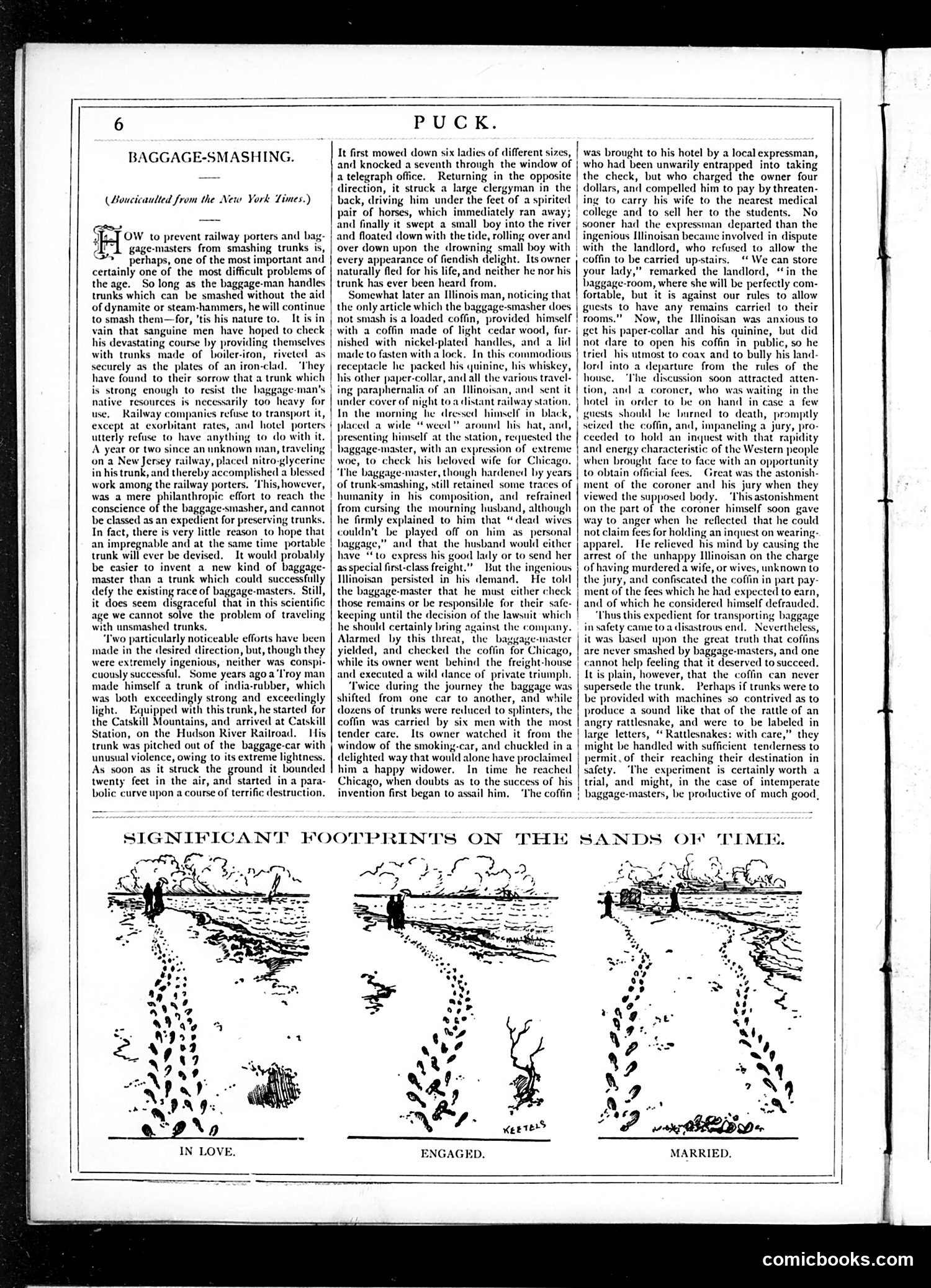
What you’re looking at
This cartoon satirizes the changing nature of relationships through three beach scenes labeled "In Love," "Engaged," and "Married." Each shows footprints in sand—symbolizing traces left by time—progressing from romantic to increasingly chaotic patterns. The humor plays on Victorian courtship conventions: the first shows orderly footprints suggesting careful, intentional romance; the second becomes more tangled as commitment approaches; the third devolves into scattered, almost destructive marks, implying marriage brings domestic chaos. The cartoon reflects period anxieties about matrimony—a common Puck theme—suggesting that romantic idealization gives way to the messy realities of married life. The "footprints" metaphor emphasizes how relationships literally leave their mark, deteriorating from initial promise.
📄 Transcribed text from this page (OCR, searchable)
Machine-transcribed from the original scan — historical spelling and the odd misread are preserved.
BAGGAGE-SMASHING. (Boucicaulted from the New York Lines.) 5m to prevent railway porters and bag- at gage-masters from smashing trunks is, | “3” perhaps, one of the most important and certainly one of the most difficult problems of the age. So long as the baggage-man handles trunks which can be smashed without the aid of dynamite or steam-hammers, he will continue | to smash them—for, ’tis his nature to. It is in vain that sanguine men have hoped to check his devastating course by providing themselves with trunks made of boiler-iron, riveted as securely as the plates of an iron-clad. ‘I'hey have found to their sorrow that a trunk which is strong enough to resist the bag} man’s | resources is necessarily too heavy for Railway companies refuse to transport it, | except at exorbitant rates, and hotel porters | utterly refuse to have anything to do with it. | A year or two since an unknown man, traveling j on‘a New Jersey railway, placed nitro-glycerine | in his trunk, and thereby accomplished a blessed work among the railway porters. ‘This,however, | was a mere philanthropic effort to reach the | conscience of the baggage-smasher, and cannot be classed as an expedient for preserving trunks. In fact, there is very little reason to hope that an impregnable and at the same time portable | trunk will ever be devised. It would probably be easier to invent a new kind of bagga master than a trunk which could successfully defy the existing race of baggage-masters. Still, it does seem disgraceful that in this scientific age we cannot solve the problem of traveling with unsmashed trunks. “lwo particularly noticeable efforts have been made in the desired direction, but, though they were extremely ingenious, neither was conspi- cuously successful. Some years ago a‘I'roy man made himself a trunk of india-rubber, which was both exceedingly strong and exceedingly light. Equipped with this trunk, he started for the Catskill Mountains, and arrived at Catskill Station, on the Hudson River Railroad. His trunk was pitched out of the baggage-car with unusual violence, owing to its extreme lightness. As soon as it struck the ground it bounded twenty feet in the air, and started in a para- bolic curve upon a course of terrific destruction. PUCK. It first mowed down six ladies of different sizes, and knocked a seventh through the window of | a telegraph office. Returning in the opposite direction, it struck a large clergyman in the back, driving him under the feet of a spirited pair of horses, which immediately ran away and floated down with the tide, rolling over and over down upon the drowning small boy with every appearance of fiendish delight. Its owner | naturally fled for his life, and neither he nor his trunk has ever been heard from. Somewhat later an Illinois man, noticing that | the only article which the baggage-smasher does not smash is a loaded coffin, provided himself | with a coffin made of light cedar wood, fur- nished with nickel-plated handles, and a lid made to fasten with a lock, In this commodious receptacle he packed his quinine, his whiskey, his other paper-collar, and all the various travel: ing paraphernalia of an Ilinoisan, and sent it | under cover of night toa distant railway station, } In the morning he dressed himself in’ black placed a wide “weed” around his hat, and, | presenting himself at the station, requested the baggage-master, with an expression of extreme woe, to check his beloved wife for Chicago. | ‘The baggage-master, though hardened by years of trunk-smashing, still retained some traces of humanity in his composition, and refrained from cursing the mourning husband, although he firmly explained to him that “dead wives couldn't be played off on him as personal baggage,” and that the husband would either have ‘to express his good lady or to send her as special first-class freight.” But the ingenious Mlinoisan persisted in his demand, He told the baggage-master that he must cither check those remains or be responsible for their safe keeping until the decision of the lawsuit which | he should certainly bring against the company. Alarmed by this threat, the bagyage-master yielded, and checked the coffin for Chicago, while its owner went behind the freight-house | and executed a wild dance of private triumph. ‘Twice during the journey the baggage was shifted from one car to another, and while dozens of trunks were reduced to splinters, the coffin was carried by six men with the most tender care, Its owner watched it from the | window of the smoking-car, and chuckled ina | delighted way that would alone have proclaimed | hima happy widower. In time he reached Chicago, when doubts as to the success of his invention first began to assail him. ‘The coffin | ENGAGED. ' college and to sell her to the students. | and finally it swept a small boy into the river | was brought to his hotel by a local expressman, who had been unwarily entrapped into taking the check, but who charged the owner four dollars, and compelled him to pay by threaten- ing to carry his wife to the nearest medical No sooner had the expressman departed than the ingenious IIlinoisan became involved in dispute with the landlord, who refused to allow the coffin to be carried up-stairs. ‘ We can store your lady,” remarked the landlord, “in the baggage-room, where she will be perfectly com- fortable, but it is against our rules to allow guests to any remains carried to their rooms." Now, the Illinoisan was anxious to get his paper-collar and his quinine, but did not dare to open his coffin in public, so he tried his utmost to coax and to bully his land- lord into a departure from the rules of the house, ‘Ihe discussion soon attracted atten- tion, and a coroner, who was waiting in the hotel in order to be on hand in case a few | guests should be burned to death, promptly seized the coffin, and, impaneling a jury, pro- ceeded to hold an inquest with that rapidity and energy characteristic of the Western people when brought face to face with an opportunity to obtain official fees. Great was the astonish- ment of the coroner and his jury when they viewed the supposed body. ‘This astonishment on the part of the coroner himself soon gave way to anger when he reflected that he could not claim fees for holding an inquest on wearing- apparel. He relieved his mind by causing the arrest of the unhappy Illinoisan on the charge of having murdered a wife, or wives, unknown to the jury, and confiscated the coffin in part pay- ment of the fees which he had expected to earn, and of which he considered himself defrauded. “hus this expedient for transporting baggage in safety came toa disastrous end. Nevertheless, it was based upon the great truth that coffins are never smashed by baggage-masters, and one cannot help feeling that it deserved to succeed. It is plain, however, that the coffin can never supersede the trunk. Perhaps if trunks were to be provided with machines so contrived as to produce a sound like that of the rattle of an angry rattlesnake, and were to be labeled in large letters, ‘Rattlesnakes: with care,” they might be handled with sufficient tenderness to permit.of their reaching their destination in safety. ‘Ihe experiment is certainly worth a trial, and might, in the case of intemperate baggage-masters, be productive of much good, DS OF {: 'TIMI«. < .) wee: FA Za. VWVWse@ MARRIED. comicbooks.com