
A complete issue · 16 pages · 1877
Puck — April 1877
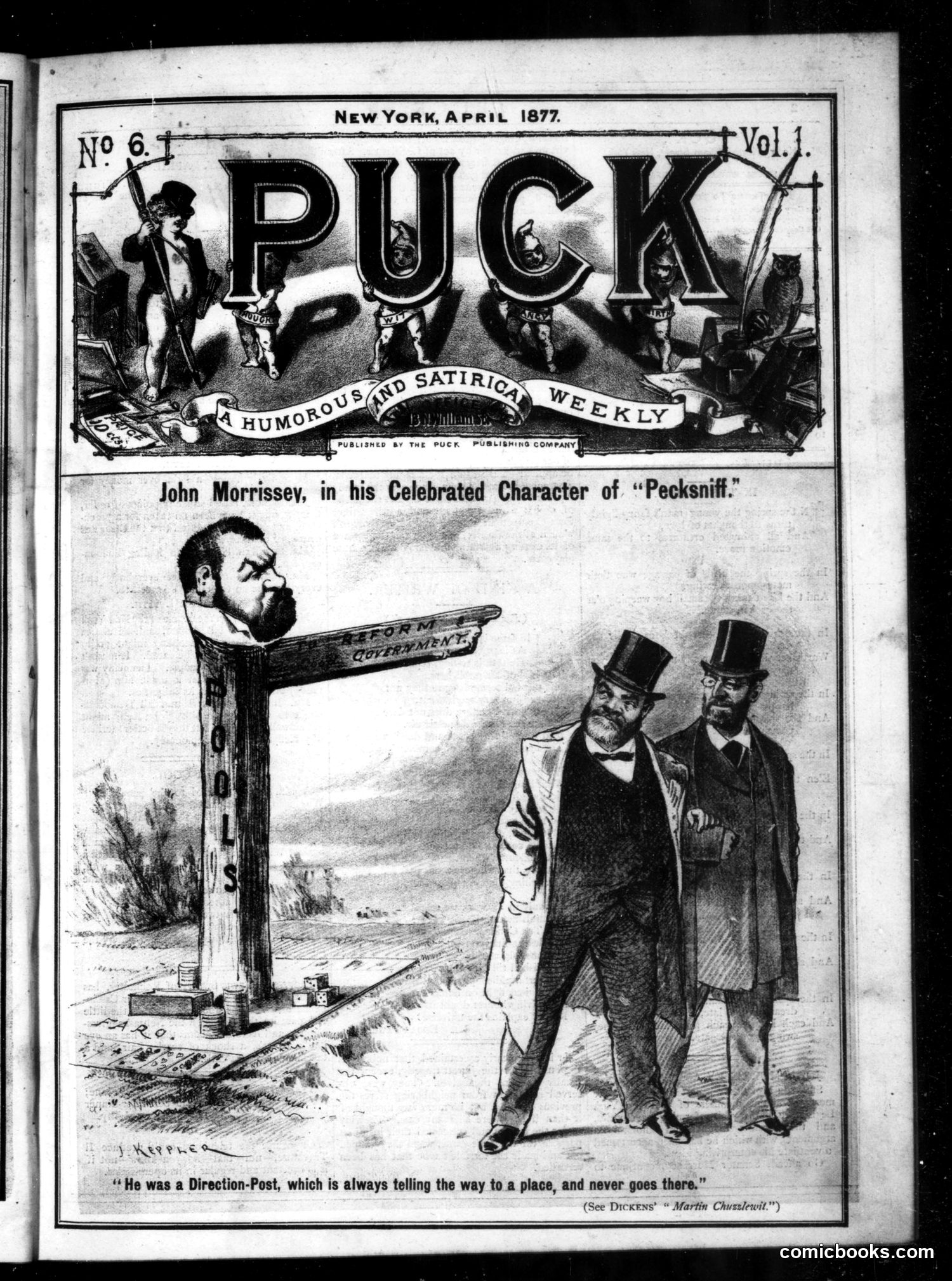
This satirical cartoon features John Morrissey as "Pecksniff," a character from Dickens's *Martin Chuzzlewit*. The image depicts Morrissey (the bearded man atop a signpost labeled "REFORM GOVERNMENT") directing two well-dressed gentlemen, who appear confused or skeptical. The satire mocks Morrissey's political leadership or reform promises as merely directional—all talk with no actual substance. The caption's Dickens reference reinforces this: like Pecksniff, Morrissey is portrayed as a hypocrite who "tells the way to a place, and never goes there." This likely critiques Morrissey's political stance or governance during the Reconstruction era, suggesting his reform rhetoric is dishonest performance rather than genuine commitment.
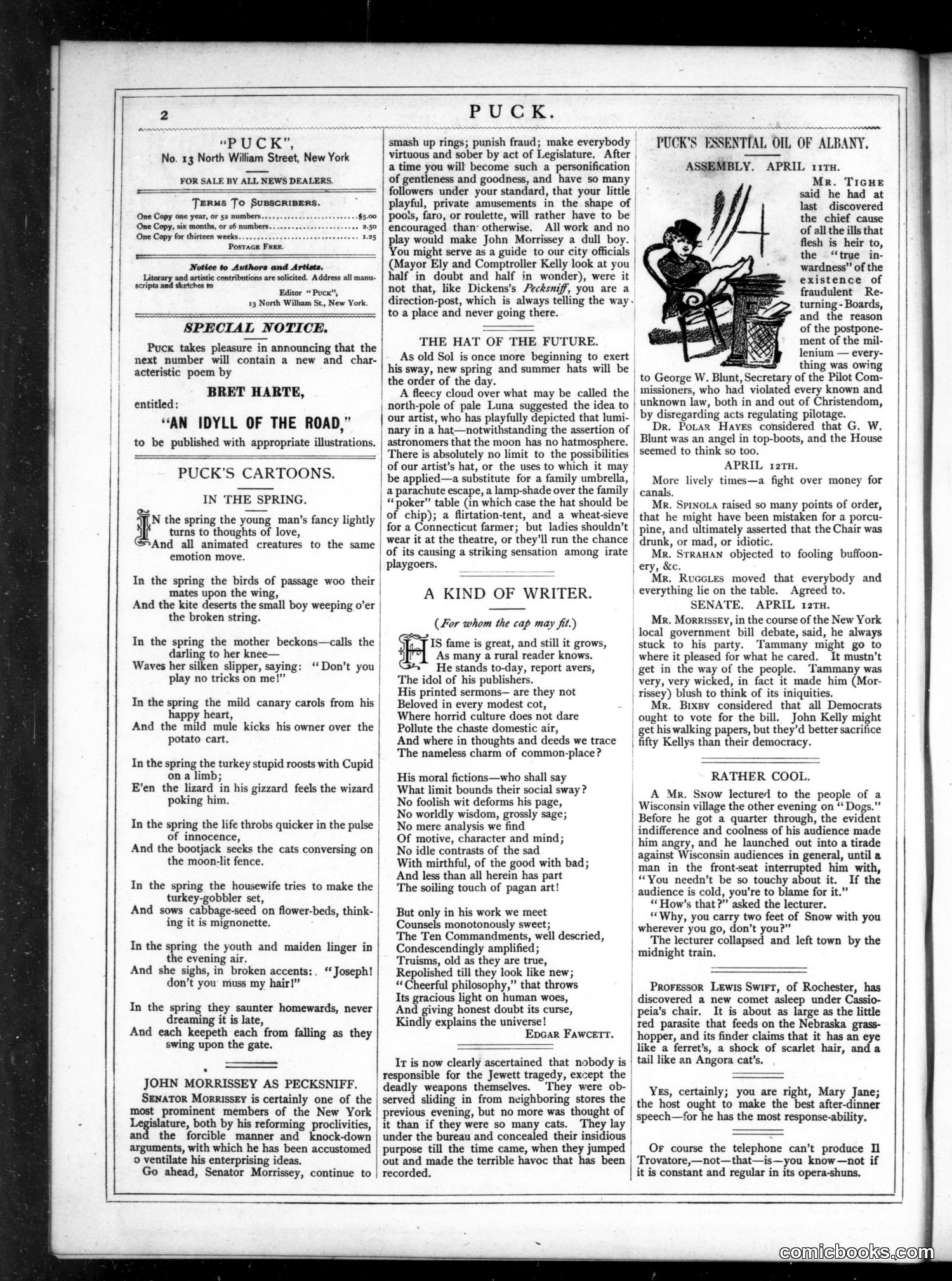
This page primarily contains **literary and political commentary** rather than illustrated cartoons. The main content includes: 1. **"An Idyll of the Road"** — a poem by Bret Harte (announced as a new feature) 2. **Political commentary sections** titled "A Kind of Writer" and "Rather Cool," discussing New York state politics and politicians, including Senator Morrissey 3. **References to specific debates** about Democratic party positions and legislative matters The page demonstrates Puck's dual function as both a humor magazine and political commentary vehicle. Without clearer illustrations visible in this section, the satire relies on textual wit and references to contemporary New York political figures and debates rather than visual caricature. The tone suggests criticism of politicians' inconsistency and grandstanding.
This page contains mostly satirical text commentary and literary pieces rather than political cartoons. The "Puckerings" section offers social criticism—including jabs at grass widows (wives whose husbands are absent), tobacco spitting in churches, and etiquette violations. The longer pieces appear to be humorous fictional narratives: "A Daring Capture" depicts a police officer apprehending burglars, while "The Puzzled Squire" presents verse about a rural character. The page critiques contemporary manners and urban/rural social dynamics through humor rather than visual caricature. Without visible illustrations to identify specific political figures, the satire targets general social behaviors and class attitudes typical of Puck's late-19th-century content.
This page consists primarily of **literary content rather than political cartoons**. It contains: 1. **"Some New Epitaphs"** — humorous mock tombstone inscriptions for various figures (Mary Hatch, Maria Bell, Horace Munn, Martha Briggs, John Murphy of Kilkenny), a common 19th-century satirical form poking fun at deceased or notable individuals through witty epitaphs. 2. **"Ethereal Mildness Come Again!"** — an editorial essay on spring, with social commentary about seasonal customs, theater performances, and general urban life observations. 3. **"Popular Mistakes"** — a column debunking common misconceptions about Lent, newspapers, music, churches, and various public figures and practices. The page relies on **textual wit and social satire** rather than visual caricature, typical of Puck's literary sections between major illustrated features.
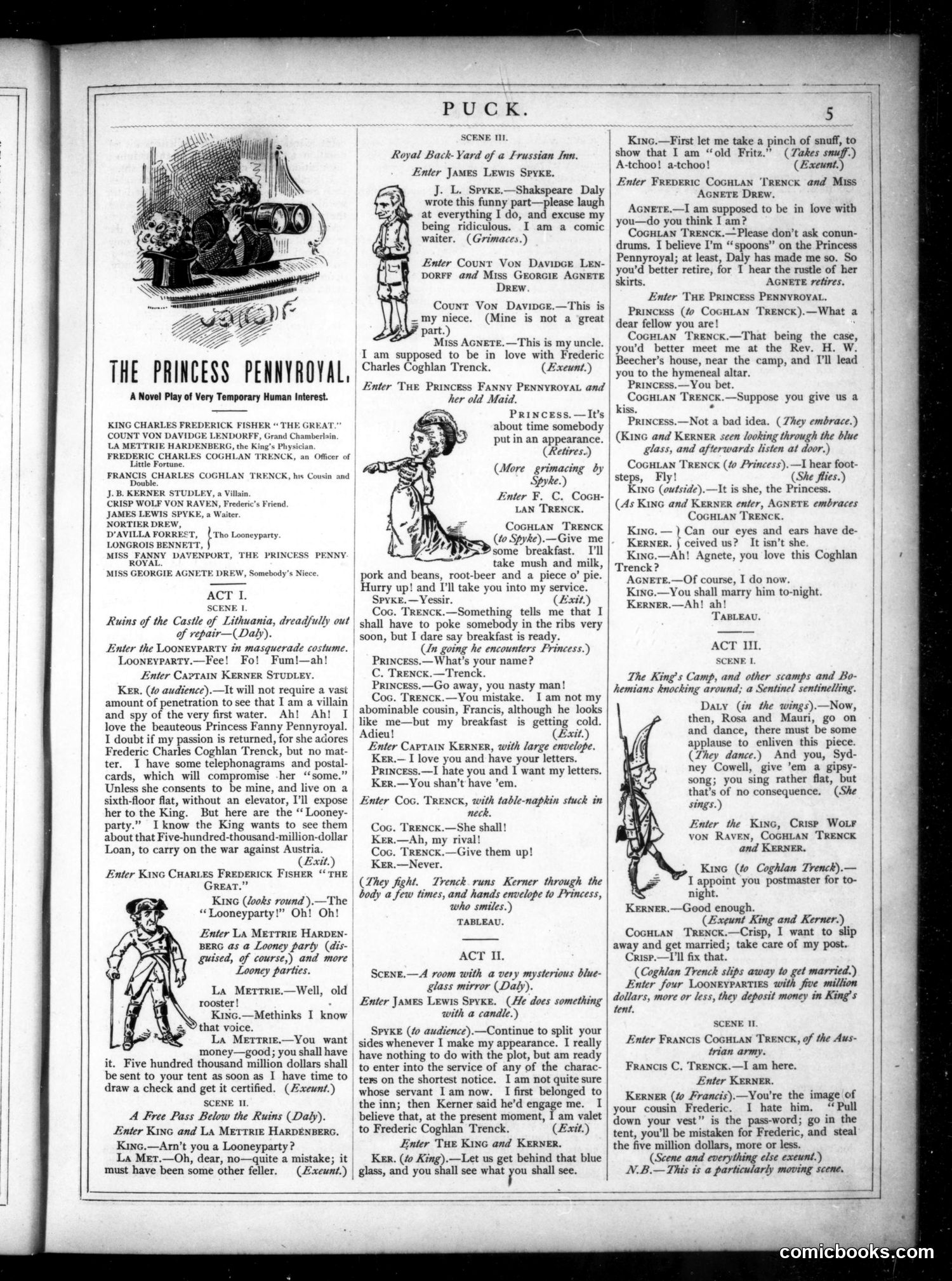
This page presents a theatrical script parody titled "The Princess Pennyroyal: A Novel Play of Very Temporary Human Interest." It's a comedic play-within-the-magazine satirizing contemporary society and relationships. The plot involves King Charles Frederick Fisher and various courtiers in the "Ruins of the Castle of Lithuania." The satire targets aristocratic pretension and romantic entanglements among the upper classes—characters scheme about marriages, love letters, and social status while speaking in exaggerated, melodramatic dialogue. The accompanying illustrations show figures in theatrical costume. While the specific political figures referenced are unclear from this page alone, the work typifies Puck's approach: using fictional scenarios to mock contemporary social absurdities, romantic complications, and upper-class vanity through theatrical parody and witty wordplay.
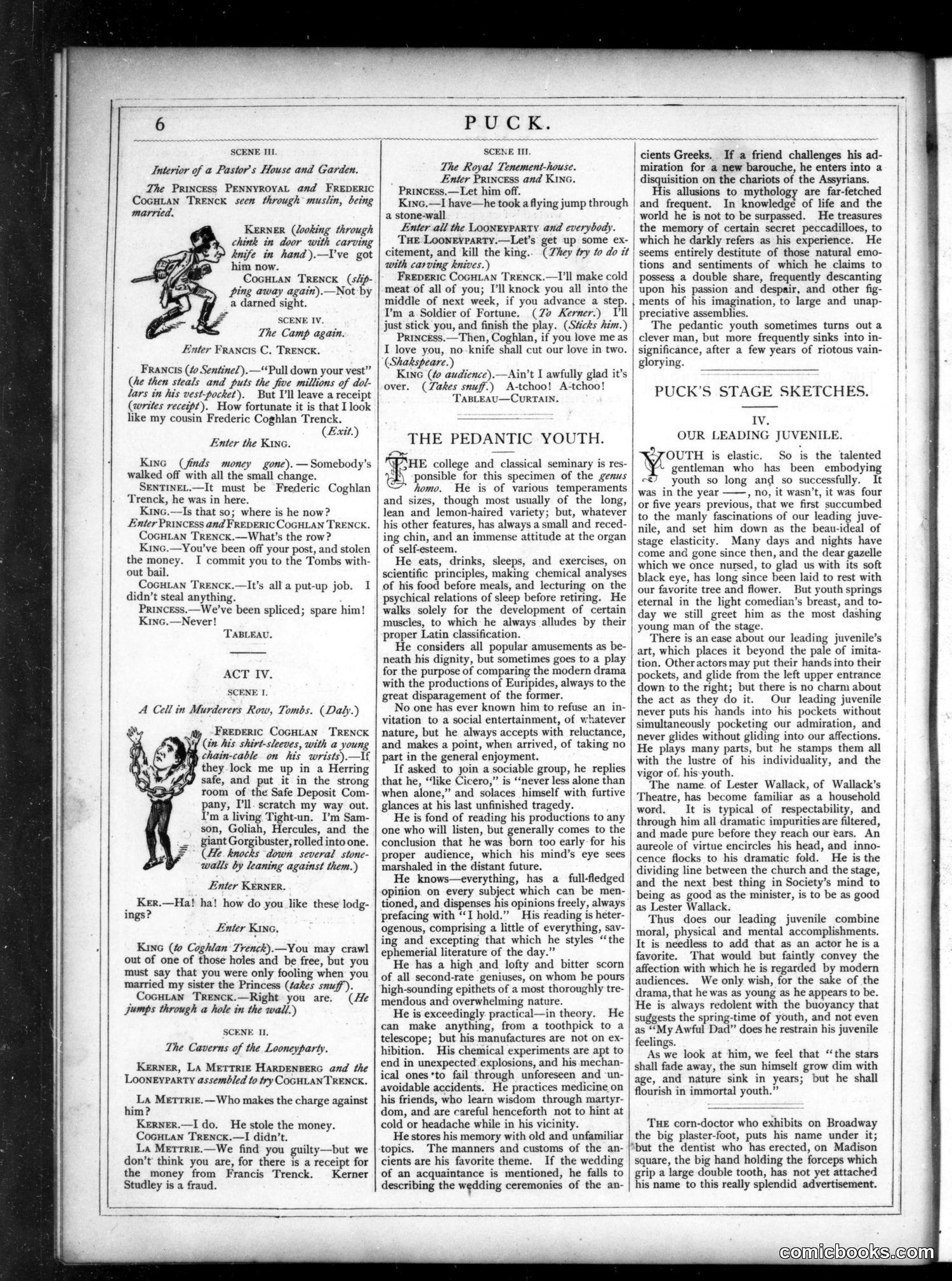
This page contains dramatic excerpts from what appears to be a theatrical production, likely a Shakespeare adaptation or period play. The visible illustrations show characters in period costume engaged in confrontational scenes. The page primarily features **theatrical content rather than political satire**: dialogue between characters named King, Princess, Cogdlan Trench, Francis, and Keener in various dramatic scenarios (a castle, a murder scene, a camp). Below the play excerpts is an essay titled "**The Pedantic Youth**" that satirizes overeducated young men—college seminary graduates with pretentious attitudes who are impractical and affected. The essay mocks their intellectual pretension and social awkwardness. The final section discusses **Lester Wallack**, apparently a noted theatrical performer of the era, praising his acting abilities and moral character. **This is primarily theatrical/cultural commentary rather than political satire.**
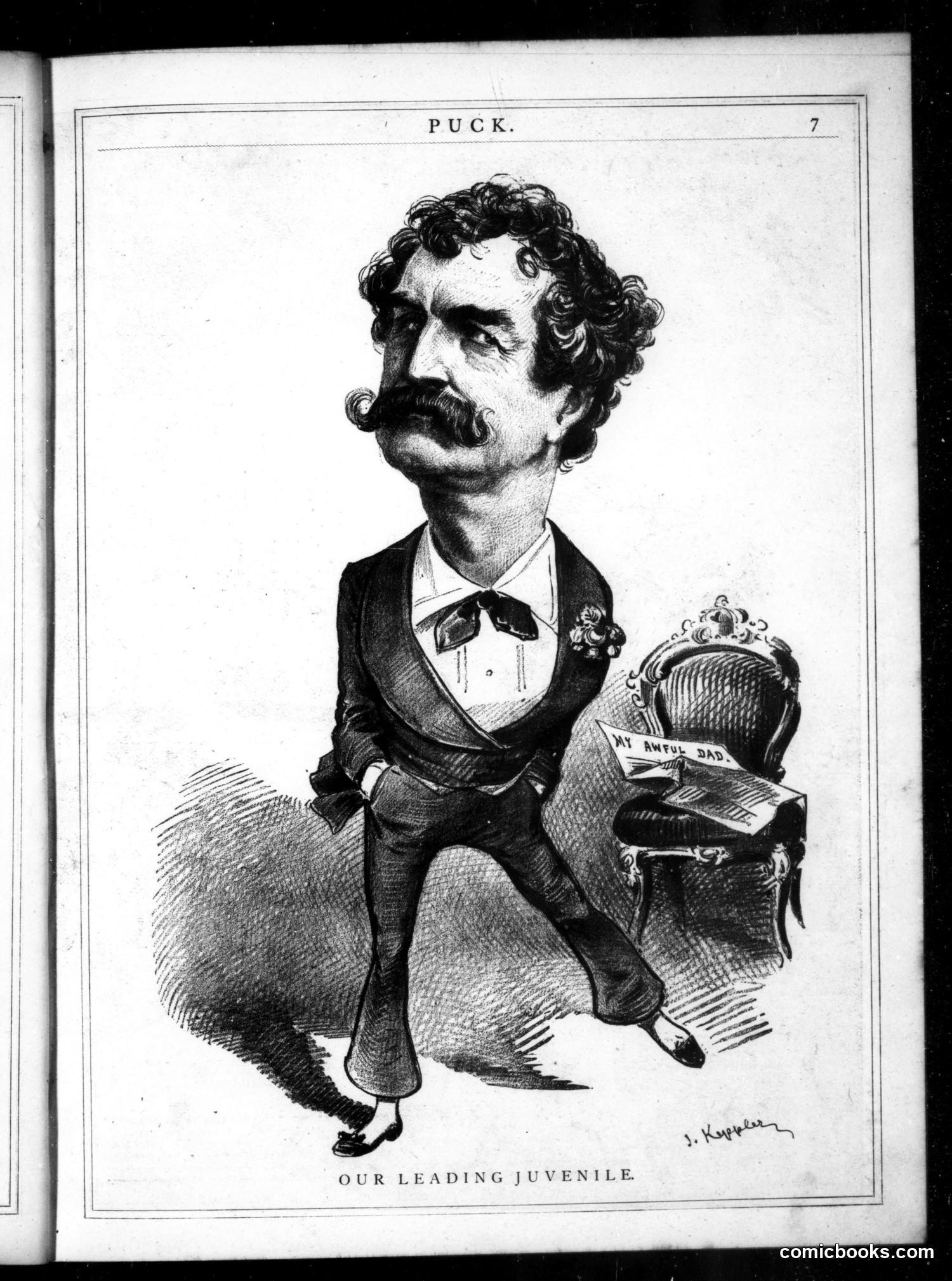
This is a caricature from Puck magazine (page 7) depicting a man with an exaggerated mustache and curled hair, dressed in formal evening wear with a bow tie. He holds what appears to be a theatrical mask or playbill labeled "MY AWFUL ROAD" (or similar). The caption "Our Leading Juvenile" is satirical—the figure is clearly an adult man, not actually juvenile, suggesting mockery of someone's pretensions or public image. The theatrical props indicate this person likely worked in entertainment or had theatrical aspirations. The artist's signature reads "S. Kuppel[er]." Without additional context, the specific identity of this "leading juvenile" remains unclear, though the cartoon mocks someone's self-presentation or reputation in the theatrical world of that era.
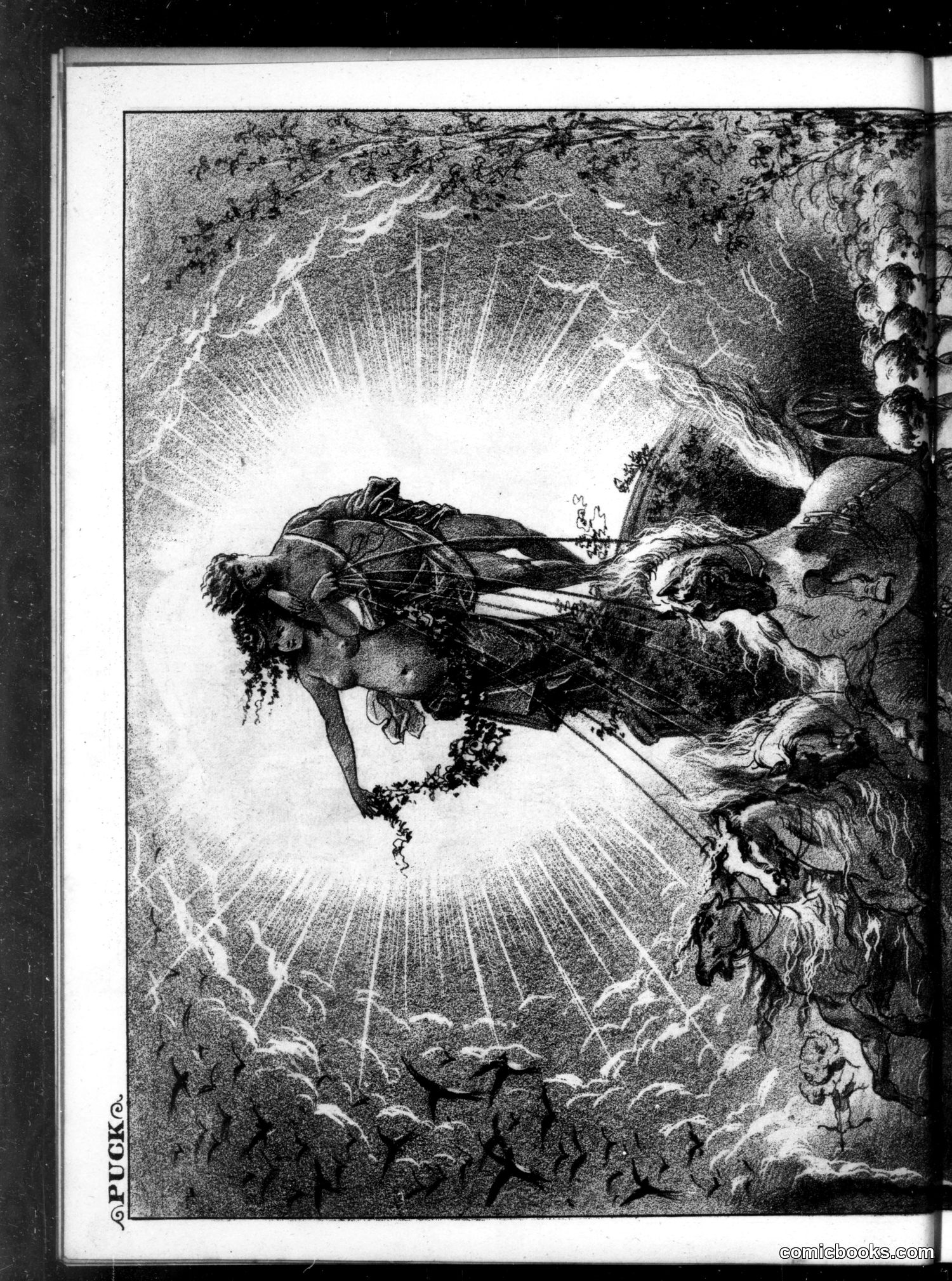
This engraving depicts a classical allegorical scene with a central female figure (likely representing Liberty or Justice) descending from radiant heavenly light, surrounded by cherubs and clouds. She holds what appears to be grape vines or natural abundance in her hands. On the right side, earthly figures—depicted as rough, possibly working-class men—gesture upward toward the descending figure, suggesting they are witnessing or receiving divine blessing or intervention. The dramatic use of radiating light lines and the contrast between the ethereal heavens above and earthly realm below creates a satirical commentary on idealism versus reality. Without the OCR'd text or a visible title, the precise political message remains unclear, but the composition suggests commentary on social aspirations or the gap between lofty ideals and earthly conditions during Puck's publication period.
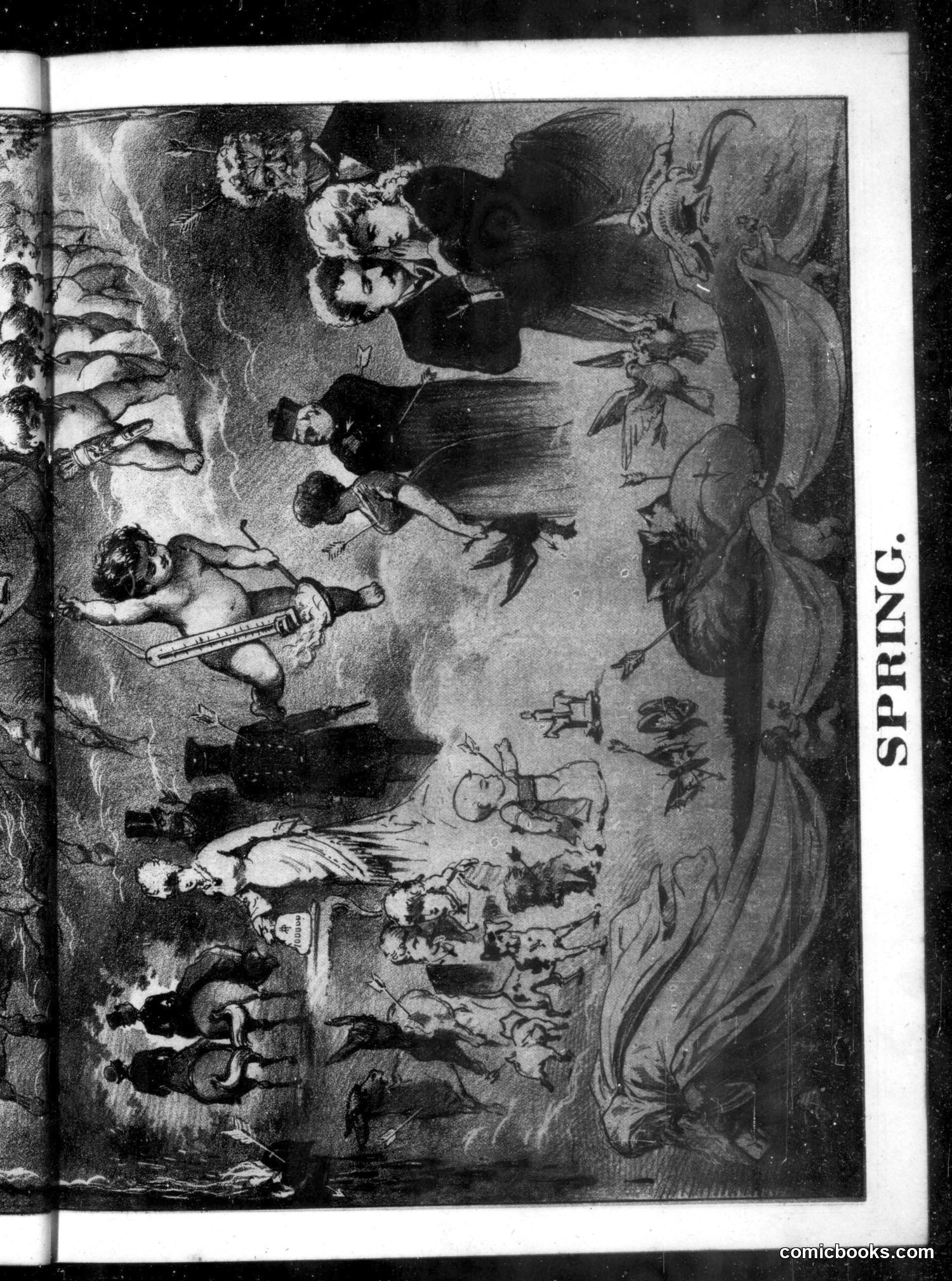
This page is titled "Spring" and depicts an allegorical scene of the season's arrival. The image shows classical figures and cherubs in a pastoral/mythological setting, with flowing drapery on the right suggesting spring's gentle breezes. The composition appears to celebrate springtime renewal through traditional artistic conventions—cherubs, semi-nude figures, and naturalistic elements like flowers or foliage. This is likely straightforward seasonal artwork rather than political satire. Without additional OCR text or clearer detail visibility, I cannot identify specific caricatures or social commentary. The page may contain accompanying text or advertisements that would clarify any satirical intent, but the image itself appears to be decorative seasonal illustration typical of Puck's aesthetic approach.
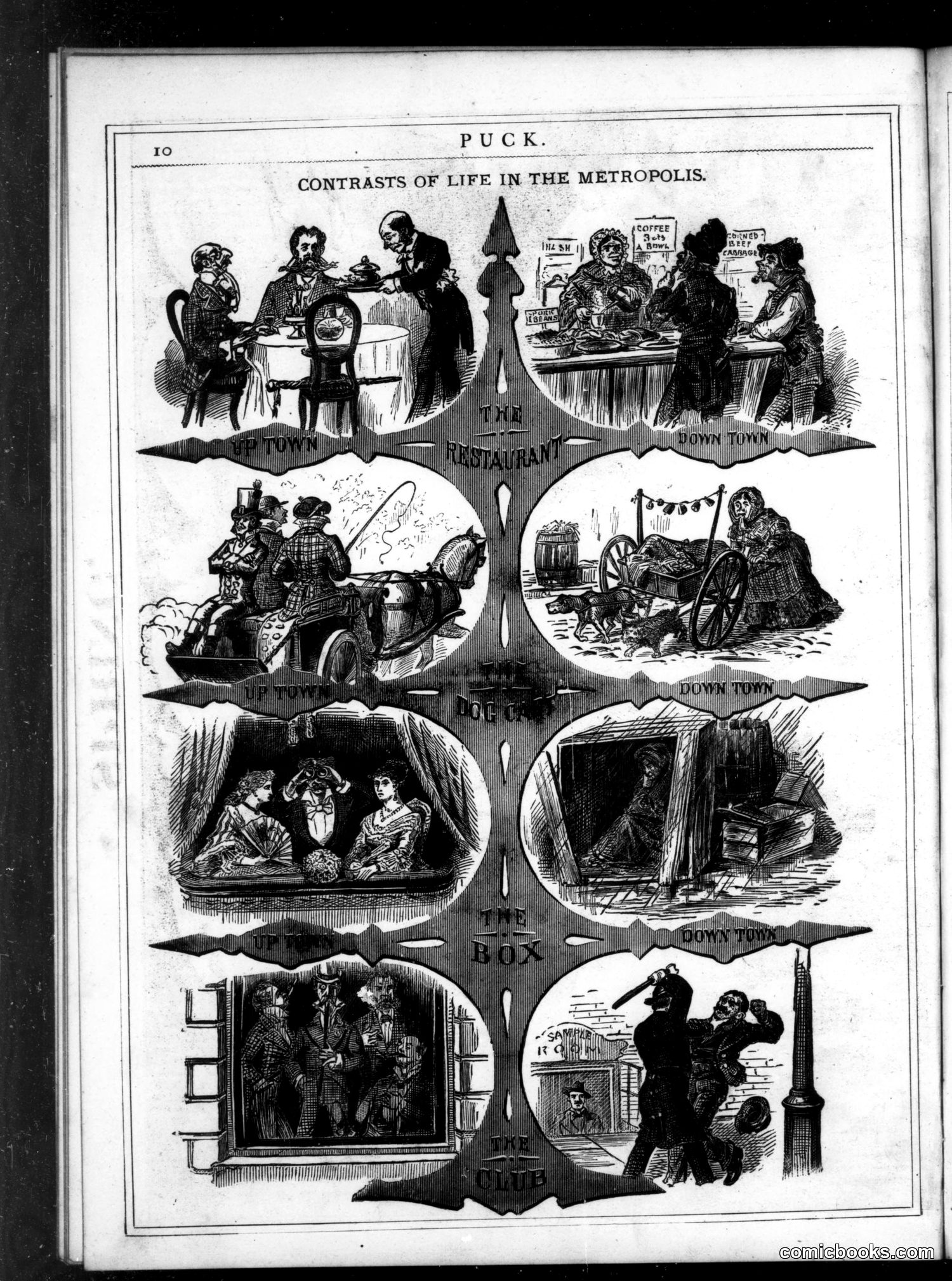
This satirical illustration compares wealthy and poor experiences in Victorian London through paired scenes organized vertically: **Top (Restaurant):** Wealthy diners enjoy fine dining with elaborate service. **Middle (Box/Theater):** Contrasts theater attendance—the wealthy in comfortable box seats versus the poor in cramped standing room ("pit"). **Bottom (Streets):** Shows wealthy individuals in carriages and comfortable circumstances alongside the poor on streets, apparently homeless or in dire poverty. The central cross dividing "UP TOWN" from "DOWN TOWN" emphasizes the stark geographic and economic separation. Puck uses this visual metaphor to critique class inequality in metropolitan life—how wealth and poverty coexist in the same city with minimal interaction, each group inhabiting entirely different social spheres and experiencing radically different living conditions.
This page contains **no cartoon or satirical illustration**—it's primarily text content from Puck magazine. The visible material includes: 1. **"What Ailed the Ghost"**—the conclusion of a serialized English short story about a man mistaken for a ghost, with domestic comedy elements 2. **"Two Knaves and a Queen"**—another continuing story with romantic/social drama involving characters named Hugh and a young woman 3. **"Science vs. Wages and Drinks"**—a dialogue between a Professor and a friend discussing the Nebular Hypothesis and astronomical theory, with commentary on intellectual versus practical pursuits These appear to be regular fiction and humor pieces typical of Puck's content, rather than political satire with identifiable caricatures or current-event commentary.
This page is primarily **text content**—a serialized story or article—rather than a political cartoon. The piece discusses social interactions among characters including Mr. Fox, Hugh, Mr. Reynolds, Sir Humphrey Clinker, and Miss Blake. The narrative appears to be **satirizing Victorian-era social conventions**, particularly around courtship, class distinctions, and gender roles. References to characters' appearance ("pink-and-white apples"), matchmaking concerns, and anxieties about social standing suggest gentle mockery of genteel society's preoccupations. Without visible illustrations on this page, the satire operates through **narrative and dialogue** rather than visual caricature. The tone is lighthearted social commentary typical of Puck's literary content.
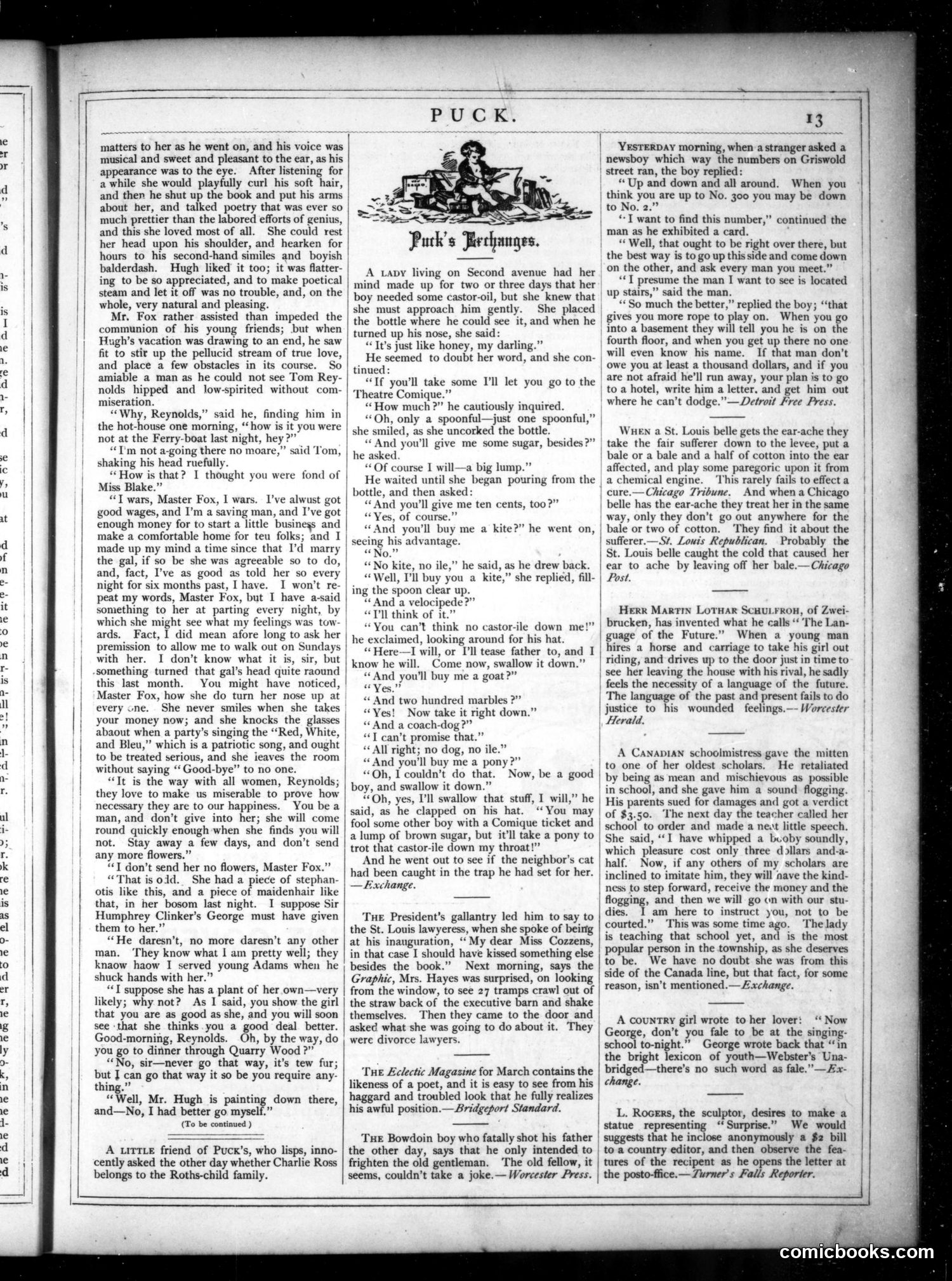
This page contains miscellaneous short humor pieces and anecdotes rather than a single cartoon. The content includes: **"Puck's Exchanges"** — a column of brief satirical anecdotes and jokes drawn from other publications, addressing social topics of the era. Notable items include: - A story about a woman and castor oil (a common laxative) - References to Chicago and St. Louis newspapers - A joke about divorce lawyers - Anecdotes mocking various social conventions The small illustration at the top shows two figures in Victorian dress, likely accompanying one of the exchanges. **Key point:** This appears to be filler content—reprinted humor from other sources—rather than original Puck satire. Without clearer attribution or specific datelines, the precise political/social references are difficult to identify with certainty from this page alone.
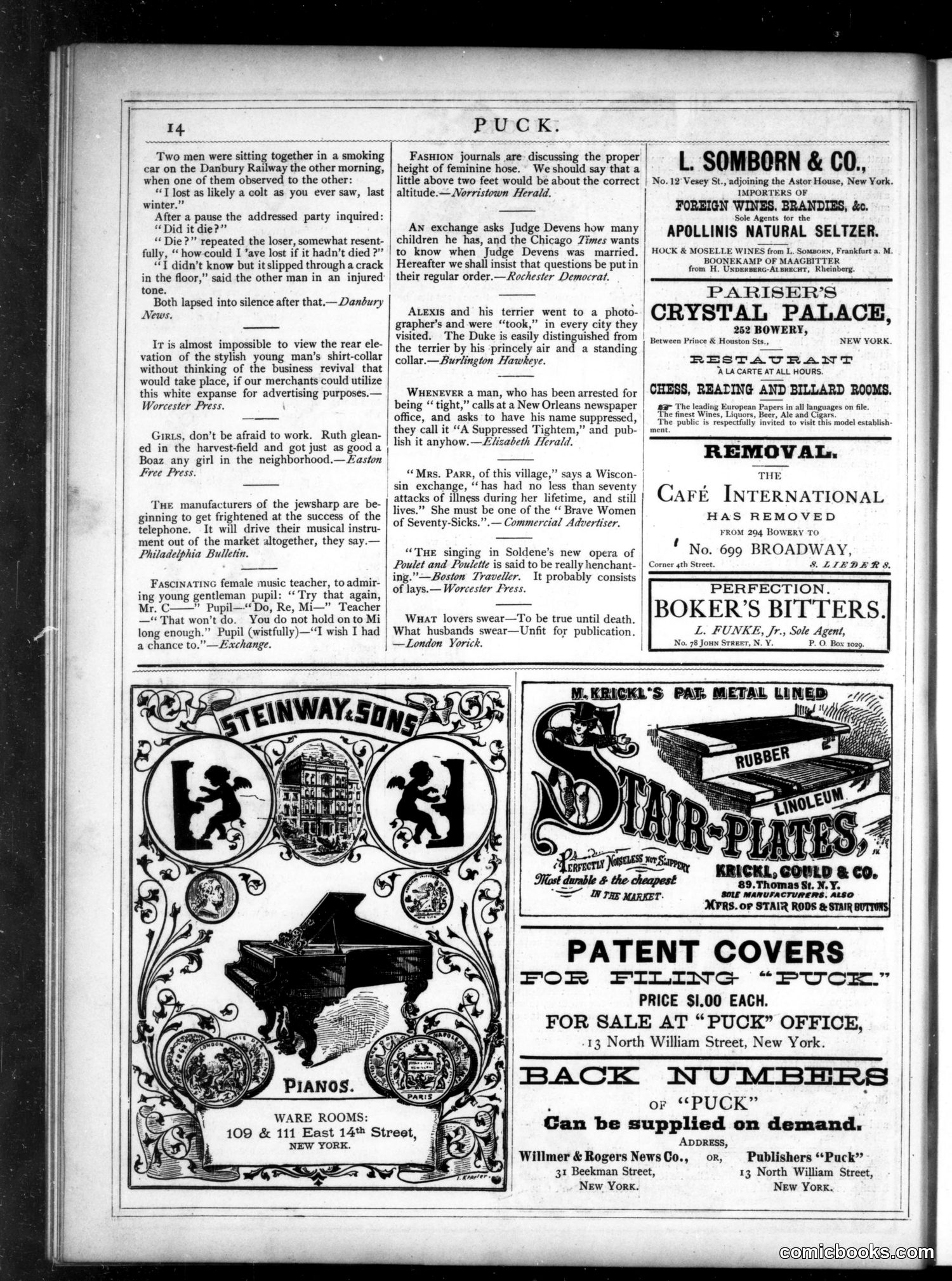
This is primarily an **advertising page** from Puck magazine, not a political cartoon. The page contains various commercial advertisements including: - L. Somborn & Co. (wine and seltzer merchant) - Parker's Crystal Palace (billiards and chess rooms in New York) - Café International (relocation notice) - Boker's Bitters - Steinway & Sons pianos (with decorative ornamental design) - M. Krickl's stair plates - Patent covers for "Flying Puck" - Back number ordering information The upper portion includes brief humorous anecdotes and social commentary typical of Puck's editorial content, but these are miscellaneous jokes rather than focused political satire. The page primarily serves a commercial function advertising goods and services to the magazine's readers.
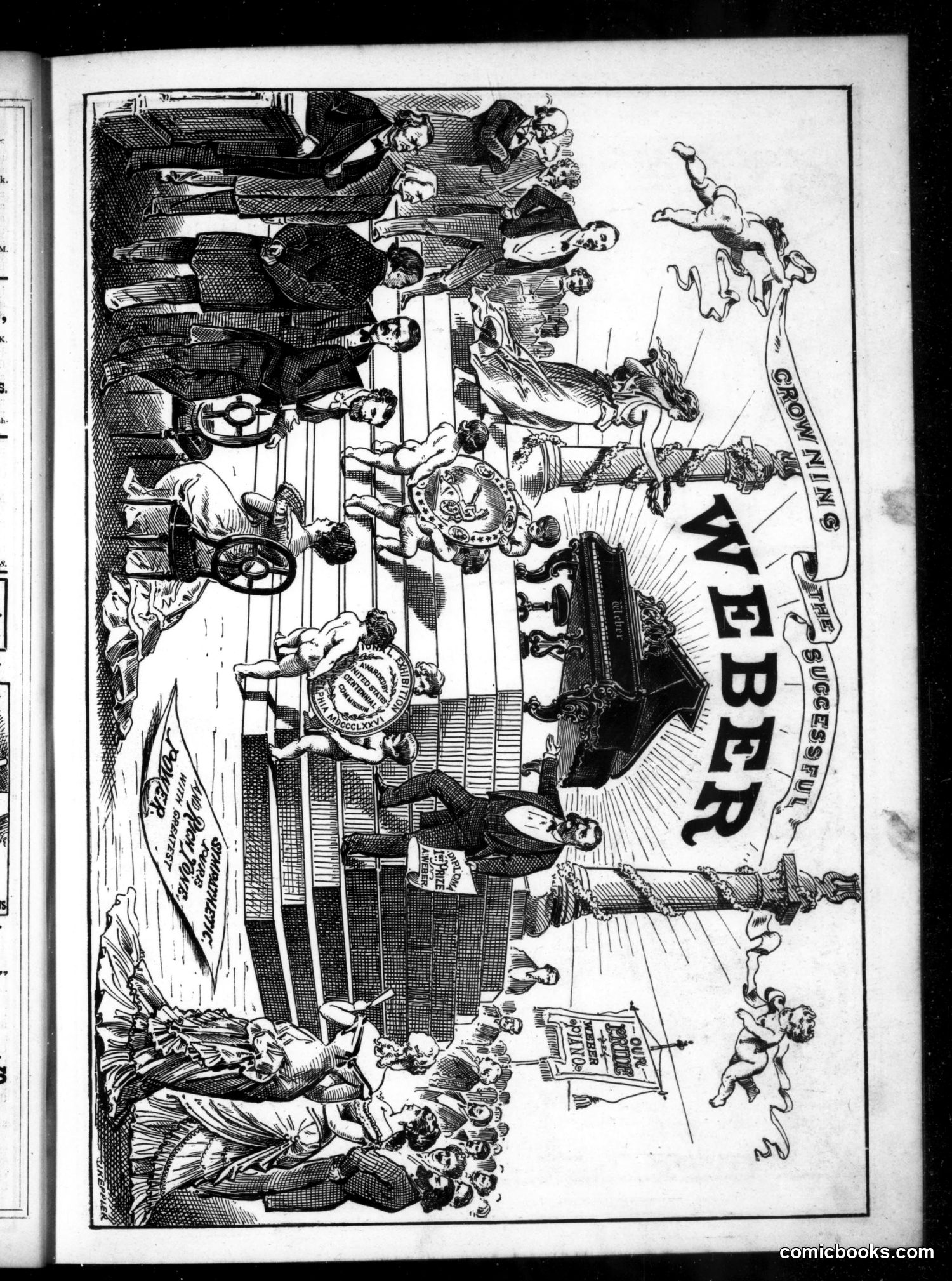
This page features a satirical illustration titled "WEB" (visible as large letters on the right). The image depicts an elaborate spider web with a large spider at its center, surrounded by various human figures and caricatures caught within or approaching the web's strands. The cartoon appears to criticize a powerful central figure or entity (represented by the spider) manipulating multiple people and interests for its own benefit. The figures around the web likely represent different social groups, politicians, or institutions being trapped by or entangled with this central power structure. Without clearer text identifying specific individuals or a visible date, the exact historical reference remains unclear, though the satirical intent—warning of hidden control or corruption—is evident. This was typical of Puck's political commentary style.
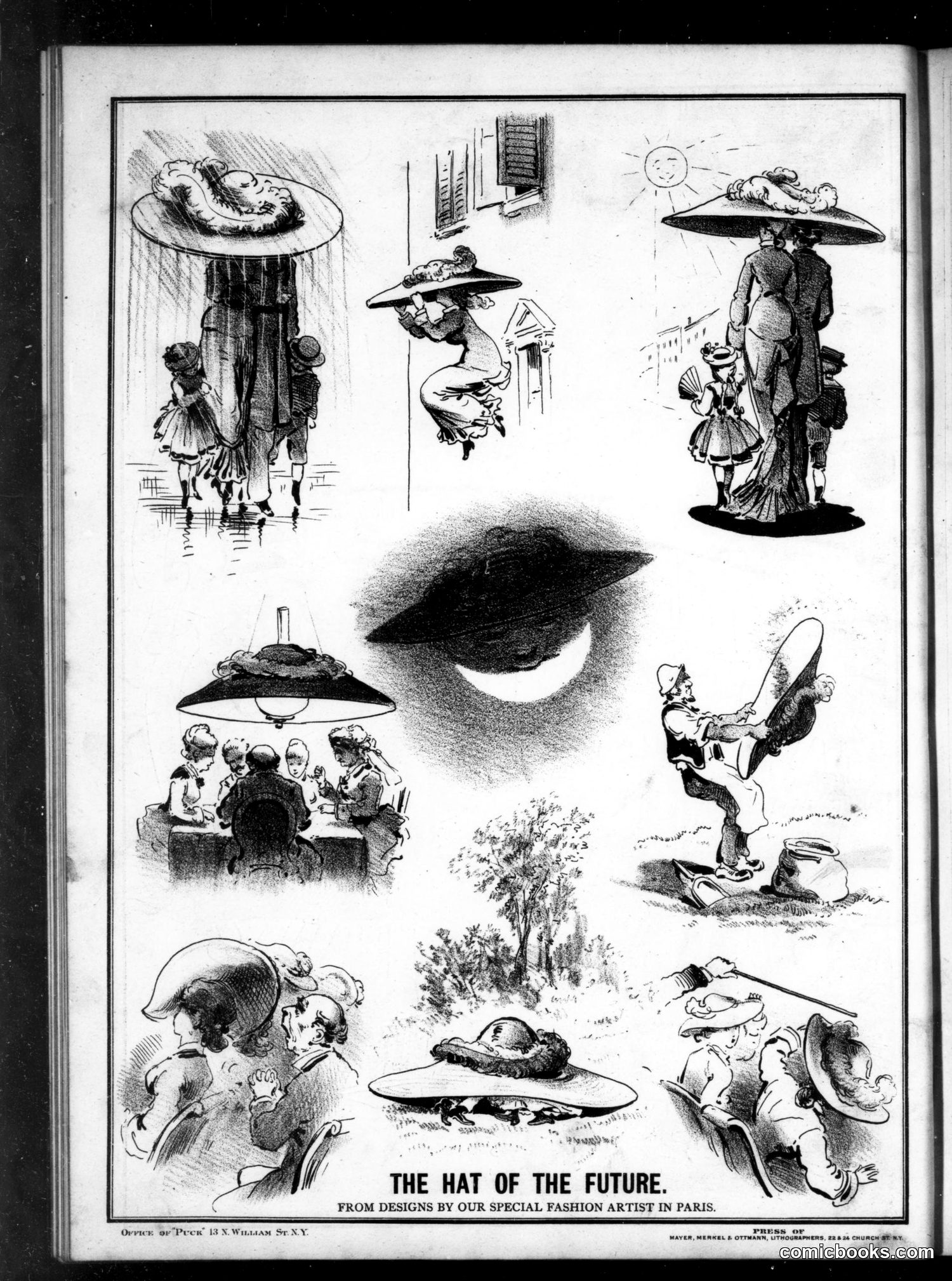
This satirical page from *Puck* magazine mocks the absurd and impractical hat fashions being promoted by Parisian designers. The central large hat dominates the composition, while surrounding vignettes show various scenarios where these oversized, unwieldy hats create problems: people struggling under their weight, hats blocking views, causing accidents, or requiring structural support. The satire targets the fashion industry's disconnect from practicality—designers prioritize aesthetic extravagance over wearability. By showing the hats in everyday situations (dining, walking, child-rearing), the cartoonist highlights how ridiculous these creations are. The credit to "our special fashion artist in Paris" underscores the critique of French fashion's influence on American women's clothing, suggesting Parisians peddle impractical vanity.