
Puck, 1877-04 · page 2 of 16
Puck — April 1877 — page 2: what you’re looking at
What you’re looking at
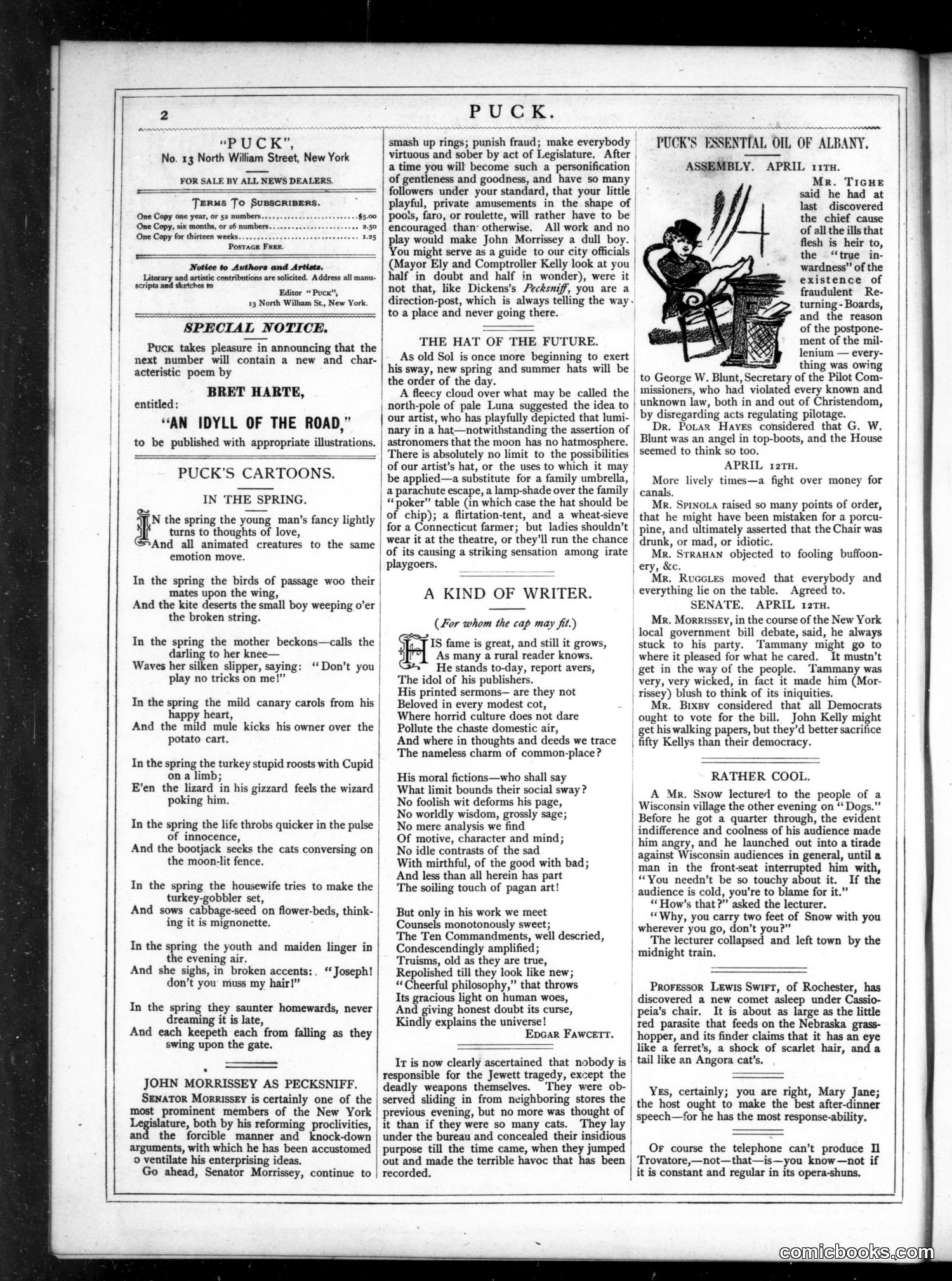
This page primarily contains **literary and political commentary** rather than illustrated cartoons. The main content includes: 1. **"An Idyll of the Road"** — a poem by Bret Harte (announced as a new feature) 2. **Political commentary sections** titled "A Kind of Writer" and "Rather Cool," discussing New York state politics and politicians, including Senator Morrissey 3. **References to specific debates** about Democratic party positions and legislative matters The page demonstrates Puck's dual function as both a humor magazine and political commentary vehicle. Without clearer illustrations visible in this section, the satire relies on textual wit and references to contemporary New York political figures and debates rather than visual caricature. The tone suggests criticism of politicians' inconsistency and grandstanding.
📄 Transcribed text from this page (OCR, searchable)
Machine-transcribed from the original scan — historical spelling and the odd misread are preserved.
“PUCK”, No. 13 North William Street, New York FOR SALE BY ALL NEWS DEALERS. = Terms To Susscripers. ‘One Copy one year, or 52 numbers... - One Copy, six months, or 26 numbers. One Copy for thirteen weeks... i Postrace Free. = Notice to Authors and Artists, Literary and artistie contributions are solicited. Address all manu- scripts and sketches 10 Editor “Puck”, 13 North Witham St., New York. SPECIAL NOTICE. Puck takes pleasure in announcing that the next number will contain a new and char- acteristic poem by BRET HARTE, entitled: | “AN IDYLL OF THE ROAD,” to be published with appropriate illustrations, PUCK’S CARTOONS. | IN THE SPRING. | N the spring the young man’s fancy lightly turns to thoughts of love, ‘And all animated creatures to the same | emotion move. | | In the spring the birds of passage woo their mates upon the wing, And the kite deserts the small boy weeping o’er the broken string. In the spring the mother beckons—calls the darling to her knee— Waves her silken slipper, saying: “Don't you play no tricks on me!” In the spring the mild canary carols from his | | happy heart, And the mild mule kicks his owner over the potato cart. In the spring the turkey stupid roosts with Cupid | on a limb; | E’en the lizard in his gizzard feels the wizard | poking him. | In the spring the life throbs quicker in the pulse of innocence, | And the bootjack seeks the cats conversing on the moon-lit fence. | In the spring the housewife tries to make the | turkey-gobbler set, | And sows cabbage-seed on flower-beds, think- | ing it is mignonette. | In the spring the youth and maiden linger in the evening air. And she sighs, in broken accents:. ‘Joseph! don’t you muss my hair!” In the spring they saunter homewards, never dreaming it is late, And each keepeth each from falling as they swing upon the gate. JOHN MORRISSEY AS PECKSNIFF. | SENATOR Morrissey is certainly one of the | most prominent members of the New York | islature, both by his reforming proclivities, | and the forcible manner and knock-down arguments, with which he has been accustomed 9 ventilate his enterprising ideas. Go ahead, Senator Morrissey, continue to | ie PU.Ce. smash up rings; punish fraud; make everybody virtuous and sober by act of Legislature. After a time you will become such a personification of gentleness and goodness, and have so many followers under your standard, that your little playful, private amusements in the shape of poois, faro, or roulette, will rather have to be encouraged than: otherwise. All work and no play would make John Morrissey a dull boy. ‘You might serve as a guide to our city officials (Mayor Ely and Comptroller Kelly look at you half in doubt and half in wonder), were it not that, like Dickens's Pecksniff, you are a direction-post, which is always telling the way. to a place and never going there. THE HAT OF THE FUTURE. As old Sol is once more beginning to exert his sway, new spring and summer hats will be the order of the day. A fleecy cloud over what may be called the north-pole of pale Luna suggested the idea to | our artist, who has playfully depicted that lumi- | nary in a hat—notwithstanding the assertion of | astronomers that the moon has no hatmos | There is absolutely no limit to the possibilities of our artist’s hat, or the uses to which it may be applied—a substitute for a family umbrella, a parachute escape, a lamp-shade over the family “poker” table (in which case the hat should be | of chip); a flirtation-tent, and a wheat-sieve | for a Connecticut farmer; but ladies shouldn't | wear it at the theatre, or they'll run the chance | of its causing a striking sensation among irate playgoers. (For whom the cap may fit.) IS fame is great, and still it grows, A KIND OF WRITER. ral As many a rural reader knows. He stands to-day, report avers, The idol of his publishers. His printed sermons— are they not Beloved in every modest cot, Where horrid culture does not dare Pollute the chaste domestic air, ‘And where in thoughts and deeds we trace The nameless charm of common-place? His moral fictions—who shall say What limit bounds their social sway? No foolish wit deforms his page, No worldly wisdom, grossly sage; No mere analysis we find Of motive, character and mind; No idle contrasts of the sad With mirthful, of the good with bad; And less than all herein has part The soiling touch of pagan art! But only in his work we meet Counsels monotonously sweet; The Ten Commandments, well descried, Condescendingly amplified; Truisms, old as they are true, Repolished till they look like new; “Cheerful philosophy,” that throws Its gracious light on human woes, And giving honest doubt its curse, | Kindly explains the universe! Epoar Fawcerr. | Ir is now clearly ascertained that nobody is responsible for the Jewett tragedy, except the deadly weapons themselves. ‘They were ob- served sliding in from neighboring stores the | previous evening, but no more was thought of | it than if they were so many cats. They lay | under the bureau and concealed their insidious _ purpose till the time came, when they jumped out and made the terrible havoc that has been | recorded, | fifty Kellys than their democracy. PUCK’S ESSENTIAL OIL OF ALBANY. ASSEMBLY. APRIL r17x. Mr. TicHe said he had at last discovered the chief cause of all the ills that flesh is heir to, the “true in- wardness” of the existence of fraudulent Re- turning - Boards, and the reason of the postpone- ment of the mil- lenium — every- thing was owing to George W. Blunt, Secretary of the Pilot Com- missioners, who had violated every known and unknown law, both in and out of Christendom, by disregarding acts regulating pilotage. Dr. Porar Hayes considered that G. W. | Blunt was an angel in top-boots, and the House seemed to think so too. APRIL 12TH. More lively times—a fight over money for canals. Mr. Spinoza raised so many points of order, that he might have been mistaken for a porcu- pine, and ultimately asserted that the Chair was drunk, or mad, or idiotic. Mr. StraHan objected to fooling buffoon- ery, &c. Mr. Ruccies moved that everybody and everything lie on the table. Agreed to. SENATE. APRIL 12TH. Mr. Morrissey, in the course of the New York local government bill debate, said, he always stuck to his party. Tammany might go to where it pleased for what he cared. It mustn't get in the way of the people. ‘Tammany was very, very wicked, in fact it made him (Mor- rissey) blush to think of its iniquities. Mr. Bixsy considered that all Democrats ought to vote for the bill. John Kelly might get his walking papers, but they’d better sacrifice RATHER COOL. A Mr. Snow lectured to the people of a Wisconsin village the other evening on “Dogs.” | Before he got a quarter through, the evident | indifference and coolness of his audience made him angry, and he launched out into a tirade against Wisconsin audiences in general, until a man in the front-seat interrupted him with, “You needn’t be so touchy about it. If the audience is cold, you're to blame for it.” “How's that?” asked the lecturer. “Why, you carry two feet of Snow with you wherever you go, don’t you?” ‘The lecturer collapsed and left town by the midnight train. Proressor Lewis Swirt, of Rochester, has discovered a new comet asleep under Cassio- peia’s chair. It is about as large as the little red parasite that feeds on the Nebraska grass- hopper, and its finder claims that it has an eye like a ferret’s, a shock of scarlet hair, anda tail like an Angora cat's. Yes, certainly; you are right, Mary Jane; the host ought to make the best after-dinner speech—for he has the most response-ability. Or course the telephone can’t produce Il Trovatore,—not—that—is—you know—not if it is constant and regular in its opera-shuns. comichooks.comn