
Puck, 1877-04 · page 13 of 16
Puck — April 1877 — page 13: what you’re looking at
What you’re looking at
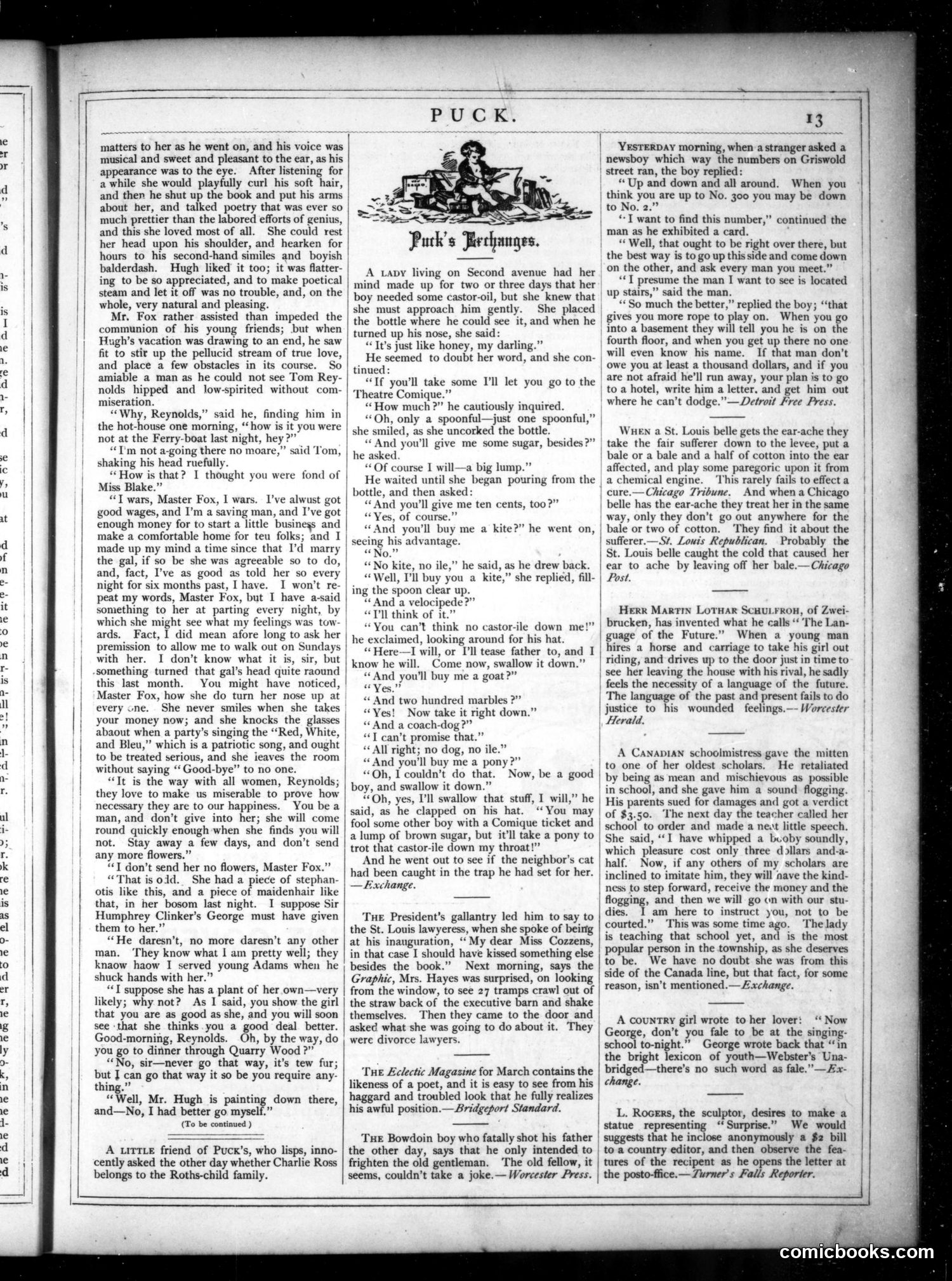
This page contains miscellaneous short humor pieces and anecdotes rather than a single cartoon. The content includes: **"Puck's Exchanges"** — a column of brief satirical anecdotes and jokes drawn from other publications, addressing social topics of the era. Notable items include: - A story about a woman and castor oil (a common laxative) - References to Chicago and St. Louis newspapers - A joke about divorce lawyers - Anecdotes mocking various social conventions The small illustration at the top shows two figures in Victorian dress, likely accompanying one of the exchanges. **Key point:** This appears to be filler content—reprinted humor from other sources—rather than original Puck satire. Without clearer attribution or specific datelines, the precise political/social references are difficult to identify with certainty from this page alone.
📄 Transcribed text from this page (OCR, searchable)
Machine-transcribed from the original scan — historical spelling and the odd misread are preserved.
matters to her as he went on, and his voice was musical and sweet and pleasant to the ear, as his appearance was to the eye. After listening for awhile she would playfully curl his soft hair, and ther he shut up the book and put his arms about her, and talked poetry that was ever so much prettier than the labored efforts of genius, and this she loved most of all. She could rest | her head upon his shoulder, and hearken for | hours to his second-hand similes and boyish | balderdash. Hugh liked it too; it was flatter- | ing to be so appreciated, and to make poetical | steam and let it off was no trouble, and, on the | whole, very natural and pleasing. Mr. Fox rather assisted than impeded the communion of his young friends; but when Hugh’s vacation was drawing to an end, he saw fit to stir up the pellucid stream of true love, | and place a few obstacles in its course. So | amiable a man as he could not see Tom Rey- | nolds hipped and low-spirited without com- miseration. | “Why, Reynolds,” said he, finding him in the hot-house one morning, “how is it you were not at the Ferry-boat last night, hey?” “I'm not a-going there no moare,” said ‘Yom, | shaking his head ruefully. “How is that? I thought you were fond of | Miss Blake.” “T wars, Master Fox, 1 wars. I’ve alwust got | good wages, and I’m a saving man, and I’ve got enough money for to start a little business and | make a comfortable home for teu folks; and I | made up my mind a time since that I’d marry the gal, if so be she was agreeable so to do, and, fact, I've as good as told her so every | night for six months past, I have. I won't re. peat my words, Master Fox, but I have a-said | something to her at parting every night, by which she might see what my feelings was tow- ards. Fact, 1 did mean afore long to ask her premission to allow me to walk out on Sundays with her. I don’t know what it is, sir, but | something turned that gal’s head quite raound this last month. You might have noticed, Master Fox, how she do turn her nose up at every one. She never smiles when she takes your money now; and she knocks the glasses | abaout when a party’s singing the “Red, White, and Bleu,” which is a patriotic song, and ought to be treated serious, and she ieaves the room without saying “Good-bye” to no one. “Tt is the way with all women, Reynolds; they love to make us miserable to prove how necessary they are to our happiness. You be a | man, and don’t give into her; she will come round quickly enough when she finds you will not. Stay away a few days, and don’t send any more flowers.” “T don’t send her no flowers, Master Fox.” “That is odd. She had a piece of stephan- otis like this, and a piece of maidenhair like that, in her bosom last night. I suppose Sir Humphrey Clinker’s George must have given them to her.” “He daresn’t, no more daresn’t any other man. ‘They know what | am pretty weil; they knaow haow I served young Adams when he | shuck hands with her.” “T suppose she has a plant of her own—very | likely; why not? As I said, you show the girl | that you are as good as she, and you will soon | see ‘that she thinks you a good deal better. | Good-morning, Reynolds. Oh, by the way, do | you go to dinner through Quarry Wood ?” | “No, sir—never go that way, it’s tew fur; but I can go that way it so be you require any- thing.” “Well, Mr. Hugh is painting down there, and—No, I had better go myself.” (To be continued ) A LITTLE friend of Puck’s, who lisps, inno- cently asked the other day whether Charlie Ross belongs to the Roths-child family. Puck's 8 a A apy living on Second avenue had her mind made up for two or three days that her | boy needed some castor-oil, but she knew that she must approach him gently. She placed the bottle where he could see it, and when he turned up his nose, she said: “Te’s just like honey, my darling.” He seemed to doubt her word, and she con- tinued: “If you'll take some I'll let you go to the | Theatre Comique.” “How much ?” he cautiously inquired. “Oh, only a spoonful—just one spoonful,” she smiled, as she uncorked the bottle. And you'll give me some sugar, besides?” ed Of course I will—a big lump.” He waited until she began pouring from the bottle, and then asked: “And you'll give me ten cents, too?” “Yes, of course. “And you'll buy me a kite? seeing his advantage. “Noi “No kite, no ile,” he said, as he drew back. “Well, Vil buy you a kite,” she replied, fill- he spoon clear up. nd a velocipede?” Il think of it.’ “You can’t think no castor-ile down me! "he went on, | he exclaimed, looking around for his hat. “ Here—I will, or I'll tease father to, and I know he will. Come now, swallow it down.” “And you'll buy me a goat?” Vea! «And two hundred marbles ?” “Yes! Now take it right down.” “ And a coach-dog?” “T can’t promise that.” “ All right; no dog, no ile.” “And you'll buy me a pony?” “Qh, I couldn’t do that. Now, be a good boy, ree swallow it down.” «Oh, es, I'll swallow that stuff, I will,” he ssidian he clapped on his hat. “You may fool some other boy with a Comique ticket and a lump of brown sugar, but it'll take a pony to trot that castor-ile down my throat!” And he went out to see if the neighbor's cat had been caught in the trap he had set for her. — Exchange. Tue President’s gallantry led him to say to the St. Louis lawyeress, when she spoke of being at his inauguration, “My dear Miss Cozzens, in that case I should have kissed something else besides the book.” Next morning, says the Graphic, Mrs. Hayes was surprised, on looking from the window, to see 27 tramps crawl out of | the straw back of the executive barn and shake themselves. Then they came to the door and asked what she was going to do about it. They were divorce lawyers. Tue Eclectic Magazine for March contains the likeness of a poet, and it is easy to see from his haggard and troubled look that he fully realizes his awful position.— Bridgeport Standard. Tue Bowdoin boy who fatally shot his father the other day, says that he only intended to | frighten the old gentleman. ‘The old fellow, it seems, couldn't take a joke.— Worcester Press. YESTERDAY snsivedtigs a astranger asked a newsboy which way the numbers on Griswold street ran, the boy replied: “Up and down and all around. When you think you are up to No. 300 you may be down to No. 2. *-T want to find this number,” continued the man as he exhibited a card. “Well, that ought to be right over there, but the best way is to go up this side and come down on the other, and ask every man you meet.” “I presume the man I want to see is located up stairs,” said the man. much the better,” replied the boy; ‘that gives you more rope to play on. When you go into a basement they will tell you he is on the fourth floor, and when you get up there no one will even know his name. If that man don’t owe you at least a thousand dollars, and if you are not afraid he'll run away, your plan is to go to a hotel, write him a letter, and get him out where he can’t dodge.” —Detroit Free Press. WueN a St. Louis belle gets the ear-ache they take the fair sufferer down to the levee, put a bale or a bale and a half of cotton into the ear affected, and play some paregoric upon it from a chemical engine. ‘This rarely fails to effect a cure.— Chicago Tribune. And when a Chicago belle has the ear-ache they treat her in the same way, only they don’t go out anywhere for the bale or two of cotton. They find it about the | sufferer.—St. Louis Republican. Probably the | St. Louis belle caught the cold that caused her | ear to ache by leaving off her bale.—Chicago | Post. | Herr Martin Loruar Scuu.rrou, of Zwei- brucken, has invented what he calls “ The Lan- guage of the Future.” When a young man hires a horse and carriage to take his girl out riding, and drives up to the door just in time to see her leaving the house with his rival, he sadly feels the necessity of a language of the future. The language of the past and present fails to do | justice to his wounded feelings.—- Worcester Herald. A Canapian schoolmistress gave the mitten to one of her oldest scholai He retaliated by being as mean and mischievous as possible in school, and she gave him a sound flogging. His parents sued for damages and got a verdict of $3.50. ‘The next day the teacher called her school to order and made a newt little speech. She said, “I have whipped a booby soundly, which pleasure cost only three dollars and-a- half. Now, if any others of my scholars are inclined to imitate him, they will nave the kind- ness to step forward, receive the money and the flogging, and then we will go on with our stu- dies. I am here to instruct you, not to be courted.” This was some time ago. The lady is teaching that school yet, and is the most popular person in the township, as she deserves to be. We have no doubt she was from this side of the Canada line, but that fact, for some | reason, isn’t mentioned.— Exchange. A country girl wrote to her lover: “Now George, don’t you fale to be at the singing- | school to-night.” George wrote back that “in | the bright lexicon of youth—Webster’s Una- | bridged—there’s no such word as fale.” —#x- change. | L, Rocers, the sculptor, desires to make a | statue representing “Surprise.” We would suggests that he inclose anonymously a $2 bill to a country editor, and then observe the fea- | tures of the recipent as he opens the letter at | the posto-fice.— Zivrner’s Falls Reporter. Comicbooks.com