
Puck, 1877-04 · page 6 of 16
Puck — April 1877 — page 6: what you’re looking at
What you’re looking at
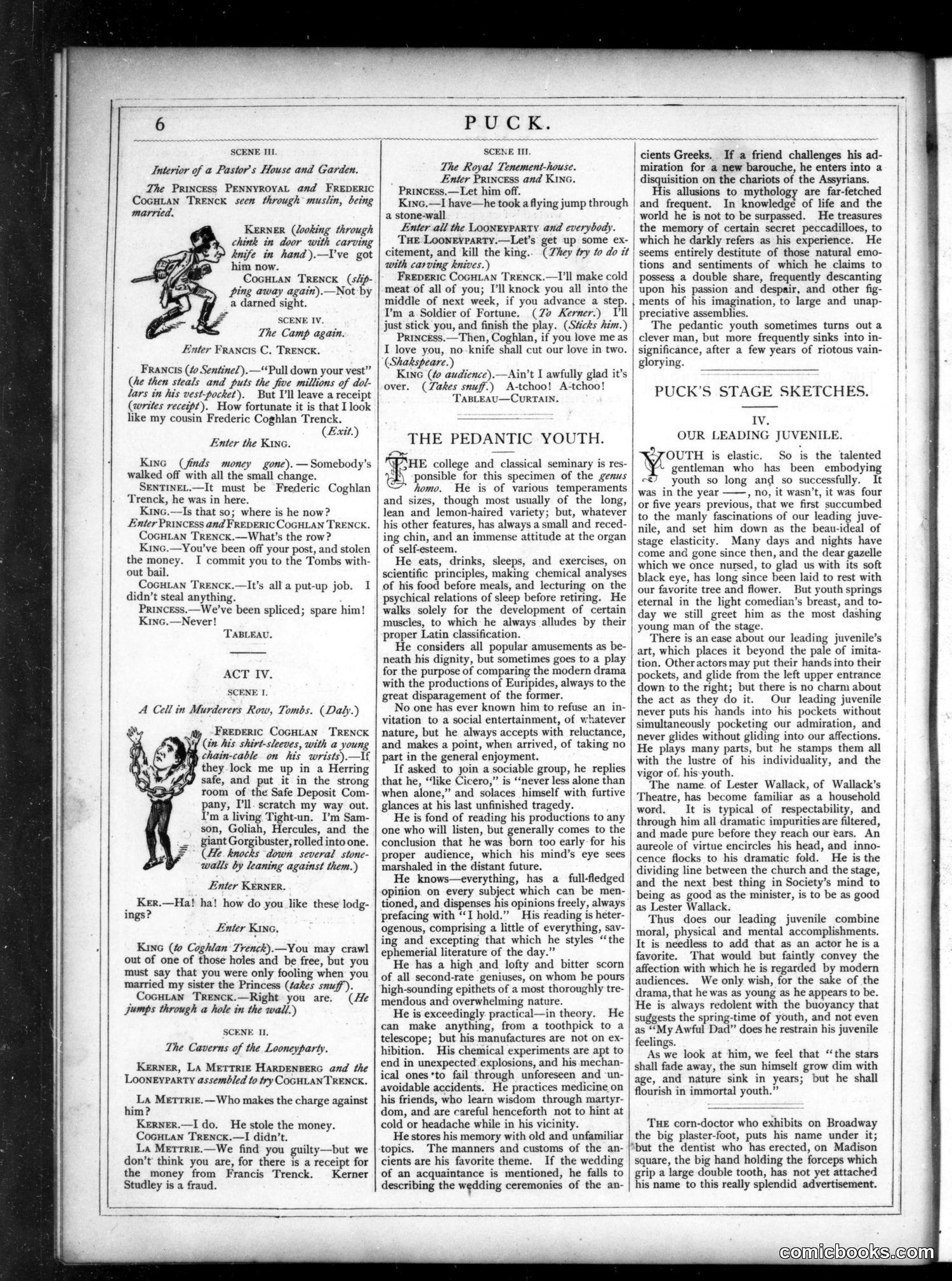
This page contains dramatic excerpts from what appears to be a theatrical production, likely a Shakespeare adaptation or period play. The visible illustrations show characters in period costume engaged in confrontational scenes. The page primarily features **theatrical content rather than political satire**: dialogue between characters named King, Princess, Cogdlan Trench, Francis, and Keener in various dramatic scenarios (a castle, a murder scene, a camp). Below the play excerpts is an essay titled "**The Pedantic Youth**" that satirizes overeducated young men—college seminary graduates with pretentious attitudes who are impractical and affected. The essay mocks their intellectual pretension and social awkwardness. The final section discusses **Lester Wallack**, apparently a noted theatrical performer of the era, praising his acting abilities and moral character. **This is primarily theatrical/cultural commentary rather than political satire.**
📄 Transcribed text from this page (OCR, searchable)
Machine-transcribed from the original scan — historical spelling and the odd misread are preserved.
Interior of a Pastor's House and Garden. The Princess PENNYROYAL and FREDERIC Cocutan TRENcK seen through muslin, being married. Kerner (looking through chink in door with carving knife in hand).—V've got him now. CocHian TRENCK (s/if- ping away again).—Not by ‘a darned sight. > SCENE IV. The Camp again. Enter Francis C, TRENCK. Francis (¢0 Sentinel).—“Pull down your vest” (he then steals and puts the five millions of dol- lars in his vest-pocket). But V'll leave a receipt (writes receipt). How fortunate it is that I look like my cousin Frederic Coghlan Trenck. (Exit) Enter the Kine. Kine (finds money gone). — Somebody's walked off with all the small change. SENTINEL.—It must be Frederic Coghlan ‘Trenck, he was in here. KinG.—Is that so; where is he now? Enter Princess and FREDERIC COGHLAN TRENCK. Cocuian TrENcK.—What’s the row? Kinc.—You've been off your post, and stolen the money. I commit you to the Tombs with- out bail. CocHLan TRENCK.—It’s all a put-up job. I didn’t steal anything. Princess.—We've been spliced; spare him! Kinc.—Never! ‘TABLEAU. ACT Iv. SCENE 1. A Cell in Murderers Row, Tombs. (Daly.) Freperic CoGHLAN TRENCK i (in his shirt-sleeves, with a young chain-cable on his wrists).—If they lock me up in a Herring safe, and put it in the strong room of the Safe Deposit Com- pany, I'll. scratch my way out. I'ma living Tight-un. I’m Sam- son, Goliah, Hercules, and the giant Gorgibuster, rolled into one. (He knocks down several stone- walls by leaning against them.) Enter Kerner. Ker.—Ha! ha! how do you like these lodg- ings? Enter Kine, Kine (& Coghlan Trenck).—You may crawl out of one of those holes and be free, but you must say that you were only fooling when you married my sister the Princess (takes snuff). Cocutan TRenck.—Right you are. (He jumps through a hole in the wall.) SCENE 11, The Caverns of the Looneyparty. Kerner, La MeTtrie HARDENBERG and the Looneyparty assembled to try COGHLANTRENCK. La Merrriz.—Who makes the charge against him? Kerner.—I do, He stole the money. Cocuian Trencx.—I didn’t. La Merrriz.—We find you guilty—but we don’t think you are, for there is a receipt for the money from Francis Trenck. Kerner Studley is a fraud. PUCK. SCENE U1 The Royal Tenement-house. | Enter Princess and Kine. | Princess.—Let him off. K1nG.—I have—he took a flying jump through | a stone-wall Enter all the Loonevparty and everybody. Tue Loonevparty.—Let’s get up some ex- citement, and kill the king... (Zhey try to do it | with carving knives.) | Freperic CocHian Trenck.—I'll make cold | meat of all of you; I'll knock you all into the middle of next week, if you advance a step. | I’m a Soldier of Fortune. (Zo Kerner.) Vil just stick you, and finish the play. (Sticks him.) | Princess,—-Then, Coghlan, if you love me as. I love you, no knife shall cut our love in two. (Shakspeare.) Kine (do audience).—Ain’t I awfully glad it’s over. (Zakes snuff.) A-tchoo! A-tchoo! ‘TaBLEau—Curtaln. THE PEDANTIC YOUTH. XHE college and classical seminary is res- Sy -ponsible for this specimen of the genus homo. He is of various temperaments and sizes, though most usually of the long, lean and lemon-haired variety; but, whatever his other features, has always a small and reced- ing chin, and an immense attitude at the organ of self-esteem. He eats, drinks, sleeps, and exercises, on scientific principles, making chemical analyses of his food before meals, and lecturing on the | psychical relations of sleep before retiring. He walks solely for the development of certain | muscles, to which he always alludes by their | proper Latin classification. | He considers all popular amusements as be- neath his dignity, but sometimes goes to a play for the purpose of comparing the modern drama with the productions of Euripides, always to the | great disparagement of the former. | No one has ever known him to refuse an in- vitation to a social entertainment, of whatever nature, but he always accepts with reluctance, and makes a point, when arrived, of taking no part in the general enjoyment. If asked to join a sociable group, he replies that he, “like Cicero,” is ‘‘never less alone than when alone,” and solaces himself with furtive glances at his last unfinished tragedy. He is fond of reading his productions to any one who will listen, but generally comes to the | conclusion that he was born too early for his proper audience, which his mind’s eye sees marshaled in the distant future. He knows—everything, has a full-fledged opinion on every subject which can be men- tioned, and dispenses his opinions freely, always prefacing with “I hold.” His reading is het ogenous, comprising a little of everything, sav- ing and excepting that which he styles “the ephemerial literature of the day.” He has a high and lofty and bitter scorn of all second-rate geniuses, on whom he pours high-sounding epithets of a most thoroughly tre- mendous and overwhelming nature. He is exceedingly practical—in theory. He | can make anything, from a toothpick to a| telescope; but his manufactures are not on ex- hibition. His chemical experiments are apt to end in unexpected explosions, and his mechan- ical ones *to fail through unforeseen and ‘un- avoidable accidents. He practices medicine on his friends, who learn wisdom through martyr- dom, and are careful henceforth not to hint at cold or headache while in his vicinity. He stores his memory with old and unfamiliar topics. The manners and customs of the an- cients are his favorite theme. If the wedding of an acquaintance is mentioned, he falls to describing the wedding ceremonies of the an- cients Greeks. If a friend challenges his ad- miration for a new barouche, he enters into a disquisition on the chariots of the Assyrians. His allusions to mythology are far-fetched and frequent. In knowledge of life and the world he is not to be surpassed. He treasures the memory of certain secret peccadilloes, to which he darkly refers as his experience. He seems entirely destitute of those natural emo- tions and sentiments of which he claims to possess a double share, frequently descanting upon his passion and despair, and other fig- ments of his imagination, to large and unap- preciative assemblies. The pedantic youth sometimes turns out a clever man, but more frequently sinks into in- significance, after a few years of riotous vain- glorying. PUCK’'S STAGE SKETCHES. iV. OUR LEADING JUVENILE. OUTH is elastic. So is the talented gentleman who has been embodying © youth so long and so successfully. It was in the year , No, it wasn’t, it was four or five years previous, that we first succumbed to the manly fascinations of our leading juve- nile, and set him down as the beau-ideal of stage elasticity. Many days and nights have come and gone since then, and the dear gazelle which we once nursed, to glad us with its soft black eye, has long since been laid to rest with our favorite tree and flower. But youth springs eternal in the light comedian’s breast, and to- day we still greet him as the most dashing young man of the stage. There is an ease about our leading juvenile’s art, which places it beyond the pale of imita- tion. Other actors may put their hands into their pockets, and glide from the left upper entrance down to the right; but there is no charm about the act as they do it. Our leading juvenile never puts his hands into his pockets without simultaneously pocketing our admiration, and never glides without gliding into our affections. He plays many parts, but he stamps them all with the lustre of his individuality, and the vigor of. his-youth. The name. of Lester Wallack, of Wallack’s Theatre, has become familiar as a household word. It is typical of respectability, and through him all dramatic impurities are filtered, and made pure before they reach our ears. An aureole of virtue encircles his head, and inno- cence flocks to his dramatic fold. He is the dividing line between the church and the stage, and the next best thing in Society’s mind to being as good as the minister, is to be as good as Lester Wallack. Thus does our leading juvenile combine moral, physical and mental accomplishments. It is needless to add that as an actor he is a favorite. That would but faintly convey the affection with which he is regarded by modern audiences. We only wish, for the sake of the drama, that he was as young as he appears to be. He is always redolent with the buoyancy that suggests the spring-time of youth, and not even as “‘My Awful Dad” does he restrain his juvenile feelings. As we look at him, we feel that “the stars shall fade away, the sun himself grow dim with age, and nature sink in years; but he shall flourish in immortal youth.” Tue corn-doctor who exhibits on Broadway the big plaster-foot, puts his name under it; “but the dentist who has erected, on Madison square, the big hand holding the forceps which grip a large double tooth, has not yet attached his name to this really splendid advertisement. comichooks.