
Puck, 1877-04 · page 3 of 16
Puck — April 1877 — page 3: what you’re looking at
What you’re looking at
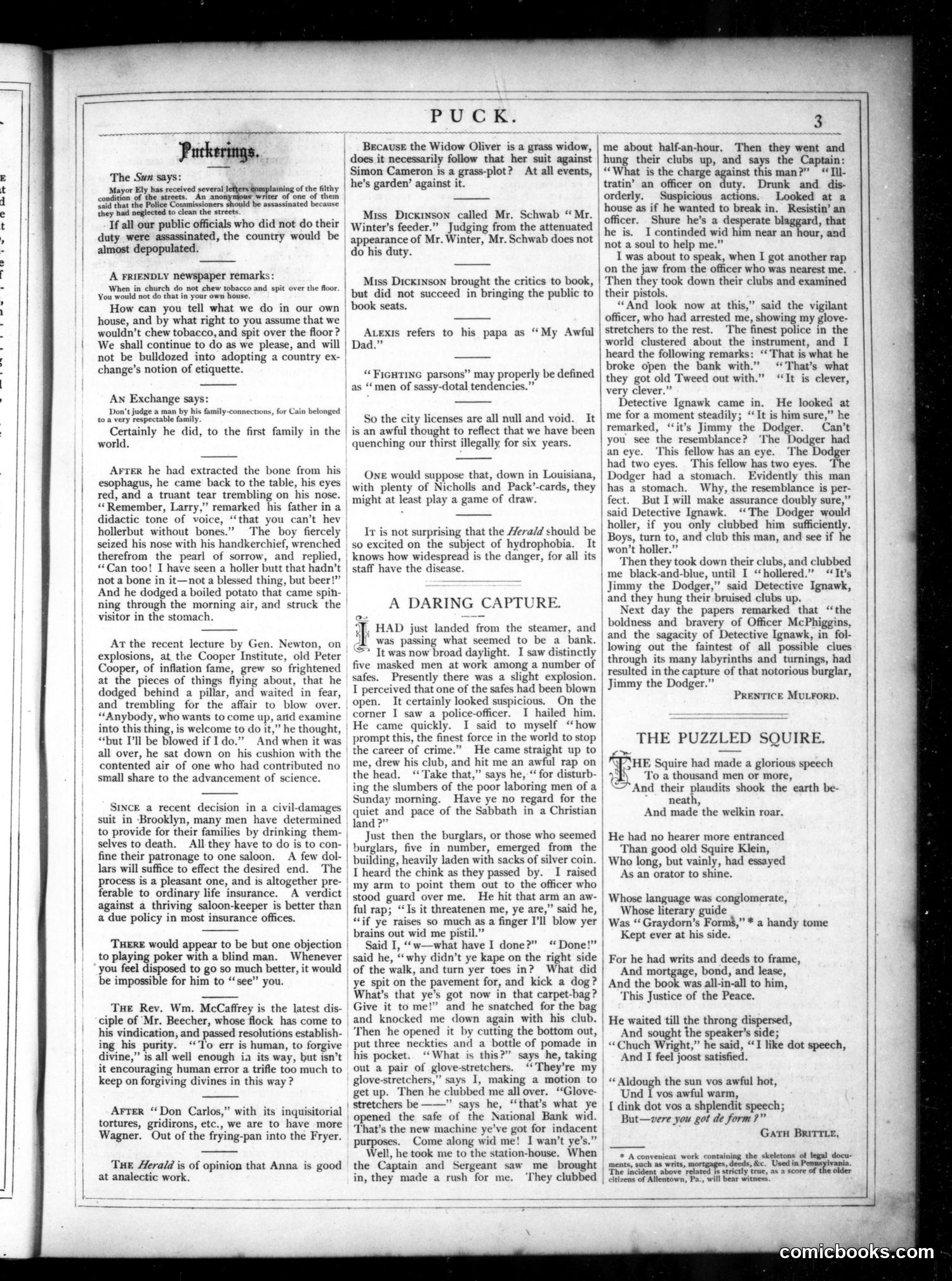
This page contains mostly satirical text commentary and literary pieces rather than political cartoons. The "Puckerings" section offers social criticism—including jabs at grass widows (wives whose husbands are absent), tobacco spitting in churches, and etiquette violations. The longer pieces appear to be humorous fictional narratives: "A Daring Capture" depicts a police officer apprehending burglars, while "The Puzzled Squire" presents verse about a rural character. The page critiques contemporary manners and urban/rural social dynamics through humor rather than visual caricature. Without visible illustrations to identify specific political figures, the satire targets general social behaviors and class attitudes typical of Puck's late-19th-century content.
📄 Transcribed text from this page (OCR, searchable)
Machine-transcribed from the original scan — historical spelling and the odd misread are preserved.
‘The Sun says: Mayor Ky asa rocaived several aining ofthe fthy Tf all our public officials who did not do their duty were assassinated, the country would be almost depopulated. A FRIENDLY newspaper remarks: When in church do not chew tobacco and spit over the floor. You would not do that in your own house. How can you tell what we do in our own house, and by what right to you assume that we wouldn’t chew tobacco, and spit over the floor? We shall continue to do as we please, and will not be bulldozed into adopting a country ex- change’s notion of etiquette. Aw Exchange says: toa very reapectable family Certainly he did, to the first family in the world. ArrTer he had extracted the bone from his esophagus, he came back to the table, his eyes red, and a truant tear trembling on his nose. “Remember, Larry,” remarked his father in a didactic tone of voice, ‘‘that you can’t hev hollerbut without bones.” The boy fiercely seized his nose with his handkerchief, wrenched therefrom the pearl of sorrow, and replied, “Can too! I have seen a holler butt that hadn’t not a bone in it—not a blessed thing, but beer!’ And he dodged a boiled potato that came spih- ning through the morning air, and struck the visitor in the stomach. Ar the recent lecture by Gen. Newton, on explosions, at the Cooper Institute, old Peter Cooper, of inflation fame, grew so frightened at the pieces of things flying about, that he dodged behind a pillar, and waited in fear, and trembling for the affair to blow over. “Anybody, who wants to come up, arid examine into this thing, is welcome to do it,” he thought, “but I’ll be blowed if ldo.” And when it was all over, he sat down on his cushion with the contented air of one who had contributed no small share to the advancement of science. SINCE a recent decision in a civil-damages suit in Brooklyn, many men have determined to provide for their families by drinking them- selves to death. All they have to do is to con- fine their patronage to one saloon. A few dol- lars will suffice to effect the desired end. The process is a pleasant one, and is altogether pre- ferable to ordinary life insurance. A verdict against a thriving saloon-keeper is better than a due policy in most insurance offices. ‘Tuere would appear to be but one objection to playing poker with a blind man. Whenever you feel disposed to go so much better, it would be impossible for him to “see” you. Tue Rev. Wm. McCaffrey is the latest dis- ciple of Mr. Beecher, whose flock has come to his vindication, and passed resolutions establish- ing his purity. “To err is human, to forgive divine,” is all well enough ia its way, but isn’t it encouraging human error a trifle too much to keep on forgiving divines in this way ? Arter “Don Carlos,” with its inquisitorial tortures, gridirons, etc., we are to have more Wagner. Out of the frying-pan into the Fryer. Tue Herald is of opinion that Anna is good at analectic work. PU OR, Because the Widow Oliver is a grass widow, does it necessarily follow that her suit against Simon Cameron is a grass-plot? At all events, he’s garden’ against it. Miss Dickinson called Mr. Schwab “Mr. | Winter’s feeder.” Judging from the attenuated | appearance of Mr. Winter, Mr. Schwab does not do his duty. Miss Dickinson brought the critics to book, | but did not succeed in bringing the public to | book seats. Axexis refers to his papa as “My Awful Dad.” « Ficutine parsons” may properly be defined as “men of sassy-dotal tendencies.” So the city licenses are all null and void. It is an awful thought to reflect that we have been quenching our thirst illegally for six years. One would suppose that, down in Louisiana, with plenty of Nicholls and Pack’-cards, they | might at least play a game of draw. Ir is not surprising that the Hera/d should be | so excited on the subject of hydrophobia. It knows how widespread is the danger, for all its staff have the disease. A DARING CAPTURE. HAD just landed from the steamer, and was passing what seemed to be a bank. It was now broad daylight. I saw distinctly five masked men at work among a number of safes. Presently there was a slight explosion. I perceived that one of the safes had been blown open. It certainly looked suspicious. On the | corner I saw a police-officer. I hailed him. | He came quickly. I said to myself “how | prompt this, the finest force in the world to stop | the career of crime.” He came straight up to me, drew his club, and hit me an awful rap on the head. ‘Take that,” says he, “ for disturb- ing the slumbers of the poor laboring men of a Sunday morning. Have ye no regard for the | quiet and pace of the Sabbath in a Christian | land ?” | Just then the burglars, or those who seemed | burglars, five in number, emerged from the | building, heavily laden with sacks of silver coin. | I heard the chink as they passed by. I raised my arm to point them out to the officer who | stood guard over me. He hit that arm an aw- ful rap; ‘Is it threatenen me, ye are,” said he, | “if ye raises so much as a finger I’ll blow yer brains out wid me pistil.” Said I, ‘‘w—what have I done?” “Done!” said he, “why didn’t ye kape on the right side of the walk, and turn yer toes in? What did | ye spit on the pavement for, and kick a dog? What's that ye’s got now in that carpet-bag? Give it to me!” and he snatched for the bag and knocked me down again with his club. ‘Then ‘he opened it by cutting the bottom out, put three neckties and a bottle of pomade in his pocket. “What is this?” says he, taking out a pair of glove-stretchers. “They're my glove-stretchers,” says I, making a motion to get up. Then he clubbed me all over. “Glove- stretchers be ——” says he, “that’s what ye opened the safe of the National Bank wid. That's the new machine ye've got for indacent purposes. Come along wid me! I wan't ye’s.” Well, he took me to the station-house. When the Captain and Sergeant saw me brought in, they made a rush for me. ‘They clubbed | stretchers to the rest. you 3 me about half-an-hour, Then they went and hung their clubs up, and says the Captain: “What is the charge against this man?” “ TIll- tratin’ an officer on duty. Drunk and dis- orderly. Suspicious actions. Looked at a house as if he wanted to break in. Resistin’ an officer. Shure he’s a desperate blaggard, that he is. 1 continded wid him near an hour, and not a soul to help me.” I was about to speak, when I got another rap on the jaw from the officer who was nearest me. Then they took down their clubs and examined their pistols. “And look now at this,” said the vigilant officer, who had arrested me, showing my glove- The finest police in the world clustered about the instrument, and I heard the following remarks: ‘That is what he broke open the bank with.” “That’s what they got old Tweed out with.” “It is clever, very clever.” Detective Ignawk came in. He looked at me for a moment steadily; ‘It is him sure,” he remarked, “it’s Jimmy the Dodger. Can't see the resemblance? The Dodger had an eye. ‘This fellow has an eye. The Dodger had two eyes. This fellow has two eyes. The Dodger had a stomach. Evidently this man has a stomach. Why, the resemblance is per- fect. But I will make assurance doubly sure,” said Detective Ignawk. “The Dodger would holler, if you only clubbed him. sufficiently. Boys, turn to, and club this man, and see if he won't holler.” Then they took down their clubs, and clubbed me black-and-blue, until I “hollered.” “It’s Jimmy the Dodger,” said Detective Ignawk, and they hung their bruised clubs up. Next day the papers remarked that “the boldness and bravery of Officer McPhiggins, and the sagacity of Detective Ignawk, in fol- lowing out the faintest of all possible clues through its many labyrinths and turnings, had resulted in the capture of that notorious burglar, Jimmy the Dodger.” PRENTICE MuLFoRD. THE PUZZLED SQUIRE. E Squire had made a glorious speech To a thousand men or more, And their plaudits shook the earth be- neath, And made the welkin roar. He had no hearer more entranced Than good old Squire Klein, Who long, but vainly, had essayed As an orator to shine. Whose language was conglomerate, Whose literary guide Was “Graydorn’s Form,” * a handy tome Kept ever at his side. | For he had writs and deeds to frame, ‘And mortgage, bond, and lease, And the book was all-in-all to him, This Justice of the Peace. He waited till the throng dispersed, And sought the speaker's side; Chuch Wright,” he said, “I like dot speech, And I feel joost satisfied. “ Aldough the sun vos awful hot, Und I vos awful warm, I dink dot vos a shplendit speech; But—vere you got de form?” Garu BritTLe, A convenient work containing the skeletons of legal docu- ments, such as writs, mot ‘deeds, &c. Used in Pennsylvania. The incident above related is strictly true, as a score of the older | citizens of Allentown, Pa., will bear witness