
Puck, 1877-04 · page 11 of 16
Puck — April 1877 — page 11: what you’re looking at
What you’re looking at
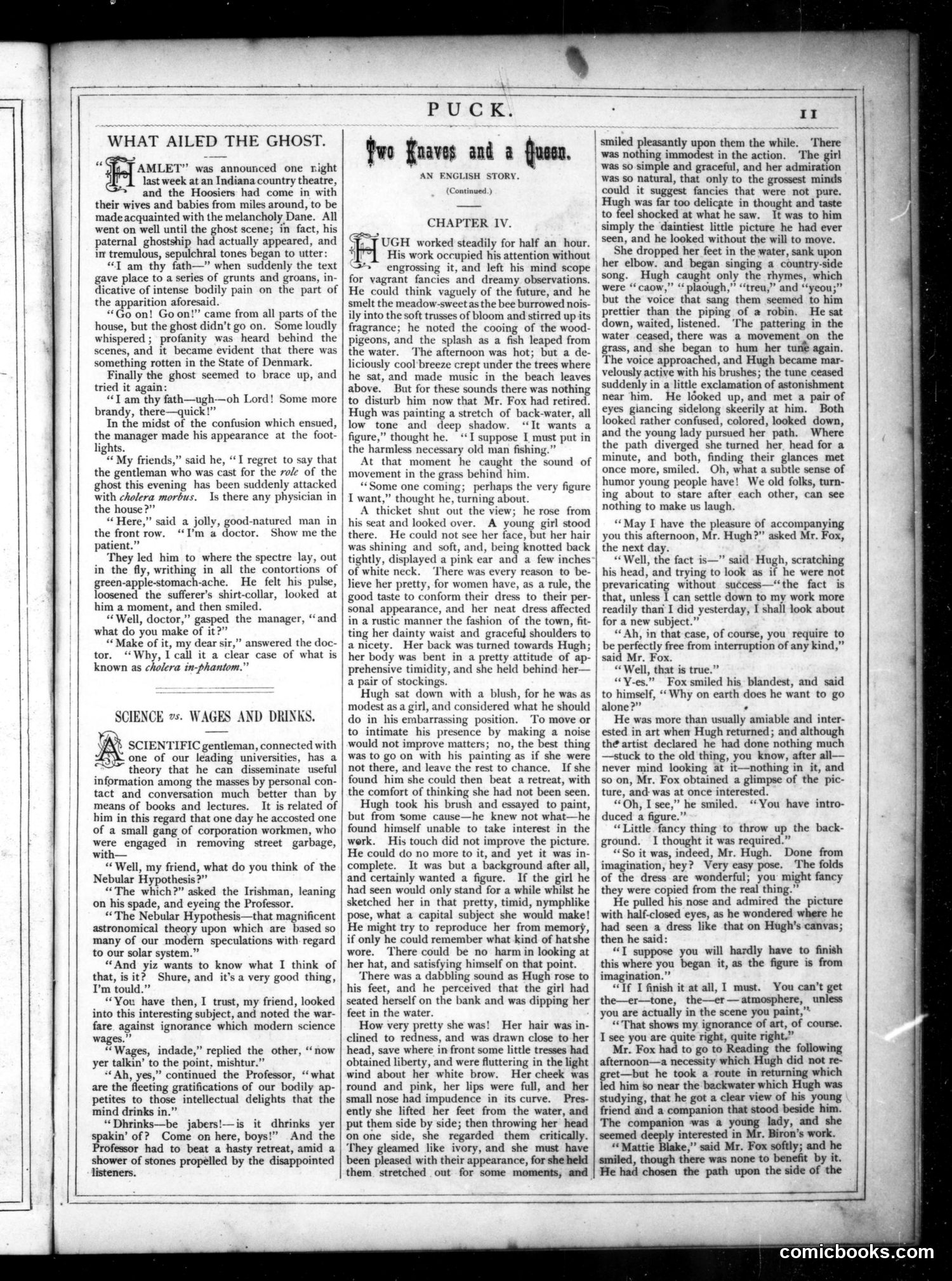
This page contains **no cartoon or satirical illustration**—it's primarily text content from Puck magazine. The visible material includes: 1. **"What Ailed the Ghost"**—the conclusion of a serialized English short story about a man mistaken for a ghost, with domestic comedy elements 2. **"Two Knaves and a Queen"**—another continuing story with romantic/social drama involving characters named Hugh and a young woman 3. **"Science vs. Wages and Drinks"**—a dialogue between a Professor and a friend discussing the Nebular Hypothesis and astronomical theory, with commentary on intellectual versus practical pursuits These appear to be regular fiction and humor pieces typical of Puck's content, rather than political satire with identifiable caricatures or current-event commentary.
📄 Transcribed text from this page (OCR, searchable)
Machine-transcribed from the original scan — historical spelling and the odd misread are preserved.
4 WHAT AILED THE GHOST. re AMLET” was announced one night last week at an Indiana country theatre, and the Hoosiers had come in with their wives and babies from miles around, to be made acquainted with the melancholy Dane. All went on well until the ghost scene; in fact, his paternal ghostship had actually appeared, and im tremulous, sepulchral tones began to utter: “T am thy fath—” when suddenly the text gave place to a series of grunts and groans, in- dicative of intense bodily pain on the part of the apparition aforesaid “Go on! Goon!” came from all parts of the house, but the ghost didn’t go on. Some loudly whispered ; profanity was heard behind the scenes, and it became evident that there was something rotten in the State of Denmark. Finally the ghost seemed to brace up, and tried it again: “T am thy fath—ugh—oh Lord! Some more brandy, there—quick!” In the midst of the confusion which ensued, the manager made his appearance at the foot- lights. “ My friends, said he, “I regret to say that the gentleman who was cast for the ro/e of the | ghost this evening has been suddenly attacked with cholera morbus. 1s there any physician in the house?” “Here,” said a jolly, good-natured man in the front row. ‘I’m a doctor. Show me the patient.” They led him to where the spectre lay, out in the fly, writhing in all the contortions of green-apple-stomach-ache. He felt his pulse, loosened the sufferer’s shirt-collar, looked at him a moment, and then smiled. “Well, doctor,” gasped the manager, “and what do you make of it?” “Make of it, my dear sir,” answered the doc- tor. “Why, I call it a clear case of what is known as cholera in-phantom.” SCIENCE 2s. WAGES AND DRINKS. UN SCIENTIFIC gentleman, connected with ne of our leading universities, has a theory that he can disseminate useful information among the masses by personal con- tact and conversation much better than by means of books and lectures. It is related of him in this regard that one day he accosted one of a small gang of corporation workmen, who were engaged in removing street garbage, with— “Well, my friend, what do you think of the Nebular Hypothesis?” “The which?” asked the Irishman, leaning on his spade, and eyeing the Professor. “The Nebular Hypothesis—that magnificent astronomical theory upon which are based so many of our modern speculations with regard to our solar system.” “And yiz wants to know what I think of that, is it? Shure, and it’s a very good thing, I'm tould.” “You have then, I trust, my friend, looked into this interesting subject, and noted the war- fare against ignorance which modern science wages.” “Wages, indade,” replied the other, “now yer talkin’ to the point, mishtur.” “Ah, yes,” continued the Professor, “what are the fieeting gratifications of our bodily ap- petites to those intellectual delights that the mind drinks i “Dhrinks—be jabers!—is it dhrinks yer spakin’ of? Come on here, boys!” And the Professor had to beat a hasty retreat, amid a shower of stones propelled by the disappointed listeners. PUG RY ffwo fnaves and a ffuecn. AN ENGLISH STORY. (Continued.) CHAPTER IV. JGH worked steadily for half an hour. His work occupied his attention without engrossing it, and left his mind scope for vagrant fancies and dreamy observations. He could think vaguely of the future, and he smelt the meadow-sweet as the bee burrowed nois- ily into the soft trusses of bloom and stirred up its fragrance; he noted the cooing of the wood- pigeons, and the splash as a fish leaped from the water. The afternoon was hot; but a de- liciously cool breeze crept under the trees where he sat, and made music in the beach leaves above. But for these sounds there was nothing to disturb him now that Mr. Fox had retired. Hugh was painting a stretch of back-water, all |low tone and deep shadow. ‘It wants a Gey the harmless necessary old man fishing.” At that moment he caught the sound of movement in the grass behind him. “Some one coming; perhaps the very figure I want,” thought he, turning about. A thicl his seat and looked over. A young girl stood the He could not see her face, but her hair was shining and soft, and, being knotted back tightly, displayed a pink ear and a few inches of white neck. ‘There was every reason to be- lieve her pretty, for women have, as a rule, the good taste to conform their dress to their per- sonal appearance, and her neat dress affected in a rustic manner the fashion of the town, fit- ting her dainty waist and gracefu] shoulders to anicety. Her back was turned towards Hugh; her body was bent in a pretty attitude of ap- prehensive timidity, and she held behind her— a pair of stocking: Hugh sat down with a blush, for he was as modest as a girl, and considered what he should do in his embarrassing position. ‘To move or to intimate his presence by making a noise would not improve matters; no, the best thing was to go on with his painting as if she were not there, and leave the rest to chance. If she found him she could then beat a retreat, with the comfort of thinking she had not been seen. Hugh took his brush and essayed to paint, but from some cause—he knew not what—he found himself unable to take interest in the werk. His touch did not improve the picture. He could do no more to it, and yet it was in- complete. It was but a background after all, and certainly wanted a figure. If the girl he had seen would only stand for a while whilst he sketched her in that pretty, timid, nymphlike pose, what a capital subject she would make! He might try to reproduce her from memory, if only he could remember what kind of hatshe wore. There could be no harm in looking at her hat, and satisfying himself on that point. ‘There was a dabbling sound as Hugh rose to his feet, and he perceived that the girl had seated herself on the bank and was dipping her feet in the water. How very pretty she was! Her hair was in- clined to redness, and was drawn close to her head, save where in front some little tresses had obtained liberty, and were fluttering in the light wind about her white brow. Her cheek was round and pink, her lips were full, and her small nose had impudence in its curve. Pres- ently she lifted her feet from the water, and put them side by side; then throwing her head on one side, she regarded them critically. ‘They gleamed like ivory, and she must have been pleased with their appearance, for she held them stretched out for some moments, and | figure,” thought he. “I suppose I must put in | et shut out the view; he rose from } ‘ It | smiled pleasantly upon them the while. ‘There | was nothing immodest in the action. ‘The girl was so simple and graceful, and her admiration was so natural, that only to the grossest minds could it suggest fancies that were not pure. | Hugh was far too delicate in thought and taste | to feel shocked at what he saw. It was to him | aowey, the daintiest little picture he had ever | seen, and he looked without the will to move. She dropped her feet in the water, sank upon her elbow. and began singing a country-side song. Hugh caught only the rhymes, which were “caow,” “plaough,” “treu,” and “yeou;” but the voice that sang them seemed to him prettier than the piping of a robin. He sat down, waited, listened. ‘The pattering in the water ceased, there was a movement on the grass, and she began to hum her tune again. ‘The voice approached, and Hugh became mar- velously active with his brushes; the tune ceased suddenly in a little exclamation of astonishment near him. He ldoked up, and met a pair of | eyes glancing sidelong skeerily at him. Both looked rather confused, colored, looked down, and the young lady pursued her path. Where | the path diverged she turned her, head for a | minute, and both, finding their glances met once more, smiled. Oh, what a subtle sense of | humor young people have! We old folks, turn- | ing about to stare after each other, can see nothing to make us laugh. | you this afternoon, Mr. Hugh?” asked Mr. Fox, the next day. “Well, the fact is—” said Hugh, scratching his head, and trying to look as if he were not prevaricating without su¢cess—‘the fact is that, unless I can settle down to my work more readily thari I did yesterday, I shall look about for a new subject.” “Ah, in that case, of course, you require to | be perfectly free from interruption of any kind,” said Mr. Fox. “Well, that is true.” “Y-es.” Fox smiled his blandest, and said to himself, “Why on earth does he want to go alone?” . He was more than usually amiable and inter- ested in art when Hugh returned; and although thé artist declared he had done nothing much —-stuck to the old thing, you know, after all— never mind looking at it—nothing in it, and ture, and- was at once interested. “Oh, I see,” he smiled. ‘You have intro- duced a figure.” “Little fancy thing to throw up the back- ground. I thought it was required.” “So it was, indeed, Mr. Hugh. Done from imagination, hey? Very easy pose. ‘The folds of the dress are wonderful; you might fancy | they were copied from the real thing.” He pulled his nose and admired the picture with half-closed eyes, as he wondered where he had seen a dress like that on Hugh's canvas; then he said: “ B Hee “T suppose you will hardly have to finisl this whee you began it, as the figure is from imagination.” “Tf I finish it at all, 1 must. You can’t get the—er—tone, the—er—atmosphere, unless you are actually in the scene you paint,” “That shows my ignorance of art, of course. I see you are quite right, quite right.” : Mr. Fox had to go to Reading the following afternoon—a necessity which Hugh did not re- ret—but he took a route in returning which led him so near the backwater which Hugh was studying, that he got a clear view of his young friend and a companion that stood beside him. ‘The companion was a young lady, and she seemed deeply interested in Mr. Biron's work. “Mattie Blake,” said Mr. Fox softly; and he smiled, though there was none to benefit by it. “May I have the pleasure of accompanying | so on, Mr. Fox obtained a glimpse of the pic- | He had chosen the path upon the side of the nl comicbooks.com