
Puck, 1877-04 · page 4 of 16
Puck — April 1877 — page 4: what you’re looking at
What you’re looking at
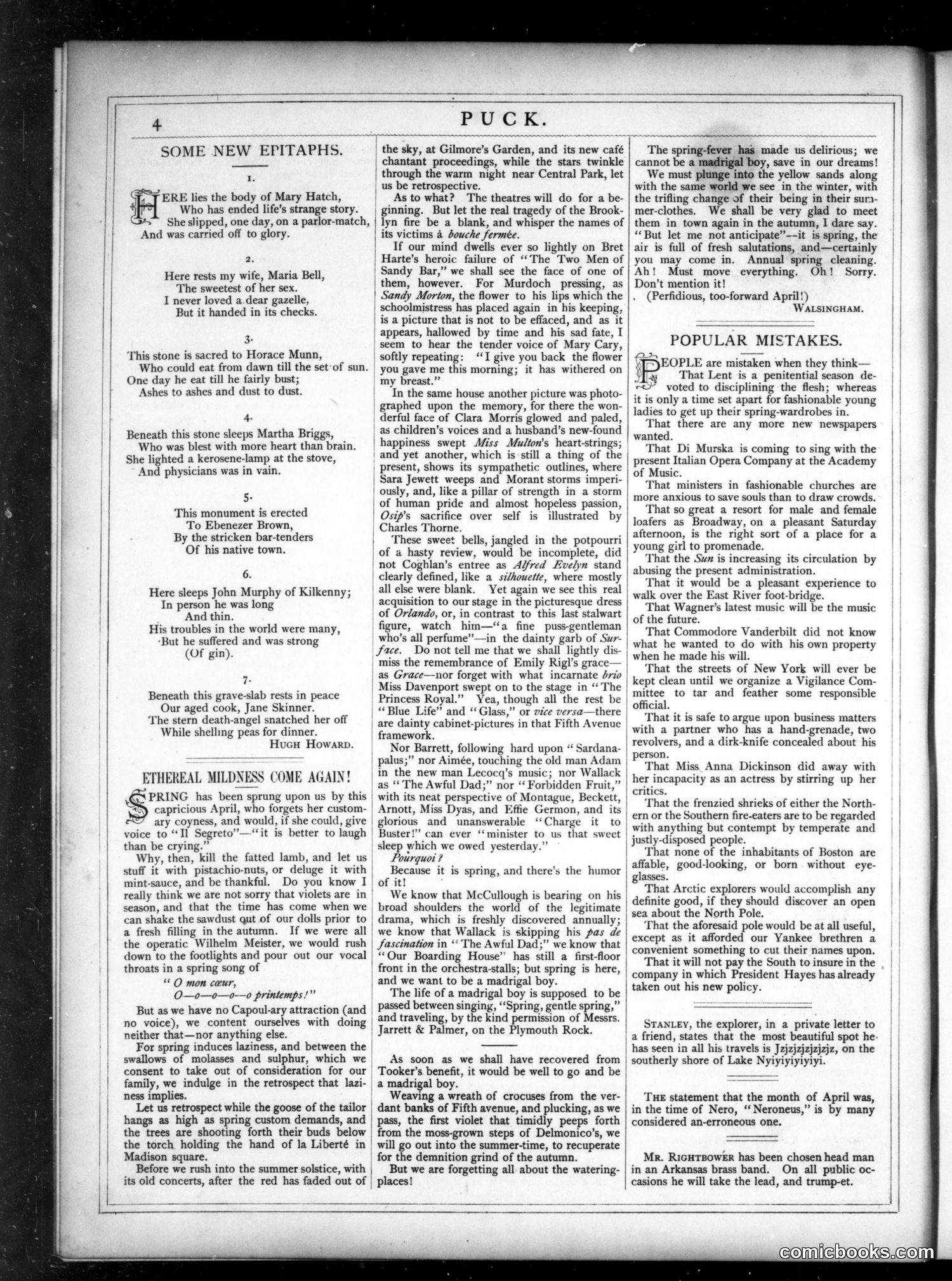
This page consists primarily of **literary content rather than political cartoons**. It contains: 1. **"Some New Epitaphs"** — humorous mock tombstone inscriptions for various figures (Mary Hatch, Maria Bell, Horace Munn, Martha Briggs, John Murphy of Kilkenny), a common 19th-century satirical form poking fun at deceased or notable individuals through witty epitaphs. 2. **"Ethereal Mildness Come Again!"** — an editorial essay on spring, with social commentary about seasonal customs, theater performances, and general urban life observations. 3. **"Popular Mistakes"** — a column debunking common misconceptions about Lent, newspapers, music, churches, and various public figures and practices. The page relies on **textual wit and social satire** rather than visual caricature, typical of Puck's literary sections between major illustrated features.
📄 Transcribed text from this page (OCR, searchable)
Machine-transcribed from the original scan — historical spelling and the odd misread are preserved.
"SOME NEW EPITAPHS. 1 J.T ERE lies the body of Mary Hatch, 1 Who has ended life’s strange story. Ga And was carried off to glory. | 2. Here rests my wife, Maria Bell, The sweetest of her sex. I never loved a.dear gazelle, But it handed in its checks. ES ‘This stone is sacred to Horace Munn, Who could eat from dawn till the set-of sun. One day he eat till he fairly bust; Ashes to ashes and dust to dust. 4 Beneath this stone sleeps Martha Briggs, Who was blest with more heart than brain. She lighted a kerosene-lamp at the stove, ‘And physicians was in vain. zs This monument is erected To Ebenezer Brown, By the stricken bar-tenders | Of his native town. 6. Here sleeps John Murphy of Kilkenny; In person he was long And thin. His troubles in the world were many, -But he suffered and was strong (Of gin). 7 Beneath this grave-slab rests in peace Our aged cook, Jane Skinner. ‘The stern death-angel snatched her off While shelling peas for dinner. Hucu Howarp. ETHEREAL MILDNESS COME AGAIN! \GSPRING has been sprung upon us by this | with its neat perspective of Montague, Beckett, | <0) capricious April, who forgets her custom- && ary coyness, and would, if she could, give voice to “Il Segreto”—‘‘it is better to laugh than be crying.” Why, then, kill the fatted lamb, and let us stuff it with pistachio-nuts, or deluge it with mint-sauce, and be thankful. Do you know I really think we are not sorry that violets are in season, and that the time has come when we can shake the sawdust gut of our dolls prior to a fresh filling in the autumn. If we were all the operatic Wilhelm Meister, we would rush | fascination in ‘‘ The Awful Dad;” we know that | down to the footlights and pour out our vocal throats in a spring song of “ O mon ceur, O—o—o—o-—o printemps!” But as we have no Capoul-ary attraction (and no voice), we content ourselves with doing neither that—nor anything else. For spring induces laziness, and between the swallows of molasses and sulphur, which we consent to take out of consideration for our family, we indulge in the retrospect that lazi- ness implies. face. the sky, at Gilmore’s Garden, and its new café chantant proceedings, while the stars twinkle | through the warm night near Central Park, let us be retrospective. As to what? The theatres will do for a be- ginning. But let the real tragedy of the Brook- She slipped, one day, on a parlor-match, | lyn fire be a blank, and whisper the names of its victims 4 bouche fermée. If our mind dwells ever so lightly on Bret Harte’s heroic failure of “The Two Men of Sandy Bar,” we shall see the face of one of them, however. For Murdoch pressing, as Sandy Morton, the flower to his lips which the schoolmistress has placed again in his keeping, is a picture that is not to be effaced, and as it appears, hallowed by time and his sad fate, I seem to hear the tender voice of Mary Cary, softly repeating: ‘‘I give you back the flower you gave me this morning; it has withered on my breast.” In the same house another picture was photo- graphed upon the memory, for there the won- derful face of Clara Morris glowed and paled, as children’s voices and a husband’s new-found happiness swept Miss Multon’s heart-strings; and yet another, which is still a thing of the present, shows its sympathetic outlines, where Sara Jewett weeps and Morant storms imperi- ously, and, like a pillar of strength in a storm of human ‘pride and almost hopeless passion, Osip’s sacrifice over self is illustrated by Charles Thorne. ‘These sweet bells, jangled in the potpourri of a hasty review, would be incomplete, did not Coghlan’s entree as Alfred Evelyn stand clearly defined, like a sidhouette, where mostly all else were blank. Yet again we see this real acquisition to our stage in the picturesque dress of Orlando, or, in contrast to this last stalwart figure, watch him—‘‘a fine puss-gentleman who’s all perfume”—in the dainty garb of Swr- Do not tell me that we shall lightly ¢ miss the remembrance of Emily Rigl’s grace— as Grace—nor forget with what incarnate drio Miss Davenport swept on to the stage in “The Princess Royal.” Yea, though all the rest be “Blue Life” and “Glass,” or vice versa—there are dainty cabinet-pictures in that Fifth Avenue framework. Nor Barrett, following hard upon “ Sardana- palus;” nor Aimée, touching the old man Adar in the new man Lecocq’s music; nor Wallac as “The Awful Dad;” nor ‘“ Forbidden Fruit,” Arnott, Miss Dyas, and Effie Germon, and its | glorious and unanswerable ‘Charge it to Buster!” can ever “minister to us that sweet sleep which we owed yesterday.” Pourquoi ? Because it is spring, and there's the humor of it! We know that McCullough is bearing on his broad shoulders the world of the legitimate drama, which is freshly discovered annually; we know that Wallack is skipping his pas de “Our Boarding House” has still a first-floor front in the orchestra-stalls; but spring is here, | and we want to be a madrigal boy. ‘The life of a madrigal boy is supposed to be passed between singing, “‘Spring, gentle spring,” and traveling, by the kind permission of Messrs. Jarrett & Palmer, on the Plymouth Rock. As soon as we shall have recovered from Tooker’s benefit, it would be well to go and be a madrigal boy. Weaving a wreath of crocuses from the ver- Let us retrospect while the goose of the tailor | dant banks of Fifth avenue, and plucking, as we hangs as high as spring custom demands, and | pass, the first violet that timidly peeps forth the trees are shooting forth their buds below | from the moss-grown steps of Delmonico’s, we the torch holding the hand of la Liberté in | will go out into the summer-time, to recuperate Madison square. for the demnition grind of the autumn. Before we rush into the summer solstice, with | _ But we are forgetting all about the watering- its old concerts, after the red has faded out of | places! ‘The spring-fever has. made us delirious; we cannot be a madrigal boy, save in our dreams! We must plunge into the yellow sands along with the same world we see in the winter, with the trifling change of their being in their sur- mer-clothes. We shall be very glad to meet them in town again in the autumn, I dare say. “But let me not anticipate”--it is spring, the air is full of fresh salutations, and—certainly you may come in. Annual spring cleaning. Ah! Must move everything. Oh! Sorry. Don’t mention it! (Perfidious, too-forward April!) WALSINGHAM. POPULAR MISTAKES. EOPLE are mistaken when they think— That Lent is a penitential season de- voted to disciplining the flesh; whereas it is only a time set apart for fashionable young ladies to get up their spring-wardrobes in. That there are any more new newspapers wanted. That Di Murska is coming to sing with the | present Italian Opera Company at the Academy | of Music. | That ministers in fashionable churches are | more anxious to save souls than to draw crowds. | That so great a resort for male and female | loafers as Broadway, on a pleasant Saturday afternoon, is the right sort of a place for a young girl to promenade. That the Swz is increasing its circulation by | abusing the present administration. | That it would be a pleasant experience to | walk over the East River foot-bridge. That Wagner's latest music will be the music of the future. | That Commodore Vanderbilt did not know oo _| what he wanted to do with his own property when he made his will. That the streets of New York will ever be kept clean until we organize a Vigilance Com- mittee to tar and feather some responsible official. That it is safe to argue upon business matters with a partner who has a hand-grenade, two | revolvers, and a dirk-knife concealed about his person. That Miss Anna Dickinson did away with | el incapacity as an actress by stirring up her | q S. ‘That the frenzied shrieks of either the North- ern or the Southern fire-eaters are to be regarded with anything but contempt by temperate and justly-disposed people. That none of the inhabitants of Boston are affable, good-looking, or born without eye- | glasses. |” That Arctic explorers would accomplish any definite good, if they should discover an open sea about the North Pole. ‘That the aforesaid pole would be at all useful, except as it afforded our Yankee brethren a convenient something to cut their names upon. That it will not pay the South to insure in the company in which President Hayes has already | taken out his new policy. STANLEY, the explorer, in a private letter to | a friend, states that the most beautiful spot he: | has seen in all his travels is Jzjzjzjzjzjzjz, on the | southerly shore of Lake Nyiyiyiyiyiyi. Tue statement that the month of April was, in the time of Nero, ‘“‘Neroneus,” is by many | considered an-erroneous one. Mr. RicHTBowER has been chosen head man in an Arkansas brass band. On all public oc- casions he will take the lead, and trump-et.