
A complete issue · 16 pages · 1877
Puck — March 1877
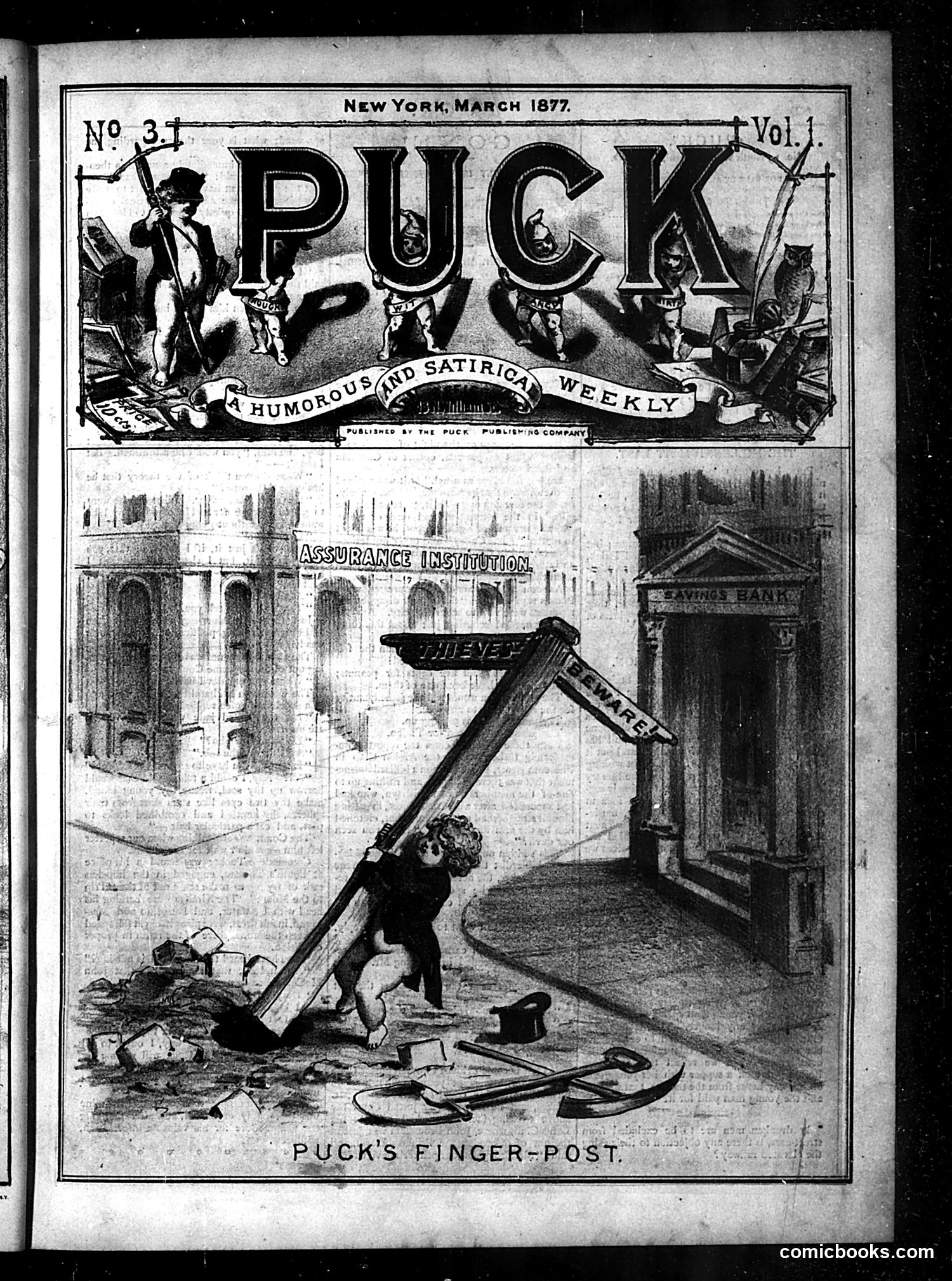
This cartoon satirizes financial institutions' vulnerability to theft. The illustration shows a burglar or thief using a large crowbar labeled "THIEVE'S FARE" to pry open a massive lever/beam. The beam appears to operate as a "finger-post" (directional sign) pointing toward buildings labeled "Assurance Institution" and "Savings Bank." The satire suggests that financial institutions—meant to protect savings and provide security—are themselves targets for criminals, or possibly that the institutions themselves employ questionable practices. The burglar's prominent placement and the mechanical nature of the imagery emphasize how financial institutions' security systems can be exploited or compromised. This reflects 1870s concerns about banking fraud and theft during America's Gilded Age.
This page is primarily **text-based content**, not a political cartoon. The main article, "Gone! Great Excitement in the Office of 'Puck,'" describes the mysterious disappearance of someone referred to as "the Ex-Devil"—apparently a *Puck* staff member or character. The piece humorously chronicles office chaos following this person's vanishing. It includes a parody investigation involving interviews with colleagues discussing whether the missing person went to Europe, speculating about an umbrella he carried, and featuring a billiards incident at the Allison Club. The humor derives from **office bureaucracy and absurdist mystery**, rather than political satire. Supporting sections include "Puck's Finger-Post" about insurance companies and "A Telephonic Suggestion" about telephone testing. This appears to be **comedic miscellany** typical of Puck's satirical magazine format.
This page consists primarily of **text articles and humor columns** rather than political cartoons. The main content includes: 1. **"Waiting for Copy"** — A satirical piece mocking newspaper editors and printers dealing with late submissions, using repetitive complaints about copy not arriving. 2. **"Dr. Mary Walker on the Rampage"** — References Dr. Mary Walker, a real Civil War surgeon and women's rights advocate known for wearing pants, mocking her as a nuisance to society. 3. **"A New Species of Sport"** — Humorous anecdotes about unusual incidents. 4. **"Mystery and Music"** — Discussion of musical terminology and criticism. The page also contains an **"Answers for the Anxious"** advice column addressing readers' questions. No significant political cartoon imagery is visible on this particular page.
This page contains **three distinct articles** rather than political cartoons: 1. **"The American Shakspeare"** - A literary critique discussing American playwrights, comparing them favorably to European dramatists. It praises works like "Puck" while critiquing others. 2. **"Blueglassomania"** - A humorous essay satirizing obsessive collecting. It mocks people who compulsively accumulate worthless items (old newspapers, business cards, tapes) and describes a youth whose hoarding becomes pathological, eventually requiring intervention by authorities. 3. **"A New Move in Life Insurance"** - Commentary on insurance industry practices, describing dubious methods companies use to inspect customers' homes and finances. The page is primarily **text-based social satire** rather than visual cartoons, targeting literary pretension, collecting obsession, and corporate overreach.
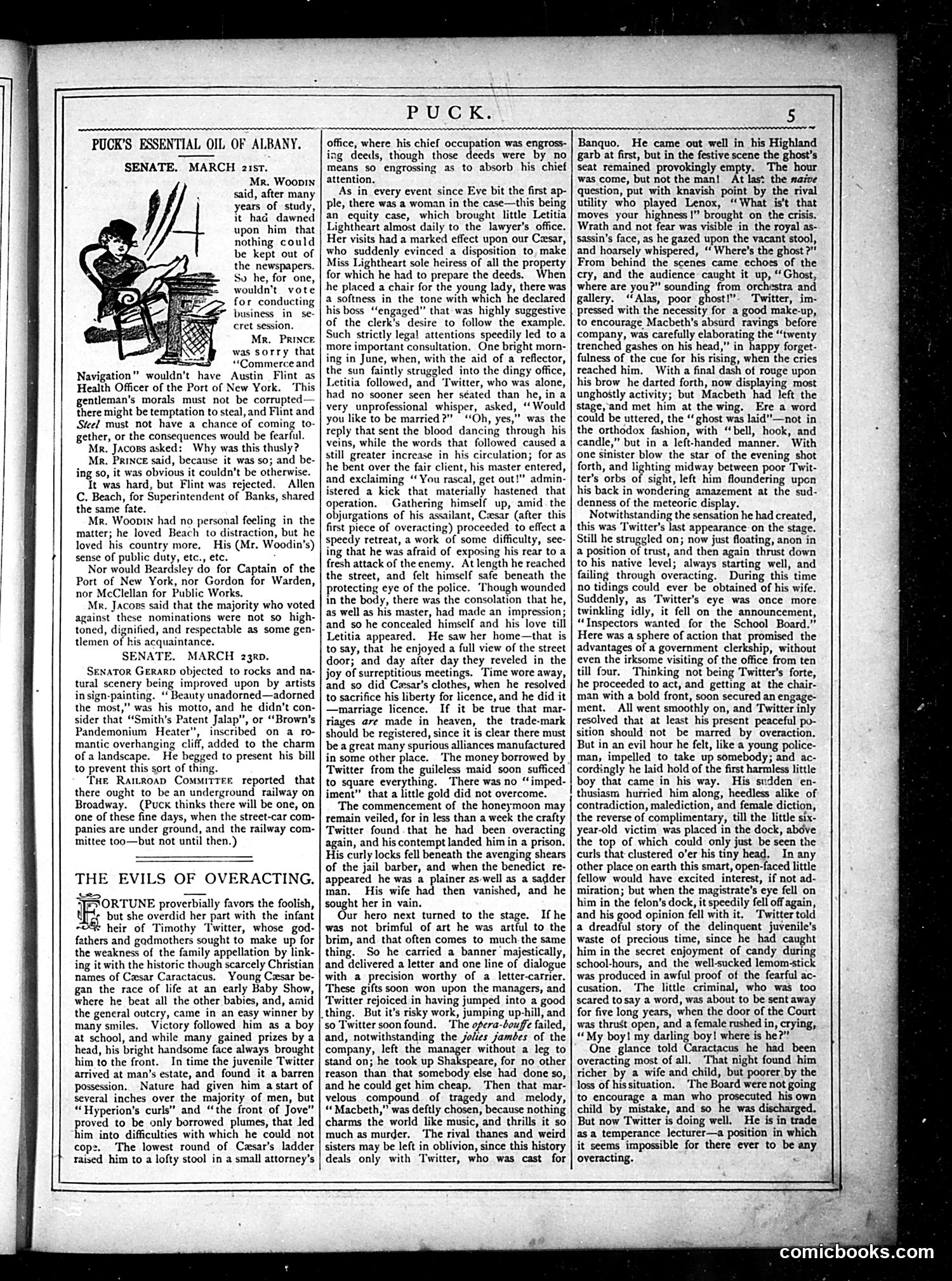
This Puck page from March 21st contains two distinct sections. The left side features "Puck's Essential Oil of Albany," a political satire about New York state legislature, with an accompanying cartoon illustration of a figure in a chair. The text criticizes various senators and their conduct, including references to votes on conduct nominations and questions about moral fitness for office. The larger section, "The Evils of Overacting," appears to be a theater critique focusing on an actor named Timothy Twitter (likely a fictional character). It discusses his overacting performances, his troubled personal life, and various theatrical scandals. The satire mocks both his theatrical excesses and his morally questionable behavior off-stage, suggesting his private misconduct mirrors his exaggerated stage performances.
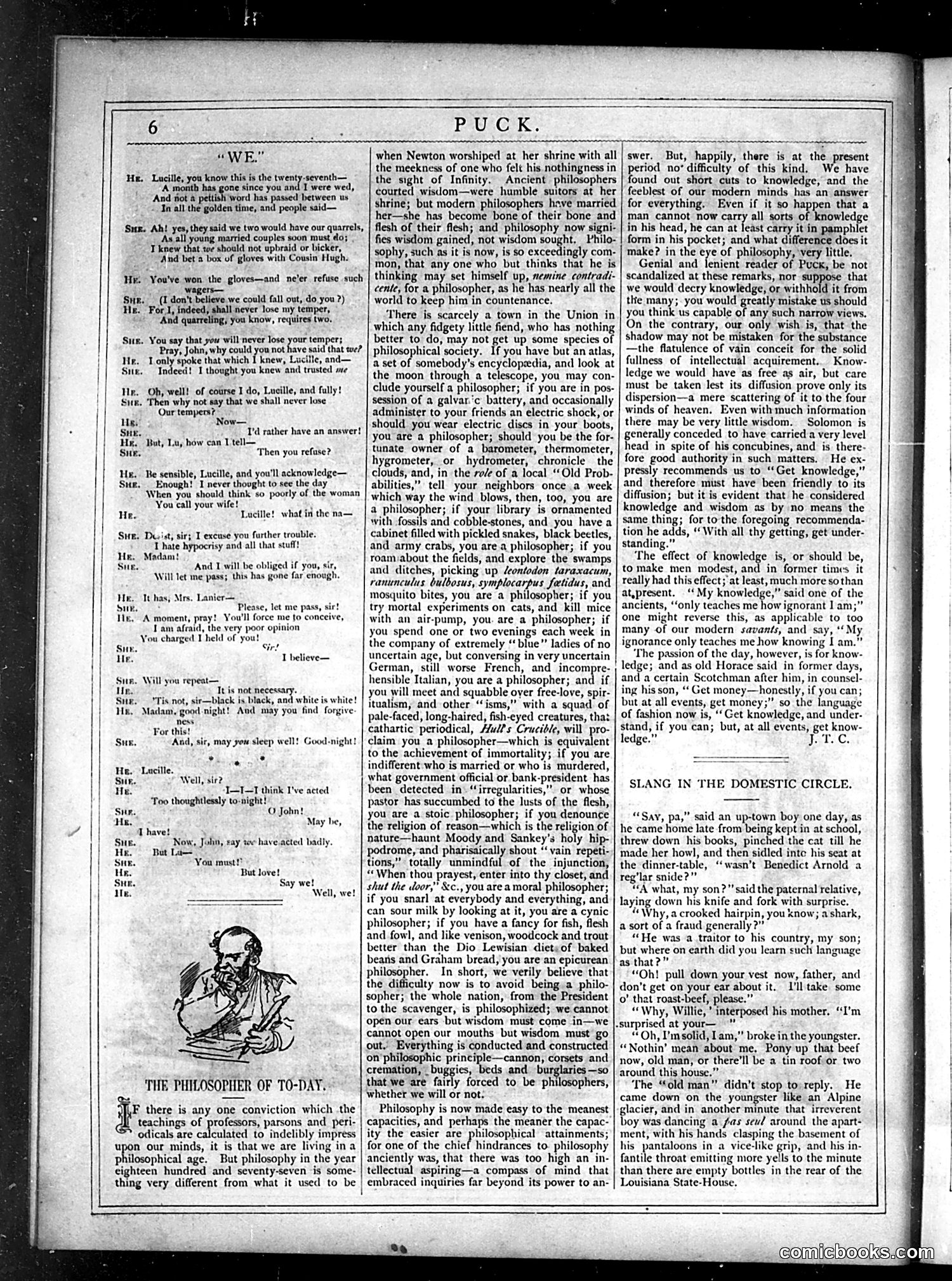
The page contains two distinct pieces: **"We"** (top): A dialogue satirizing philosophical pretension. It mocks people who adopt the language and trappings of philosophy—owning telescopes, barometers, and taxidermied specimens—while lacking genuine understanding. The satire targets the "armchair philosopher" of the era who conflates owning scientific instruments with possessing actual knowledge. **"Slang in the Domestic Circle"** (bottom): A brief humorous exchange between a mother and son about the phrase "a hot air," with accompanying illustration of a boy. It satirizes how children absorb and misuse adult slang without understanding it. Both pieces target intellectual pretension and the gap between appearance and substance—common Puck themes mocking social climbing and false sophistication in the Gilded Age.
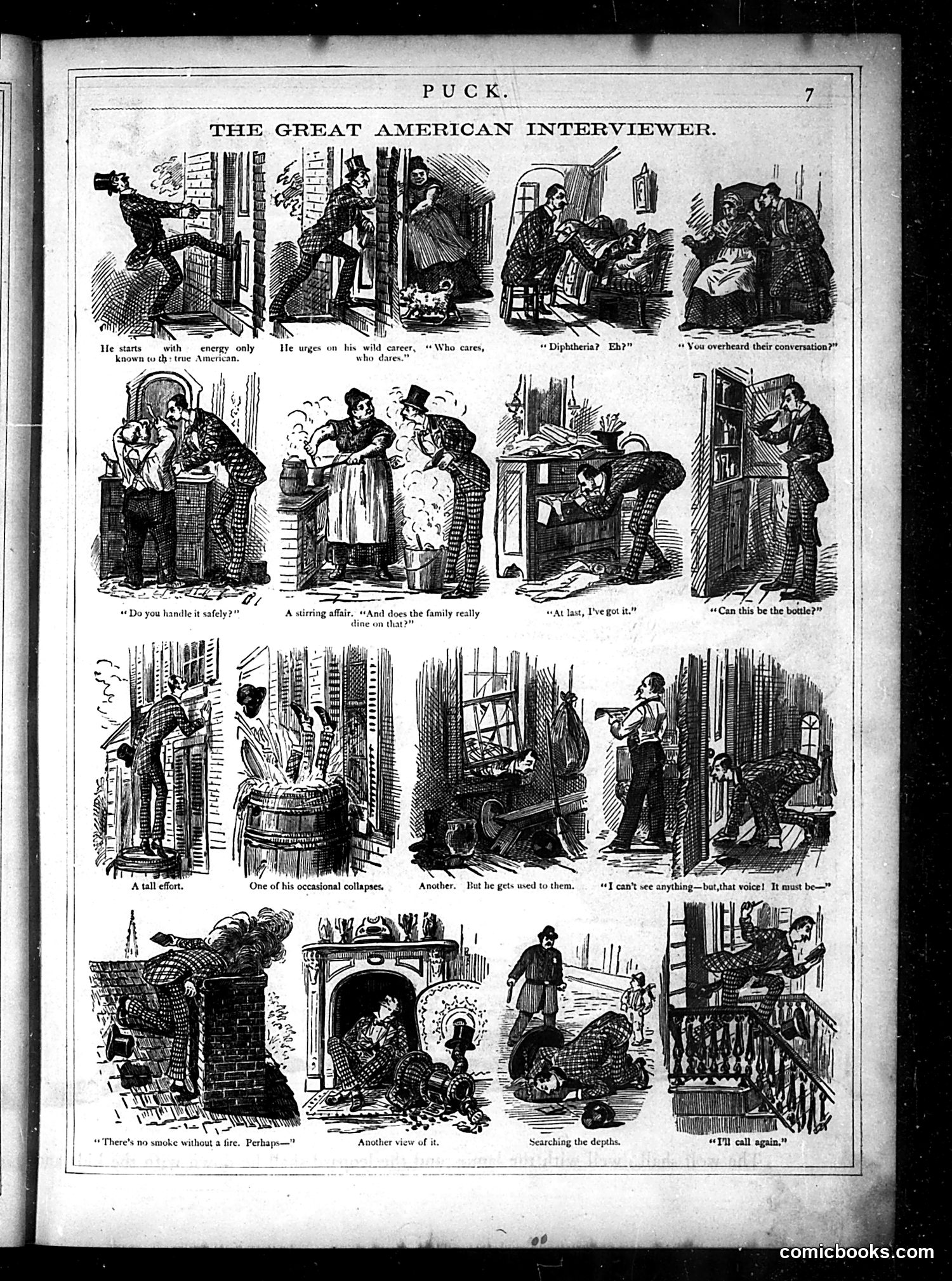
This satirical comic strip mocks the emerging practice of aggressive newspaper interviewing in late 19th-century America. The sequence shows a persistent journalist pursuing subjects through increasingly invasive methods—climbing walls, pursuing people indoors, interrupting intimate moments, and literally chasing them through chimneys and down sewers. The captions ("Do you handle it safely?" "A stirring affair. What does the family really dine on that?" "At last, I've got it!") suggest the interviewer will stop at nothing for a story, even compromising privacy and dignity. The satire targets journalism's growing sensationalism and intrusive tactics, portraying the "Great American Interviewer" as obsessive and undeterred by social boundaries—a critique of how newspapers were becoming increasingly aggressive in pursuing news and gossip.
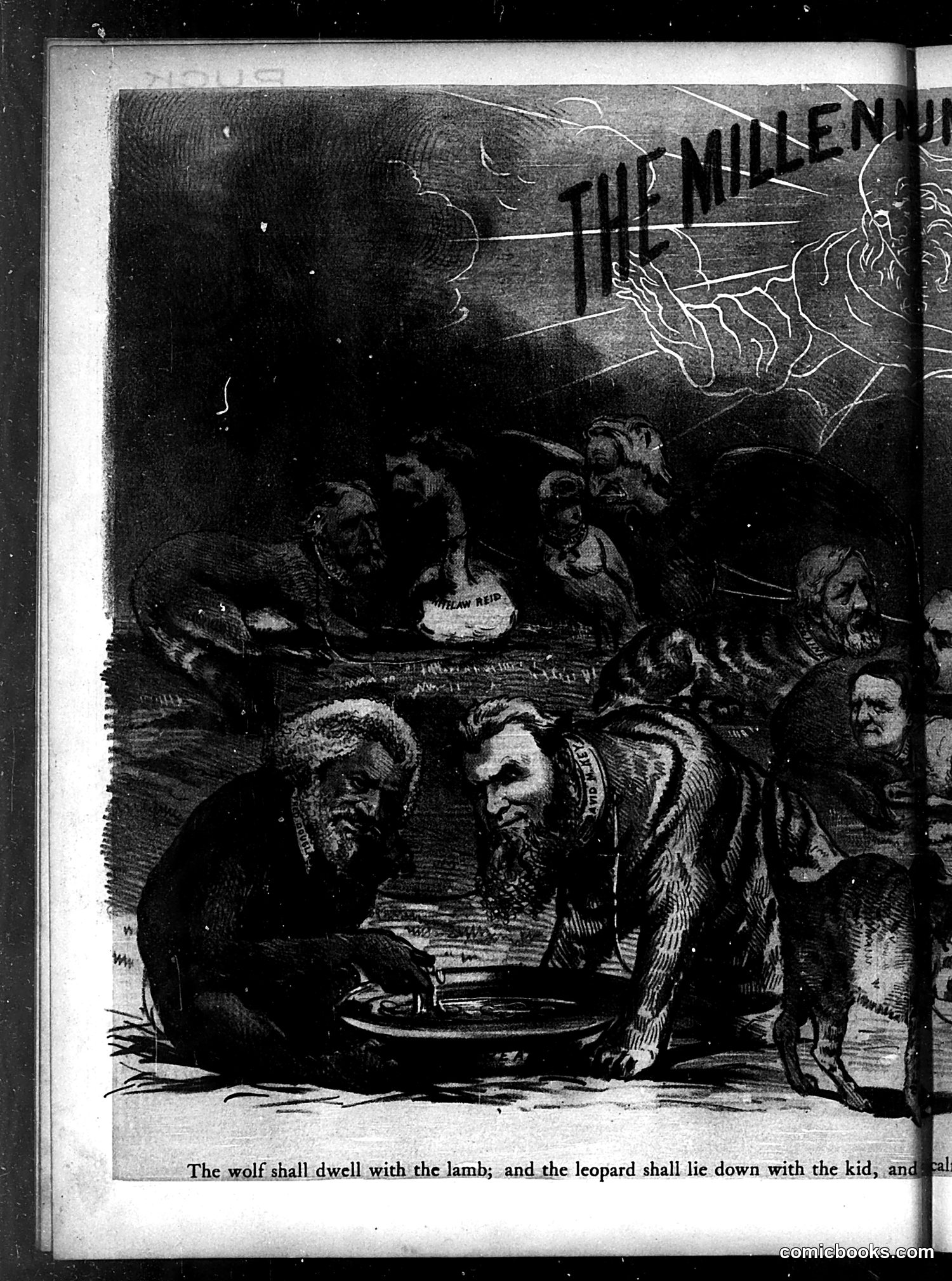
This appears to be a satirical illustration from *Puck* magazine depicting a scene where various figures—rendered as caricatures with exaggerated features—gather around a table or fire. The caption reads: "The wolf shall dwell with the lamb; and the leopard shall lie down with the kid, and..." This is a biblical reference (Isaiah 11:6) about unlikely enemies coexisting peacefully. The cartoon uses this scripture ironically to mock some political situation where bitter rivals or hostile groups were supposedly reconciling or cooperating. The grotesque, animalistic caricatures suggest the cartoonist viewed this reconciliation as absurd or false—like predators pretending to be harmless. Without clearer identification of the specific figures, the exact historical or political context remains unclear, though the satire targets hypocrisy about peace between adversaries.
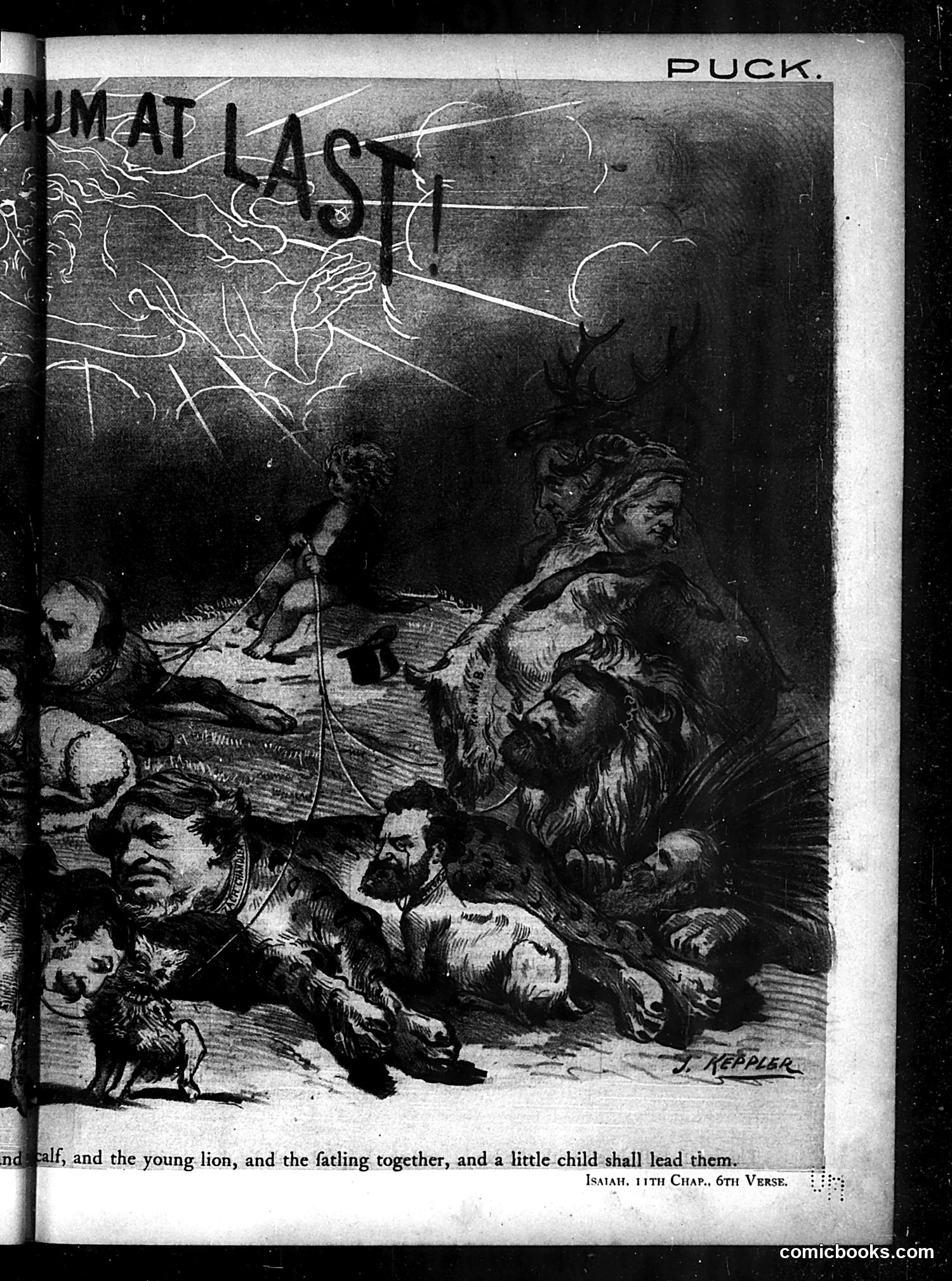
This illustration depicts a biblical allegory based on Isaiah 11:6—"the wolf also shall dwell with the lamb, and the leopard shall lie down with the kid; and the calf and the young lion, and the fatling together, and a little child shall lead them." The cartoon shows various wild animals and fierce creatures (wolf, lion, leopard, and others) coexisting peacefully under a child's leadership, with lightning in the sky above. The title "At Last" suggests achieving an impossible, long-awaited harmony. This likely satirizes a contemporary political or social movement toward peace, reconciliation, or utopian reform—using the biblical prophecy ironically to mock whether such idealistic goals could realistically occur. The specific historical context requires additional information to identify fully.
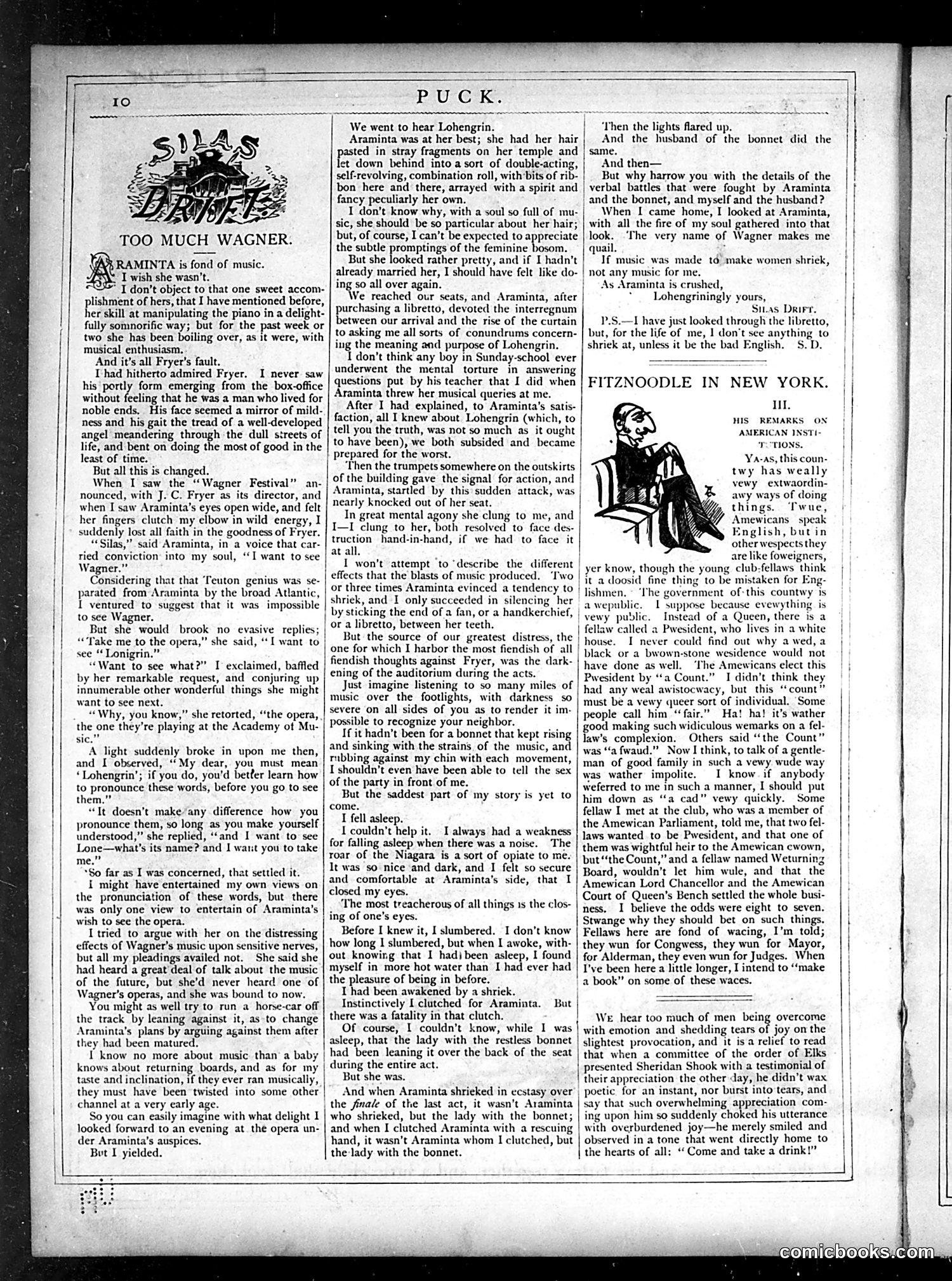
This Puck magazine page contains two articles with illustrations: 1. **"Too Much Wagner"** — A humorous essay criticizing composer Richard Wagner's music as overly complex and tedious. The author recounts attending a Wagner Festival performance with someone named Araminta, describing the experience as mentally exhausting. The piece mocks Wagner's excessive artistic pretensions. 2. **"Fitznoodle in New York"** — A satirical piece about an English visitor's observations of American customs and government. The illustration shows a distinguished Englishman. The text criticizes American political practices (mentioning Presidents and Parliament) and social behaviors as crude compared to English standards. Both pieces use humor to contrast European (particularly English and German) cultural sophistication with perceived American and Wagnerian excess or vulgarity.
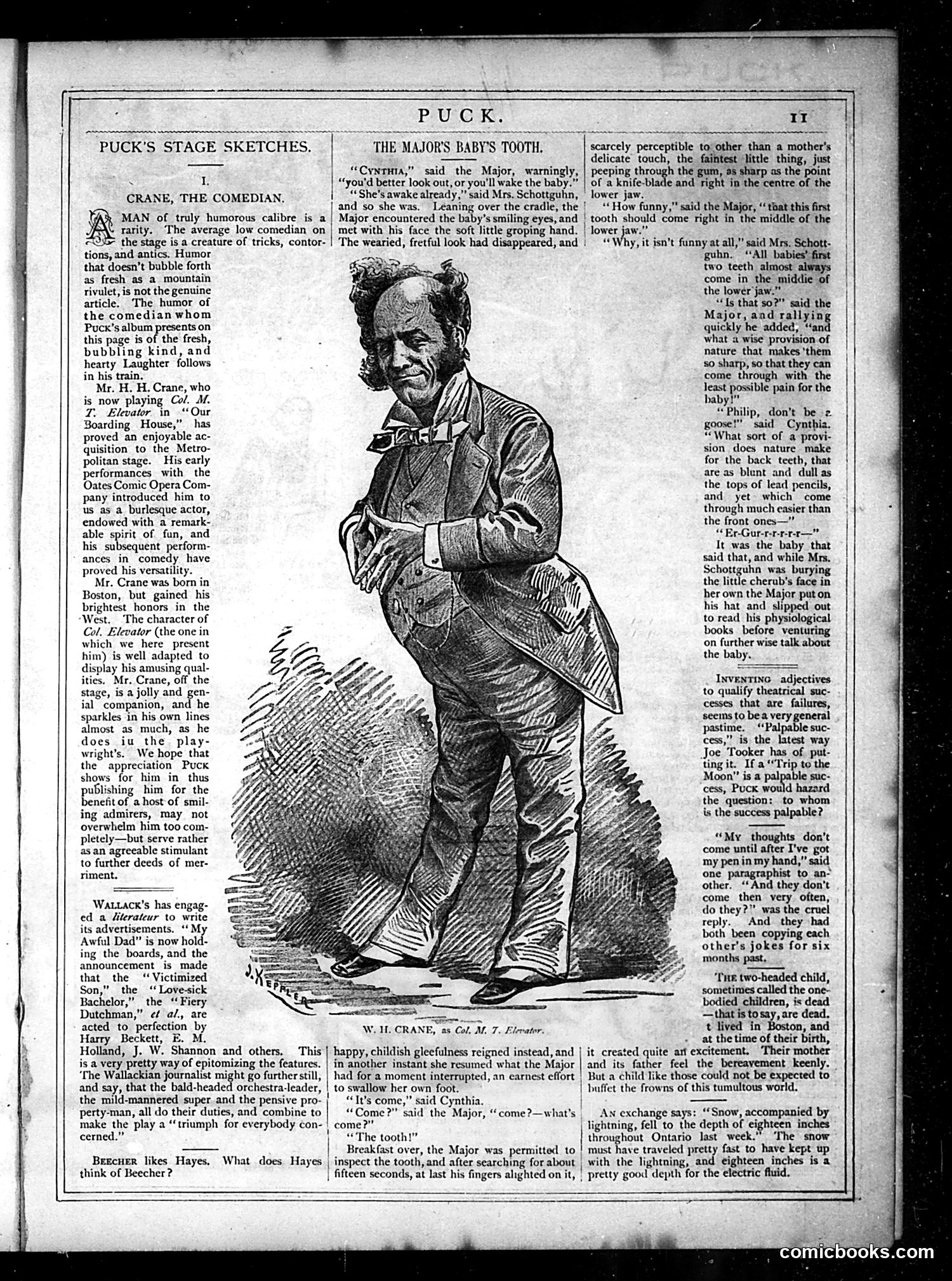
This page contains **theater criticism and sketches**, not political satire. The main content features: **"Crane, the Comedian"** — A portrait and review of actor W.H. Crane, who appears in *Col. M.T. Elevator* ("Our Boarding House"). The text praises his "burlesque" acting style and versatility, noting he's now in a Metropolitan stage production. The accompanying sketch shows Crane in character as the Colonel. **"The Major's Baby's Tooth"** — A humorous story about a Major and his wife Cynthia discussing their baby's first tooth. The satire mocks Victorian parenting obsessions and pseudo-scientific explanations of child development—the Major invents elaborate theories about why back teeth emerge differently than front teeth. The page exemplifies Puck's dual focus: **theater coverage mixed with gentle domestic humor** targeting middle-class preoccupations rather than politics.
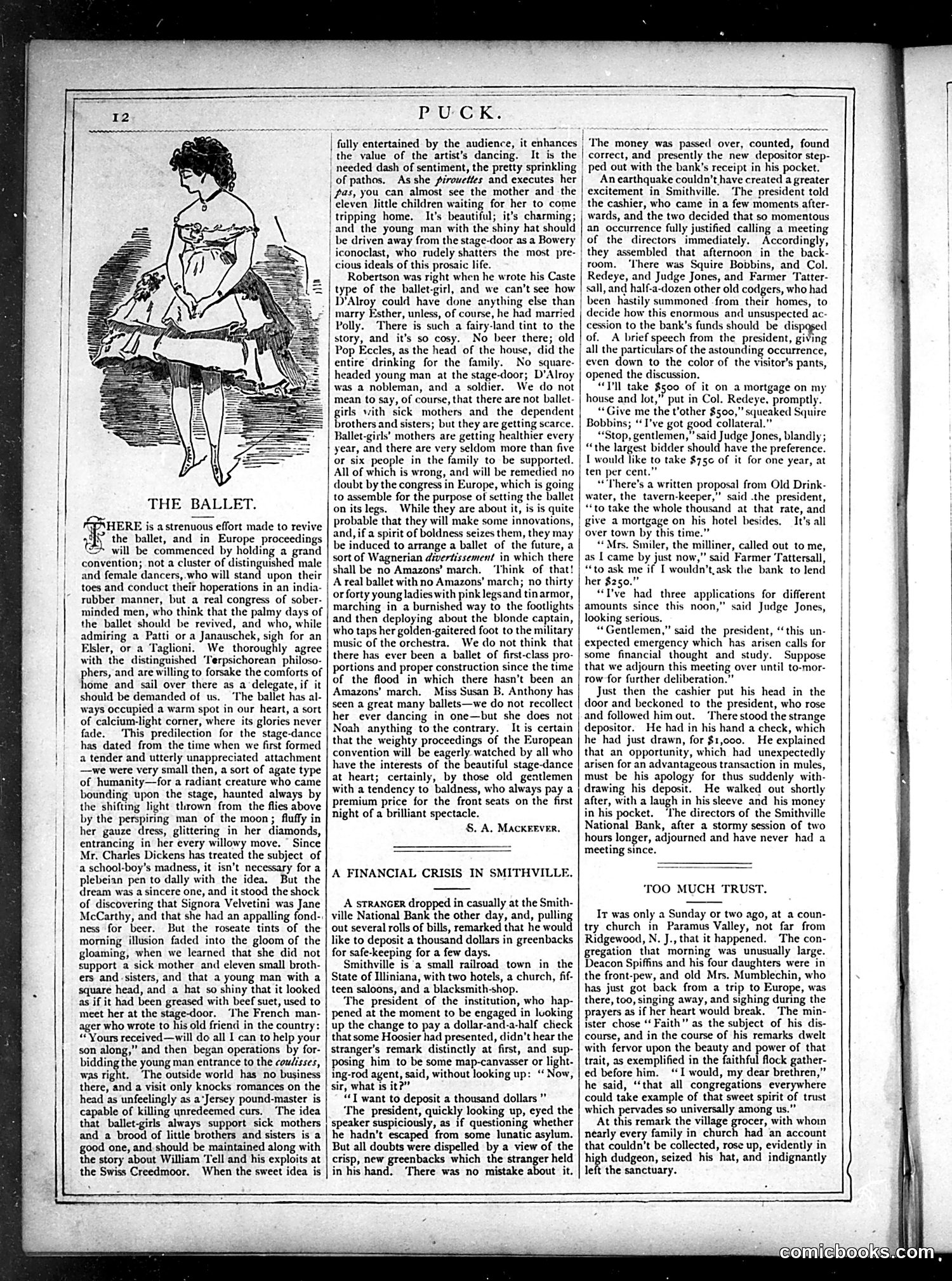
This page contains three distinct articles with one illustration. The main piece, "THE BALLET," features a sketch of a young woman in ballet attire and discusses efforts to revive ballet in America and Europe. The author argues that ballet has declined due to "old hop-fooeys" managing productions and suggests reform is needed—particularly advocating for the "Amazons' march" and modernized choreography. Below are two separate articles: "A FINANCIAL CRISIS IN SMITHVILLE" (a satirical anecdote about a banker's embarrassment when unable to pay a check) and "TOO MUCH TRUST" (a cautionary tale about misplaced faith in a village grocer). These appear to be humorous social commentary rather than political satire.
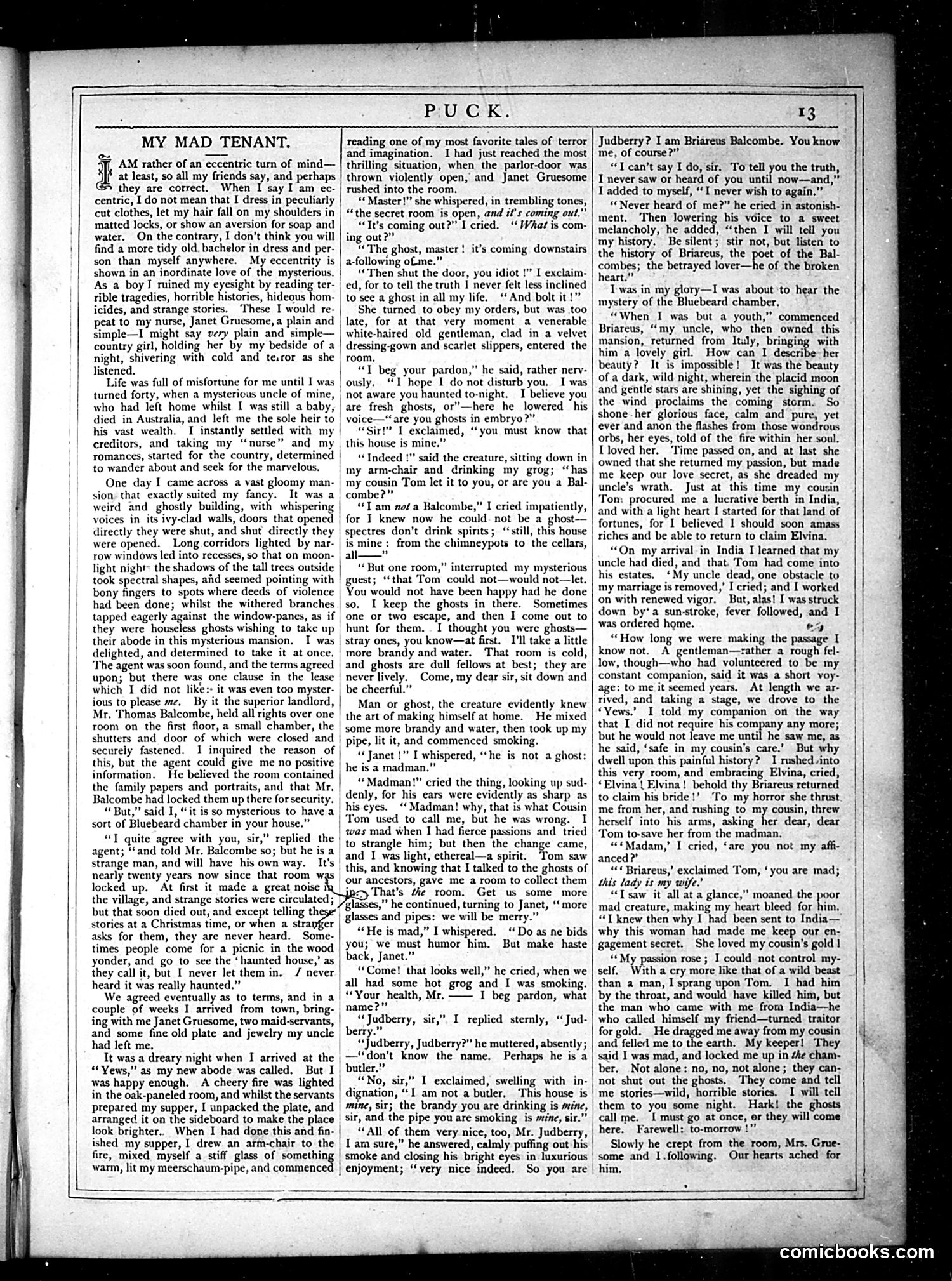
This page contains a serialized short story rather than a political cartoon. The narrative follows a narrator recounting encounters with a supposedly haunted house and its eccentric tenant, a man named Tom who claims to be a ghost or supernatural creature. The story appears to be a Gothic horror satire, playing on Victorian-era ghost story conventions popular in literature. The humor seems to derive from the absurdity of Tom's claims and the narrator's gullible belief in supernatural explanations for mundane occurrences—a common satirical target of the period. Without visible illustrations on this page, the satire relies entirely on the written narrative mocking contemporary superstitions and credulous attitudes toward ghost stories and the paranormal.
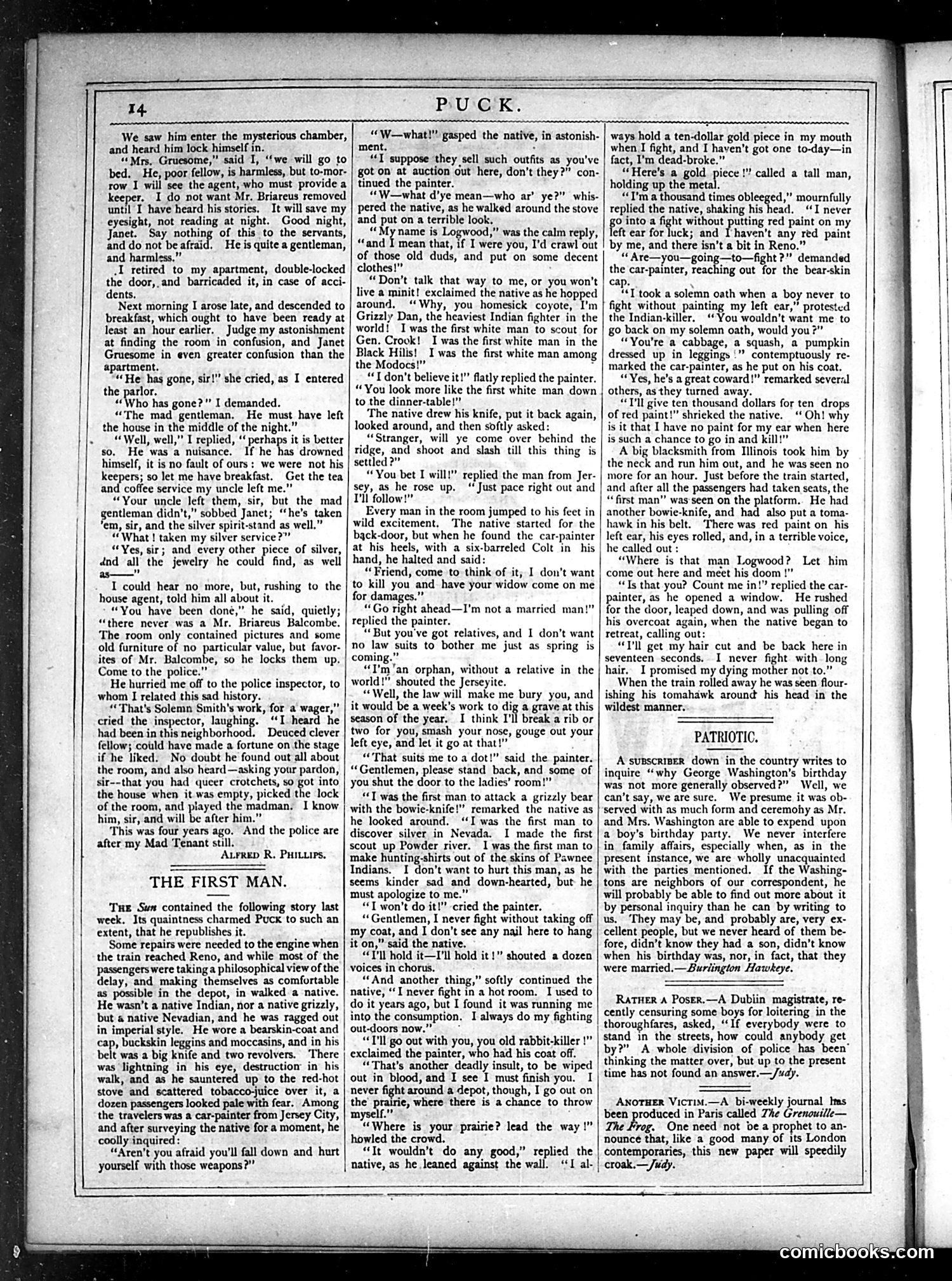
This page is primarily **text-based content** from Puck magazine, containing two stories: "Puck" (a narrative about a train journey and conflict) and "The First Man" (described as reprinted from The Sun). The visible content includes a short section titled **"PATRIOTIC"** near the bottom, which appears to be a humorous anecdote about a subscriber questioning whether George Washington's birthday was "generally observed." The joke seems to mock either patriotic pretense or forgetfulness about national holidays. Below that are brief notices about other publications, including references to *The Free* and *The Congregationalist*. **There are no political cartoons visible on this page**—it is primarily composed of satirical prose pieces and miscellaneous editorial content typical of Puck's format.
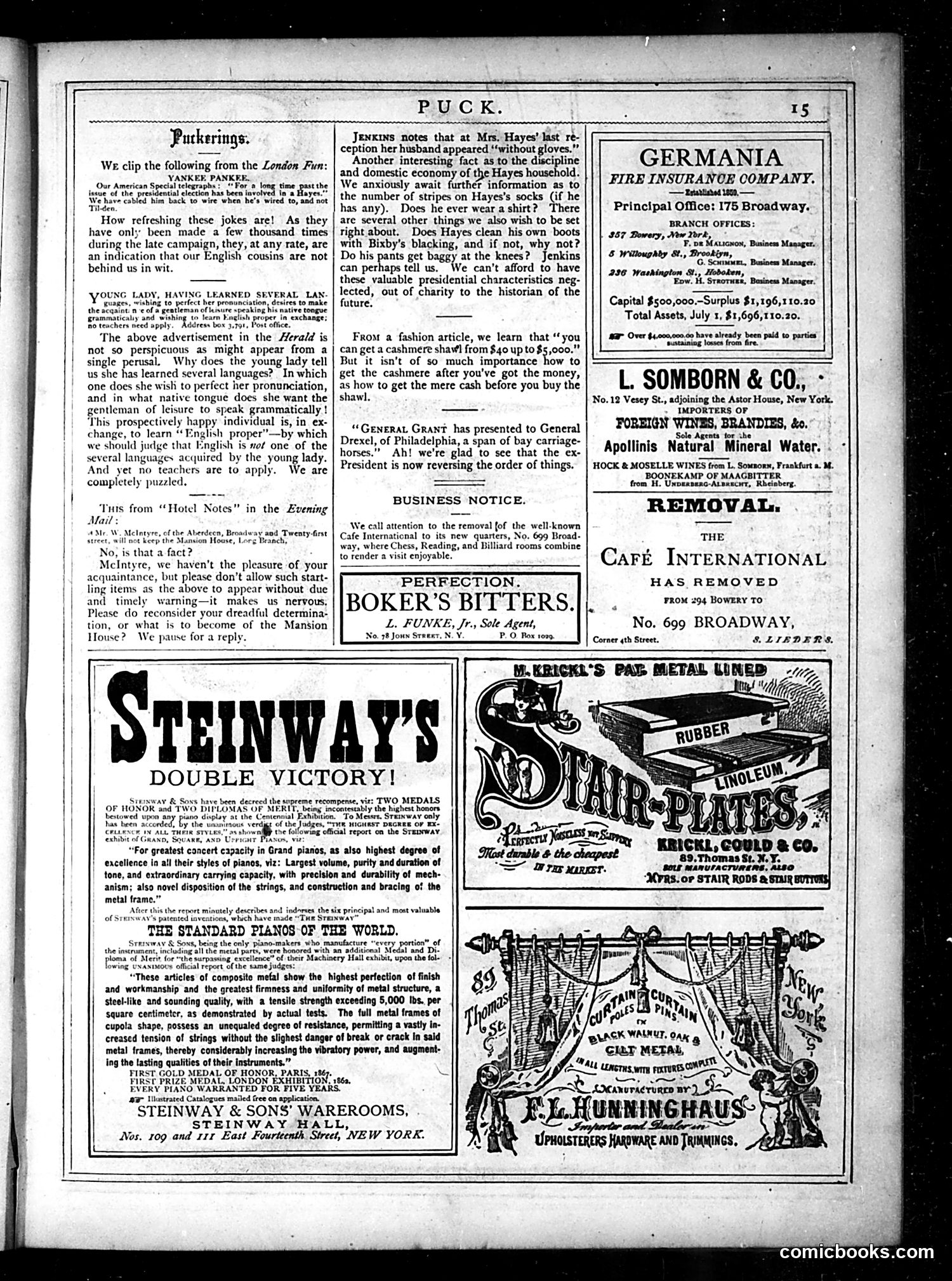
This is primarily an **advertising page** from Puck magazine, not a political cartoon. The page contains multiple commercial advertisements typical of the era, including: - **Steinway pianos** (large display ad emphasizing awards and craftsmanship) - **Germania Fire Insurance Company** - **L. Somborn & Co.** (wine and spirits importer) - **Café International** (relocation notice) - **Boker's Bitters** (patent medicine) - **M. Krickl's stair plates** and **L.H. Hunninghaus** (upholstery hardware) The page also contains brief satirical snippets titled "**Puckerings**"—short humor pieces about fashion, social customs, and household management—but these are minor filler content rather than featured cartoons. The dominant content is commercial advertising, reflecting how 19th-century magazines monetized publication.
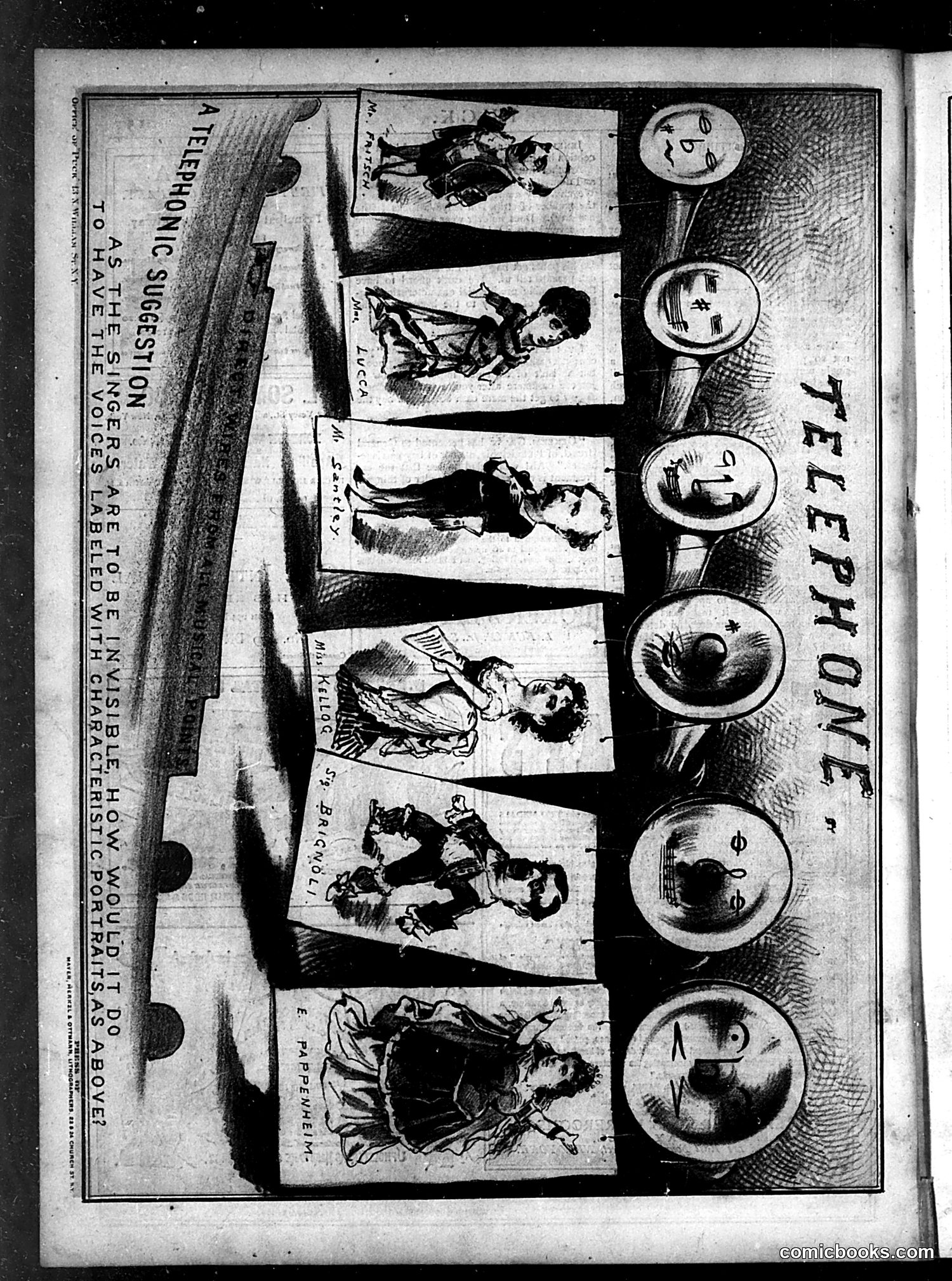
This Puck cartoon satirizes how wealthy industrialists and politicians use the telephone to conduct backroom deals while appearing respectable in public. The circular "phone receiver" vignettes on the right show the same figures in different contexts—likely demonstrating hypocrisy or double-dealing. The left panel shows figures in formal dress, apparently conducting legitimate business. The satire suggests these same people are simultaneously making questionable arrangements via telephone, hidden from public view. This reflects Gilded Age concerns about monopolies, corruption, and how new technology (the telephone) enabled secretive deals among the powerful. The "suggestion" in the title implies these conversations are inappropriate or unethical—the kind of manipulation ordinary citizens couldn't witness or prevent.