
Puck, 1877-03 · page 5 of 16
Puck — March 1877 — page 5: what you’re looking at
What you’re looking at
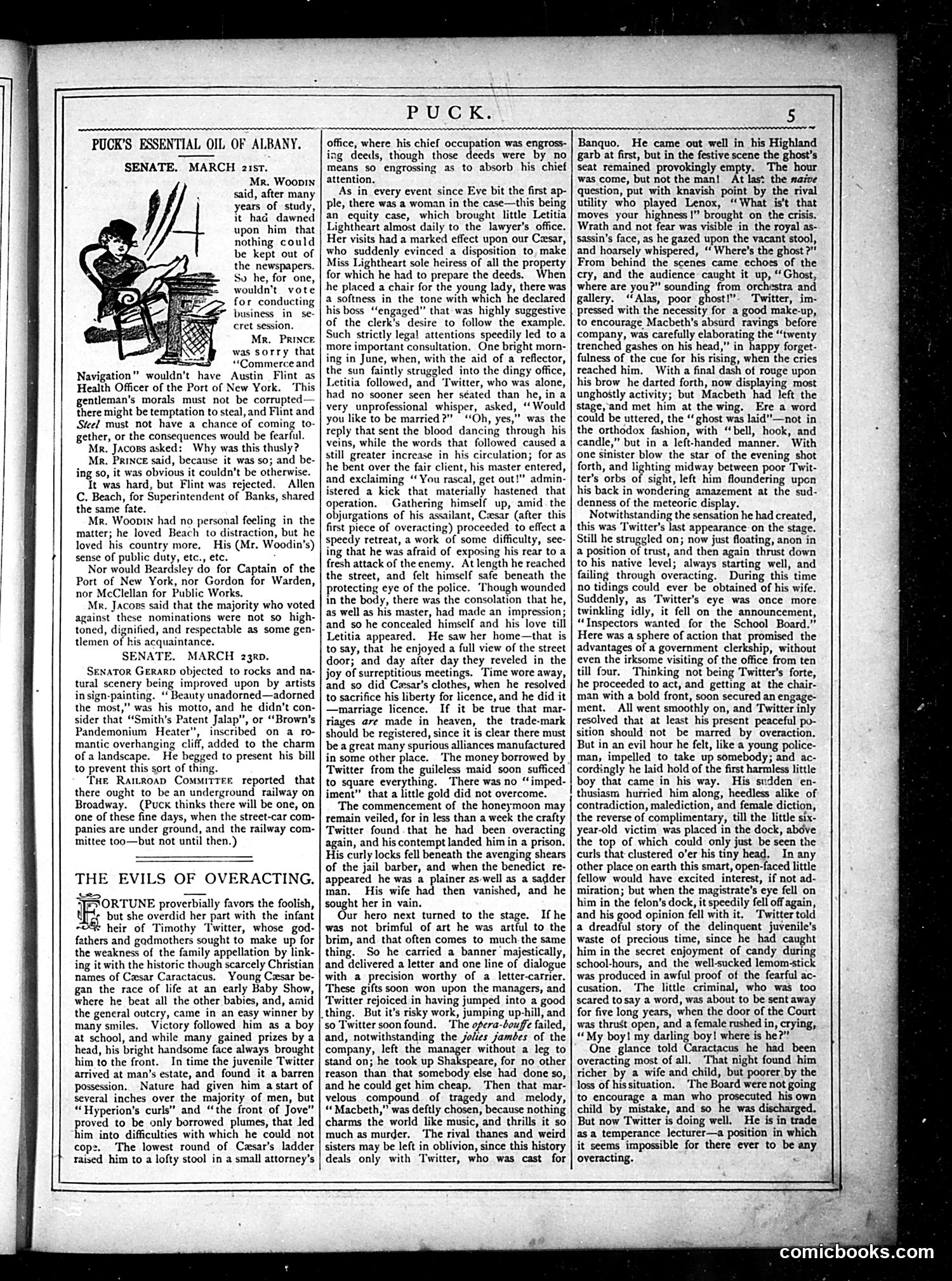
This Puck page from March 21st contains two distinct sections. The left side features "Puck's Essential Oil of Albany," a political satire about New York state legislature, with an accompanying cartoon illustration of a figure in a chair. The text criticizes various senators and their conduct, including references to votes on conduct nominations and questions about moral fitness for office. The larger section, "The Evils of Overacting," appears to be a theater critique focusing on an actor named Timothy Twitter (likely a fictional character). It discusses his overacting performances, his troubled personal life, and various theatrical scandals. The satire mocks both his theatrical excesses and his morally questionable behavior off-stage, suggesting his private misconduct mirrors his exaggerated stage performances.
📄 Transcribed text from this page (OCR, searchable)
Machine-transcribed from the original scan — historical spelling and the odd misread are preserved.
PUCK. PUCK’S ESSENTIAL OIL OF ALBANY. SENATE. MARCH aisr. Mr. Woopin said, after many years of study, it had dawned upon him that nothing could be kept out of the newspapers. So he, for one, wouldn't vote for conducting business in se- cret session. Mr. PRINCE was sorry that 7" “Commerce and Navigation” wouldn't have Austin Flint as Health Officer of the Port of New York. This gentleman’s morals must not be corrupted— there might be temptation to steal, and Flint and Steel must not have a chance of coming to- gether, or the consequences would be fearful. Mr. Jacoss asked: Why was this thusly? Mr. Prince said, because it was so; and be- ing so, it was obvious it couldn’t be otherwise. It was hard, but Flint was rejected. Allen C. Beach, for Superintendent of Banks, shared the same fate. Mr. Woopin had no personal feeling in the matter; he loved Beach to distraction, but loved his country more. His (Mr. Woodin’s) sense of public duty, etc., etc. Nor would Beardsley do for Captain of the Port of New York, nor Gordon for Warden, nor McClellan for Public Works. Mr. Jacons said that the majority who voted against these nominations were not so high- toned, dignified, and respectable as some gen- tlemen of his acquaintance. SENATE. MARCH 23rp. Senator Gerarp objected to rocks and na- tural scenery being improved upon by artists insign-painting. “ Beauty unadorned—adorned the most,” was his motto, and he didn’t con- sider that “Smith's Patent Jalap”, or “Brown's Pandemonium Heater”, inscribed on a ro- mantic overhanging cliff, added to the charm of a landscape. He begged to present his bill to prevent this sort of thing. Tue Raitroap Comsitree reported that there ought to be an underground railway on Broadway. (Puck thinks there will be one, on one of these fine days, when the street-car com- panies are under ground, and the railway com- mittee too—but not until then.) THE EVILS OF OVERACTING. SERORTUNE proverbially favors the foolish, UP but she overdid her part with the infant 4 heir of Timothy Twitter, whose god- fathers and gadmothers sought to make up for the weakness of the family appellation by link- ing it with the historic though scarcely Christian names of Caesar Caractacus. Young Cesar be- gan the race of life at an early Baby Show, where he beat all the other babies, and, amid the general outcry, came in an easy winner by many smiles. Victory followed him as a boy at school, and while many gained prizes by a head, his bright handsome face always brought him to the front. In time the juvenile Twitter arrived at man’s estate, and found it a barren possession. Nature had given him a start of several inches over the majority of men, but “Hyperion’s curls” and “the front of Jove” roved to be only borrowed plumes, that led im into difficulties with which he could not co] The lowest round of Casar’s ladder P: | raised him to a lofty stool in a small attorney's office, where his chief occupation was engross- ing deeds, though those deeds were by no means so engrossing as to absorb his chief attention. As in every event since Eve bit the first ap- ple, there was a woman in the case—this being an equity case, which brought little Letitia Lightheart almost daily to the lawyer's office. Her visits had a marked effect upon our Cesar, who suddenly evinced a disposition to, make Miss Lightheart sole heiress of all the property for which he had to prepare the deeds. When he placed a chair for the young lady, there was a softness in the tone with which he declared his boss “engaged” that was highly suggestive of the clerk’s desire to follow the example. Such strictly lega! attentions speedily led to a more important consultation. One bright morn- ing in June, when, with the aid of a reflector, the sun faintly struggled into the dingy office, Letitia followed, aad Twitter, who was alone, had no sooner seen her séated than he, in a very unprofessional whisper, asked, ‘Would you like to be married?” “Oh, yes,” was the reply that sent the blood dancing through his veins, while the words that followed caused a still greater increase in his circulation; for as he bent over the fair client, his master entered, and exclaiming ‘You rascal, get out!” admin- istered a kick that materially hastened that operation. Gathering himself up, amid. the objurgations of his assailant, Czsar (after this first piece of overacting) proceeded to effect a speedy retreat, a work of some difficulty, see- ing that he was afraid of exposing his rear to a fresh attack of theenemy. At length he reached the street, and felt himself safe beneath the protecting eyc of the police. ‘Though wounded in the body, there was the consolation that he, as well as his master, had made an impression; and so he concealed himself and his love till Letitia appeared. He saw her home—that is to say, that he enjoyed a full view of the street door; and day after day they reveled in the joy of surreptitious meetings. ‘Time wore away, and so did Czsar’s clothes, when he resolved to sacrifice his liberty for licence, and he did it —marriage licence. If it be true that mar- riages are made in heaven, the trade-mark should be registered, since it is clear there must bea great many spurious alliances manufactured in some other place. ‘The money borrowed by Twitter from the guileless maid soon sufficed to square everything. ‘There was no “imped- iment” that a little gold did not overcome. The commencement of the honeymoon may remain veiled, for in less than a week the crafty Twitter found. that he had been overacting again, and his contempt landed him in a prison. His curly locks fell beneath the avenging shears of the jail barber, and when the benedict re- appeared he was a plainer as-well as a sadder man. His wife had then vanished, and he sought her in vain. ur hero next turned to the stage. Ifhe was not brimful of art he was artful to the brim, and that often comes to much.the same thing. So he carried a banner’ majestically, and delivered a letter and one line of dialogue with a precision worthy of a letter-carrier. These gifts soon won upon the managers, and Twitter rejoiced in having jumped into a good |thing. But it’s risky work, jumping up-hill, and so Twitter soon found. ‘The ofera-bouffe failed, and, notwithstanding the jolies jambes of the company, left the manages without a leg to stand on; he took up Shakspeare, for no other reason than that somebody else had done so, and he could get him cheap. Then that mar- velous compound of tragedy and melody, “ Macbeth,” was deftly chosen, because nothing charms the world like music, and thrills it so much as murder. The rival thanes and weird sisters may be left in oblivion, since this history deals only with Twitter, who was cast for Banquo. He came out well in his Highland garb at first, but in the festive scene the ghost’s seat remained provokingly empty. The hour was come, but not the man! At las: the naive question, put with knavish point by the rival utility who played Lenox, “What is't that moves your highness!” brought on the crisis. Wrath and not fear was visible in the royal as- Sassin’s face, as he gazed upon the vacant stool, and hoarsely whispered, “ Where’s the ghost ?”” From behind the scenes came echoes of the cry, and the audience caught it up, “Ghost, where are you?” sounding from orchestra and gallery. ‘Alas, poor ghost!” Twitter, im- pressed with the necessity for a good make-up, to encourage Macbeth’s absurd ravings before company, was carefully elaborating the “twenty trenched gashes on his head," in a, forget- fulness of the cue for his rising, when the cries reached him. With a final dash of rouge upon his brow he darted forth, now displaying most unghoStly activity; but Macbeth had left the stage, and met him at the wing. Ere a word could be uttered, the “ ghost was laid”—not in the orthodox fashion, with “bell, hook, and candle,” but in a left-handed manner. With one sinister blow the star of the evening shot forth, and lighting midway between poor Twit- ter’s orbs of sight, left him floundering upon his back in wondering amazement at the sud- denness of the meteoric display. Notwithstanding the sensation he had created, this was Twitter's last appearance on the stage. Still he struggled on; now just floating, anon in a position of trust, and then again thrust down to his native level; always starting well, and failing through overacting. During this time no tidings could ever be obtained of his wife. Suddenly, as Twitter's eye was once more twinkling idly, it fell on the announcement, “Inspectors wanted for the School Board.” Here was a sphere of action that promised the advantages of a government clerkship, without even the irksome visiting of the office from ten till four. Thinking not being Twitter's forte, he proceeded to act, and getting at the chair- man with a bold front, soon secured an engage- ment. All went smoothly on, and ‘Twitter inly resolved that at least his present peaceful po- sition should not be marred by overaction. But in an evil hour he felt, like a young police- man, impelled to take up somebody; and ac- cordingly he laid hold of the first harmless little boy that came in his way. His sudden en- thusiasm hurried him along, heedless alike of contradiction, malediction, and female diction, the reverse of complimentary, till the little six- year-old victim was placed in the dock, abdve the top of which could only just be seen the curls that clustered o’er his tiny head, In any other place on earth this smart, open-faced little fellow would have excited interest, if not ad- miration; but when the magistrate’s eye fell on him in the felon’s dock, it speedily fell off again, and his good opinion fell with it, Twitter told a dreadful story of the delinquent juvenile’s waste of precious time, since he had caught him in the secret enjoyment of candy during school-hours, and the well-sucked lemom-stick was produced in awful proof of the fearful ac- cusation. ‘The little criminal, who was too scared to say a word, was about to be sent away for five long years, when the door of the Court was thrust open, and a female rushed in, crying, “My boy! my darling boy! where is he?” One glance told Caractacus he had been overacting most of all. That night found him richer by a wife and child, but poorer by the loss of hissituation. ‘The Board were not going to encourage a man who prosecuted his own child by mistake, and so he was discharged. But now Twitter is doing well. He is in trade asa temperance lecturer—a position in which it seems impossible for there ever to be any overacting. *