
Puck, 1877-03 · page 12 of 16
Puck — March 1877 — page 12: what you’re looking at
What you’re looking at
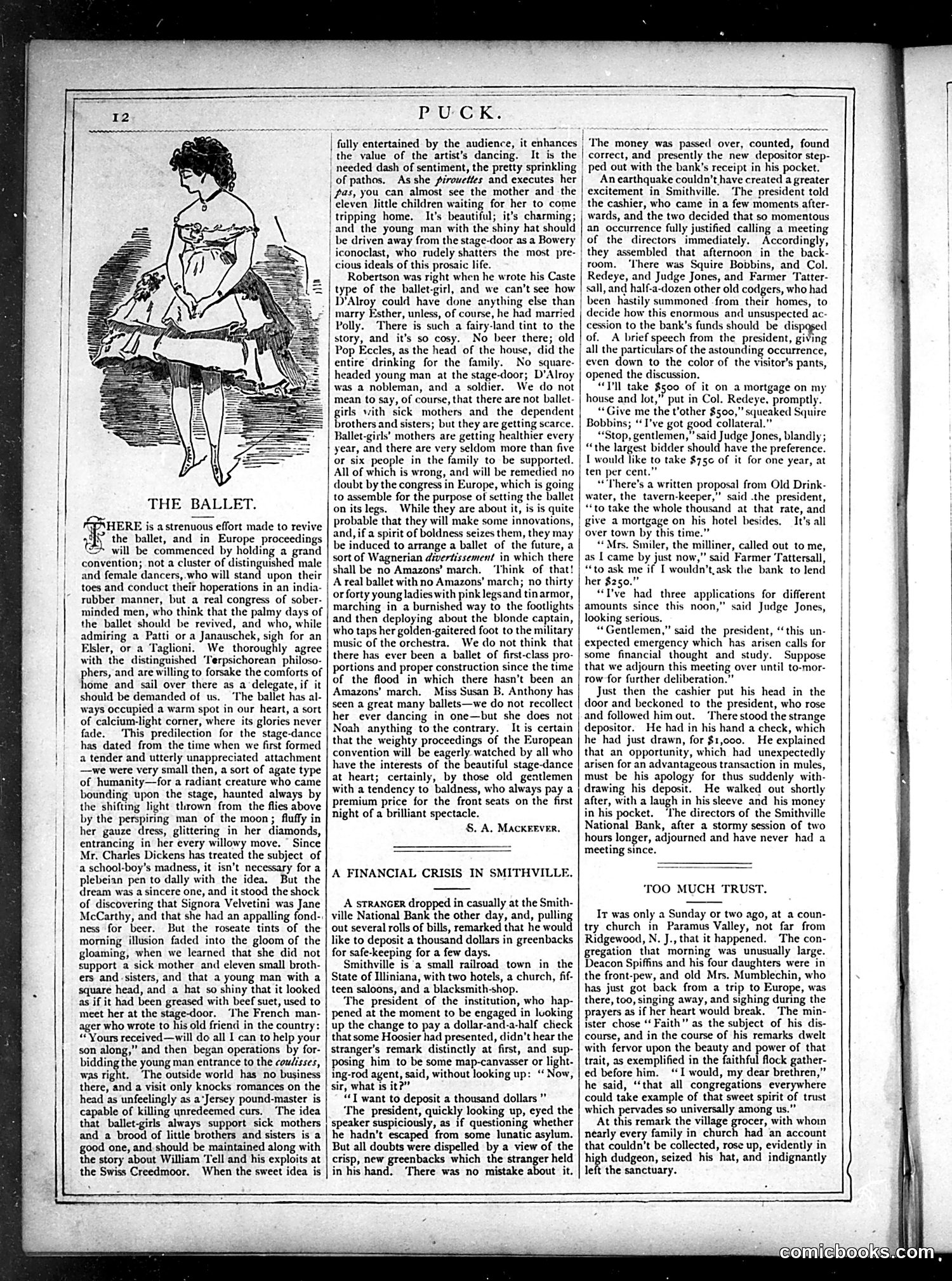
This page contains three distinct articles with one illustration. The main piece, "THE BALLET," features a sketch of a young woman in ballet attire and discusses efforts to revive ballet in America and Europe. The author argues that ballet has declined due to "old hop-fooeys" managing productions and suggests reform is needed—particularly advocating for the "Amazons' march" and modernized choreography. Below are two separate articles: "A FINANCIAL CRISIS IN SMITHVILLE" (a satirical anecdote about a banker's embarrassment when unable to pay a check) and "TOO MUCH TRUST" (a cautionary tale about misplaced faith in a village grocer). These appear to be humorous social commentary rather than political satire.
📄 Transcribed text from this page (OCR, searchable)
Machine-transcribed from the original scan — historical spelling and the odd misread are preserved.
THE BALLET. HERE is a strenuous effort made to revive the ballet, and in Europe proceedings will be commenced by holding a grand convention; not a cluster of distinguished male and female dancers,.who will stand upon their toes and conduct their hoperations in an india- rubber manner, but a real congress of sober- minded men, who think that the palmy days of the ballet should be revived, and who, while admiring a Patti or a Janauschek, sigh for an Ebler, or a Taglioni. We thoroughly agree with the distinguished ‘Terpsichorean philoso- hers, and are willing to forsake the comforts of home and ‘sail over there as a delegate, if it should be demanded of us. The ballet has al- ways occupied a warm spot in our heart, a sort of calcium-light corner, where its glories never fade. This predilection for the stage-dance has dated from the time when we first formed a tender and utterly unappreciated attachment —we were very small then, a sort of agate type of humanity—for a radiant creature who came bounding upon the stage, haunted always by the shifting light thrown from the flies above by the perspiring man of the moon; fluffy in her gauze dress, glittering in her diamonds, entrancing in her every willowy move. " Since Mr. Charles Dickens has treated the subject of a school-boy’s madness, it isn’t necessary for a plebeian pen to dally with the idea, But the dream was a sincere one, and it stood the shock of discovering that Signora Velvetini was Jane McCarthy, and that she had an appalling fond- ness for beer. But the roseate tints of the morning illusion faded into the gloom of the gloaming, when we learned that she did not support a sick mother and eleven small broth- ers and sisters, and that a young man with a square head, and a hat so shiny that it looked as if it had been greased with beef suet, used to meet her at the stage-door, ‘The French man- ager who wrote to his old friend in the country: “Yours received —will do all I can to help your son along,” and then began operations by for- bidding the young man entrance to the coudisses, was right. The outside world has no business there, and a visit only knocks romances on the head as unfeelingly as a“Jersey pound-master is capable of killing unredeemed curs. The idea that ballet-girls always support sick mothers and a brood of little brothers and sisters is a good one, and should be maintained along with the story about William Tell and his exploits at the Swiss Creedmoor. When the sweet idea is aN | Polly. There is such a fairy-land tint to the fully entertained by the audience, it enhances | the value of the artist’s dancing. It is the | | needed dash of sentiment, the pretty sprinkling | of pathos, As she pirouettes and executes her | pas, you can almost see the mother and the eleven Jittle children waiting for her to come tripping home. It’s beautiful; it’s charming; and the young man with the shiny hat should be driven away from the stage-door as a Bowery iconoclast, who rudely shatters the most pre- | cious ideals of this prosaic life. | Robertson was right when he wrote his Caste type of the ballet-girl, and we can’t see how D’Alroy could have done anything else than | marry Esther, unless, of course, he had married story, and it’s so cosy. No beer there; old | Pop Eccles, as the head of the house, did the | entire drinking for the family. No square- headed young man at the stage-door; D’Alroy was a nobleman, and a soldier. We do not mean to say, of course, that there are not ballet- Ee with sick mothers and the dependent brothers and sisters; but they are getting scarce. Ballet-girls’ mothers are getting healthier every year, and there are very seldom more than five or six people in the family to be supported. | All of which is wrong, and will be remedied no doubt by the congress in Europe, which is going to assemble for the purpose of setting the ballet on its legs. While they are about it, is is quite probable that they will make some innovations, and, if a spirit of boldness seizes them, they may | be induced to arrange a ballet of the future, a sort of Wagnerian divertissement in which there shall be no Amazons’ march. ‘Think of that! A real ballet with no Amazons’ march; no thirty or forty young ladies with pink legsand tinarmor, marching in a burnished way to the footlights and then deploying about the blonde captain, who taps her golden-gaitered foot to the military music of the orchestra. We do not think that there has ever been a ballet of first-class pro- portions and proper construction since the time of the flood in which there hasn’t been an Amazons’ march. Miss Susan B. Anthony has seen a great many ballets—we do not recollect her ever dancing in one—but she does not Noah anything to the contrary. It is certain that the weighty proceedings of the European convention will be eagerly watched by all who have the interests of the beautiful stage-dance at heart; certainly, by those old gentlemen with a tendency to baldness, who always pay a premium price for the front seats on the first night of a brilliant spectacle. S. A. MACKEEVER. A FINANCIAL CRISIS IN SMITHVILLE. A STRANGER dropped in casually at the Smith- ville National Bank the other day, and, pullin, out several rolls of bills, remarked that he woul like to deposit a thousand dollars in greenbacks for safe-keeping for a few days. Smithville is ‘a small railroad town in the State of Illiniana, with two hotels, a church, fif- teen saloons, and a blacksmith-shop. The president of the institution, who hap- pened at the moment to be engaged in lvoking up the change to pay a dollar-and-a-half check that some Hoosier had presented, didn’t hear the stranger’s remark distinctly at first, and sup- posing him to be some map-canvasser or light- ing-rod agent, said, without looking up: “Now, sir, what is it?” “I want to deposit a thousand dollars ” The president, quickly looking up, eyed the speaker suspiciously, as if questioning whether he hadn't escaped from some lunatic asylum. But all doubts were dispelled by a view of the crisp, new greenbacks which the stranger held in his hand. ‘There was no mistake about it. ‘The money was passed over, counted, found correct, and presently the new depositor step- ped out with the bank’s receipt in his pocket. An earthquake couldn’t have created a greater excitement in Smithville. ‘The president told the cashier, who came in a few moments after- wards, and the two decided that so momentous an occurrence fully justified calling a meeting of the directors immediately. Accordingly, | they assembled that afternoon in the back- room. ‘There was Squire Bobbins, and Col. Redeye, and Judge Jones, and Farmer Tatter- sall, and half-a-dozen other old codgers, who had been hastily summoned -from their homes, to decide how this enormous and unsuspected ac- cession to the bank’s funds should be disposed of. A brief speech from the president, giving all the particulars of the astounding occurrence, even down to the color of the visitor’s pants, opened the discussion, “TL take $500 of it on a mortgage on my house and lot,” put in Col. Redeye. promptly. sive me the t’other $500,” squeaked Squire Bobbins; “I've got good collateral.” “Stop, gentlemen,” said Judge Jones, blandly; “the largest bidder should have the preference. I would like to take $75¢ of it for one year, at ten per cent.” “There's a written proposal from Old Drink- water, the tavern-keeper,” said .the president, “to take the whole thousand at that rate, and ve a mortgage on his hotel besides. It’s all over town by this time.” “Mrs. Smiler, the milliner, called out to me, as I came by just now,” said Farmer Tattersall, “to ask me if I wouldn’t,ask the bank to lend her $250.” “I've had three applications for different amounts since this noon,” said Judge Jones, looking serious. “Gentlemen,” said the president, “this un- expected emergency which has arisen calls for some financial thought and study. Suppose that we adjourn this meeting over until to-mor- row for further deliberation.” Just then the cashier put his head in the door and beckoned to the president, who rose and followed him out. ‘There stood the strange depositor. He had in his hand a check, which he had just drawn, for $1,000. He explained that an opportunity, which had unexpectedly arisen for an advantageous transaction in mules, must be his apology for thus suddenly with- drawing his deposit. He walked out shortly after, with a laugh in his sleeve and his money in his pocket. ‘The directors of the Smithville National Bank, after a stormy session of two hours longer, adjourned and have never had a meeting since. ‘TOO MUCH TRUST. Ir was only a Sunday or two ago, at_a coun- try church in Paramus Valley, not far from Ridgewood, N. J., that it happened. ‘The con- gregation that morning was unusually large. Deacon Spiffins and his four daughters were in the front-pew, and old Mrs. Mumblechin, who has just got back from a trip to Europe, was there, too, singing away, and sighing during the prayers as if her heart would break. ‘The min- ister chose “ Faith" as the subject of his dis- course, and in the course of his remarks dwelt with fervor upon the beauty and power of that trait, as exemplified in the faithful flock gather- ed before him. “I would, my dear brethren,” he said, ‘‘that all congregations everywhere could take example of that sweet spirit of trust which pervades so universally among us.” At this remark the village er, with whoin nearly every family in church had an account that couldn’t be collected, rose up, evidently in high dudgeon, seized his hat, and indignantly left the sanctuary.