
Puck, 1877-03 · page 4 of 16
Puck — March 1877 — page 4: what you’re looking at
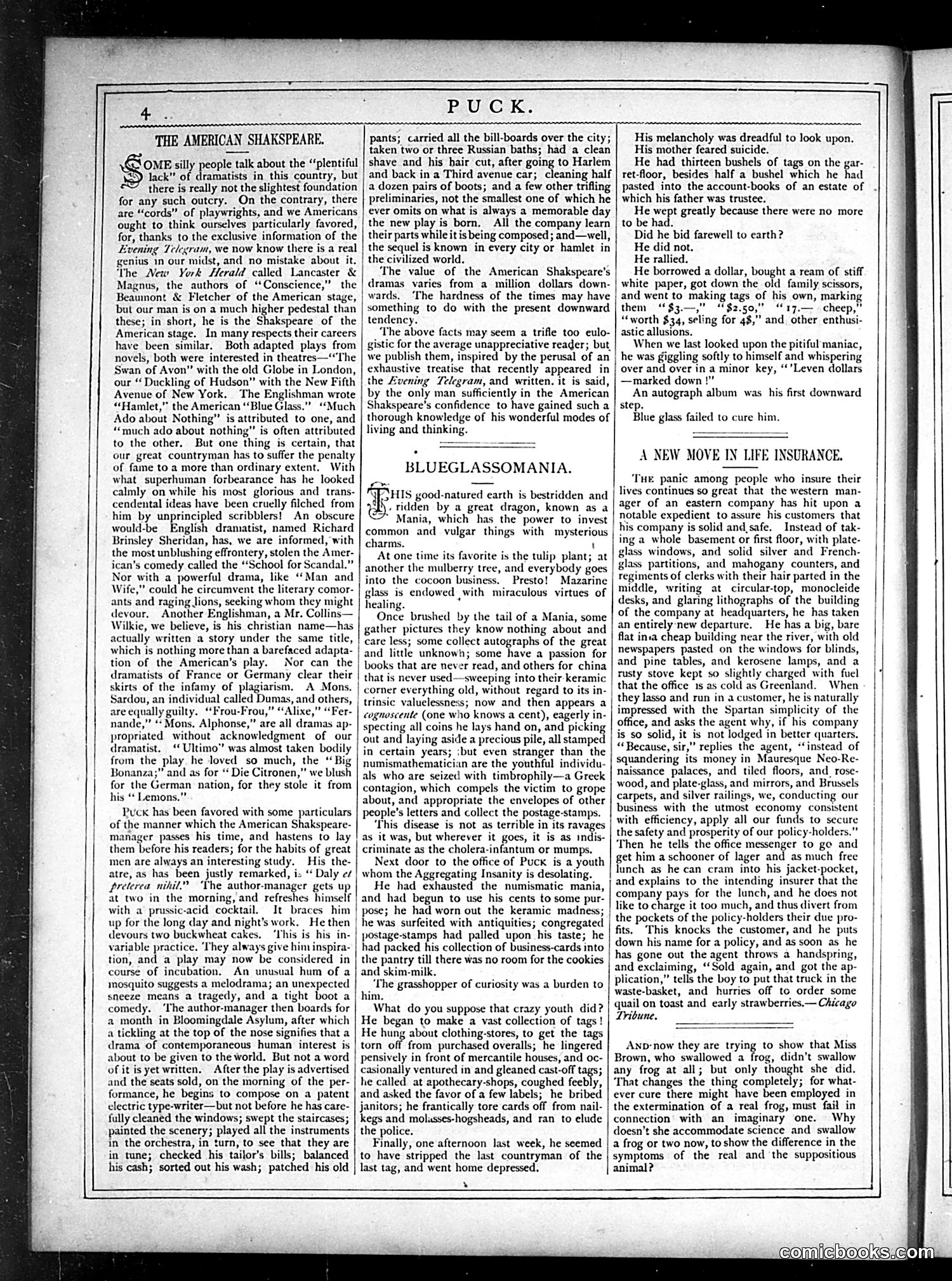
What you’re looking at
This page contains **three distinct articles** rather than political cartoons: 1. **"The American Shakspeare"** - A literary critique discussing American playwrights, comparing them favorably to European dramatists. It praises works like "Puck" while critiquing others. 2. **"Blueglassomania"** - A humorous essay satirizing obsessive collecting. It mocks people who compulsively accumulate worthless items (old newspapers, business cards, tapes) and describes a youth whose hoarding becomes pathological, eventually requiring intervention by authorities. 3. **"A New Move in Life Insurance"** - Commentary on insurance industry practices, describing dubious methods companies use to inspect customers' homes and finances. The page is primarily **text-based social satire** rather than visual cartoons, targeting literary pretension, collecting obsession, and corporate overreach.
📄 Transcribed text from this page (OCR, searchable)
Machine-transcribed from the original scan — historical spelling and the odd misread are preserved.
4 PUCK. THE AMERICAN SHAKSPEARE. OME silly people talk about the “plentiful “S) lack” of dramatists in this country, but there is really not the slightest foundation for any such outcry. On the contrary, there are “cords” of playwrights, and we Americans ought to think ourselves particularly favored, for, thanks to the exclusive information of the Evening Telegram, we now know there is a real genius 1n our midst, and no mistake about it, ‘The Mew York Herald called Lancaster & Magnus, the authors of “Conscience,” the Beaumont & Fletcher of the American stage, | : | something to do with the present downward | tendency. but our man is on a much higher pedestal than these; in short, he is the Shakspeare of the American stage. In many respects their careers have been similar, Both adapted plays from novels, both were interested in theatres—“The Swan of Avon” with the old Globe in London, our “Duckling of Hudson” with the New Fifth Avenue of New York. The Englishman wrote “Hamlet,” the American ‘Blue Glass.” ‘(Much Ado about Nothing” is attributed to one, and “much ado about nothing” is often attributed to the other. But one thing is certain, that our great countryman has to suffer the penalty of fame to a more than ordinary extent. With what superhuman forbearance has he looked calmly on while his most glorious and_trans- cendental ideas have been cruelly filched from him by unprincipled scribblers! An obscure would-be English dramatist, named Richard Brinsley Sheridan, has, we are informed, with the most unblushing effrontery, stolen the Amer- ican’s comedy called the “School for Scandal.” Nor with a powerful drama, like ‘Man and Wife,” could he circumvent the literary comor- ants and raging lions, seeking whom they might devour. Another Englishman, a Mr. Collins— Wilkie, we believe, is his christian name— actually written a story under the same title, which is nothing more than a barefaced adapta- | tion of the American's play. Nor can the dramatists of France or Germany clear their skirts of the infamy of plagiarism. A Mons. dou, an individual called Dumas, and others, | are equally guilty. “Frou-Frou,” “Alixe,” “Fer- nande,” “ Mons. Alphonse,” are all dramas ap- propriated without acknowledgment of our dramatist.‘ Ultimo” was almost taken bodily from the play he loved so much, the “Big Bonanza;” and as for “‘ Die Citronen,” we blush for the German nation, for they stole it from his “ Lemons.”” Puck has been favored with some particulars of the manner which the American Shakspeare- manager passes his time, and hastens to lay them before his readers; for the habits of great men are always an interesting study. His the- atre, as has been justly remarked, is ‘ Daly e¢ preterea nihil” ‘The author-manager gets up at two in the morning, and refreshes himself with a prussic-acid cocktail. It braces him up for the long day and night’s work. He then devours two buckwheat cakes. ‘Ihis is his in- variable practice. ‘They always give him inspira- tion, and a play may now be considered in course of incubation. An unusual hum of a mosquito suggests a melodrama; an unexpected sneeze means a tragedy, and a tight boot a | comedy, ‘The author-manager then boards for a month in Bloomingdale Asylum, after which a tickling at the top of the nose signifies that a drama of contemporaneous human interest is about to be given to the world. But not a word of it is yet written. After the play is advertised and the seats sold, on the morning of the per- formance, he begins to compose on a patent electric type-writer—but not before he has care- fully cleaned the windows; swept the staircases; painted the scenery; played all the instruments in the orchestra, in turn, to see that they are in tune; checked his tailor’s bills; balanced his cash; sorted out his wash; patched his old pants; carried all the bill-boards over the city; taken two or three Russian baths; had a clean shave and his hair cut, after going to Harlem and back in a Third avenue car; cleaning half a dozen pairs of boots; and a few other trifling preliminaries, not the smallest one of which he ever omits on what is always a memorable day the new play is born, All the company learn their parts while it is being composed ; and—well, the sequel is known in every city or hamlet in the civilized world. ‘The value of the American Shakspeare’s dramas varies from a million dollars down- wards, ‘The hardness of the times may have ‘The above facts may seem a trifle too eulo- sistic for the average unappreciative reader; but, we publish them, inspired by the perusal of an exhaustive treatise that recently appeared in the Evening Telegram, and written. it is said, by the only man sufficiently in the American Shakspeare’s confidence to have gained such a thorough knowledge of his wonderful modes of living and thinking. BLUEGLASSOMANIA. = — PAHIS good-natured earth is bestridden and eR -tidden by a great dragon, known as a * Mania, which has the power to invest common and vulgar things with mysterious | 7 "whole basement of first floor, with plate- charms. 1 At one time its favorite is the tulip plant; at another the mulberry tree, and everybody goes into the cocoon business. Presto! Mazarine glass is endowed with miraculous virtues of healing. ‘ Once brushed by the tail of a Mania, some gather pictures they know nothing about and care less; some collect autographs of the great and little unknowh; some have a passion for books that are never read, and others for china that is never used—sweeping into their keramic corner everything old, without regard to its trinsic valuelessness; now and then appears a cognoscente (one who knows a cent), eagerly in- specting all coins he lays hand on, and picking out and laying aside a precious pile, all stamped in certain years; ;but even stranger than the numismathematician are the youthful individu- als who are seized with timbrophily—a Greek contagion, which compels the victim to grope about, and appropriate the envelopes of other people’s letters and collect the postage-stamps. ‘This disease is not as terrible in its ravages as it was, but wherever it goes, it is as indis- criminate as the cholera-infantum or mumps. Next door to the office of Puck is a youth whom the Aggregating Insanity is desolating. He had exhausted the numismatic mania, and had begun to use his cents to some pur- pose; he had worn out the keramic madness; | he was surfeited with antiquities; congregated postage-stamps had palled upon his taste; he had packed his collection of business-cards into the pantry till there was no room for the cookies and skim-milk, ; _ ‘The grasshopper of curiosity was a burden to him. What do you suppose that crazy youth did? He began to make a vast collection of tags ! He hung about clothing-stores, to get the tags torn off from purchased overalls; he lingered pensively in front of mercantile houses, and oc- casionally ventured in and gleaned cast-off tags; he called. at apothecary-shops, coughed feebly, and asked the favor of a few labels; he bribed janitors; he frantically tore cards off from nail- kegs and molasses-hogsheads, and ran to elude the police. Finally, one afternoon last week, he seemed to have stripped the last countryman of the last tag, and went home depressed. 8 His melancholy was dreadful to look upon. His mother feared suicide. He had thirteen bushels of tags on the gar- ret-floor, besides half a bushel which he had pasted into the account-books of an estate of _ which his father was trustee. He wept greatly because there were no more to be had. Did he bid farewell to earth? He did not. He rallied. He borrowed a dollar, bought a ream of stiff. white paper, got down the old family scissors, ; and went to making tags of his own, marking them “$3.—," “$2.50,” “17.— cheep,” “worth $34, seling for 4$,” and. other enthusi- astic allusions. When we last looked upon the pitiful’ maniac, he was giggling softly to himself and whispering over and over in a minor key, “’Leven dollars —marked down !” An autograph album was his first downward step. Blue glass failed to cure him. A NEW MOVE IN LIFE INSURANCE. ‘THe panic among people who insure their lives continues so great that the western man- ager of an eastern company has hit upon a notable expedient to assure his customers that his company is solid and,safe. Instead of tak- glass windows, and solid silver and French- glass partitions, and mahogany counters, and | regiments of clerks with their hair parted in the middle, writing at circular-top, monocleide desks, and glaring lithographs of the building of the company at headquarters, he has taken an entirely‘new departure. He has a big, bare flat ina cheap building near the river, with old newspapers pasted on the windows for blinds, and pine tables, and kerosene lamps, and a tusty stove kept so slightly charged with fuel that the office 1s as cold as Greenland. When they lasso and run in a customer, he is naturally impressed with the Spartan simplicity of the office, and asks the agent why, if his company is so solid, it is not lodged in better quarters. “Because, sir,” replies the agent, ‘‘instead of squandering its money in Mauresque Neo-Re- naissance palaces, and tiled floors, and. rose- wood, and plate-glass, and mirrors, and Brussels carpets, and silver railings, we, conducting our business with the utmost economy consistent with efficiency, apply all our funds to secure the safety and prosperity of our policy-holders.” ‘Then he tells the office messenger to go and get him a schooner of lager and as much free lunch as he can cram into his jacket-pocket, and explains to the intending insurer that the company pays for the lunch, and he does not | like to charge it too much, and thus divert from | the pockets of the policy-holders their due pro- fits. This knocks the customer, and he puts down his name for a policy, and as soon as he | has gone out the agent throws a handspring, and exclaiming, “Sold again, and got the ap- plication,” tells the boy to put that truck in the waste-basket, and hurries off to order some quail on toast and early strawberries.— Chicago Tribune, Anp-now they are trying to show that Miss re Brown, who swallowed a frog, didn’t swallow any frog at all; but only thought she did. ‘That changes the thing completely; for what- ever cure there might have been employed in the extermination of a real frog, must fail in connection with an imaginary one. Why doesn’t she accommodate science and swallow a frog or two now, to show the difference in the symptoms of the real and the suppositious animal?