
Puck, 1877-03 · page 10 of 16
Puck — March 1877 — page 10: what you’re looking at
What you’re looking at
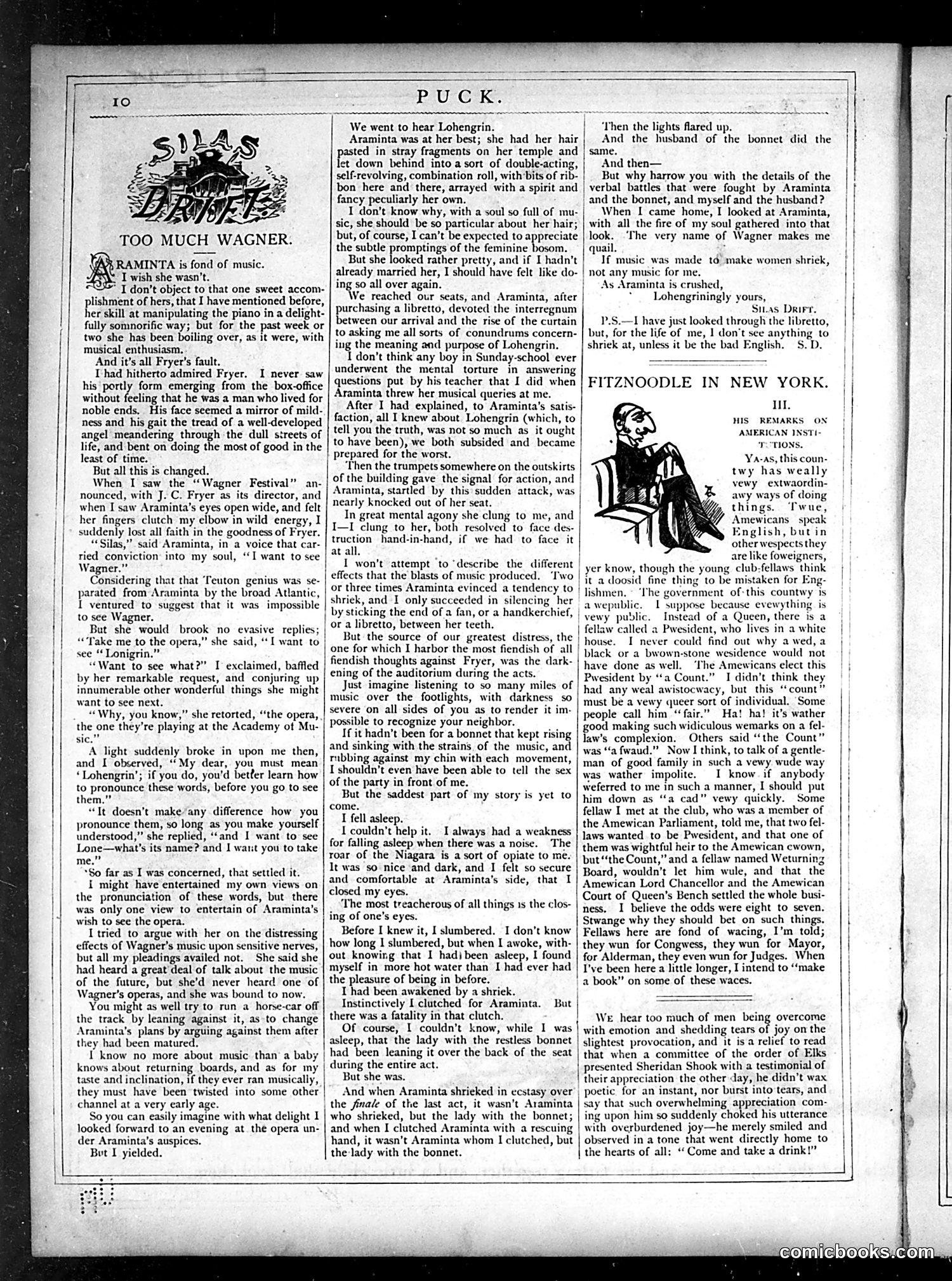
This Puck magazine page contains two articles with illustrations: 1. **"Too Much Wagner"** — A humorous essay criticizing composer Richard Wagner's music as overly complex and tedious. The author recounts attending a Wagner Festival performance with someone named Araminta, describing the experience as mentally exhausting. The piece mocks Wagner's excessive artistic pretensions. 2. **"Fitznoodle in New York"** — A satirical piece about an English visitor's observations of American customs and government. The illustration shows a distinguished Englishman. The text criticizes American political practices (mentioning Presidents and Parliament) and social behaviors as crude compared to English standards. Both pieces use humor to contrast European (particularly English and German) cultural sophistication with perceived American and Wagnerian excess or vulgarity.
📄 Transcribed text from this page (OCR, searchable)
Machine-transcribed from the original scan — historical spelling and the odd misread are preserved.
TOO MUCH WAGNER. RAMINTA is fond of music. I wish she wasn’t. " I don’t object to that one sweet accom- plishment of hers, that I have mentioned before, her skill at manipulating the piano in a delight- fully somnorific way; but for the past week or two she has been boiling over, as it were, with musical enthusiasm, And it’s all Fryer’s fault. Thad hitherto admired Fryer. I never saw his portly form emerging from the box-office without feeling that he was a man who lived for noble ends, His face seemed a mirror of mild- ness and his gait the tread of a well-developed angel meandering through the dull streets of life, and bent on doing the most of good in the least of time. But all this is changed. When I saw the ‘Wagner Festival” an- nounced, with J. C. Fryer as its director, and when I saw Araminta’s eyes open wide, and felt her fingers clutch my elbow in wild energy, I suddenly lost all faith in the goodness of Fryer. said Araminta, in a voice that car- ion into my soul, ‘I want to see | Considering that that Teuton genius was se- parated from Araminta by the broad Atlantic, I ventured to suggest that it was impossible to see Wagner. But she would brook no evasive replies; “Take me to the opera,” she said, “I want t see Lonigrin.” | “Want to see what?” I exclaimed, baffled | by her remarkable request, and conjuring up innumerable other wonderful things she might want to see next. “Why, you know,” she retorted, “the opera, | the one they’re playing at the Academy of Mu- sic.” A light suddenly broke in upon me then, and I observed, “My dear, you must mean ‘Lohengrin’; if you do, you'd better learn how to pronounce these words, before you go to see them.” “Tt doesn’t make/any difference how you pronounce them, so long as you make yourself he replied, ‘‘and I want to see name? and I want you to take me.’ ‘So far as I was concerned, that settled it. i might have entertained my own views on the pronunciation of these words, but there was only one view to entertain of Araminta’s wish to see the opera. I tried to argue with her on the distressing effects of Wagner’s music upon sensitive nerves, but all my pleadings availed not. She said she had heard a great deal of talk about the music of the future, but she’d never heard one of Wagner's operas, and she was bound to now. You might as well try to run a horse-car off the track by leaning against it, as to change Araminta’s plans by arguing against them after they had been matured. I know no more about music than’ a baby | knows about returning boards, and as for my | taste and inclination, if they ever ran musically, they must have been twisted into some other channel at a very carly age. So you can easily imagine with what delight I looked forward to an evening at the opera un- der Araminta’s auspices. But I yielded. | effects that the blasts of music produced. We went to hear Lohengrin. Araminta was at her best; she had her hair pasted in stray fragments on her temple and let down behind into a sort of double-acting, self-revolving, combination roll, with’bits of rib- bon here and there, arrayed with a spirit and fancy peculiarly her own. I don’t know why, with a soul so full of mu- sic, she should be so particular about her hair; but, of course, I can’t be expected to appreciate the subtle promptings of the feminine bosom. But she if already married her, I should have felt like do- ing so all over again. We reached our seats, and Araminta, after purchasing a libretto, devoted the interregnum between our arrival and the rise of the curtain to asking me all sorts of conundrums concern- ing the meaning and purpose of Lohengrin. I don’t think any boy in Sunday-school ever underwent the mental torture in answering questions put by his teacher that I did when Araminta threw her musical queries at me. After I had explained, to Araminta’s satis- faction, all I knew about Lohengrin (which, to tell you the truth, was not so much as it ought to have been), we both subsided and became | prepared for the worst. | Then the trumpets somewhere on the outskirts. of the building gave the signal for action, and Araminta, startled by this sudden attack, was nearly knocked out of her seat. In great mental agony she clung to me, and I—I clung to her, both resolved to face des- truction hand-in-hand, if we had to face it atall. I won't attempt ‘to ‘describe the different wo or three times Araminta evinced a tendency to shriek, and I only succeeded in silencing her by sticking the end of a fan, or a handkerchief, | or a libretto, between her teeth. But the source of our greatest distress, the née for which I harbor the most fiendish of all iendish thoughts against Fryer, was the dark ening of the auditorium during the acts. Just imagine listening to so many miles of music over the footlights, with darkness so severe on all sides of you as to render it im- possible to recognize your neighbor. If it hadn’t been for a bonnet that kept rising and sinking with the strains of the music, and rubbing against my chin with each movement, Ishouldn’t even have been able to tell the sex of the party in front of me. But the saddest part of my story is yet to come. I fell asleep. I couldn't help it. [always had a weakness for falling asleep when there was a noise. The roar of the Niagara is a sort of opiate to me. It was ‘so nice ‘and dark, and I felt so secure and comfortable at Araminta’s side, that I closed my eyes. ‘The most treacherous of all things 1s the clos- ing of one’s eyes. Before I knew it, I slumbered. I don’t know how long I slumbered, but when I awoke, with- out knowing that I hadi been asleep, I found myself in more hot water than I had ever had the pleasure of being in before. Thad been awakened by a shriek. Instinctively I clutched for Araminta. there was a fatality in that clutch. Of course, I couldn’t know, while I was asleep, that the lady with the restless bonnet had been leaning it over the back of the seat during the entire act. But she was. And when Araminta shrieked in ecstasy over the finale of the last act, it wasn’t Araminta who shrieked, but the lady with the bonnet; and when I clutched Araminta with a rescuing hand, it wasn’t Araminta whom I clutched, but But the lady with the bonnet. looked rather pretty, and if I hadn't | | ‘Then the lights flared up. And the husband of the bonnet did the same. And then— | But why harrow you with the details of the verbal battles that were fought by Araminta and the bonnet, and myself and the husband? When I came home, I looked at Araminta, with all the fire of my soul gathered into that look. ‘he very name of Wagner makes me quail. ; If music was made té make women shriek, | not any music for me. ‘As Araminta is crushed, + Lohengriningly yours, Sitas Drier. P.S.—I have just looked through the libretto, but, for the life of me, I don’t see anything to shriek at, unless it be the bad English. S.D. FITZNOODLE IN NEW YORK. UI. HIS REMARKS ON Ya-as, this coun- twy has weally vewy extwaordin- awy ways of doing English, but in other wespects they | are like foweigners, | yer know, though the young club-fellaws think | it a doosid fine thing to be mistaken for |Tishmen,- ‘The government of-this county awepublic. I suppose because evewything is vewy pu! Instead of a Queen, there is a | fellaw called a Pwesident, who lives in a white | house. I never could find out why a wed, a black or a bwown-stone wesidence would not have done as well. ‘he Amewicans elect this | Pwesident by ‘‘a Count.” I didn’t think they had any weal awistocwacy, but this “count” must be a vewy queer sort of individual. “Some people call him “fair.” Ha! ha! it’s wather good making such widiculous wemarks on a fel- law's complexion. Others said “the Count” was “a fwaud.” Now I think, to talk of a gentle- man of good family in such a vewy wude way s wather impolite. I know. if anybody weferred to me in such a manner, I should put him down as “a cad” vewy quickly. Some fellaw I met at the club, who was a member of the Amewican Parliament, told me, that two fel- laws wanted to be Pwesident, and that one of them was wightful heir to the Amewican cwown, but “the Count,” and a fellaw named Weturning Board, wouldn’t let him wule, and that the Amewican Lord Chancellor and the Amewican Court of Queen’s Bench settled the whole busi- ness. I believe the odds were eight to seven. Stwange why they should bet on such things. Fellaws here are fond of wacing, I’m told; they wun for Congwess, they wun for Mayor, for Alderman, they even wun for Judges. When I’ve been here a little longer, I intend to “make a book” on some of these waces. We hear too much of men being overcome with emotion and shedding tears of joy on the slightest provocation, and it isa relief to read that when a committee of the order of Elks presented Sheridan Shook with a testimonial of their appreciation the other day, he didn’t wax poetic for an instant, nor burst into tears, and say that such overwhelming appreciation com- ing upon him so suddenly choked his utterance | with overburdened joy—he merely smiled and observed in a tone that went directly home to the hearts of all: “Come and take a drink!”