
Puck, 1877-03 · page 6 of 16
Puck — March 1877 — page 6: what you’re looking at
What you’re looking at
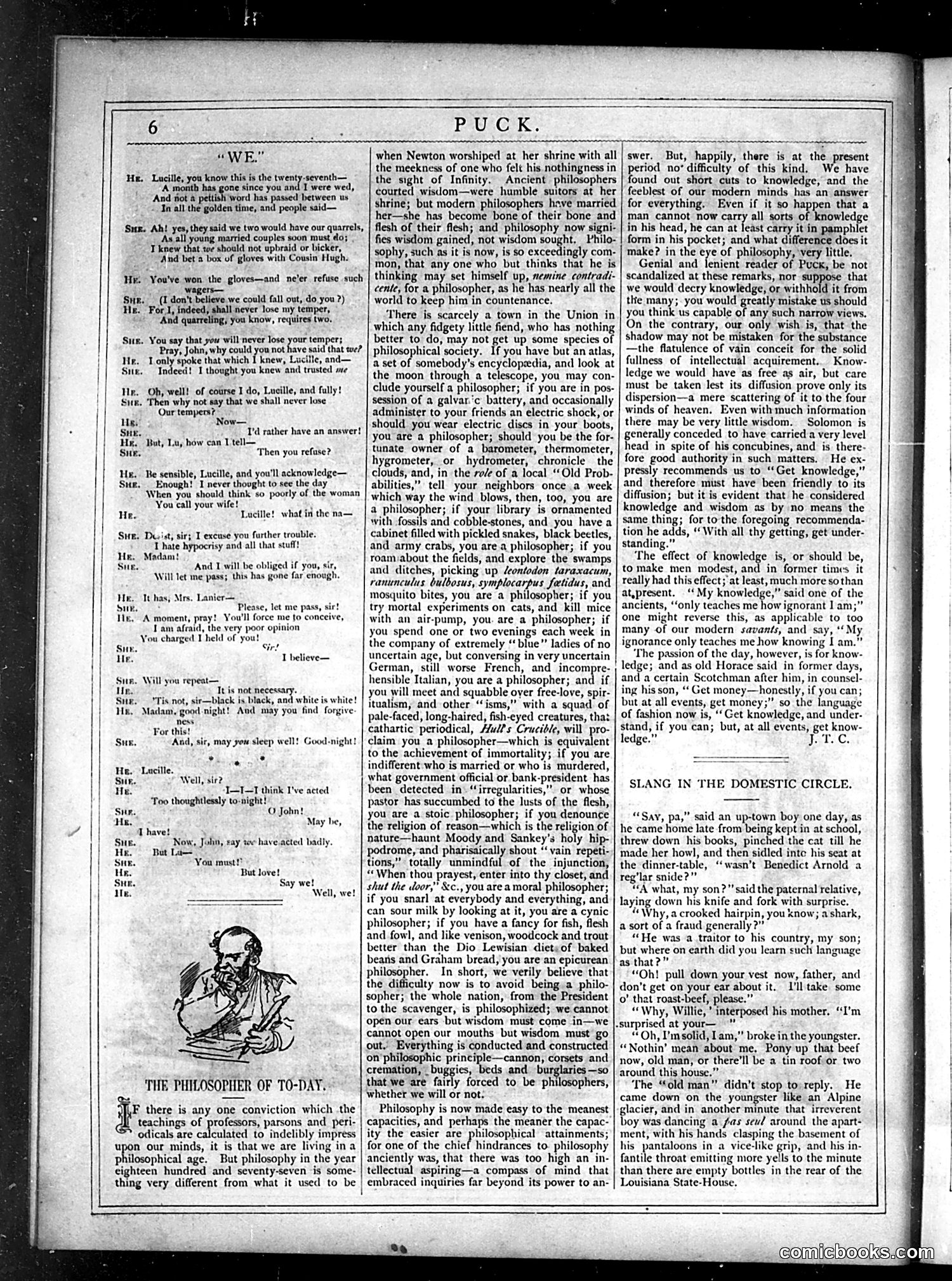
The page contains two distinct pieces: **"We"** (top): A dialogue satirizing philosophical pretension. It mocks people who adopt the language and trappings of philosophy—owning telescopes, barometers, and taxidermied specimens—while lacking genuine understanding. The satire targets the "armchair philosopher" of the era who conflates owning scientific instruments with possessing actual knowledge. **"Slang in the Domestic Circle"** (bottom): A brief humorous exchange between a mother and son about the phrase "a hot air," with accompanying illustration of a boy. It satirizes how children absorb and misuse adult slang without understanding it. Both pieces target intellectual pretension and the gap between appearance and substance—common Puck themes mocking social climbing and false sophistication in the Gilded Age.
📄 Transcribed text from this page (OCR, searchable)
Machine-transcribed from the original scan — historical spelling and the odd misread are preserved.
| | | | PUCK. UWE.” He. Lucille, you know this is the twenty-seventh— ‘A month has gone since you and I were wed, ‘And thot & pettish'word has passed between us “In all the golden time, and people said— Sux. Ah! yes, they said we two would have our quarrels, ‘As all young married couples soon must do; T knew that te should not upbraid or bicker, ‘And bet a box of gloves with Cousin Hugh. Hi. Youve won the gloves—and neler. refuse such wagers— Sux. _ (1 don’t believe we could fall out, do you ?) He. For.1, indeed, shall never lose my temper, ‘And quarreling, you know, requires two. ‘Sux. You say that you will never lose your temper; Pray, John, why could you not have said that tue? Hr. I only spoke that which 1 knew, Lucille, and— Sue. Indeed! I thought you knew and trusted sme Hr. Ob, well! of colirse I do, Lucille, and fully! Site. ‘Phen why not say that we shall never lose Our tempers? le. Now— Sux. T’d rather have an answer! He, But, Lu, how can Ttell— Sur. ‘Then you refuse? He. Be sensible, Lucille, and you'll acknowledge— Suz. — Enough! I never thovght to see the day When you should think so poorly of the woman You call your wife! - He. Lucille! what ii the na— Swe, Duis sir; I excuse you further trouble. T hate hypocrisy and all that stuff! Mr. Madam! Sur. And I will be obliged if you, sir, Will let me pass; this has gone far enough. He. It has, Mrs, Lanier— Su 1 Please, let me pass, sir! ‘A moment, pray! You'll force me to conceive, Tans afraid, the very poor opinion You charged T held of you! Sux. ! ie. I believe— Sue. Will you repeat— Ur. Tt is not necessary. Sue. 'Tis not, sir—black is black, and white is white! Hx, Madam, good-night! And may you find forgi ness For this! Sux, And, sir, may you sleep well! Good-night! Fy ARERR He. Lucille. Si Well, ir? I—I—T think I've acted. Too thoughtlessly to-night! Q John! May he, Nov, John, ray we have.aeted badly. But La— You must! But lovet Say wel Well, wet F there is any one conviction which the | i teachings of professors, parsons and peri- odicals are calculated to indelibly impress upon our minds, it is that we are living ina philosophical age. But philosophy in the year eighteen hundred and seventy-seven is some- thing very different from what it used to be | when Newton worshiped at her shrine with all the meekness of one who felt his nothingness in the sight of Infinity. Ancient philosophers courted wisdom—were humble suitors at her shrine; but modern philosophers have married her—she has become bone of their bone and flesh of their flesh; and philosophy now signi- fies wisdom gained, not wisdom sought, Philo- sophy, such as it is now, is so exceedingly com- mon, that any one who but thinks that he is thinking may set himself up, nemine contradi- cente, for a philosopher, as he has nearly all the world to keep him in countenance. ‘There is scarcely a town in the Union in which any fidgety little fiend, who has nothing better to do, may not get up some species of philosophical society. If you have but an atlas, a set of somebody's encyclopzdia, and look at the moon through a telescope, you may con- clude yourself a philosopher; if you are in pos- session of a galvarc battery, and occasionally administer to your friends an electric shock, or should you wear electric discs in your boots, you are a philosopher; should you be the for- tunate owner of a barometer, thermometer, hygrometer, or hydrometer, chronicle the clouds, and, in the rove of a local ‘Old Prob- abilities,” tell your neighbors once a week which way the wind blows, then, too, you are a philosopher; if your library is ornamented with fossils and cobble-stones, and you have a cabinet filled with pickled snakes, black beetles, and army crabs, you area philosopher; if you roam:about the fields, and explore the swamps and ditches, picking up /ontodon taraxacum, ranunculus bulbosus, symplocarpus fetidus, and mosquito bites, you are a philosopher; if you try mortal experiments on cats, and kill mice with an air-pump, you. are a philosopher; if you spend one or two evenings each week in the company of extremely “blue” ladies of no uncertain age, but conversing in very uncertain | German, still worse French, and incompre- hensible Italian, you are a philosopher; and if you will meet and squabble oyer free-love, spir- itualism, and other “isms,” with a squad of pale-faced, long-haired, fish-eyed creatures, that cathartic periodical, Hud?s Crucible, will pro- claim you a philosopher—which is equivalent to the achievement of immortality; if you are indifferent-who is married or who is murdered, what government official or bank-president has been detected in» ‘‘irregularities,”. or whose pastor has succumbed to the lusts of the flesh, you are a stoic philosopher; if you denounce the religion of reason—which is the religion of nature—haunt Moody and Sankey’s holy hip- podrome, and pharisaically shout ‘vain repeti- tions,” totally unmindful of the injunction, “When thou prayest, enter into thy closet, and shut the door," &c., you area moral philosopher; if you snarl at everybody and everything, and can sour milk by looking at it, you are a cynic philosopher; if you have a fancy for fish, flesh and fowl, and like venison, woodcock and trout better than the Dio Lewisian dietyof baked beans and Graham bread, you are an epicurean philosopher. In short, we verily believe that the difficulty now is to avoid being.a philo- sopher; the whole nation, from the President to the scavenger, is philosophized; we cannot open our ears but wisdom must come in—we cannot open our mouths but wisdom must go out.’ Everything is conducted and constructed on'philosophic principle—cannon, corsets and cremation, buggies, beds and burglaries —so that we are fairly forced to be philosophers, whether we will or not. Philosophy is now made easy to the meanest capacities, and perhaps the meaner the capac- ity the easier are Prilctonbigsl attainments; for one of the chief hindrances to. philosophy anciently was, that there was too high an in- tellectual aspiring—a compass of mind that embraced inquiries far beyond its power to an- surprised at your— swer. But, happily, there is at the present period no’ difficulty of this kind. We have found out short cuts to knowledge, and the feeblest of our modern minds has an answer for everything. Even if it so happen that a man cannot now carry all sorts of knowledge in his head, he can at least carry it in aropile? form in his pocket; and what difference does it make? in the eye of philosophy, ‘very little. Genial and lenient reader of Puck, be not scandalized at these remarks, nor su that we would decry knowledge, or withhold it from the many; you would greatly mistake us should you think us capable of any such narrow views. On the contrary, our only wish is, that the shadow may not be mistaken for the substance —the flatulence of vain conceit for the solid fullness of intellectual acquirement... Know- ledge we would have as free as air, but care must be taken lest its diffusion prove only its dispersion—a mere scattering of it to the four winds of heaven. Even with much information there may be very little wisdom. Solomon is generally conceded to have carried a very level head in spite of his concubines, and is there- fore good authority in such matters. He ex- pressly recommends us to ‘Get knowledge,” and therefore mist have been friendly to its diffusion; but it is evident that he considered knowledge and wisdom as by no means the same thing; for tothe foregoing recommenda- tion he adds, ‘ With all thy getting, get under- standing.” The effect of knowledge is, or should be, to make men modest, and in former times it really had this effect; at least, much more sothan atypresent. ‘My knowledge,” said one of the ancients, ‘only teaches me how ignorant I am;”" one might reverse this, as applicable to too many of our modern savants, and say, “My ignorance only teaches me how knowing I am.” ‘The passion of the day, however, is for know- ledge; and as old Horace said in former days, and a certain Scotchman after him, in counsel- ing his son, “Get money—honestly, if you can; but at all events, get money;” so the language of fashion now is, ‘‘ Get knowledge, and under- stand, if you can; but, at all events, get know- ledge.” J.T. C. SLANG IN THE DOMESTIC CIRCLE, “Say, pa,” said an up-town boy one day, as he came home late from being kept in at school, threw down his books, pinched the cat till he made her howl, and then sidled inte his seat at the dinner-table, ‘wasn’t Benedict Arnold a reg’lar snide?” “A what, my son?’’said the paternal relative, laying down his knife and fork with surprise. “Why, a crooked hairpin, you know; ashark, a sort of a fraud generally?” “He was a traitor to his country, my son; but where on earth did you learn such language as that?” “Oh! pull down your vest now, father, and don’t get on your ear about it. I'll take some o’ that roast-beef, please.” “Why, Willie,” interposed his mother. ‘I'm “Oh, I’'msolid, Lam,” broke in the youngster. “Nothin’ mean about me, Pony up that beef now, old man, or there'll be a tin roof or two around this house.” ‘The “old man” didn’t stop to reply. He came down on the youngster like an Alpine glacier, and in another minute that irreverent boy was dancing a fas sew’ around the apart- ment, with his hands clasping the basement of his pantaloons in a vice-like grip, and his in- fantile throat emitting more yells to the minute than there are empty bottles in the rear of the Louisiana State-House. Comichooks.celim ——|