
A complete issue · 16 pages · 1877
Puck — March 1877
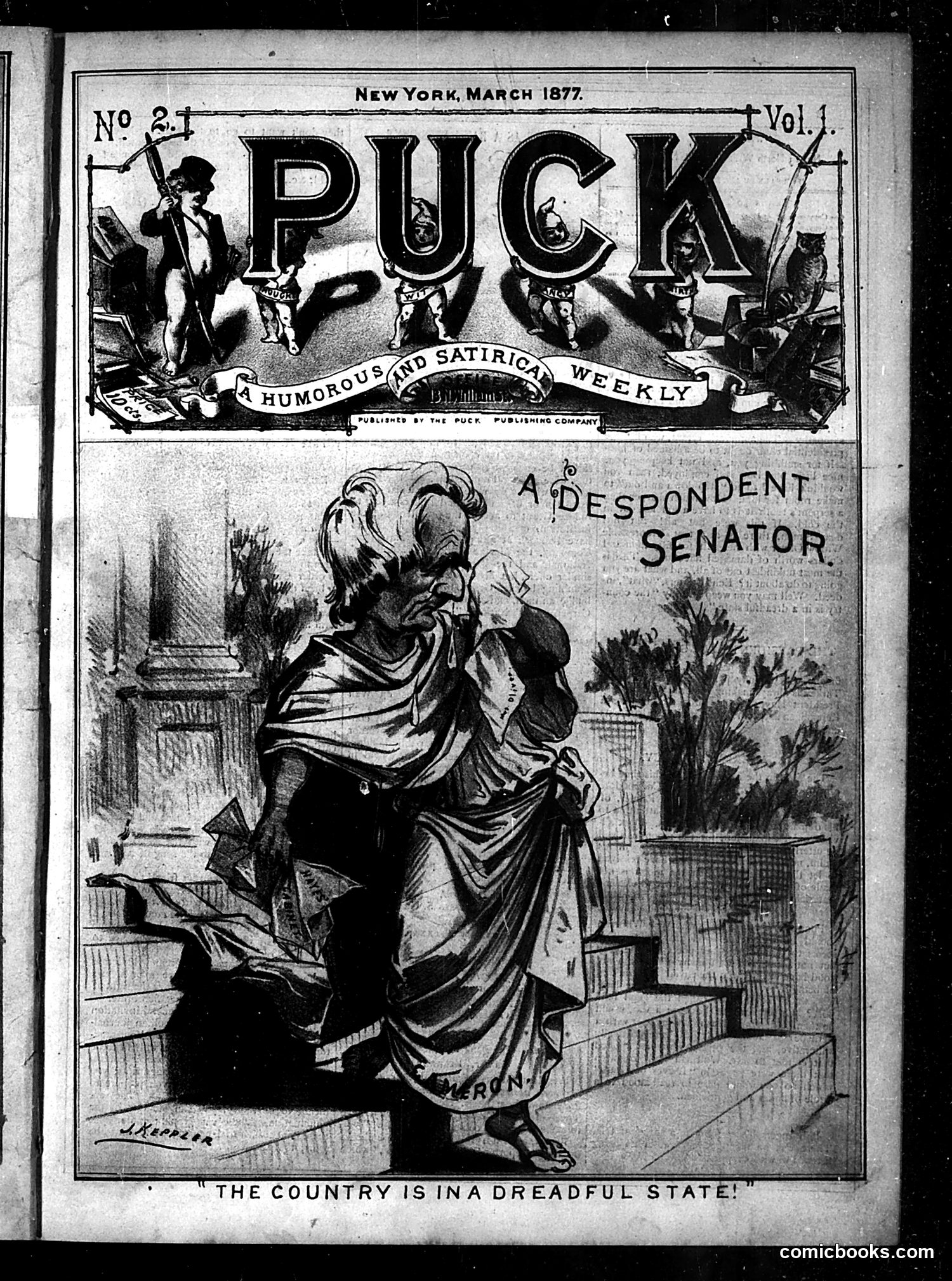
This is the cover of *Puck*, "A Humorous and Satirical Weekly," showing a political cartoon titled "A Despondent Senator." The main illustration depicts a disheveled figure in classical robes, labeled as representing a senator, appearing distressed on Capitol steps. The caption reads "The Country Is in a Dreadful State!" The cartoon satirizes political despair during the Reconstruction era following the Civil War. The senator's exaggerated distress and classical pose mock what the magazine likely viewed as hyperbolic or self-serving political complaints. The composition suggests *Puck* is ridiculing senators who claimed crisis while potentially neglecting actual governance. The specific senator referenced remains unclear without additional context, though the March 1877 date places this during Hayes's presidency and post-Reconstruction political turbulence.
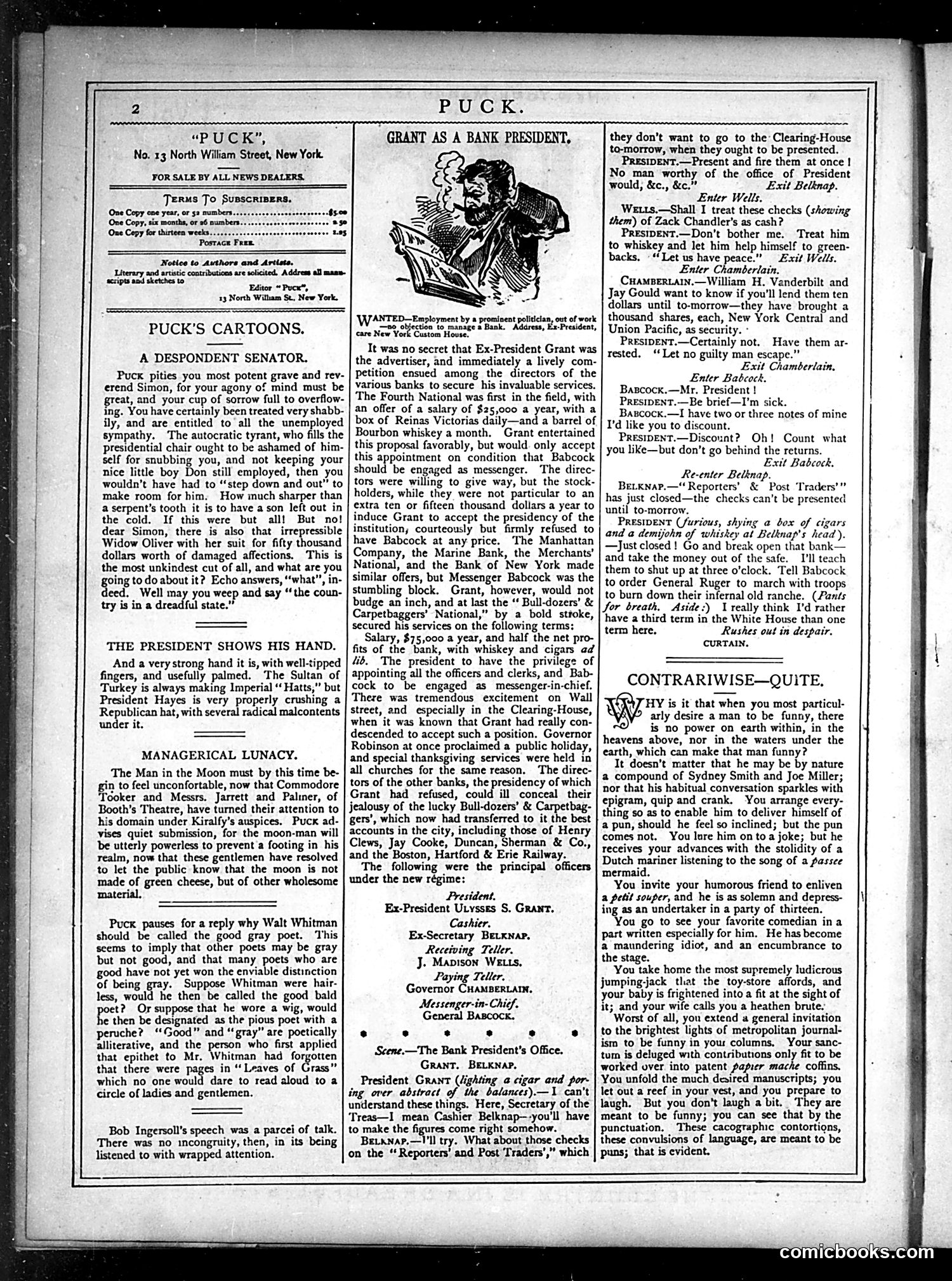
This cartoon satirizes **ex-President Ulysses S. Grant's** acceptance of a bank presidency, likely with **Jay Gould** and other wealthy financiers involved. The accompanying dialogue mocks the arrangement—Grant is depicted as uncomfortable and out of his depth in banking, while his associates attempt to convince him the position is acceptable. The satire targets the post-presidency corruption common in the Gilded Age: prominent politicians accepting lucrative corporate positions from the same financial figures they'd dealt with in office. The cartoon ridicules both Grant's naïveté and the cronyism of elite circles, suggesting Grant was being used as a figurehead to legitimize questionable banking practices while maintaining plausible deniability.
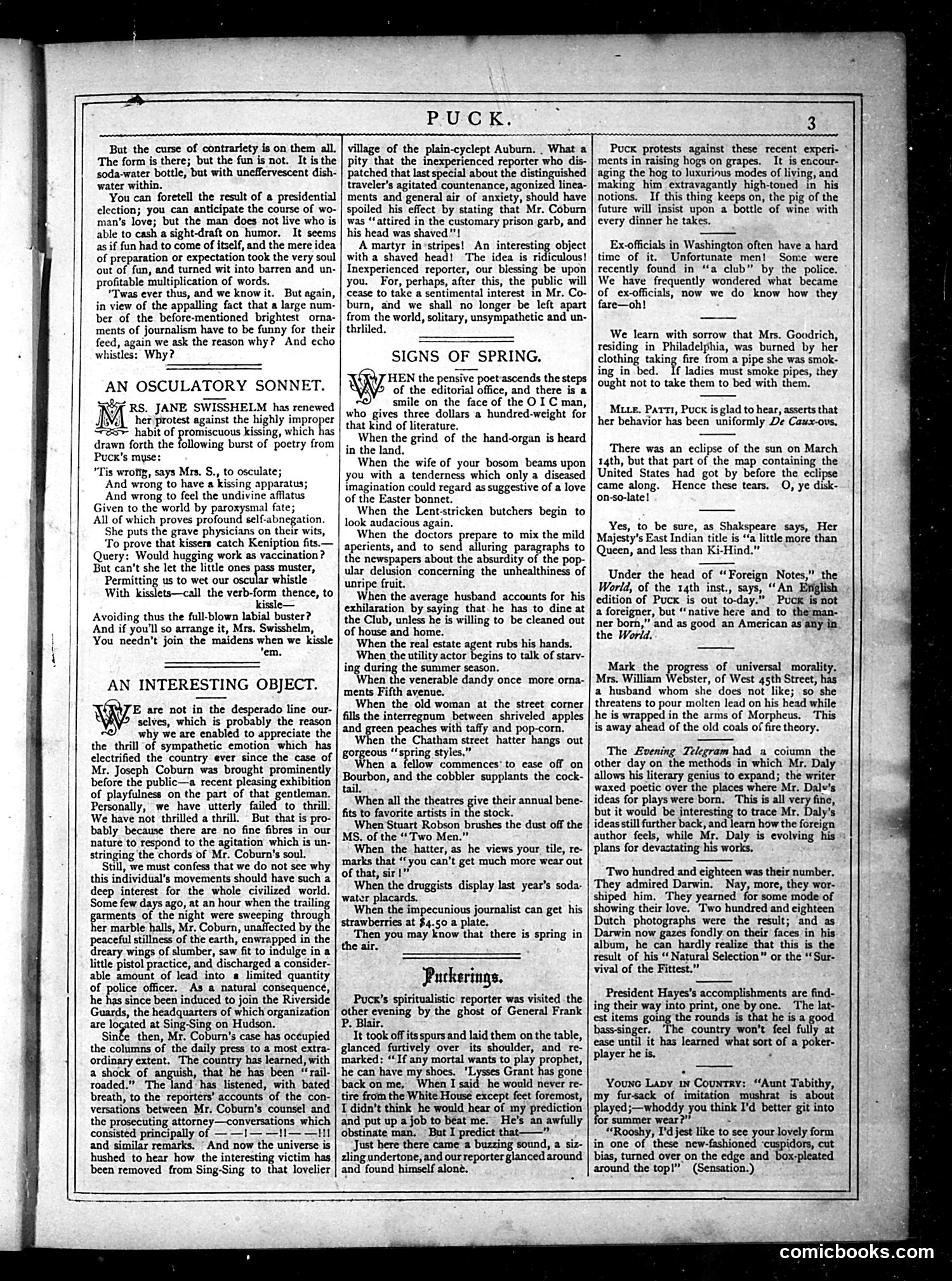
This page contains several short satirical pieces rather than a single cartoon. The content includes: **"An Osculatory Sonnet"** by Mrs. Jane Swisshelm, protesting improper publication of a poem by Puck. She sarcastically mocks the magazine for running it without permission. **"Signs of Spring"** satirizes various urban spring activities—poets, street vendors, butchers, doctors, and society women—in humorous vignettes capturing seasonal behavior. **"An Interesting Object"** discusses Mr. Coburn's case involving electrocution and subsequent police/legal complications, appearing to criticize both the incident and its handling. **"Puckerings"** (bottom section) includes brief social commentary items, including references to President Hayes and a "Young Lady in Country" segment with humorous anecdotes. The page emphasizes written humor over visual cartoons, typical of satirical magazines mixing illustrations with editorial wit.
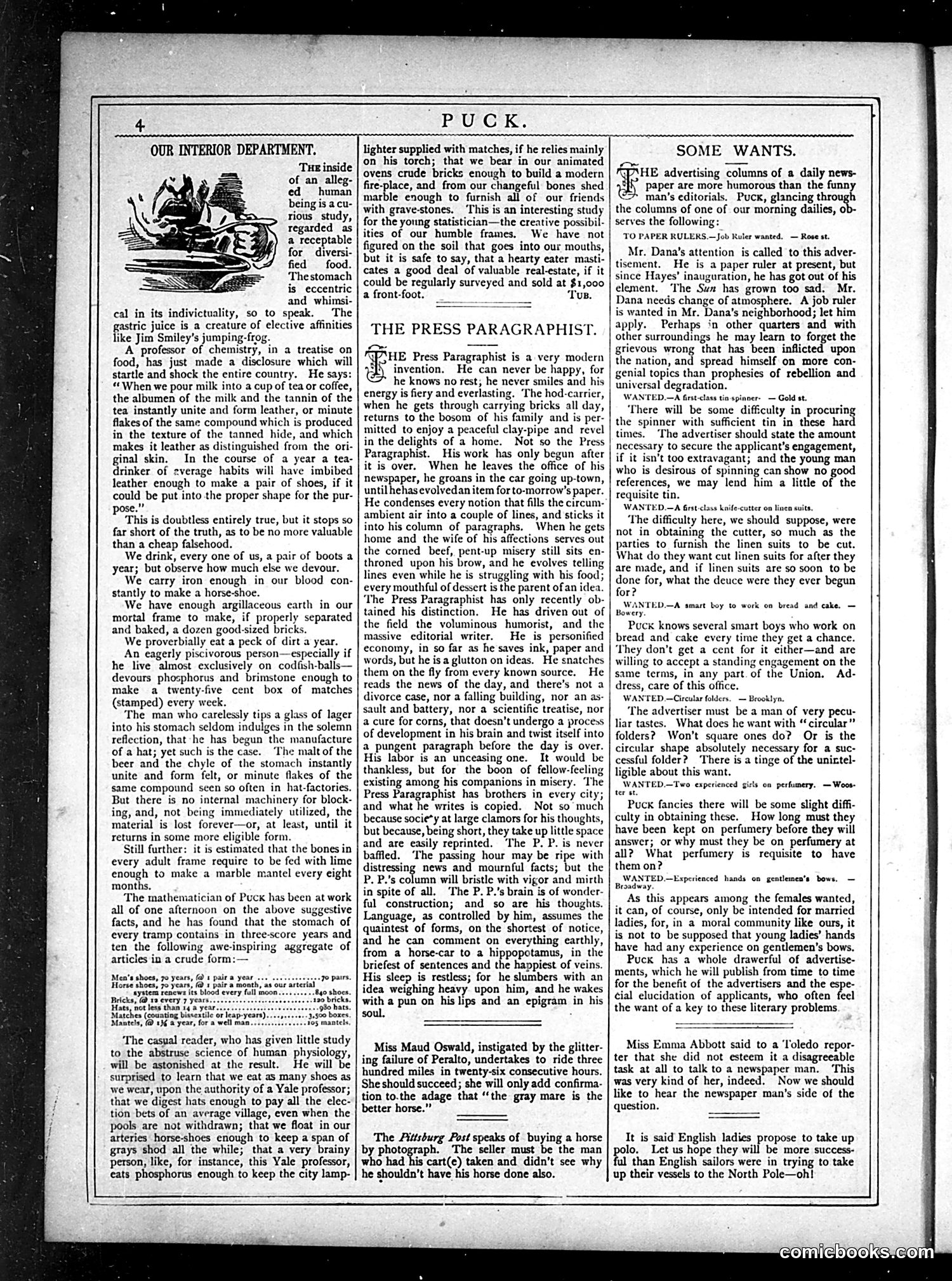
This page is primarily **text-based content** rather than political cartoons. The main sections include: 1. **"Our Interior Department"** - A humorous essay about domestic life and household economics, using exaggerated scientific language to describe cooking and household management as if it were chemistry. 2. **"The Press Paragraphist"** - A satirical piece mocking newspaper columnists who churn out brief, disconnected witticisms and observations, portraying them as lazy writers who recycle ideas without genuine insight. 3. **"Some Wants"** - A collection of short, comedic want ads and social commentary on various topics including newspaper criticism and labor. The small illustration at the top shows domestic kitchen items. The satire targets **Victorian-era journalism practices** and **household management pretension** rather than specific political figures or events.
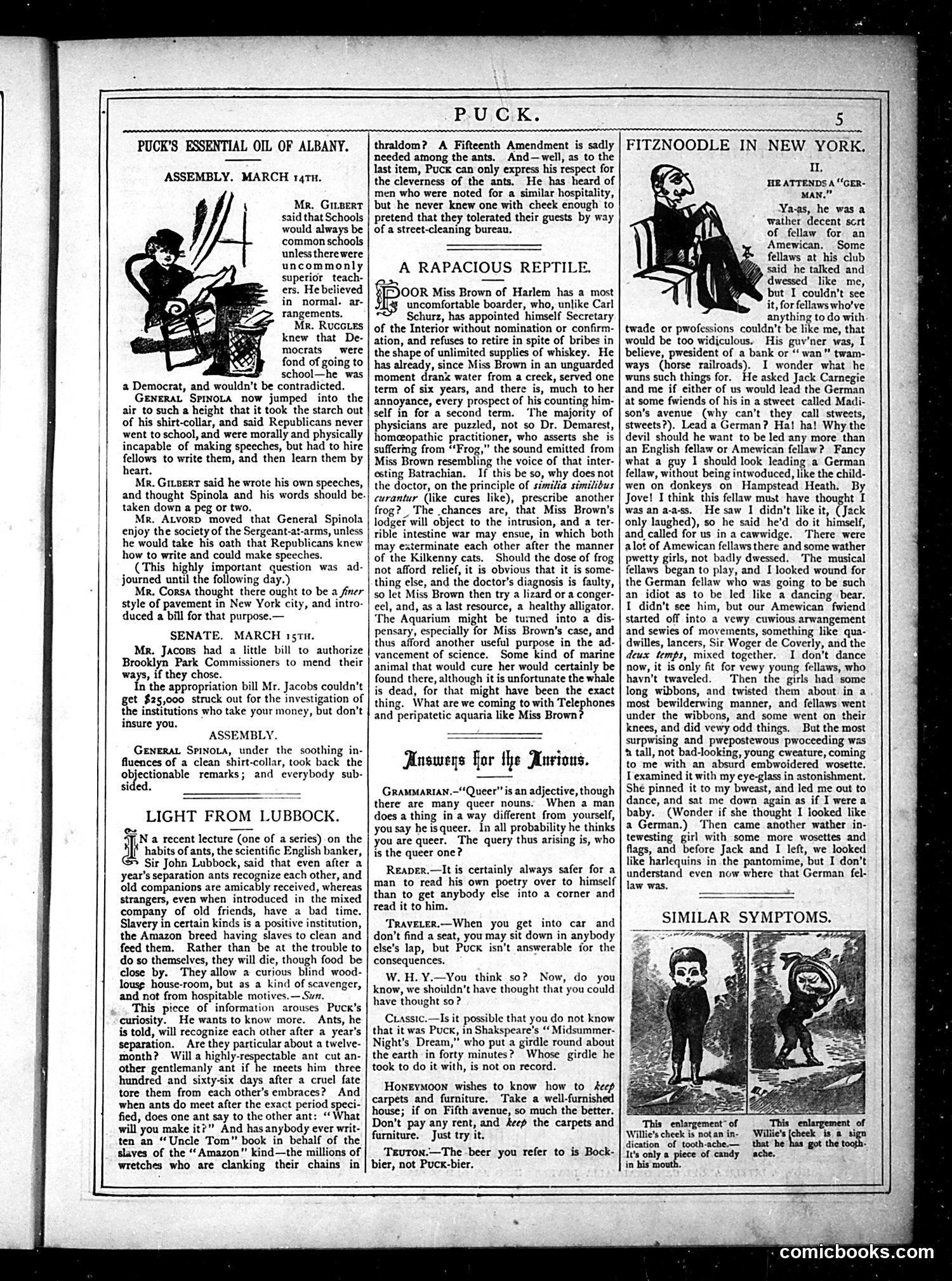
This page contains satirical commentary and humor rather than political cartoons. The main pieces address: **"Puck's Essential Oil of Albany"**: Mocks New York State Assembly members, particularly criticizing General Spinola for flip-flopping on Republican positions and General Spinola's contradictory speech-making. **"A Rapacious Reptile"**: Satirizes Miss Brown of Harlem, a boarding house keeper who acts as an unofficial secretary to a politician, refusing bribes while exploiting her position. The humor derives from her pretended virtue masking self-serving behavior. **"Fitznoodle in New York"**: A humorous narrative about a confused immigrant's misadventures in New York City, involving animals and cultural misunderstandings. The page primarily offers satirical social and political commentary typical of Puck's style, targeting local political figures and social types rather than national events.
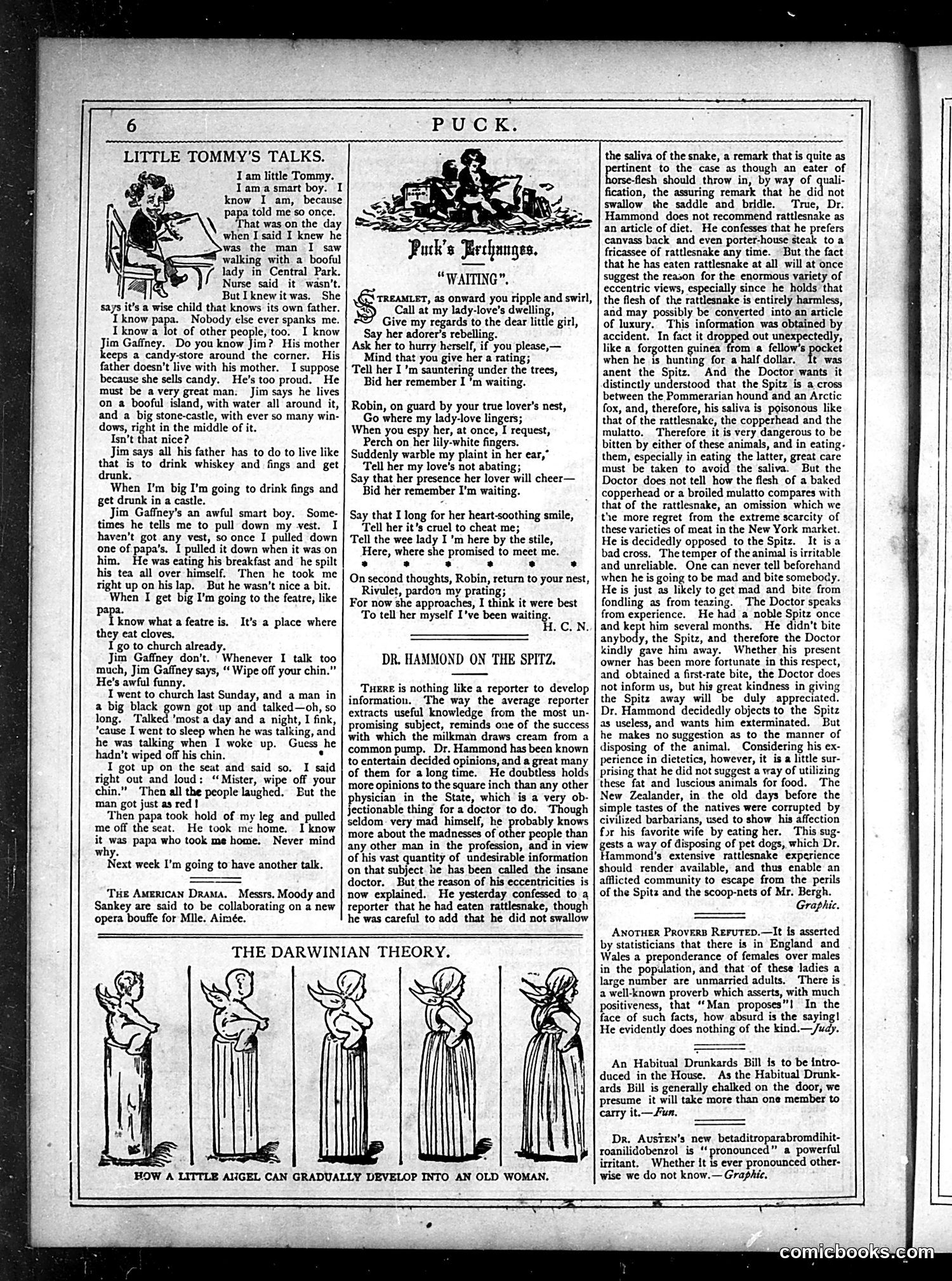
This page contains three main satirical pieces: 1. **"Little Tommy's Talks"** - A humorous monologue by a working-class child describing his impoverished family situation, used to mock social inequalities and urban poverty. 2. **"Puck's Jestings"** - Brief comic verses, including "Waiting" (a romantic poem parody) and "Dr. Hammond on the Spitz" (mocking a physician's opinions on rattlesnakes as food). The latter satirizes Dr. Hammond's eccentric dietary theories. 3. **"The Darwinian Theory"** - A visual sequence showing a progression from angel to elderly woman, sarcastically captioned "How a Little Angel Can Gradually Develop Into an Old Woman." This mocks evolution theory and aging. The page reflects Puck's typical mix of social commentary, personal ridicule, and pseudo-scientific satire popular in the era.
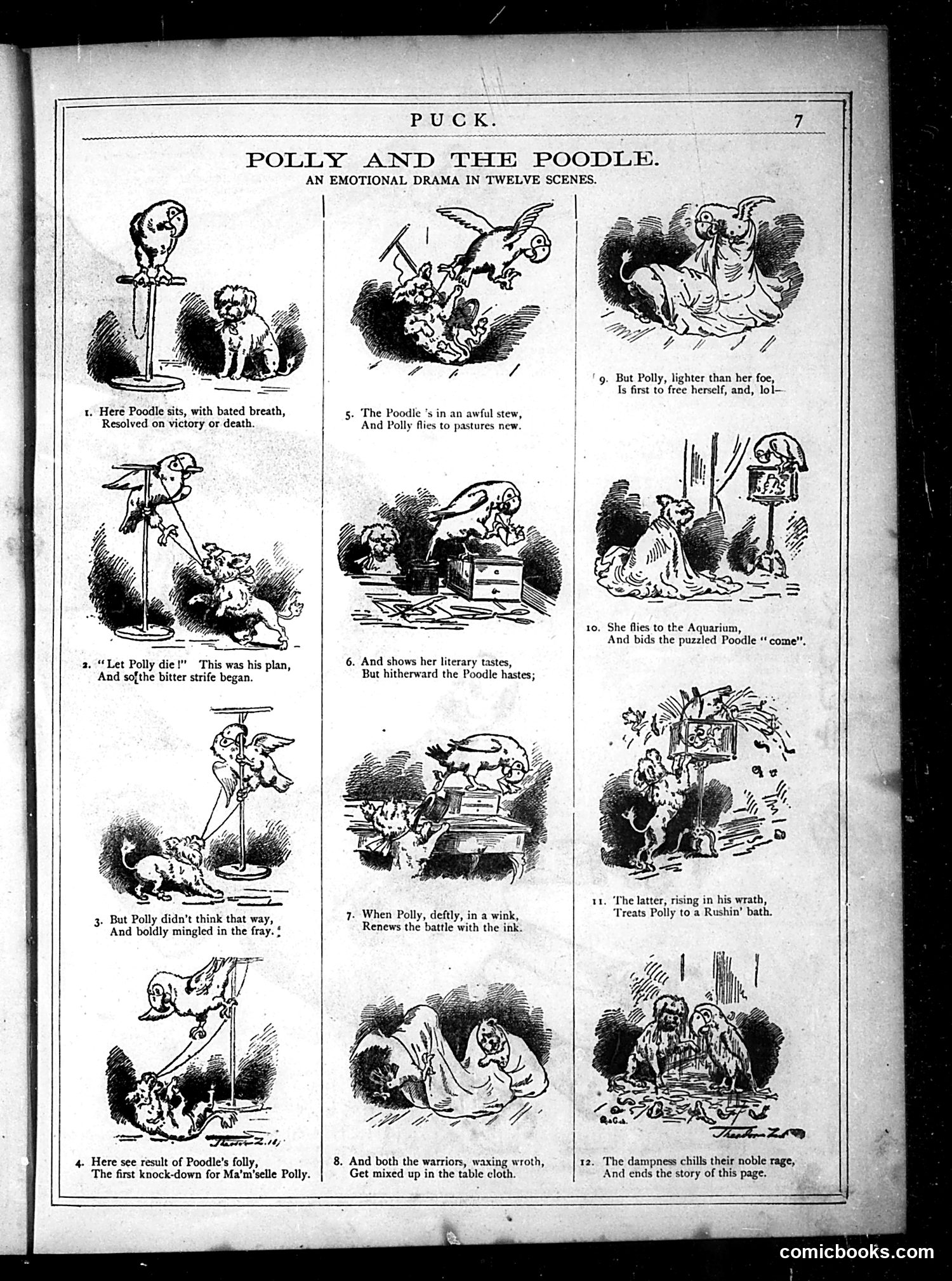
This twelve-panel comic strip tells a melodramatic story of conflict between Polly (a woman) and a Poodle, presented as an "emotional drama." The narrative shows: 1. The poodle "resolved on victory or death" 2. Polly initiates conflict ("Let Polly die!") 3. An escalating battle involving ink and writing materials 4. The poodle attacking Polly's literary interests 5. A climactic "rushing bath" punishment 6. Resolution where "dampness chills their noble rage" The satire appears to mock Victorian melodrama conventions—treating a trivial domestic dispute between a woman and pet dog with overwrought theatrical language and grandiose illustrations. It's comedic exaggeration of domestic life as high drama, typical of Puck's humorous approach to everyday situations.
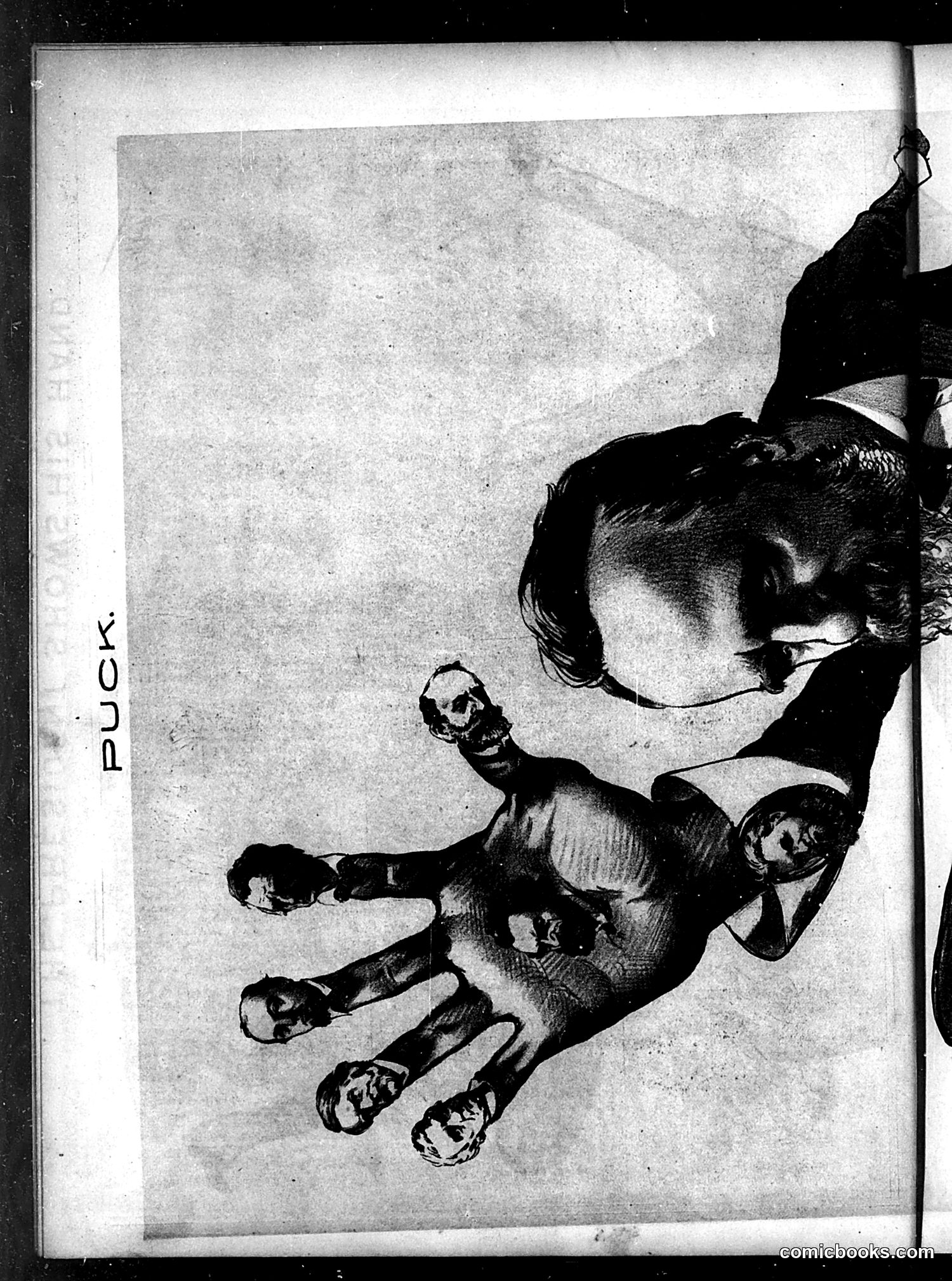
This page appears to be from Puck magazine, though the OCR text provided is minimal (only "PUCK" visible on the left margin). The black and white image shows what appears to be a political cartoon rendered upside-down on the page. It depicts figures in late 19th or early 20th-century dress, with exaggerated facial features typical of period caricature work. The composition suggests satire about political or social figures of the era. Without clearer text or visible date/caption information, I cannot definitively identify the specific figures being caricatured or the precise political event or social issue being satirized. The inverted orientation may be intentional for satirical effect, or could reflect the page's reproduction quality. To properly explain this cartoon's meaning to modern readers would require visible identifying captions or clearer OCR text.
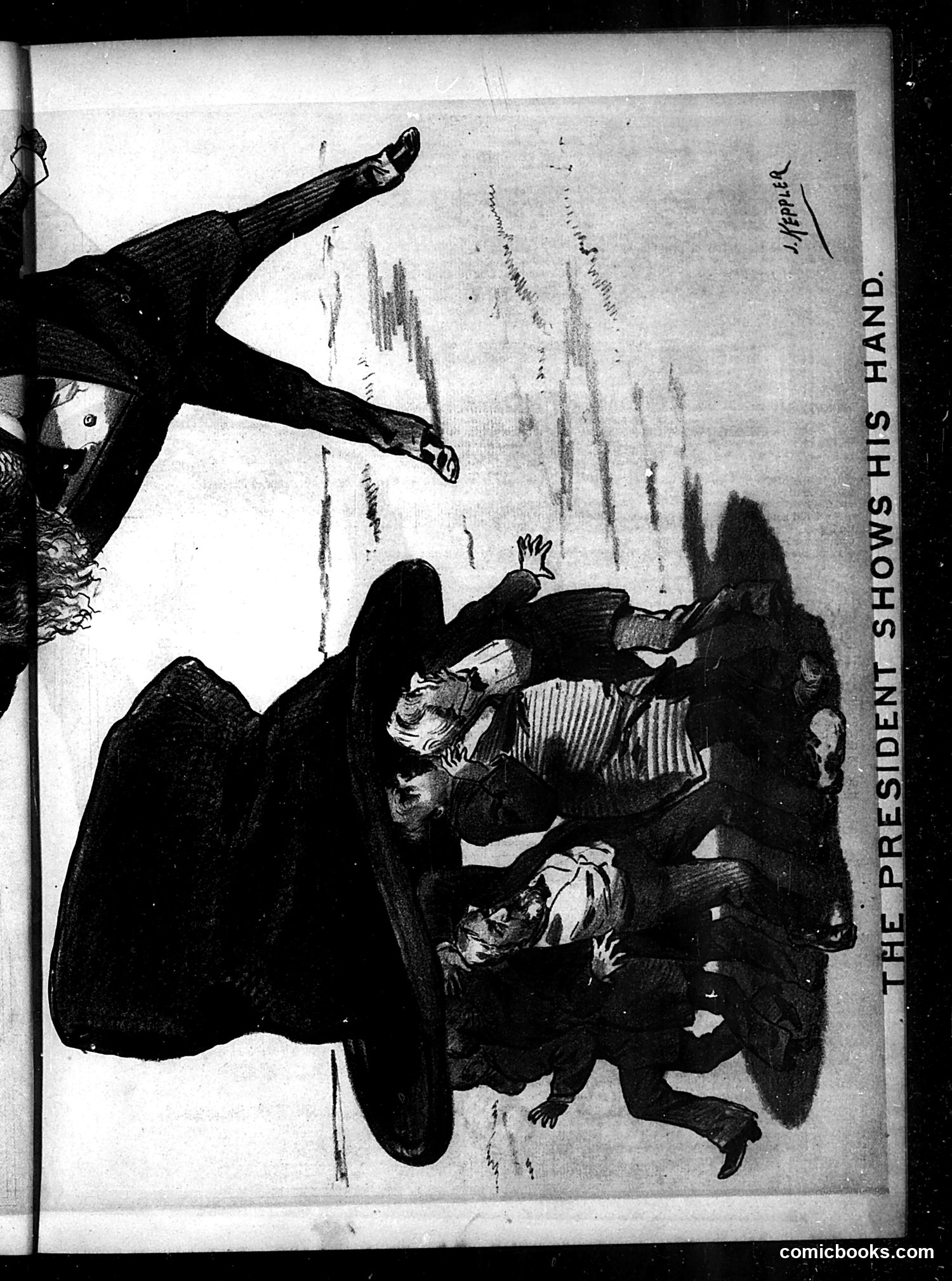
This political cartoon satirizes a U.S. President's decision-making or policy reveal. The image shows a figure in formal attire displaying or revealing something to observers, with the caption suggesting the President has disclosed his actual intentions or true position on an issue. The dramatic gesture and composition—with figures gathered around to witness the revelation—implies the cartoon criticizes the President for either: - Acting hypocritically (showing a "true hand" different from public claims) - Making an unpopular decision - Revealing previously hidden policies Without a visible date or additional context, I cannot identify which specific President or historical moment this references. The style suggests early-to-mid 20th century publication in *Puck* magazine.
This page features a humorous essay by Silas Daff about being asked to deliver a lecture on butterflies. The author humorously resists, claiming butterflies are too light a subject and that he lacks enthusiasm for the topic. He jokes about various absurd alternatives—turning a butterfly into a Spitz-dog, getting acquainted with the Lepidoptera family—all to avoid the assignment. The satire targets the pretension of lecture circuits and speakers who accept engagements on subjects they know nothing about, while also poking fun at the author's own reluctance and ridiculous rationalizations. It's social commentary on 19th-century intellectual culture and the pressure to appear knowledgeable on any topic. The "Little Game of Life" poem on the right appears unrelated.
This page contains two distinct sections: **"The Season on a Spree"** (top left): A theater critique discussing various New York playhouses and their offerings. The author discusses "Blue Glass," reviews of recent theatrical productions at venues like the Eagle Theatre and Fifth Avenue Theatre, and commentary on contemporary performances. The piece critiques both the venues and performers, with particular attention to the quality of drama being produced. **"Trick-Flowers"** (bottom): An article about artificial flowers sold in theater lobbies as souvenirs. The author satirizes the practice of selling these fake flowers to theatergoers, suggesting managers use them to extract money from audiences under the pretense of supporting stage actresses. The piece mocks this deceptive marketing tactic as exploitative entertainment-industry practice. Both sections represent Puck's satirical commentary on contemporary theatrical culture and commercial practices.
This page is entirely text—a short story titled "The Story of his Eye," not a political cartoon. The narrative concerns a gentleman narrator explaining to a friend named Strickland why his wife left him years ago after their marriage became unhappy. The story references a disfiguring eye injury the narrator received from his wife during an argument, which caused her to lose respect for him. The tale involves marital discord, separation, and the narrator's subsequent philosophical acceptance of their failed relationship. This appears to be humor-through-narrative rather than visual satire. Without visible illustrations, the comedy derives from the domestic melodrama and the narrator's attempts to rationalize his wife's departure to an acquaintance.
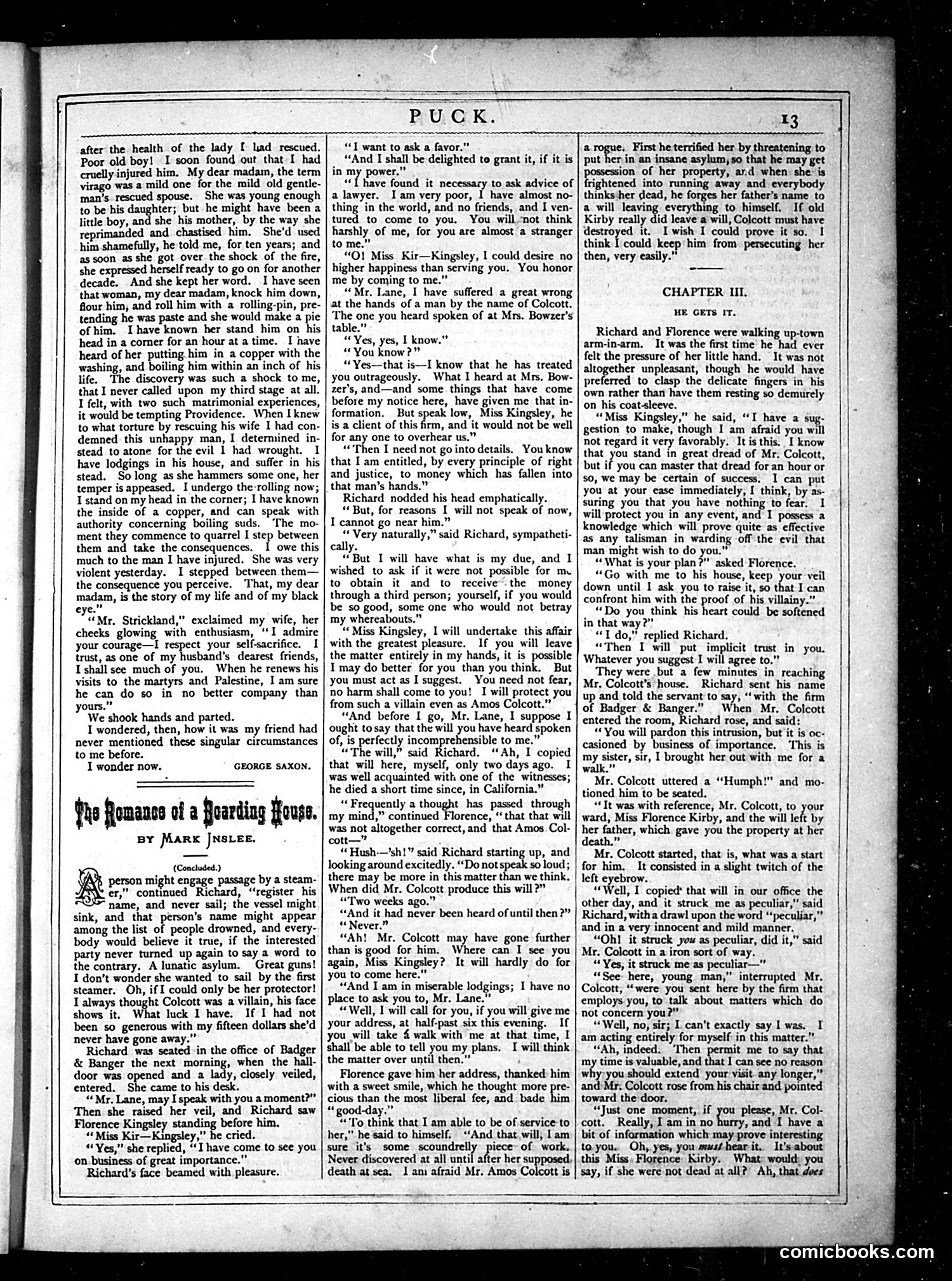
This page from *Puck* magazine (page 13) contains no political cartoon—it's entirely text: the conclusion of a serialized story titled "The Romances of a Boarding House" by Mark Insley, followed by "Chapter III: He Gets It." The narrative depicts Victorian-era domestic drama involving characters named Richard, Florence, Mr. Colcott, and Miss Kingsley. The plot involves financial disputes, threats of property seizure, and romantic complications. Characters discuss blackmail, debts, and securing money through intermediaries. This appears to be light fiction entertainment rather than political satire. *Puck* regularly published serialized stories alongside its satirical illustrations. Without seeing the accompanying illustrations (if any), the satirical intent of this particular installment remains unclear from text alone.
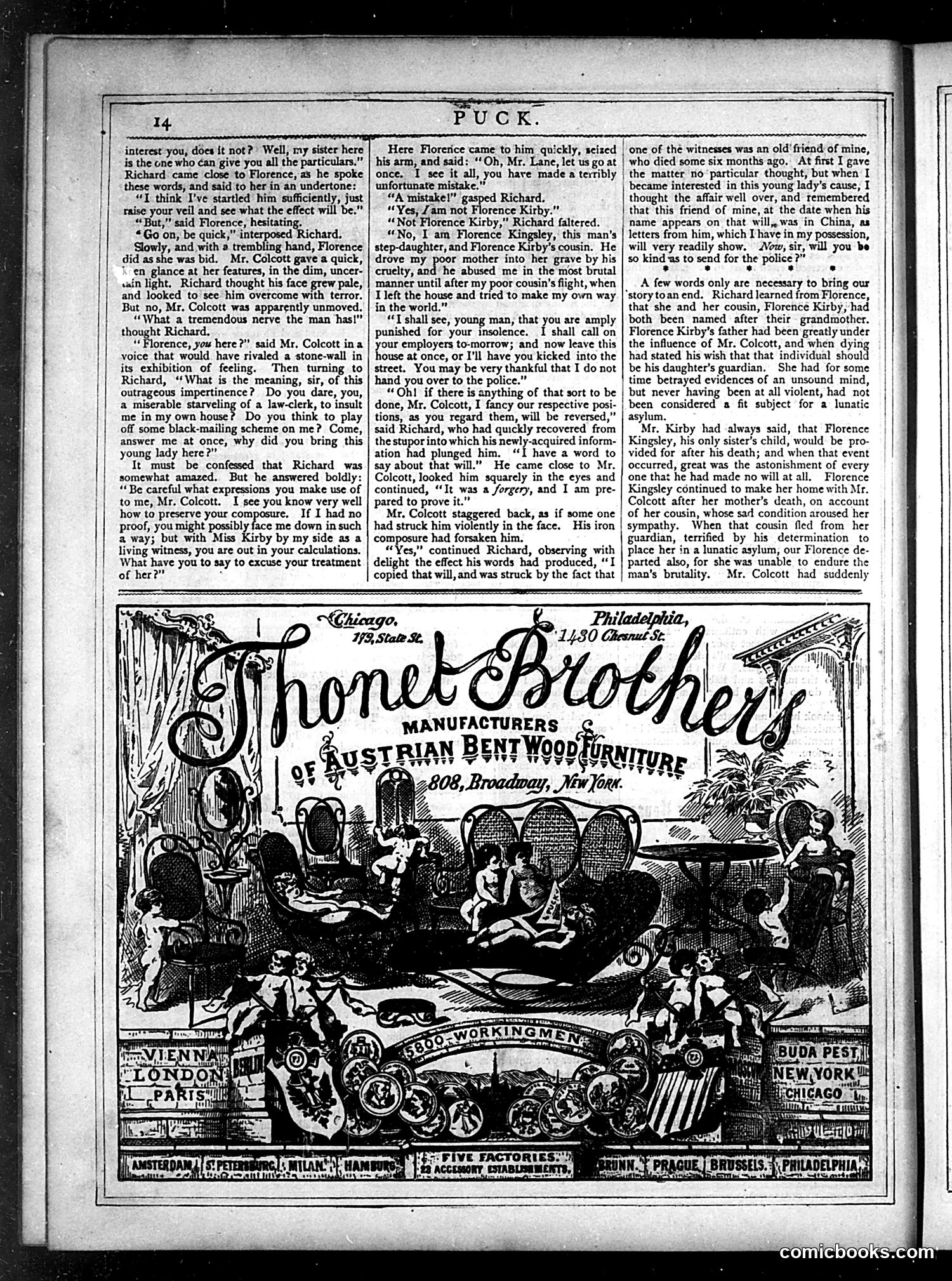
This page contains a serialized fiction story titled "PUCK" (top section) alongside a **full-page advertisement** for Thonet Brothers furniture manufacturers. The story text discusses characters named Richard, Florence, and Mr. Colcott in what appears to be a Victorian-era domestic drama involving accusations of impropriety and class tensions. However, **this is not political satire**—it's serialized fiction. The advertisement is the dominant visual element: an ornate, decorative illustration promoting Austrian bent-wood furniture, with locations listed in Chicago, Philadelphia, Vienna, London, Paris, and other cities. The ad emphasizes "Good Working Men" and manufacturing establishments, suggesting aspirational middle-class appeal. **This page is primarily commercial/entertainment content rather than political commentary.** The satirical magazine format has shifted to include substantial advertising alongside serialized stories.
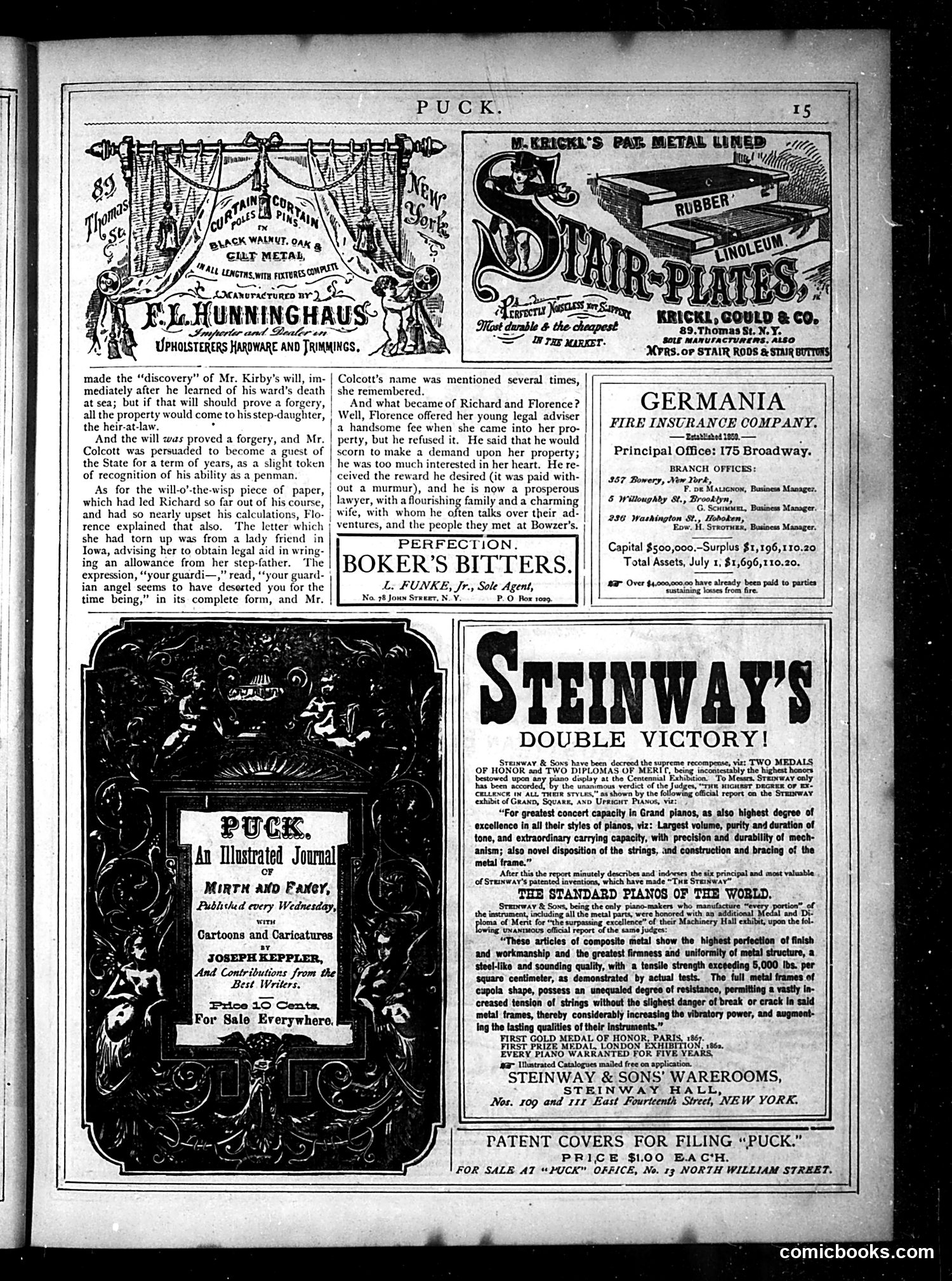
This page is primarily **advertising and promotional content** for Puck magazine itself, rather than political satire. The main elements are: 1. **Top left**: An ornate advertisement for F.L. Hunninghaus (upholsterers and hardware), featuring theatrical curtains and gilt metal details 2. **Center/right**: Various product advertisements (Kreichl's stair plates, Germania Fire Insurance, Boker's Bitters) 3. **Large central image**: A decorative frame advertising Puck as "An Illustrated Journal of Mirth and Farce," published Wednesdays with cartoons by Joseph Keppler, available "For Sale Everywhere" 4. **Right side**: Steinway piano advertisement highlighting "Double Victory" — two gold medals for concert grand pianos This appears to be a **back page or advertising section** rather than editorial content, showing how 19th-century magazines financed themselves through paid advertisements interspersed with self-promotion.
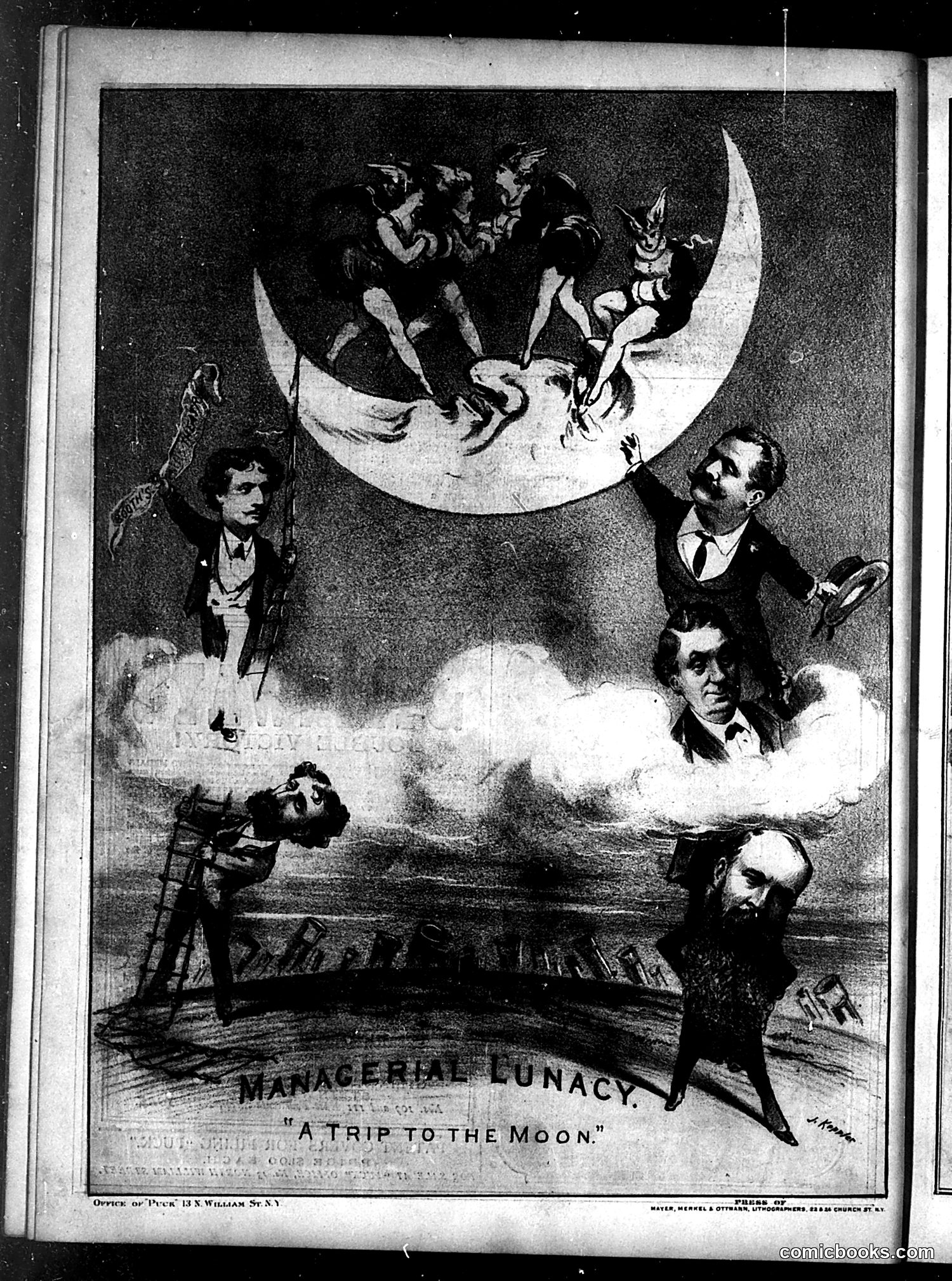
This Puck cartoon satirizes what appears to be theatrical or business management incompetence, using a moon-voyage fantasy as its metaphor. The title "Managerial Lunacy" suggests the managers themselves are the "lunatics" (beings from the moon). The composition shows several well-dressed men in formal attire gazing upward at a crescent moon populated by wild, demonic figures. The lower figures appear to represent different management personalities or types, each with distinct expressions of either aspiration or concern. The satire likely critiques absurd business decisions, impossible schemes, or the disconnect between ambitious managers and reality—depicting their plans as fantastical "trips to the moon." Without clearer identification of specific individuals, the cartoon appears to be a general commentary on managerial folly rather than targeting particular named figures.