
Puck, 1877-03 · page 2 of 16
Puck — March 1877 — page 2: what you’re looking at
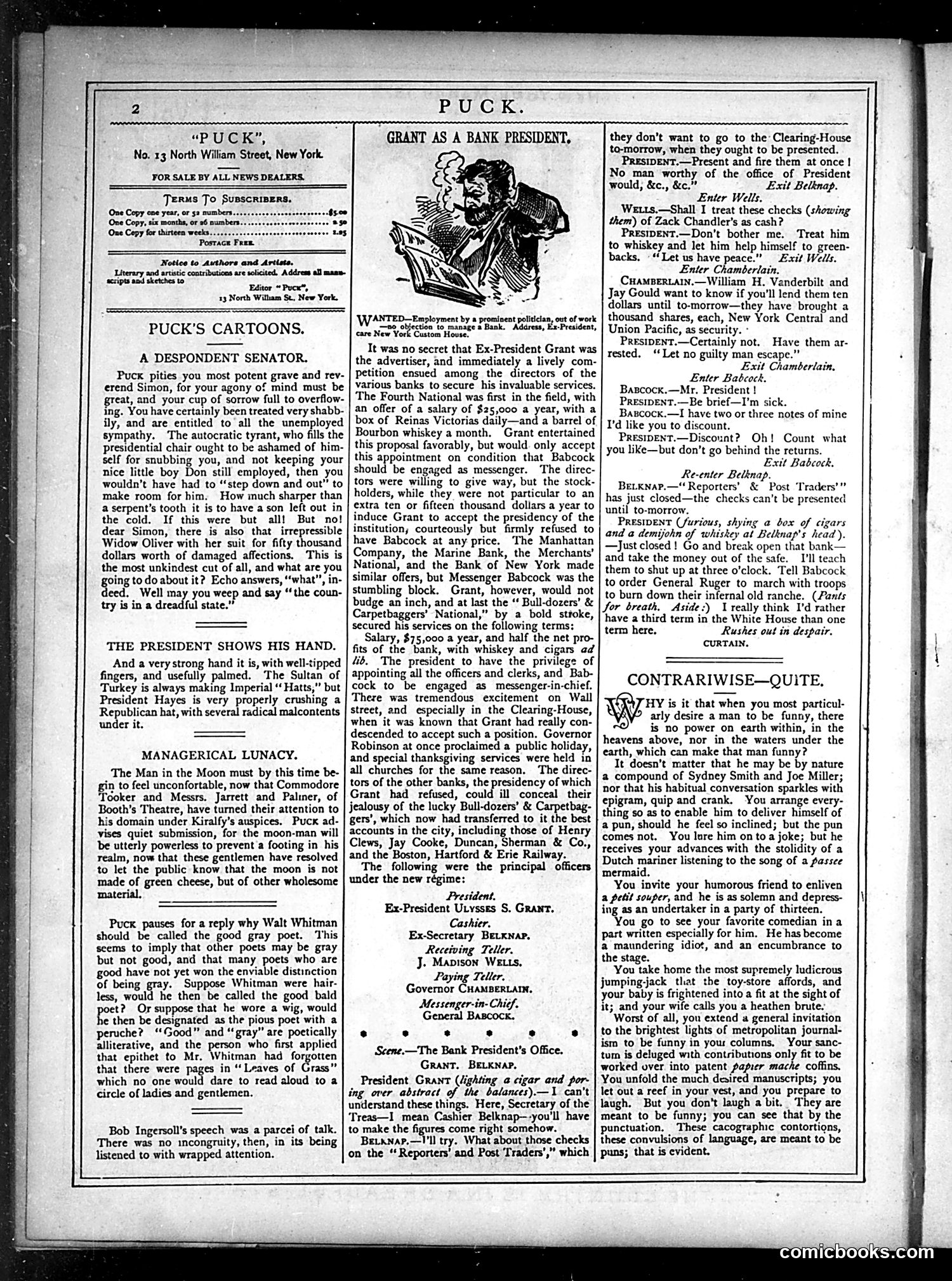
What you’re looking at
This cartoon satirizes **ex-President Ulysses S. Grant's** acceptance of a bank presidency, likely with **Jay Gould** and other wealthy financiers involved. The accompanying dialogue mocks the arrangement—Grant is depicted as uncomfortable and out of his depth in banking, while his associates attempt to convince him the position is acceptable. The satire targets the post-presidency corruption common in the Gilded Age: prominent politicians accepting lucrative corporate positions from the same financial figures they'd dealt with in office. The cartoon ridicules both Grant's naïveté and the cronyism of elite circles, suggesting Grant was being used as a figurehead to legitimize questionable banking practices while maintaining plausible deniability.
📄 Transcribed text from this page (OCR, searchable)
Machine-transcribed from the original scan — historical spelling and the odd misread are preserved.
“PUCK”, No. 13 North William Street, New York. FOR SALE BY ALL NEWS DEALERS. = Terms To SuBscRIBERS. One Copy one year, or 52 numbers One Copy, six months, or 26 num! One Copy for thirteen weeks. Literary and artistic contributions are solicited, Address al! mans- ‘sccipts and sketches to Editor ~ Puck”, 13 North Witham Se, New York. PUCK’S CARTOONS. A DESPONDENT SENATOR. Puck pities you most potent grave and rev- erend Simon, for your agony of mind must be great, and your cup of sorrow full to overflow- ing. You have certainly been treated very shabb- ily, and are entitled to all the unemployed sympathy. The autocratic tyrant, who fills the presidential chair ought to be ashamed of him- self for snubbing you, and not keeping your nice little boy Don still employed, then you wouldn’t have had to ‘step down and out” to make room for him. How much sharper than a serpent’s tooth it is to have a son left out in the cold. If this were but all! But no! dear Simon, there is also that irrepressible Widow Oliver with her suit for fifty thousand dollars worth of damaged affections. This is the most unkindest cut of all, and what are you ing to do about it? Echo answers, “what”, in- eed. Well may you weep and say “the coun- try is in a dreadful state.” THE PRESIDENT SHOWS HIS HAND. And a very strong hand it is, with well-tipped fingers, and usefully palmed. ‘The Sultan of Turkey is always making Imperial “ Hatts,” but President Hayes is very properly crushing a Republican hat, with several radical malcontents under it. MANAGERICAL LUNACY, The Man in the Moon must by this time be- gin to feel unconfortable, now that Commodore Tooker and Messrs. Jarrett and Paliner, of Booth’s Theatre, have turned their attention to his domain under Kiralfy’s auspices. Puck ad- yises quiet submission, for the moon-man will be utterly powerless to prevent a footing in his realm, now that these gentlemen have resolved to let the public know that the moon is not made of green cheese, but of other wholesome material. Puck pauses for a reply why Walt Whitman should be called the good gray poet. This seems to imply that other poets may be gray but not good, and that many poets who are good have not yet won the enviable distinction of being gray. Suppose Whitman were hair- less, would he then be called the good bald t? Or suppose that he wore a wig, would ¢ then be designated as the pious poet with a peruche? “Good” and “gray” are poetically alliterative, and the person who first applied that epithet to Mr. Whitman had forgotten that there were pages in ‘Leaves of Grass” which no one would dare to read aloud to a circle of ladies and gentlemen. Bob Ingersoll’s speech was a parcei of talk. There was no incongruity, then, in its being listened to with wrapped attention. -ANTED—Em; bya inent politician, out of work: wos elfeien fo anaes Bank Adare, Re Preiaeny care New York Custom House. It was no secret that Ex-President Grant was the advertiser, and immediately a lively com- petition ensued among the directors of the various banks to secure his invaluable services. The Fourth National was first in the field, with an offer of a salary of $25,000 a year, with a box of Reinas Victorias daily—and a barrel of Bourbon whiskey a month, Grant entertained this proposal favorably, but would. only accept this appointment on condition that Babcock should be engaged as messenger. The direc- tors were willing to give way, but the stock- holders, while they were not particular to an extra ten or fifteen thousand dollars a year to induce Grant to accept the presidency of the institution, courteously but firmly refused to have Babcock at any price. The Manhattan Company, the Marine Bank, the Merchants’ National, and the Bank of New York made similar offers, but Messenger Babcock was the stumbling block. Grant, however, would not budge an inch, and at last the “ Bull-dozers’ & Carpetbaggers’ National,” by a bold sttoke, secured his services on the following terms: Salary, $75,000 a year, and half the net pro- fits of the bank, with whiskey and cigars ad 4b, The president to have the privilege of appointing all the officers and clerks, and Bab- cock to be engaged as messenger-in-chief. There was tremendous excitement on Wall street, and especially in the Clearing-House, when it was known that Grant had really con- descended to accept such a position. Governor Robinson at once proclaimed a public holiday, and special thanksgiving services were held in all churches for the same reason. The direc- tors of the other banks, the presidency of which Grant had refused, could ill conceal their jealousy of the lucky Bull-dozers’ & Carpetbag- gers’, which now had transferred to it the best accounts in the city, including those of Henry Clews, Jay Cooke, Duncan, Sherman & Co., and the Boston, Hartford & Erie Railway. ‘The following were the principal officers under the new régime: President, Ex-President Utysses S. Grant. Cashier. Ex-Secretary BELKNaP, Receiving Teller. J. Mapison WELLS, Paying Teller. Governor CHAMBERLAIN, Messenger-in- Chitf. General Bascocx. s s s s s Scene.—The Bank President's Office. Grant. BELKNAP. President Grant (lighting a cigar and por- ing over abstract of the balances).—1 can't understand these things. Here, Secretary of the ‘Treas—I mean Cashier Belknap—-you'll have to make the figures come right somehow. Bexnap.—'ll try. What about those checks on the ‘Reporters’ and Post ‘Traders’,” which they don’t want to go to the Clearing-House to-morrow, when they ought to be presented. PresipeNT.—Present and fire them at once! No man worthy of the office of President would, &c., &c.” Exit Belknap. Enter Wells, Wetts.—Shall I treat these checks (showing them) of Zack Chandler's as cash? PrEsIDENT.—Don't bother me. ‘Treat him to whiskey and let him help himself to green- backs. ‘Let us have peace.” Exit Wells. Enter Chamberlain. CHAMBERLAIN.— William H. Vanderbilt and Jay Gould want to know if you'll lend them ten dollars until to-morrow—they have brought a thousand shares, each, New York Central and Union Pacific, as security. « Presipent.—Certainly not. Have them ar- rested. ‘Let no guilty man escape.” Exit Chamberlain, Enter Babcock. Baxcock.—Mr. President ! Presipent.—Be brief—I’m sick. Bascock.—I have two or three notes of mine I'd like you to discount. PRESIDENT.—Discount? Oh! Count what you like—but don’t go behind the returns. Exit Babcock. Re-enter Belknap. Betxnap.—‘‘ Reporters’ & Post ‘Traders’” has just closed—the checks can’t be presented until to-morrow. PRESIDENT (furious, shying a box of cigars and a demijohn of whiskey at Belknap’s head). —Just closed ! Go and break open that bank— and take the money out of the safe. I'll teach them to shut up at three o’clock. Tell Babcock to order General Ruger to march with troops to burn down their infernal old ranche. (Pants Sor breath, Aside:) {really think I’d rather have a third term in the White House than one term here, Rushes out in despair. CURTAIN. CONTRARIWISE—QUITE, HY is it that when you most particul- arly desire a man to be funny, there is no power on earth within, in the heavens above, nor in the waters under the earth, which can make that man funny? It doesn’t matter that he may be by nature a compound of Sydney Smith and Joe Miller; nor that his habitual conversation sparkles with epigram, quip and crank. You arrange every- thing so as to enable him to deliver himself of a pun, should he feel so inclined; but the pun comes not. You lure him on toa joke; but he receives your advances with the stolidity of a Dutch mariner listening to the song of a passce mermaid. You invite your humorous friend to enliven a petit souper, and he is as solemn and depress- ing as an undertaker in a party of thirteen. fou go to see your favorite comedian ina written especially for him. He has become a maundering idiot, and an encumbrance to the stage. You take home the most supremely ludicrous jumping-jack that the toy-store affords, and your baby is frightened into a fit at the sight of it; and your wife calls you a heathen brute. ‘Worst of all, you extend a general invitation to the brightest lights of metropolitan journal- ism to be funny in your columns, Your sanc- tum is deluged with contributions only fit to be worked over into patent papier mache coffins. You unfold the much desired manuscripts; you let out a reef in your vest, and you prepare to laugh. But you don’t laugh a bit. They are meant to be funny; you can see that by the punctuation, These cacographic contortions, these convulsions of language, are meant to be puns; that is evident.