
Puck, 1877-03 · page 11 of 16
Puck — March 1877 — page 11: what you’re looking at
What you’re looking at
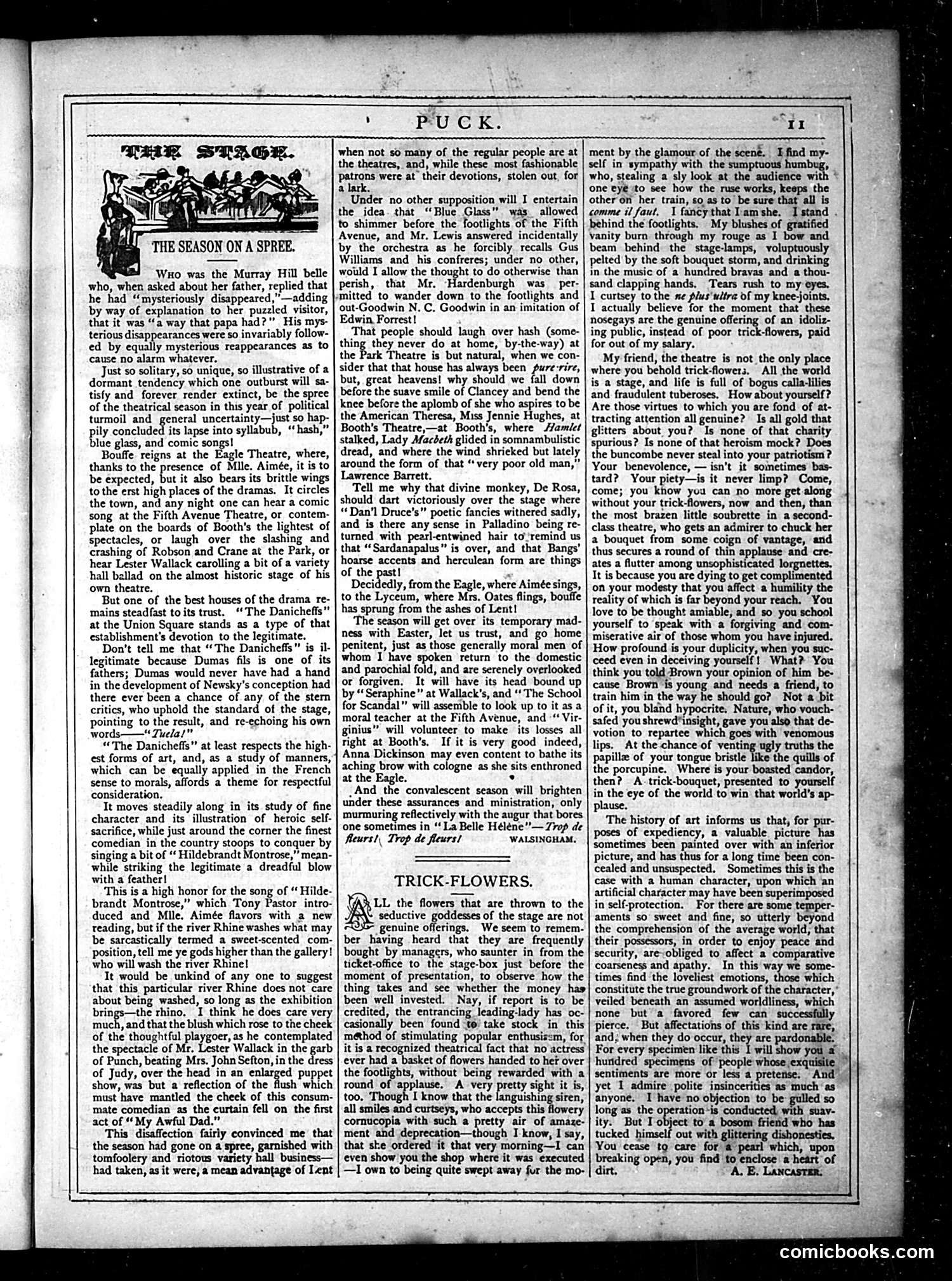
This page contains two distinct sections: **"The Season on a Spree"** (top left): A theater critique discussing various New York playhouses and their offerings. The author discusses "Blue Glass," reviews of recent theatrical productions at venues like the Eagle Theatre and Fifth Avenue Theatre, and commentary on contemporary performances. The piece critiques both the venues and performers, with particular attention to the quality of drama being produced. **"Trick-Flowers"** (bottom): An article about artificial flowers sold in theater lobbies as souvenirs. The author satirizes the practice of selling these fake flowers to theatergoers, suggesting managers use them to extract money from audiences under the pretense of supporting stage actresses. The piece mocks this deceptive marketing tactic as exploitative entertainment-industry practice. Both sections represent Puck's satirical commentary on contemporary theatrical culture and commercial practices.
📄 Transcribed text from this page (OCR, searchable)
Machine-transcribed from the original scan — historical spelling and the odd misread are preserved.
> (i = MAA Tite SEASON ON A SPREE. Wao was the Murray Hill belle who, when asked about her father, replied that he had ‘mysteriously disappeared,”—adding by way of explanation to her puzzled visitor, that it was “a way that papa had?" His mys- terious disappearances ‘were so invariably follow- ed by equally mysterious reappearances as to cause no alarm whatever. " Just so solitary, so unique, so illustrative ofa dormant tendency which one outburst will sa- tisfy and forever render extinct, be the spree of the theatrical season in this year of political turmoil and general uncertainty—just so hap- pily concluded its lapse into syllabub, “hash,” blue glass, and comic songs! Bouffe reigns at the Eagle Theatre, where, thanks to the presence of Mlle. Aimée, it is to be expected, but it also bears its brittle wings to the erst high places of the dramas. It circles the town, and any night one can hear a comic song at the Fifth Avenue Theatre, or contem- plate on the boards of Booth’s the lightest of spectacles, or laugh over the slashing and crashing of Robson and Crane at the Park, or hear Lester Wallack carolling a bit of a variety hall ballad on the almost historic stage of his own theatre. But one of the best houses of the drama re- mains steadfast to its trust. “The Danicheffs” at the Union Square stands as a type of that establishment's devotion to the legitimate. Don’t tell me that “The Danicheffs” is il- legitimate because Dumas fils is one of its fathers; Dumas would never have had a hand in the development of Newsky’s conception had there ever been a chance of any of the stern critics, who uphold the standard of the stage, pointing to the result, and re-echoing his own words——“ Tuela/" “The Danicheffs” at least respects the high- est forms of art, and, as a study of manners, which can be equally applied in the French sense to morals, affords a theme for respectful consideration. It moves steadily along in its study of fine character and its illustration of heroic self- sacrifice, while just around the corner the finest comedian in the country stoops to conquer by singing a bit of “ Hildebrandt Montrose,” mean- while striking the legitimate a dreadful blow with a feather! This is a high honor for the song of “ Hilde- brandt Montrose,” which Tony Pastor intro- duced and Mile. Aimée flavors with a new reading, but if the river Rhine washes what may be sarcastically termed a sweet-scented com- position, tell me ye gods higher than the gallery! who will wash the river Rhine! It would be unkind of any one to suggest that this particular river Rhine does not care about being washed, so long as the exhibition brings—the rhino, I think he does care ve: much, and that the blush which rose to the cheel of the thoughtful playgoer, as he contemplated the spectacle of Mr. Lester Wallack in the garb of Punch, beating Mrs. John Sefton, in the dress of Judy, over the head in an eet tae puppet show, was but a reflection of the flush which must have mantled the cheek of this consum- mate comedian as the curtain fell on the first act of “My Awful Dad.” This disaffection fairly convinced me that the season had gone on a spree, garnished with tomfoolery and riotous variety hall business— had taken, as it were, a mean advantage of Int PUCK. “tr when not so many of the regular people are at the theatres, and, while these most fashionable Pete were at their devotions, stolen out, for a Under no other supposition will I entertain the idea. that ‘Blue Glass” was allowed to shimmer before the footlights of the Fifth Avenue, and Mr. Lewis answered incidentally by the orchestra as he forcibly recalls Gus Williams and his confreres; under no other, would I allow the thought to do otherwise than perish, that Mr. “Hardenburgh was __ per- smitted to wander down to the footlights and out-Goodwin N, C. Goodwin in an imitation of Edwin Forrest! That people should laugh over hash (some- thing they never do at home, by-the-way) at the Park Theatre is but natural, when we con- sider that that house has always been pure-rire, but, great heavens! why should we fall down before the suave smile of Clancey and bend the knee before the aplomb of she who aspires to be the American Theresa, Miss Jennie Hughes, at Booth’s Theatre,—at Booth's, where Hamlet stalked, Lady Macbeth glided in somnambulistic dread, and where the wind shrieked but lately around the form of that ‘very poor old man,” Lawrence Barrett. Tell me why that divine monkey, De Rosa, should dart victoriously over the stage where “ Dan'l Druce's” poetic fancies withered sadly, and is there any sense in Palladino being re- turned with pearl-entwined hair to!remind us that ‘‘Sardanapalus” is over, and that Bangs’ hoarse accents and herculean form are things of the past! ~ Decidedly, from the Eagle, where Aimée sings, to the Lyceum, where Mrs. Oates flings, bouffe has sprung from the ashes of Lent! The season will get over its temporary mad- ness with Easter, let us trust, and go home penitent, just as those generally moral men of whom I have spoken return to the domestic and parochial fold, and are serenely overlooked or forgiven, It will have its head bound up by “‘Seraphine” at Wallack’s, and ‘The School for Scandal” will assemble to look up to it as a moral teacher at the Fifth Avenue, and °“ Vir- ginius” will volunteer to make its losses all right at Booth’s. If it is very good indeed, Anna Dickinson may even content to bathe its aching brow with cologne as she sits enthroned at the Eagle. ° .And the convalescent season will brighten under these assurances and ministration, only murmuring reflectively with the augur that bores one sometimes in “La Belle Héléne”— Zrop de Reurs!\ Trop de fleurs! WALSINGHAM. TRICK-FLOWERS. LL the flowers that are thrown to the seductive goddesses of the stage are not genuine offerings. We seem to remem- ber having heard that they are frequently bought by managers, who saunter in from the ticket-office to the stage-box just before the moment of presentation, to observe how the thing takes and see whether the money has been well invested. Nay, if report is to be credited, the entrancing leading-lady has oc- casionally been found -to! take stock in this hod of stimulating popular enthusisem, for is a recognized theatrical fact that no actress) ever had a basket of flowers handed to her over the footlights, without being rewarded with a round of spriaie: A very pretty sight it is, too, ‘Though I know that the languishing siren, all smiles and curtseys, who accepts this flowery cornucopia with such a pretty air of amaze- ment and deprecation—though I know, I say, that she ordered’ it that very morning—I can even show you the shop where it was executed —I own to being quite swept away fur the mo- ment by the glamour of the scené, Efind my- self in sympathy with the sumptuous Bae who, stealing a sly look at the audience wii one eyésto see how the ruse works, keeps the other on her train, so as to’ be sure that all is comme il faut, 1 fancythatYamshe. Istand . behind the footlights. My blushes of gratified vanity burn through my rouge as I bow and beam behind the stage-lamps, voluptuously pelted by the soft bouquet storm, and drinking in the music of a hundred bravas and a thou- sand clapping hands, Tears rush to my eyes. I curtsey tothe ne p/us'ultra of my knee-joints, I actually believe for the moment that these nosegays are the genuine offering of an idoliz- ing public, instead of poor trick-flowers, paid for out of my salary. My friend, the theatre is not the only place where you behold trick-flowers. All the world is a stage, and life is full of bogus calla-lilies and fraudulent tuberoses. How about yourself? Are those virtues to which you are fond of at- tracting attention all genuine? Is all gold that glitters about you? Is none of that charity spurious? Is none of that heroism mock? Does the buncombe never steal into your patriotism ? Your benevolence, — isn’t it sometimes bas- tard? Your piety—is it never limp? Come, come; you khow you can no more get along without your trick-flowers, now and then, than the most brazen little soubrette in a second- class theatre, who gets an admirer to chuck her a bouquet from some coign of vantage, and thus secures a round of thin applause and cre- ates a flutter among unsophisticated lorgnettes, It is because you are dying to get complimented on your modesty that you affect a humility the reality of which is far beyond your reach. You love to be thought amiable, and so you school yourself to ‘speak with a forgiving and com- miserative air of those whom you have injured. How profound is your duplicity, when you suc- ceed even in deceiving yourself! What? You think you told Brown your opinion of him be- cause Brown is young and needs a friend, to train him in the way he should go? Not a bit of it, you bland hypocrite, Nature, who vouch- safed you shrewd"insight, gave you also that de- votion to repartee which goes with venomous lips. At the chance of venting ugly truths the papillse of your tongue bristle like the quills of the porcupine. Where is your boasted candor, then? A. trick-bouquet, presented to yourself in the eye of the world to win that world’s ap- plause. The history of art informs us that, for pur- poses of expediency, a valuable picture has sometimes been painted over with an inferior picture, and has thus for a long time been con- cealed and unsuspected. Sometimes this is the case with a human character, upon which an artificial character may have been superimposed in self-protection. For there are some temper- aments so sweet and fine, so utterly beyond the comprehension of the average world, that their possessors, in order to enjoy peace and security, arejobliged to affect a comparative coarseness and apathy. In this way we some- times find ‘the loveliest emotions, those which constitute the true groundwork of the character,” veiled beneath an assumed worldliness, which none but a favored few can successfully pierce. But affectations of this kind are rare, and; when they do’occur, or are pardonable. For every specimen like this’ I will show you a hundred’ specimens ‘of people whose exquisite © sentiments are more or less a pretense. “And | yet I admire polite insincerities as’ much ‘as anyone, I have’no objection to be 50 long as the operation~is conducted with suav- ity. But T object to’ a bosom friend who has tucked hii out with glittering dishonesties, You cease to care’ for a~ which, upon breaking open, you find to enclose \ a heart of dirt, ‘A. E. LANCASTER. eer y Bi) comicbooks.com