
Puck, 1877-03 · page 10 of 16
Puck — March 1877 — page 10: what you’re looking at
What you’re looking at
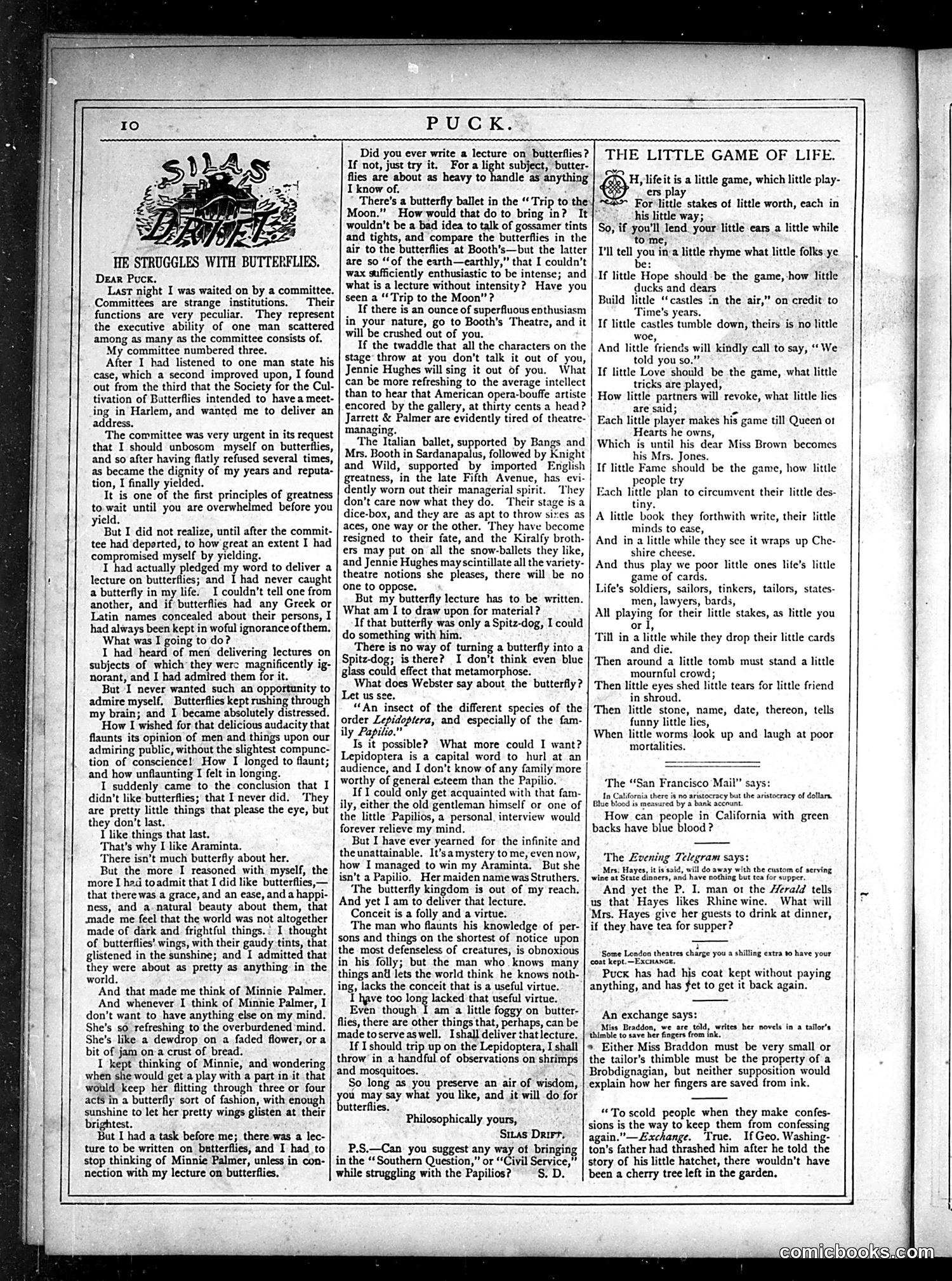
This page features a humorous essay by Silas Daff about being asked to deliver a lecture on butterflies. The author humorously resists, claiming butterflies are too light a subject and that he lacks enthusiasm for the topic. He jokes about various absurd alternatives—turning a butterfly into a Spitz-dog, getting acquainted with the Lepidoptera family—all to avoid the assignment. The satire targets the pretension of lecture circuits and speakers who accept engagements on subjects they know nothing about, while also poking fun at the author's own reluctance and ridiculous rationalizations. It's social commentary on 19th-century intellectual culture and the pressure to appear knowledgeable on any topic. The "Little Game of Life" poem on the right appears unrelated.
📄 Transcribed text from this page (OCR, searchable)
Machine-transcribed from the original scan — historical spelling and the odd misread are preserved.
HE STRUGGLES WITH BUTTERFLIES. Dear Puck. Last night I was waited on by a committee. Committees are strange institutions. Their functions are very peculiar. They represent the executive ability of one man scattered among as many as the committee consists of. My committee numbered three. After I had listened to one man state his case, which a second improved upon, I found out from the third that the Society for the Cul- tivation of Butterflies intended to havea meet- ing in Harlem, and wanted me to deliver an address. The committee was very urgent in its request that I should unbosom myself on butterflies, and so after having flatly refused several times, as became the dignity of my years and reputa- tion, I finally yielded. It is one of the first principles of greatness to.wait until you are overwhelmed before you eld. z But I did not realize, until after the commit- tee had deported, to how great an extent I had compromised myself by yielding. I had actually pledged my word to deliver a lecture on butterflies; and I had never caught a butterfly in my life. I couldn't tell one from another, and if butterflies had any Greek or Latin names concealed about their persons, I had always been kept in woful ignorance of them. What was I going to do? I had heard, of men delivering lectures on subjects of which’ they werc magnificently ig- norant, and I had admired them for it. But I never wanted such an opportunity to admire myself. Butterflies kept rushing through my brain; and I became absolutely distressed. How I wished for that delicious audacity that flaunts its opinion of men and things upon our admiring public, without the slightest compunc- tion of conscience!’ How I longed to flaunt; and how unflaunting I felt in longing. I suddenly came to the conclusion that I didn’t like butterflies; that I never did. They are pretty little things that please the eye, but they don’t last. T like things that last. ‘That's why I like Araminta. ‘There isn’t much butterfly about her. But the more I reasoned with myself, the more I had toadmit that I did like butterflies, — that there was a grace, and an ease, and a happi- ness, and a-natural beauty about them, that made me feel that the world was not altogether made of dark and frightful things.’ I thought of butterflies’ wings, with their gaudy tints, that glistened in the sunshine; and I admitted that they were about as pretty as anything in the world. And that made me think of Minnie Palmer. And whenever I think of Minnie Palmer, I don’t want to have anything else on my mind. She's 50 refreshing to the overburdened ‘mind. She's like a dewdrop on a faded flower, or a bit of jam on-a crust of bread. I kept thinking of Minnie, and wondering when she would get a play with a part in it that would keep her flitting through three or four acts in a butterfly sort of fashion, with enough sunshine to let her pretty wings glisten at their brightest. But I had a task before me; there was a lec- ture to be written on butterflies, and I had to stop thinking of Minnie Palmer, unless in con- PUCK. Did you ever write a lecture on utterfies? | THE LITTLE GAME OF LIFE. If not, just try it. Fora light subject, ‘butter- flies are about as heavy to handle as anything I know of. 5 There's a butterfly ballet in the “‘ Trip to the Moon.” wouldn’t be a bad idea to talk of gossamer tints and tights, and compare the butterflies in the air to the butterflies at Booth’s—but the latter are so ‘‘of the earth—earthly,” that I couldn’t wax sufficiently enthusiastic to be intense; and what is a lecture without intensity? Have you seen a “Trip to the Moon”? If there is an ounce of superfluous enthusiasm in your nature, go to Booth’s Theatre, and it will be crushed out of you. If the twaddle that all the characters on the stage throw at you don’t talk it out of you, Jennie Hughes will sing it out of you. What can be more refreshing to the average intellect than to hear that American opera-bouffe artiste encored by the gallery, at thirty cents a head? Jarrett & Palmer are evidently tired of theatre- managing. ‘The Italian ballet, supported by Bangs and Mrs. Booth in Sardanapalus, followed by Knight and Wild, supported by’ imported English greatness, in the late Fifth Avenue, has evi- dently worn out their managerial spirit. ‘They don’t care now what they do. ‘Their stage is a dice-box, and they are as apt to throw sizes as aces, one way or the other. They have become resigned to their fate, and the Kiralfy broth- ers may put on all the snow-ballets they like, and Jennie Hughes may scintillate all the variety. theatre notions she pleases, there will be no one to oppose. But my butterfly lecture has to be written. What am I to draw upon for material? If that butterfly was only a Spitz-dog, I could do something with him. There is no way of turning a butterfly into a Spitz-dog; is there? I don’t think even blue glass could effect that metamorphose. What does Webster say about the butterfly? Let us see. “An insect of the different species of the order Lepidoptera, and especially of the fam- ily Papilio.” Is it possible? What more could I want? Lepidoptera is a capital word to hurl at an audience, and I don’t know of any family more worthy of general esteem than the Papilio. If I could only get acquainted with that fam- ily, either the old gentleman himself or one of the little Papilios, a personal. interview would forever relieve my mind. But I have ever yearned for the infinite and theunattainable. It’samystery to me, even now, how I managed to win my Araminta. But she isn’t a Papilio. Her maiden name was Struthers. ‘The butterfly kingdom is out of my reach. And yet I am to deliver that lecture. Conceit is a folly and a virtue. The man who flaunts his knowledge of per- sons and things on the shortest of notice upon the most defenseless of creatures, is obnoxious in his folly; but the man who. knows many things and lets the world think he knows noth- ing, lacks the conceit that is a useful virtue. T have too long lacked that useful virtue. Even though I am a little foggy on butter- flies, there are other things that, perhaps, can be made toserve aswell. Ishall deliver thatlecture. If Ishould trip up on the Lepidoptera, I shall throw in a handful of observations on shrimps and mosquitoes. So long as you preserve an air of wisdom, you may say what you like, and it will do for utterflies. Philosophically yours, Sitas Drirr, P.S.—Can you suggest any way of bringing in the ‘Southern Question,” or “Civil Service,” while struggling with the Papilios? S. D. How would that do to bring in? It} ers play For little stakes of little worth, each in his little way; So, if you'll lend. your little ears a little while @" lifeit is a little game, which little play- to me, I'll tell you inva little rhyme what little folks ye. be: If little Hope should be the game, how little ducks and dears Build little ‘castles in the air,” on credit to Time's years. Tf little castles tumble down, theirs is no little woe, And little friends will kindly call to say, “We told you so.” If little Love should be the game, what little tricks are played, How little partners will revoke, what little lies are said; = Each little player makes his game till Queen ot Hearts he owns, Which is until his dear Miss Brown becomes his Mrs. Jones. If little Fame should be the game, how little people try Each little plan to circumvent their little des- tiny. A little book they forthwith write, their little minds to ease, And ina little while they sce it wraps up Che- shire cheese. And thus play we poor little ones life’s little game of cards. Life’s soldiers, sailors, tinkers, tailors, states- men, lawyers, bards, All playing for their little stakes, as little you or I, Till in a little while they drop their little cards and die. Then around a little tomb must stand a little mournful crowd; Then little eyes shed little tears for little friend in shroud. Then little stone, name, date, thereon, tells funny little lies, When little worms look up and laugh at poor mortalities. ‘The “San Francisco Mail” says: In California there is no aristocracy but the aristocracy of doll How can people in California with green backs have blue blood ? The Evening Telegram says: ‘Mrs: Hayes, it is sald, will do away with the custom of serving wine at Stace diners, and have othing but tea for supper. And yet the P. I. man or the Hera/d tells us that Hayes likes Rhine wine. What will ‘Mrs. Hayes give her guests to drink at dinner, if they have tea for supper? ‘Some London theatres charge you a shilling extra to have your coat kept. EXCHANGE. Puck has had his coat kept without paying anything, and has fet to get it back again. An exchange says: Miss Braddon, we are told thimble to save her fingers from fal ® Either Miss Braddon must be very small or the tailor’s thimble must be the property of a Brobdignagian, but neither supposition would explain how her fingers are saved from ink. sriites her novels in a tallor's “To scold people when they make confes- sions is the way to keep them from confessing again.”"—Exchange. True. If Geo. Washing- ton’s father had thrashed him after he told the story of his little hatchet, there wouldn’t have been a cherry tree left in the garden, nection with my lecture on butterflies.