
Puck, 1877-03 · page 12 of 16
Puck — March 1877 — page 12: what you’re looking at
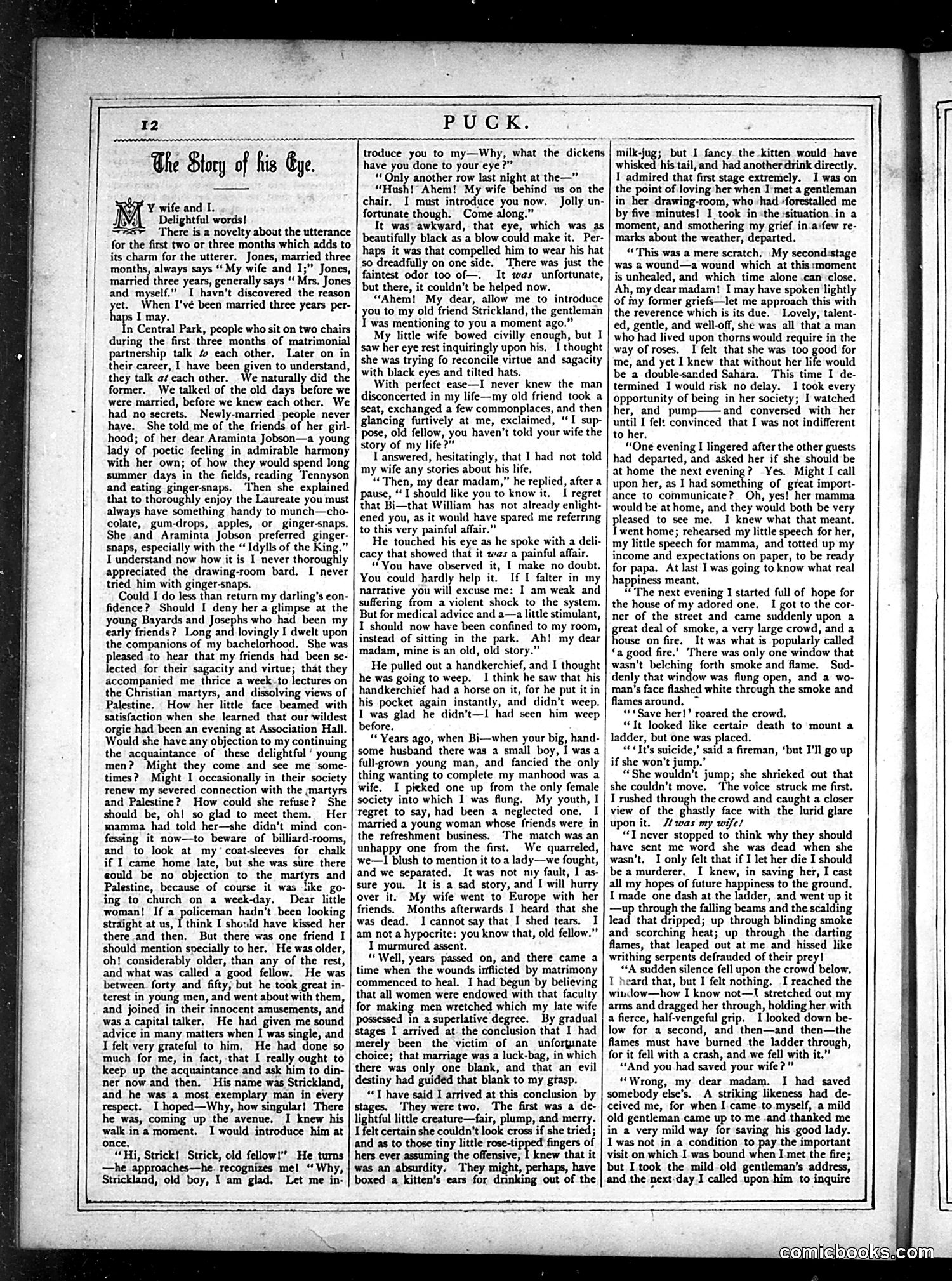
What you’re looking at
This page is entirely text—a short story titled "The Story of his Eye," not a political cartoon. The narrative concerns a gentleman narrator explaining to a friend named Strickland why his wife left him years ago after their marriage became unhappy. The story references a disfiguring eye injury the narrator received from his wife during an argument, which caused her to lose respect for him. The tale involves marital discord, separation, and the narrator's subsequent philosophical acceptance of their failed relationship. This appears to be humor-through-narrative rather than visual satire. Without visible illustrations, the comedy derives from the domestic melodrama and the narrator's attempts to rationalize his wife's departure to an acquaintance.
📄 Transcribed text from this page (OCR, searchable)
Machine-transcribed from the original scan — historical spelling and the odd misread are preserved.
12 PUCK. The Story of his Gye Y wife and I. J Delightful words! ‘There is a novelty about the utterance for the first two or three months which adds to its charm for the utterer. Jones, married three months, always says “ My wife and I;” Jones, married three years, generally says ‘‘ Mrs. Jones and myself.” I havn't discovered the reason yet. When I'vé been married three years per- ps I may. In Central Park, people who sit on two chairs during the first three months of matrimonial partnership talk fo each other. Later on in their career, I have been given to understand, they talk af each other. We naturally did the former. We talked of the old days before we were married, before we knew each other. We had no secrets. Newly-married people never have. She told me of the friends of her girl- hood; of her dear Araminta Jobson—a young Tady of poetic feeling in admirable harmony with her own; of how they would spend long summer days in the fields, reading Tennyson and eating gingersnaps. ‘Then she explained that to thoroughly enjoy the Laureate you must always have something handy to munch—cho- colate, gum-drops, apples, or ginger-snaps. She and’ Araminta Jobson preferred ginger- snaps, especially with the “Idylls of the King.” I understand now how it is 1 never thoroughly appreciated the drawing-room bard. I never tried him with ginger-snaps. Could I do less than return my darling’s eon- fidence? Should I deny her a glimpse at the young Bayards and Josephs who had been my early friends? Long and lovingly I dwelt upon the companions of my bachelorhood. She was leased to hear that my friends had been se- lected for their sagacity and virtue; that they accompanied me thrice a week.to lectures on the Christian martyrs, and dissolving views of Palestine. How her little face beamed with satisfaction when she learned that our wildest orgie had been an evening at Association Hall. Would she have any objection to my continuing the acquaintance of these delightful ‘ young men? Might they come and see me some- times? Might I occasionally in their society renew my severed connection with the martyrs and Palestine? How could she refuse? She should be, oh! so glad to meet them. Her mamma had told her—she didn’t mind con- fessing it now—to beware of billiard-rooms, and to look at my coat-sleeves for chalk if I came home late, but she was sure there gould be no objection to the martyrs and Palestine, because of course it was like go- ing to church on a week-day. Dear little woman! If a policeman hadn't been looking straight at us, I think I should have kissed her there and then. But there was one friend 1 should mention specially to her. He was older, oh! considerably older, than any of the rest, and what was called a good fellow. He was between forty and fifty, but he took great in- terest in young men, and went about with them, and joined in their innocent amusements, and was a capital talker. He had given me sound advice in many matters when I was single, and I felt very grateful to him. He had done so much for me, in fact,-that I really ought to keep up the acquaintance and ask him to din- ner now and then. His name was Strickland, and he was a most exemplary man in every respect. I hoped—Why, how singular! There he was, coming up the avenue. I knew his walk ina moment. I would introduce him at once, “Hi, Strick! Strick, old fellow!” He turns —he approaches—he. recognizes me! “Why, Strickland, old boy, I am glad. Let me in- troduce you to my—Why, what the dickens have you done to your eye?” “Only another row last ight at the—” “Hush! Ahem! My wife behind us on the chair. I must introduce you now. Jolly un- fortunate though. Come along.” It was: awkward, that eye, which was as beautifully black as a blow could make it. Per- haps it was that compelled him to wear his hat so dreadfully on one side. There was just the faintest odor too of—. It was unfortunate, but there, it couldn’t be helped now. “Ahem! My dear, allow me to introduce you to my old friend Strickland, the gentleman was mentioning to you a moment ago.” My little wife bowed civilly enough, but I saw her eye rest inquiringly upon his. I thought she was trying fo reconcile virtue and sagacity with black eyes and tilted hats. With perfect ease—I never knew the man disconcerted in my life—my old friend took a seat, exchanged a few commonplaces, and then glancing furtively at me, exclaimed, “1 sup- pose, old fellow, you haven't told your wife the story of my life?” lL answered, hesitatingly, that I had not told my wife any stories about his life. “Then, my dear madam,” he replied, after a pause, “I’should like you to know it. I regret that Bi—that William’ has not already enlight- ened you, as it would have spared me referring to this very painful affair.” He touched his eye as he spoke with a deli- cacy that showed that it was a painful affair. “You have observed it, I make no doubt. You could hardly help it. If I falter in my narrative you will excuse me: I am weak and suffering from a violent shock to the system. But for medical advice and a—a little stimulant, I should now have been confined to my room, instead of sitting in the park. Ah! my dear madam, mine is an old, old story.” He pulled out a handkerchief, and I thought he was going to weep. I think he saw that his handkerchief had a horse on it, for he put it in his pocket again instantly, and didn’t weep. I was glad he didn't—I had seen him weep before. “Years ago, when Bi—when your big, hand- some husband there was a small boy, I was a full-grown young man, and fancied the only thing wanting to complete my manhood was a wife. I pieked one up from the only female society into which I was flung. My youth, I regret to say, had been a neglected one. I married a young woman whose friends were in the refreshment business. The match was an unhappy one from the first. We quarreled, we—I blush to mention it to a lady—we fought, and we separated. It was not my fault, I as- sure you. It is a sad story, and I will hurry over it. My wife went to Europe with her friends. Months afterwards I heard that she was dead. 1 cannot say that I shed tears. I am not a hypocrite: you know that, old fellow.”” I murmured assent. “Well, years passed on, and there came a time when the wounds inflicted by matrimony commenced to heal. I had begun by believing that all women were endowed with that faculty for making men wretched which my late wife in a superlative degree. By gradual stages 1 arrived at the conclusion that I had merely been the victim of an unforyinate choice; that marriage was a luck-bag, in which there was only one blank, and that an evil destiny had guided that blank to my grasp. “T have said I arrived at this conclusion by stages. ‘They were two, The first was a de- lightful little creature—fair, plump, and merry. I felt certain she couldn't look cross if she tried; and as to those tiny little rose-ti; fingers of hers ever assuming the offensive, I knew that it was an absurdity, They might, perhaps, have boxed a kitten’s ears for drinking out of the milk-jug; but 1 fancy the_kitten would have whisked his tail, and had another drink directly. 1 admired that first stage extremely. I was on the point of loving her when I'met a gentleman in her drawing-room, who ‘had :forestalled me by five minutes! I took in:the:situation in a moment, and smothering my grief in.a‘few re- marks about the weather, departed. “This was a mere scratch. My second:stage was a wound—a wound which at this:moment is unhealed, and which time alone .can’ close. Ah, my dear madam! I may have spoken lightly of iny former griefs—let me approach this with the reverence which is its due. Lovely, talent- ed, gentle, and well-off, she was all that a man who had lived upon thorns would require in the way of roses. I felt that she was too good for me, and yet I knew that without her life would be a double-sanded Sahara. This time I de- termined I would risk no delay. I took every opportunity of being in her society; I watched her, and pump—and conversed with her until I felt convinced that I was not indifferent to her. “One evening I lingered after the other guests had departed, and asked her if she should be at home the next evening? Yes. Might I call upon her, as I had something of great import- ance to communicate? Oh, yes! her mamma would be at home, and they would both be very leased to see me. I knew what that meant. went home; rehearsed my little speech for her, my little speech for mamma, and totted up my income and expectations on paper, to be ready for papa. At last I was going to know what real happiness meant, “The next evening I started full of hope for the house of my adored one. I got to the cor- ner of the street and came suddenly upon a reat deal of smoke, a very large crowd, and a jouse on fire. It was what is popularly called ‘a good fire.’ ‘There was only one window that wasn't belching forth smoke and flame. Sud- denly that window was flung open, and a wo- man's face flashed white through the smoke and flames around, ~ “*Save her!’ roared the crowd. “It looked like certair death to mount a ladder, but one was placed. “ «It's suicide,’ said a fireman, ‘but I'll go up if she won't jump.’ “She wouldn’t jump; she shrieked out that she couldn't move. ‘The voice struck me first. I rushed through the crowd and caught a closer view of the ghastly face with the lurid glare upon it. Jtwas my wife! “I never stopped to think why they should have sent me word she was dead when she wasn’t. I only felt that if I let her die I should be a murderer, I knew, in saving her, I cast all my hopes of future happiness to the ground. I made one dash at the ladder, and went up it —up through the falling beams and the scalding lead that dripped; up through blinding smoke and scorching heat; up through the darting flames, that leaped out at me and hissed like writhing serpents defrauded of their prey! “A sudden silence fell upon the crowd below. T heard that, but I felt nothing. I reached the witclow—how I know not—I stretched out my arms and dragged her through, holding her with a fierce, half-vengeful grip. 1 looked down be- low for a second, and then—and then—the flames must have burned the ladder through, for it fell with a crash, and we fell with it.” “And you had saved your wife?” “Wrong, my dear madam. I had saved somebody else’s, A striking likeness had de- ceived me, for when I.came to.myself, a mild old gentleman came up to me .and.thanked me in a very mild way for saving his good lady. 1 was not in a condition to pay the important visit on which I was bound when I.met the fire; but I took the mild old gentleman’s address, and the next-day J called upon him to inquire