
Puck, 1877-03 · page 4 of 16
Puck — March 1877 — page 4: what you’re looking at
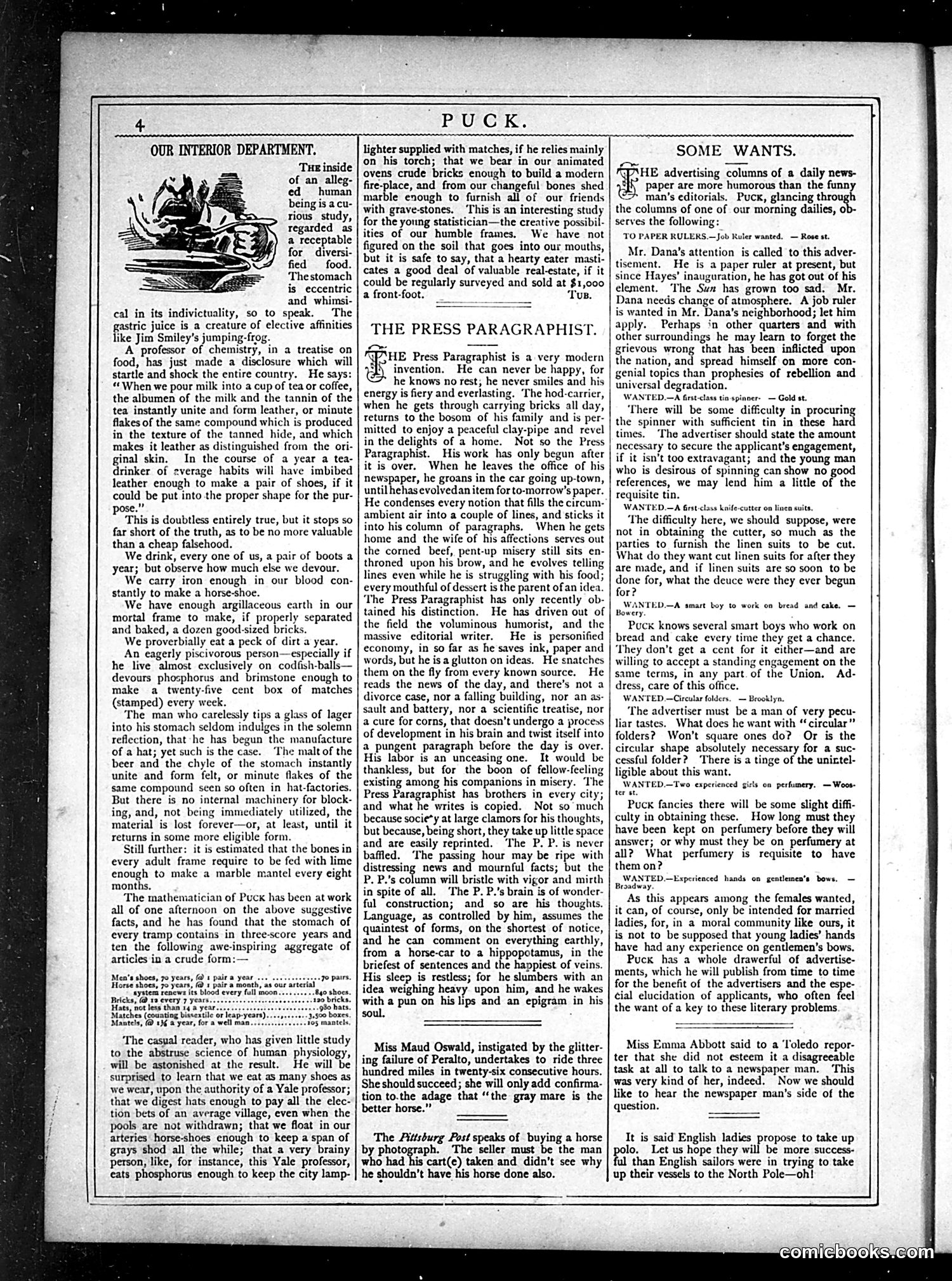
What you’re looking at
This page is primarily **text-based content** rather than political cartoons. The main sections include: 1. **"Our Interior Department"** - A humorous essay about domestic life and household economics, using exaggerated scientific language to describe cooking and household management as if it were chemistry. 2. **"The Press Paragraphist"** - A satirical piece mocking newspaper columnists who churn out brief, disconnected witticisms and observations, portraying them as lazy writers who recycle ideas without genuine insight. 3. **"Some Wants"** - A collection of short, comedic want ads and social commentary on various topics including newspaper criticism and labor. The small illustration at the top shows domestic kitchen items. The satire targets **Victorian-era journalism practices** and **household management pretension** rather than specific political figures or events.
📄 Transcribed text from this page (OCR, searchable)
Machine-transcribed from the original scan — historical spelling and the odd misread are preserved.
4 PUCK. OUR INTERIOR DEPARTMENT. Tue inside being is acu- rious study, regarded as a receptable for diversi- fied food. Thestomach is eccentric and whimsi- cal in its indivictuality, so to speak. The gastric juice is a creature of elective affinities like Jim Smiley's jumping-frog. A professor of chemistry, in a treatise on food, has just made a disclosure which will startle and shock the entire country. He says: “When we pour milk into a cup of tea or coffee, the albumen of the milk and the tannin of the tea instantly unite and form leather, or minute flakes of the same compound which is produced in the texture of the tanned hide, and which makes it leather as distinguished from the ori- ginal skin. In the course of a year a tea- drinker of everage habits will have imbibed leather enough to make a pair of shoes, if it could be put into the proper shape for the pur- This is doubtless entirely true, but it stops so far short of the truth, as to be no more valuable than a cheap falsehood. We drink, every one of us, a pair of boots a year; but observe how much else we devour. We carry iron enough in our blood con- stantly to make a horse-shoe. We have enough argillaceous earth in our mortal frame to make, if properly separated and baked, a dozen good-sized bricks. We proverbially eat a peck of dirt a year. An eagerly piscivorous person—especially if he live almost exclusively on codfish-balls— devours phosphorus and brimstone enough to make a twenty-five cent box of matches (stamped) every week. The man who carelessly tips a glass of lager into his stomach seldom indulges in the solemn. reflection, that he has begun the manufacture of a hat; yet such is the case. ‘The malt of the beer and the chyle of the stomach instantly unite and form felt, or minute flakes of the same compound seen so often in hat-factories. But there is no internal machinery for block- ing, and, not being immediately utilized, the material is lost forever—or, at least, until it returns in some more eligible form. Still further: it is estimated that the bones in every adult frame require to be fed with lime enough to make a marble mantel every eight months. The mathematician of Puck has been at work all of one afternoon on the above suggestive facts, and he has found that the stomach of every tramp contains in three-score years and ten the following awe-inspiring aggregate of articles in a crude form:— Men's shoes, 7o years, @ 1 paira year .. Horse shoes, yo years, (@ 1 pair a month, systers renews its blood every full moo Biicks, (a 19 every 7 years. Hats, not less than 14/8 year Matches (counting biseatile Mantels, (@ 136 a year, for a well ma ‘The casual reader, who has given little study to the abstruse science of human physiology, will be astonished at the result. He will be surprised to learn that we eat as many shoes as ‘we wear, upon the authority of a Yale professor; that we digest hats enough to pay all the elec- tion bets of an average village, even when the pools are not withdrawn; that we float in our arteries horse-shoes enough to keep a span of gtays shod all the while; that a very brainy person, like, for instance, this Yale professor, eats phosphorus enough to keep the city lamp- lighter supplied with matches, if he relies mainly on his torch; that we bear in our animated ovens crude bricks enough to build a modern fire-place, and from our changeful bones shed marble enough to furnish all of our friends with grave-stones. ‘This is an interesting study for the young statistician—the creative possibil- ities of our humble frames. We have not figured on the soil that goes into our mouths, but it is safe to say, that a hearty eater masti- cates a good deal of valuable real-estate, if it could be regularly surveyed and sold at $1,000 a front-foot. Tus. THE PRESS PARAGRAPHIST. pee pete SPSHE Press Paragraphist is a very modern 3) invention. He can never be happy, for he knows no rest; he never smiles and his energy is fiery and everlasting. ‘The hod-carrier, when he gets through carrying bricks all day, returns to the bosom of his family and is per- mitted to enjoy a peaceful clay-pipe and revel in the delights of a home. Not so the Press Paragraphist. His work has only begun after it is over. When he leaves the office of his newspaper, he groans in the car going up-town, until hehas evolvedan item for to-morrow’s paper. He condenses every notion that fills the circum- ambient air into a couple of lines, and sticks it into his column of paragraphs. When he gets home and the wife of his affections serves out the corned beef, pent-up misery still sits en- throned upon his brow, and he evolves telling lines even while he is struggling with his food; every mouthful of dessert is the parent ofan idea. ‘The Press Paragraphist has only recently ob- tained his distinction. He has driven out of the field the voluminous humorist, and the massive editorial writer. He is personified economy, in so far as he saves ink, paper and words, but he is a glutton on ideas. He snatches them on the fly from every known source. He reads the news of the day, and there’s not a divorce case, nor a falling building, nor an as sault and battery, nor a scientific treatise, nor a cure for corns, that doesn’t undergo a process of development in his brain and twist itself into a pungent paragraph before the day is over. His labor is an unceasing one. It would be thankless, but for the boon of fellow-feeling existing among his companions in misery. ‘The Press Paragraphist has brothers in every city; and what he writes is copied. Not so’ much because socie*y at large clamors for his thoughts, but because, being short, they take up little space and are easily reprinted. ‘The P. P. is never baffled. The passing hour may be ripe with distressing news and mournful facts; but the P. P.’s column will bristle with vigor and mirth in spite of all. The P. P.’s brain is of wonder- ful construction; and so are his thoughts. Language, as controlled by him, assumes the quaintest of forms, on the shortest of notice, and he can comment on everything earthly, from a horse-car to a hippopotamns, in the briefest of sentences and the happiest of veins. His sleep is restless; for he slumbers with an idea weighing heavy upon him, and he wakes with a pun on his lips and an epigram in his soul. Miss Maud Oswald, instigated by the glitter- ing failure of Peralto, undertakes to ride three hundred miles in twenty-six consecutive hours. She should succeed; she will only add confirma- tion to.the adage that ‘the gray mare is the better horse.” The Pittsburg Post speaks of buying a horse by photograph. The seller must be the man who had his cart(e) taken and didn’t see why he shouldn't have his horse done also. SOME WANTS. Pas = y HE advertising columns of a daily news- paper are more humorous than the funn man’s editorials. Puck, glancing throu; the columns of one of our morning dailies, o| serves the following: ‘TO PAPER RULERS.—Job Ruler wanted, — Rove st. Mr. Dana's attention is called to this adver- tisement. He is a paper ruler at present, but since Hayes’ inauguration, he has got out of his element. ‘The Sun has grown too sad. Mr. Dana needs change of atmosphere. A job ruler is wanted in Mr. Dana’s neighborhood; let him apply. Perhaps in other quarters and with other surroundings he may learn to forget the grievous wrong that has been inflicted upon the nation, and spread himself on more con- genial topics than prophesies of rebellion and universal degradation. WANTED.—A first-class tin spinoer- — Gold st. ‘There will be some difficulty in procurin, the spinner with sufficient tin in these har times. The advertiser should state the amount necessary to secure the applicant’s engagement, if it isn’t too extravagant; and the young man who is desirous of spinning can show no good references, we may lend him a little of the ED.—A Grit-class koife-cutter on linen suits, difficulty here, we should suppose, were not in obtaining the cutter, so much as the parties to furnish the linen suits to be cut. What do they want cut linen suits for after they are made, and if linen suits are so soon to be done for, what the deuce were they ever begun for? WANTED.—A smart boy to work on bread and cake. — Bowery Puck knows several smart boys who work on bread and cake every time they get a chance. ‘They don't get a cent for it either—and are willing to accept a standing engagement on the same terms, in any part.of the Union. Ad- dress, care of this office. WANTED.—Circular folders. — Brooklyn. ‘The advertiser must be a man of very pecu- liar tastes. What does he want with “circular” folders? Won't square ones do? Or is the circular shape absolutely necessary for a suc- cessful folder? There is a tinge of the unirtel- ligible about this want. WANTED.—Two experienced gists on perfumery. —Woos- ter st. Puck fancies there will be some slight diffi- culty in obtaining these. How long must they have been kept on perfumery before they will answer; or why must they be on perfumery at all? What perfumery is requisite to have them on? WANTED.—Experienced hands on gentlemen's bows, — Broadway. As this appears among the females wanted, it can, of course, only be intended for married ladies, for, in a moral community like ours, it is not to be supposed that young ladies’ hands have had any experience on gentlemen's bows. Puck has a whole drawerful of advertise- ments, which he will publish from time to time for the benefit of the advertisers and the espe- cial elucidation of applicants, who often feel the want of a key to these literary problems. Miss Emma Abbott said to a ‘Toledo repor- ter that she did not esteem it a disagreeable task at all to talk to a newspaper man. This was very kind of her, indeed. Now we should like to hear the newspaper man’s side of the question. It is said English ladies propose to take up Jo, Let us hope they will be more success- fal than English sailors were in trying to take up their vessels to the North Pole—oh!