
A complete issue · 42 pages · 1927
Doctoral Thesis Cover Page
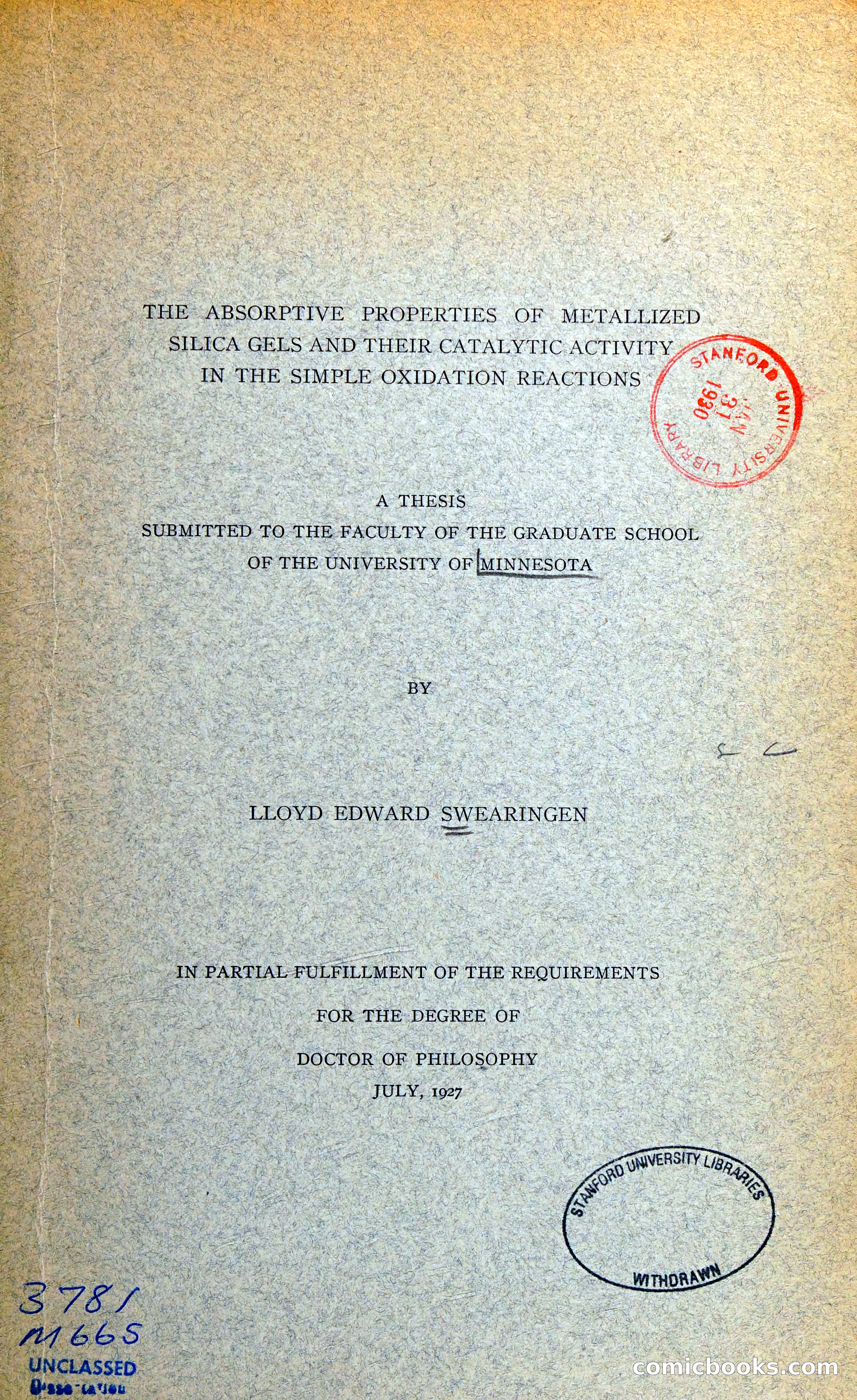
This is a title page of a scholarly thesis, not a Victorian penny dreadful. The document, submitted to the University of Minnesota's Graduate School in July 1927, concerns "The Absorptive Properties of Metallized Silica Gels and Their Catalytic Activity in the Simple Oxidation Reactions" by Lloyd Edward Swearingen, submitted for a Doctor of Philosophy degree. Library stamps indicate it was held at Stanford University and has since been withdrawn from their collection. This is academic chemistry research, not popular entertainment literature.

This appears to be a title or cover page rather than running prose or an illustration. The page features a simple architectural drawing of a classical building with four columns and a triangular pediment, rendered in muted tones against a yellowed background. The OCR text is heavily corrupted and largely illegible, making it impossible to determine the actual title or subject matter of this penny dreadful from the text alone. The Internet Archive digitization notice and URL are the only clearly readable modern elements overlaid on the page.
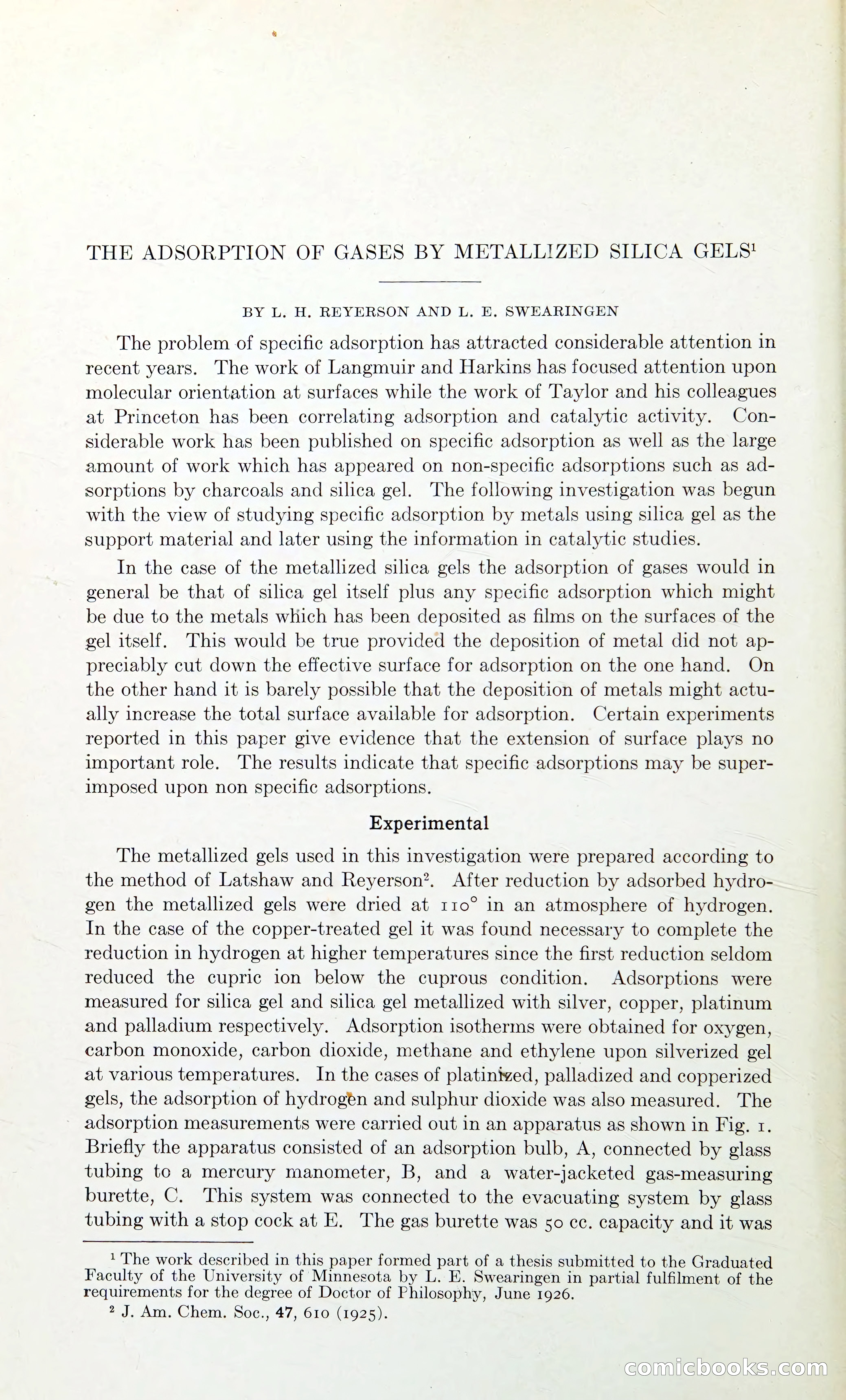
This is a running prose page—specifically, the opening of a scientific research paper, not a Victorian penny dreadful. The page contains the title "The Adsorption of Gases by Metallized Silica Gels" by L. H. Reyerson and L. E. Swearingen, followed by an introduction discussing previous work on molecular adsorption by researchers like Langmuir and Taylor, then an "Experimental" section describing the materials and apparatus used in their investigation of how metal-coated silica gels absorb various gases.
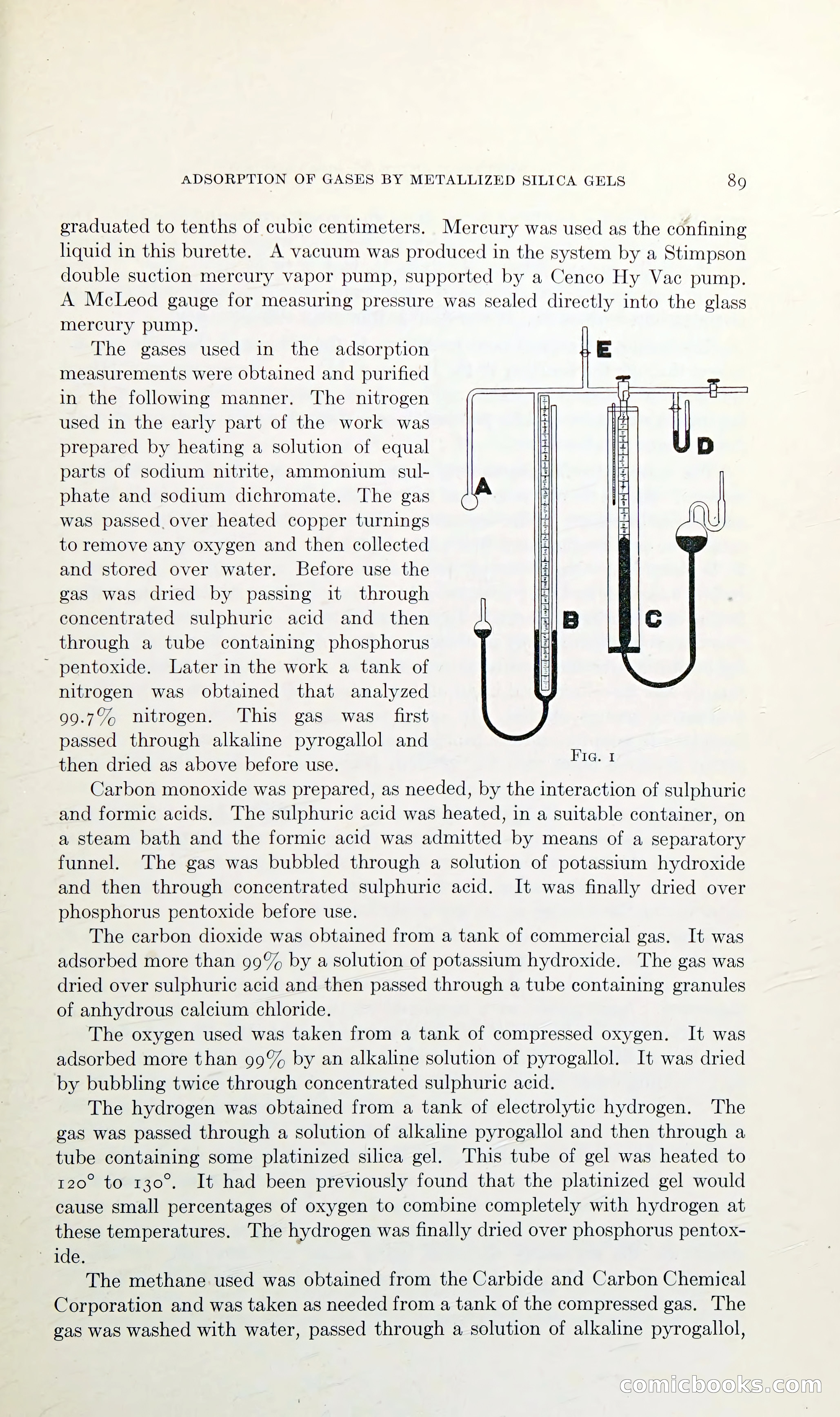
This is a page of technical prose from a scientific paper, not a Victorian penny dreadful. The text describes laboratory procedures for purifying various gases—nitrogen, carbon monoxide, carbon dioxide, oxygen, hydrogen, and methane—used in adsorption experiments with metallized silica gels. It includes a simple diagram (labeled "Fig. 1") showing laboratory apparatus with labeled components (A through E). The page is numbered 89 and appears to be from a chemistry or physics journal or academic publication, not popular fiction.
This is a page of running scientific prose, not a penny dreadful. The text describes experimental methodology for measuring gas adsorption, authored by L. H. Reyerson and L. E. Swearingen. It details the preparation and purification of gases (ethylene and helium), the setup of laboratory apparatus including an adsorption bulb and oil bath, and the procedure for conducting adsorption measurements at various temperatures ranging from 0° to 218°. The page includes a footnote citation to the *Journal of the American Chemical Society* (1921), confirming this is a scientific research paper, likely from an academic journal or chemistry publication.
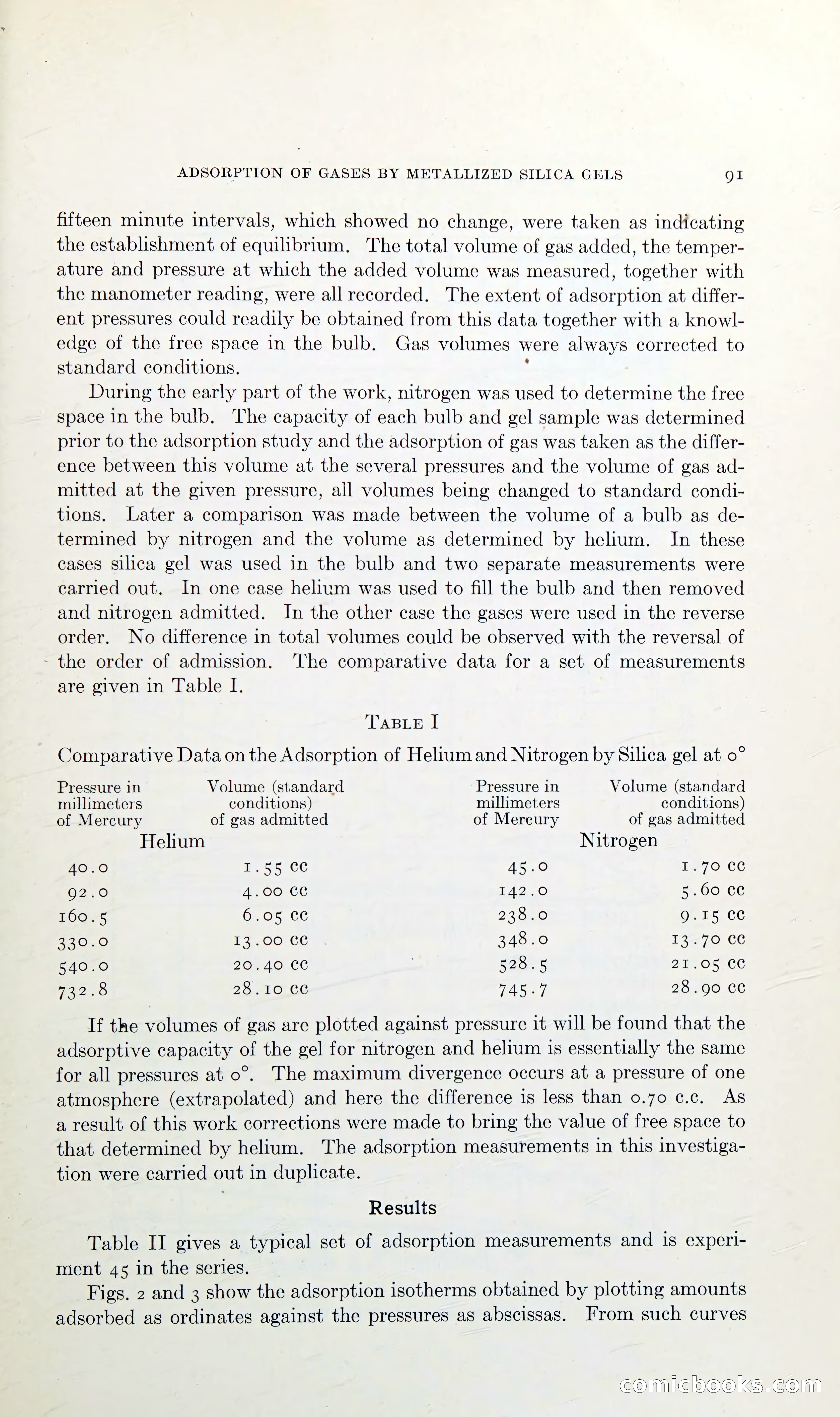
This is a page of running prose from a scientific research paper, not a Victorian penny dreadful. The text describes experimental methodology for measuring gas adsorption on silica gels, including detailed procedures for determining free space in laboratory equipment using nitrogen and helium, comparative data presented in a table, and initial results. The page appears to be numbered 91 and discusses how different gases behave similarly when adsorbed at various pressures.
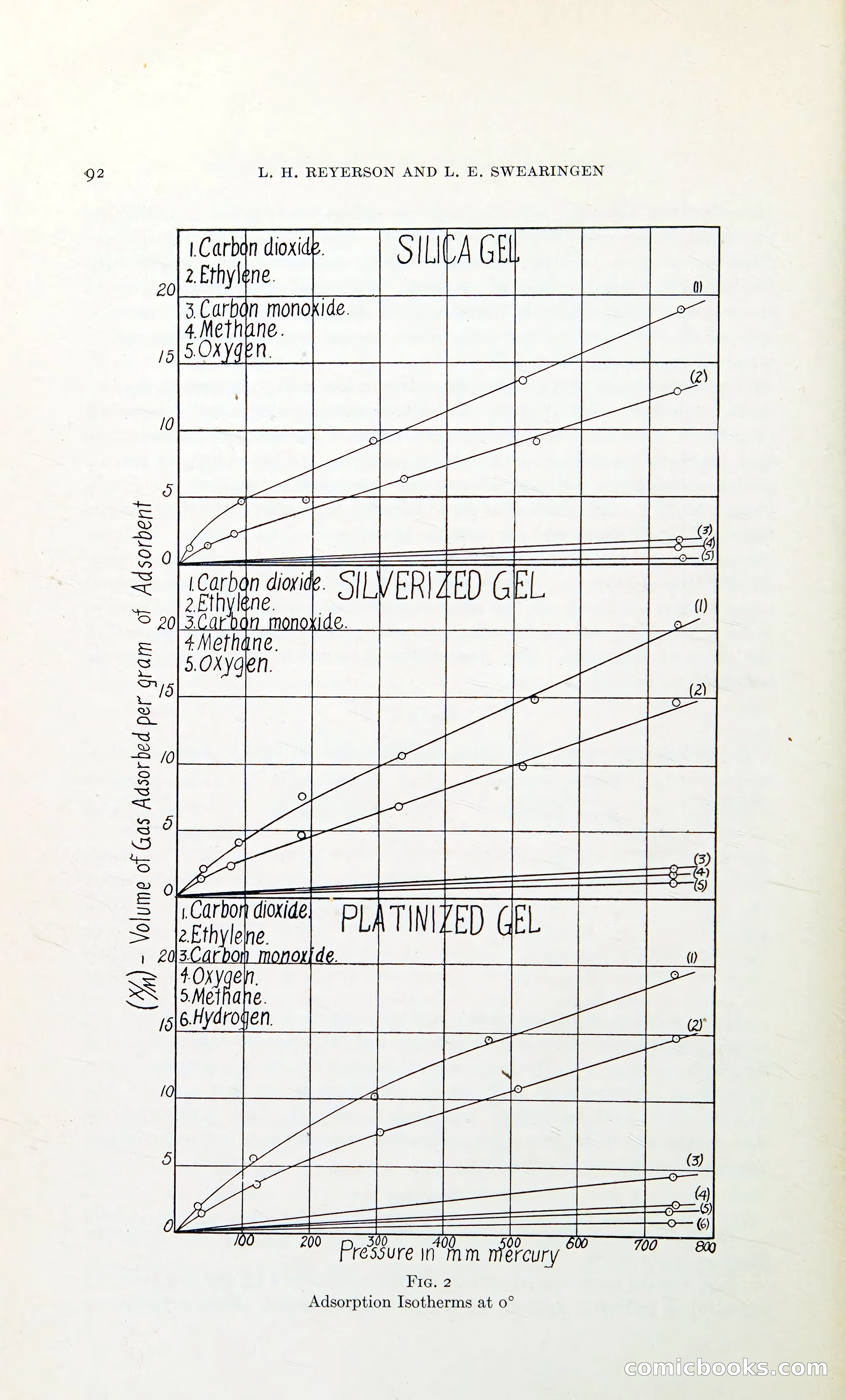
This page is a scientific chart, not penny dreadful fiction. It displays three graphs titled "Adsorption Isotherms at 0°" by L. H. Reyerson and L. E. Swearingen, showing the volume of gas absorbed per gram of adsorbent (measured in ml) against pressure in mm mercury for three different gel types: silica gel, silverized gel, and platinized gel. Each gel type tests the adsorption of five different gases (carbon dioxide, ethylene, carbon monoxide, methane, and oxygen, with hydrogen tested for platinized gel).
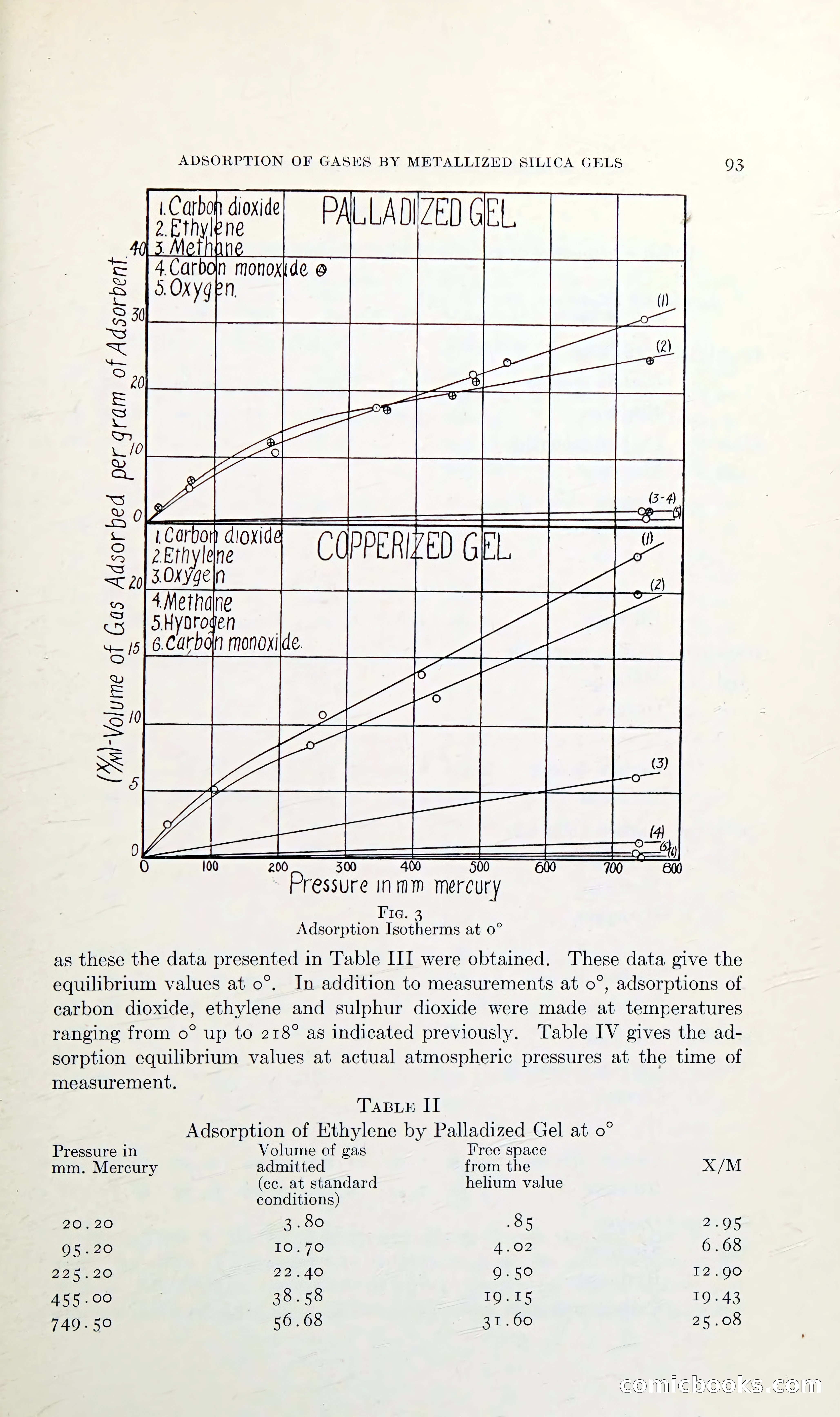
# Content Analysis This page is **scientific text with accompanying figures and data tables**, not a Victorian penny dreadful. It appears to be from a chemistry or materials science journal article titled "Adsorption of Gases by Metallized Silica Gels." The page contains Figure 3, which displays two graphs showing adsorption isotherms (at 0 degrees Celsius) for palladized and copperized gels with various gases, and Table II presenting specific experimental data on ethylene adsorption by palladized gel at different pressure levels, measuring gas volume admitted and the X/M ratio.
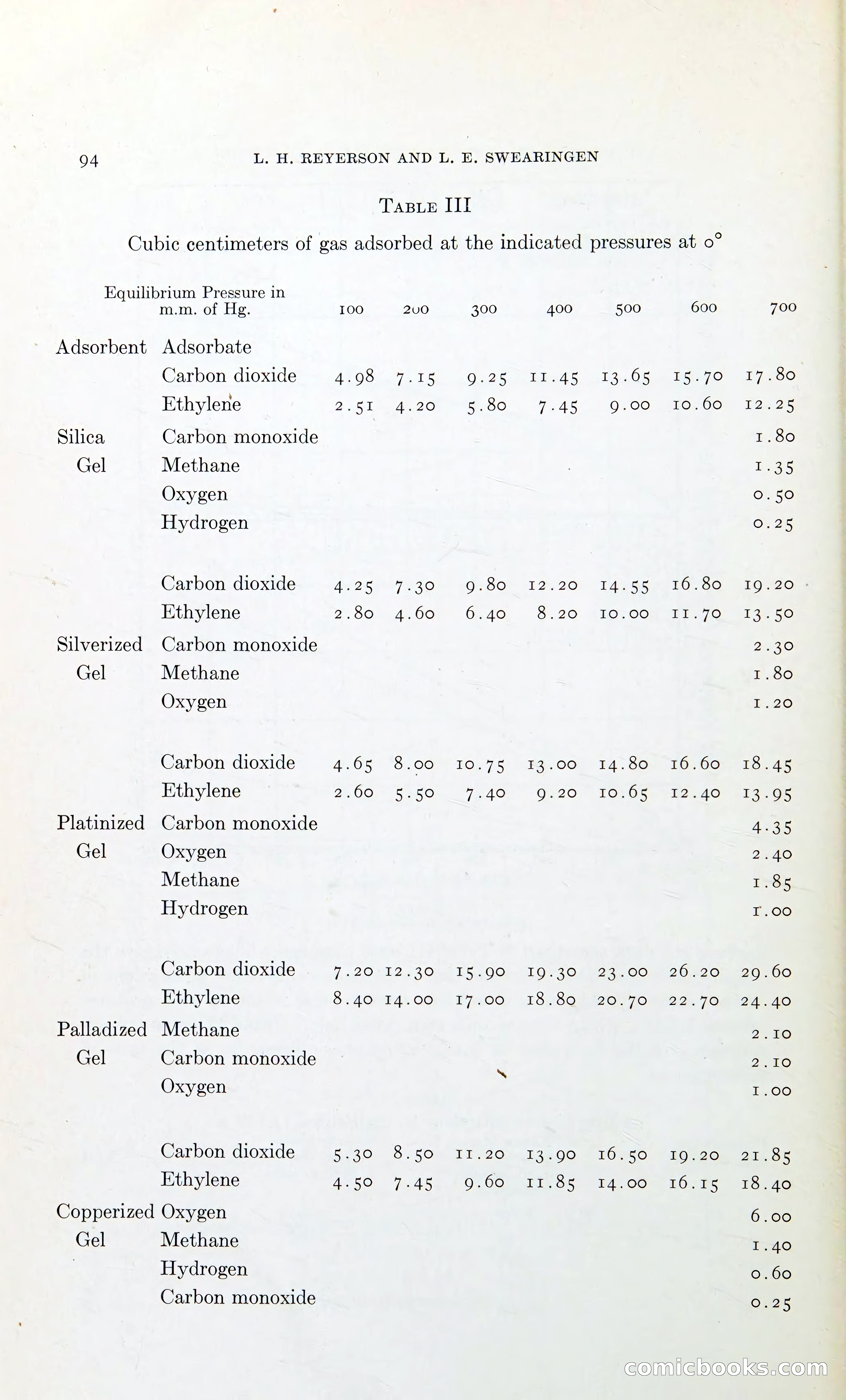
This is a scientific data table, not a Victorian penny dreadful. **Table III** presents measurements of gas adsorption at various pressures (100-700 m.m. of mercury at 0°C), organized by different adsorbent materials (silica gel, silverized gel, platinized gel, palladized gel, and copperized gel) and various adsorbate gases (carbon dioxide, ethylene, carbon monoxide, methane, oxygen, and hydrogen). The table displays cubic centimeters of gas adsorbed under each condition. This appears to be from a scientific or technical publication by L. H. Reyerson and L. E. Swearingen documenting experimental chemistry results.
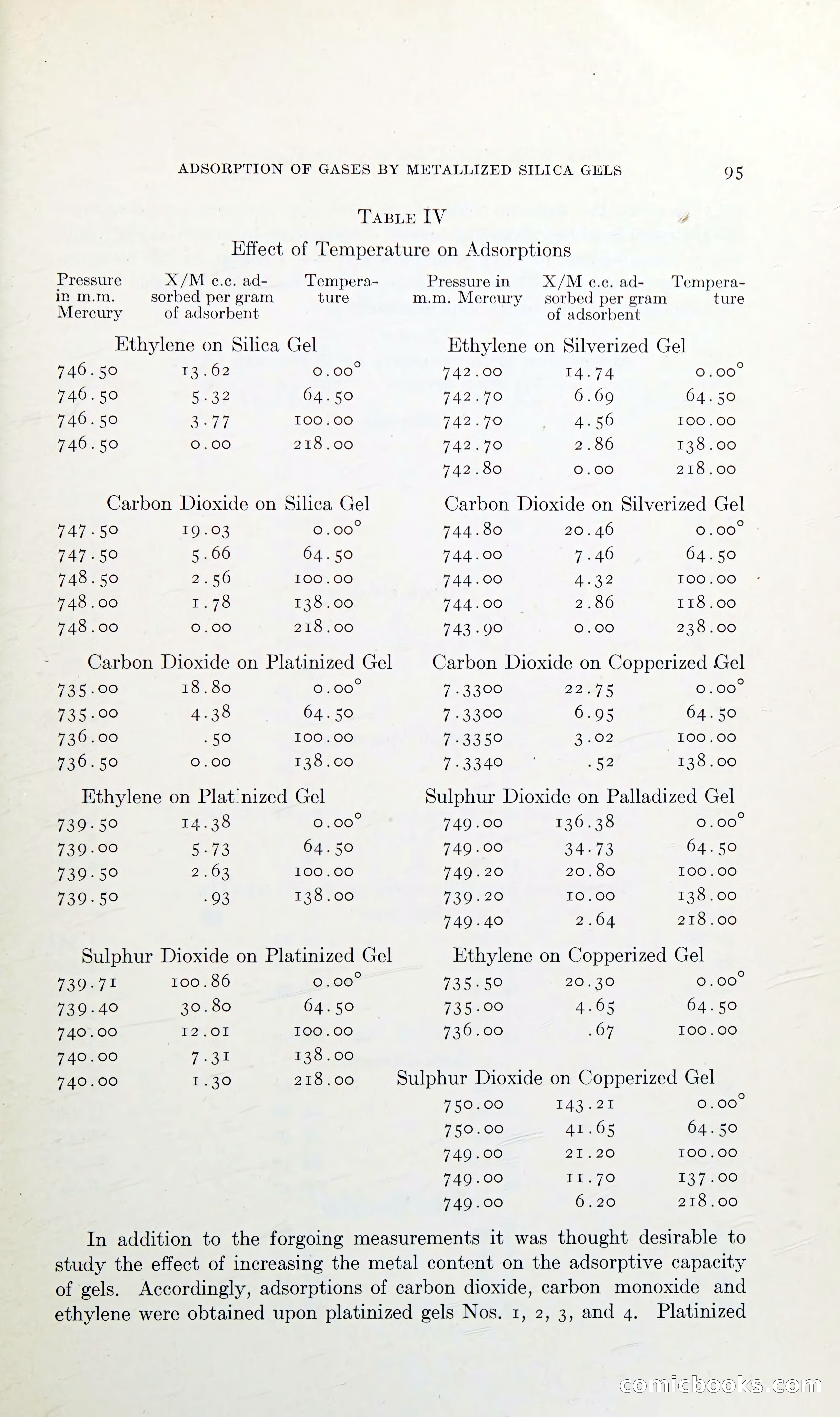
# Page Analysis This is a data table page from a scientific text, not a Victorian penny dreadful. The page presents **Table IV**, titled "Effect of Temperature on Adsorptions," containing experimental measurements of gas adsorption on various metallized silica gels at different temperatures and pressures. The data records how much ethylene, carbon dioxide, and sulphur dioxide are absorbed per gram of different gel types (silica, silverized, platinized, copperized, and palladized) across temperature ranges from approximately 0°C to 218°C. A brief paragraph at the bottom introduces planned experiments using platinized gels with varying metal content.
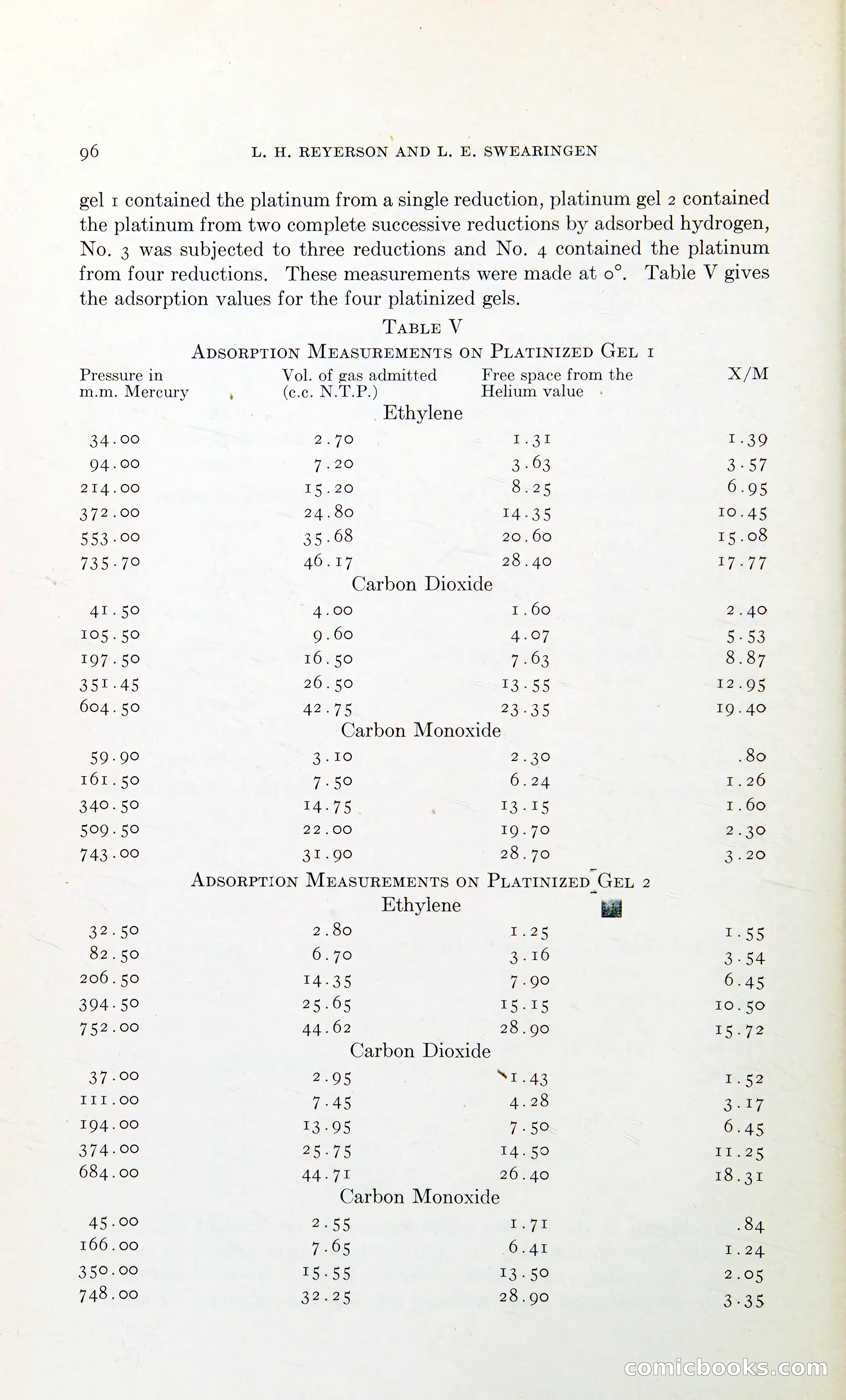
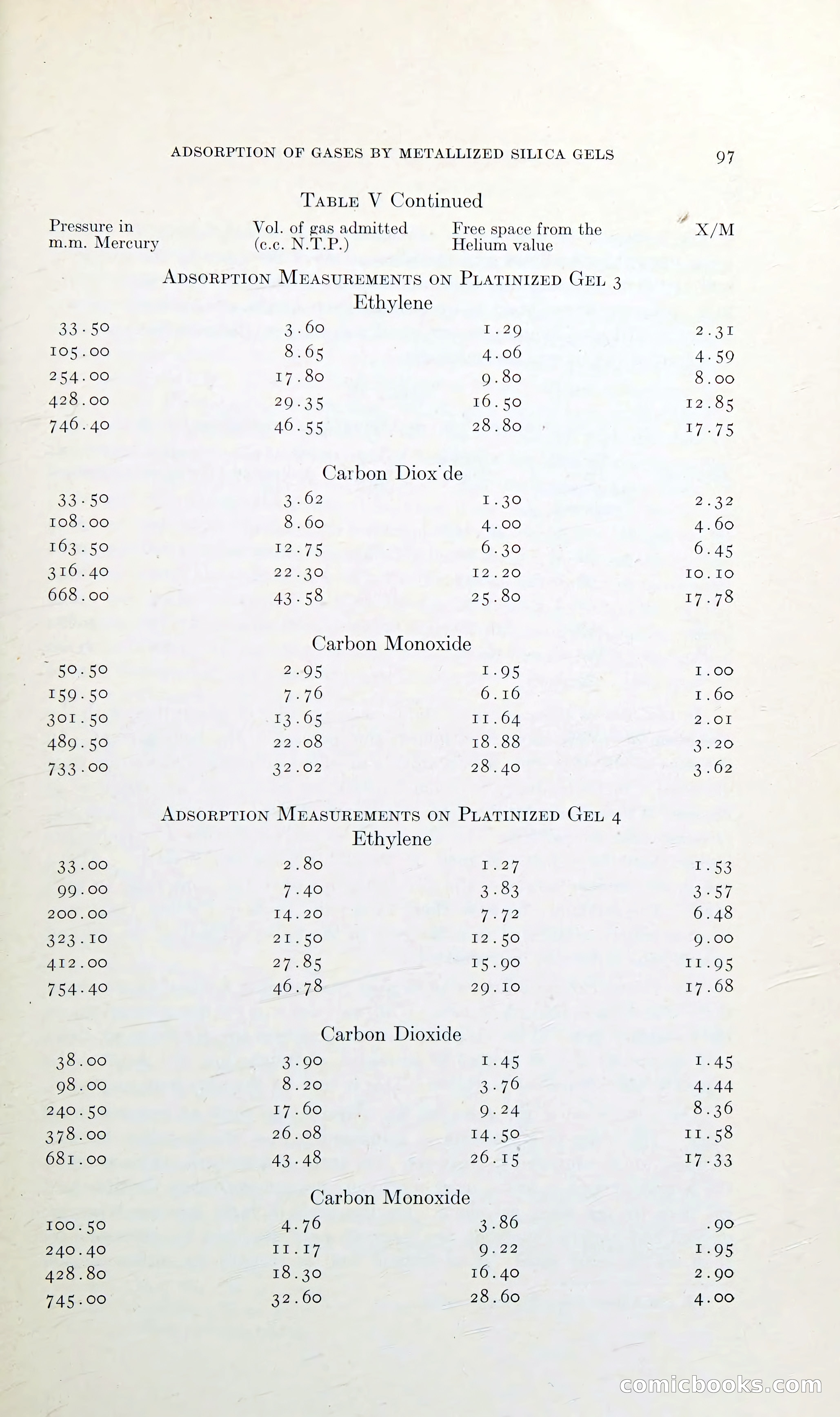
This is a scientific data page, not a penny dreadful. It contains two tables (Table V and an unnumbered table) presenting laboratory measurements of gas adsorption on platinized gels conducted by L. H. Reyerson and L. E. Swearingen. The tables record adsorption values for ethylene, carbon dioxide, and carbon monoxide at various pressures, with columns showing pressure in millimeters of mercury, volume of gas admitted, free space measurements, and X/M ratios. The gels tested had undergone different numbers of reduction cycles.
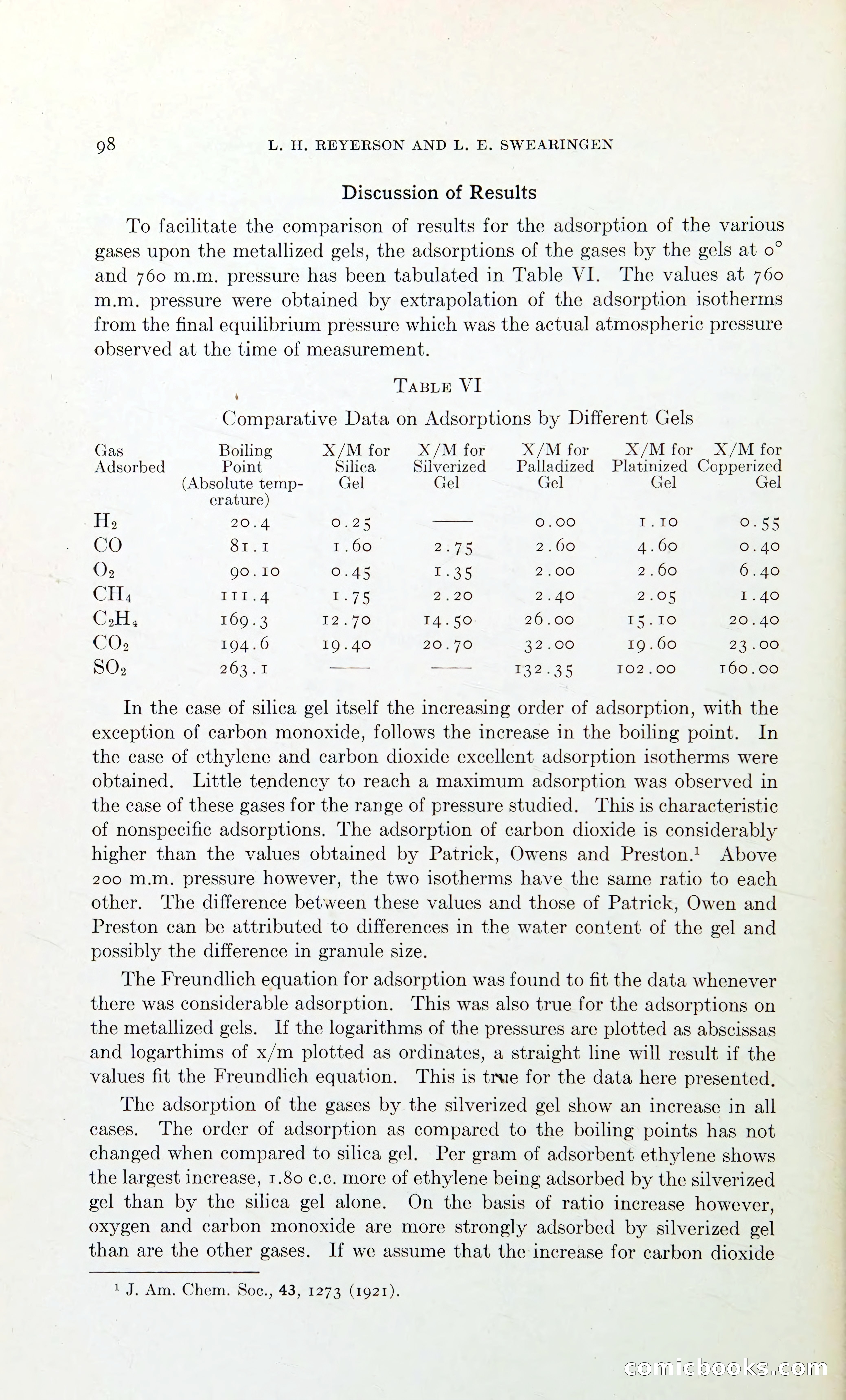
# This Page Contains Scientific Research, Not Victorian Penny Dreadful Fiction This is a page of academic scientific writing—specifically, a chemistry research paper discussing experimental results on gas adsorption by metallized gels. The page includes a "Discussion of Results" section and a data table (Table VI) comparing how different gases (hydrogen, carbon monoxide, oxygen, methane, ethylene, carbon dioxide, and sulfur dioxide) are adsorbed by various gel types (silica, silverized, palladized, platinized, and copperized gels). The text analyzes the adsorption patterns and references the Freundlich equation. This is clearly not a penny dreadful but a technical scientific journal article by L. H. Reyerson and L. E. Swearingen.
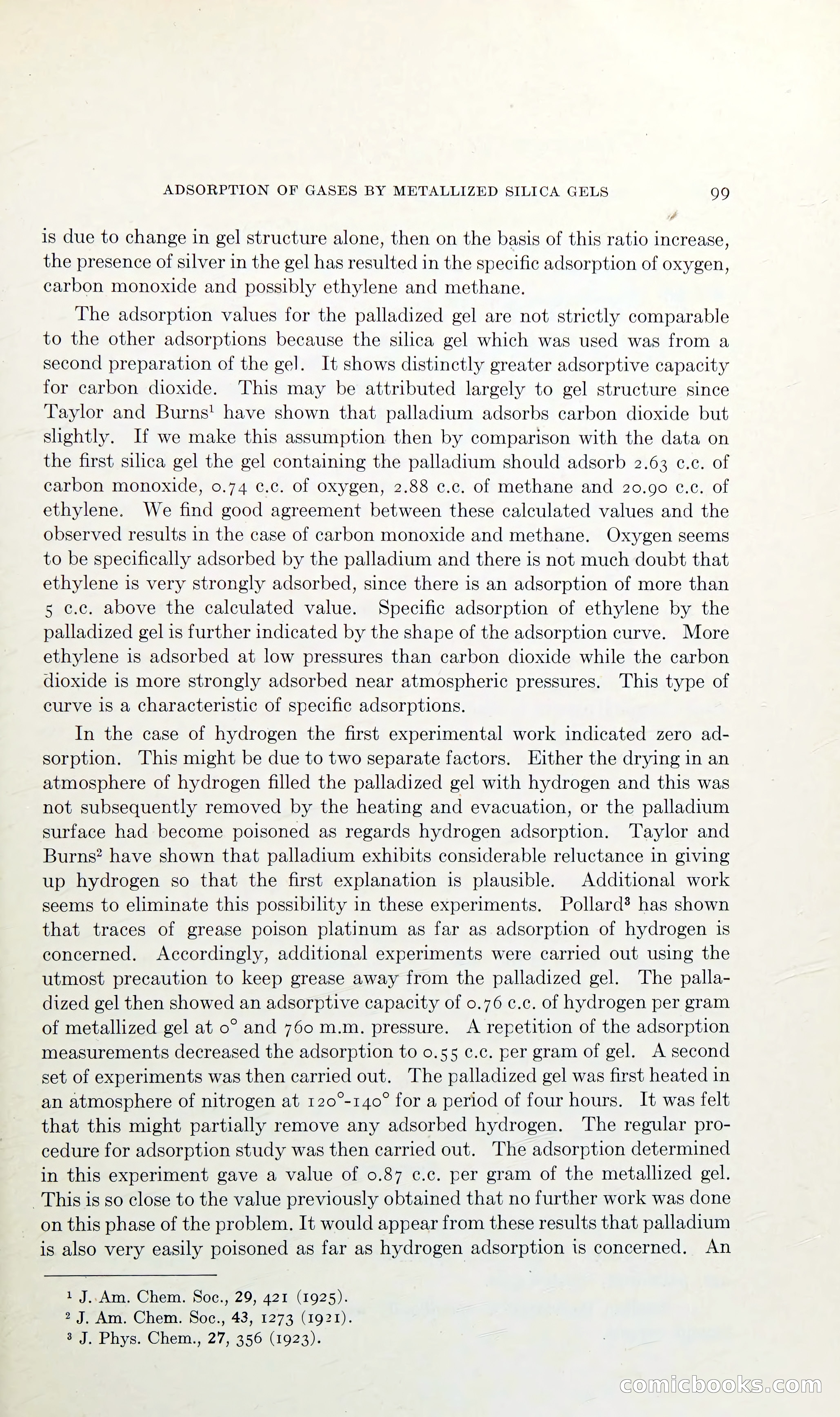
This is a page of scientific prose from a technical journal article, not a Victorian penny dreadful. The text discusses experimental results on gas adsorption by metallized silica gels, particularly palladium-containing gels. It details measurements of how various gases (oxygen, carbon monoxide, ethylene, methane, and hydrogen) are absorbed by these materials, explains discrepancies between predicted and observed values, and explores why hydrogen adsorption initially appeared to be zero before subsequent experiments revealed measurable adsorption. The page includes footnote citations to chemistry journals from the 1920s.
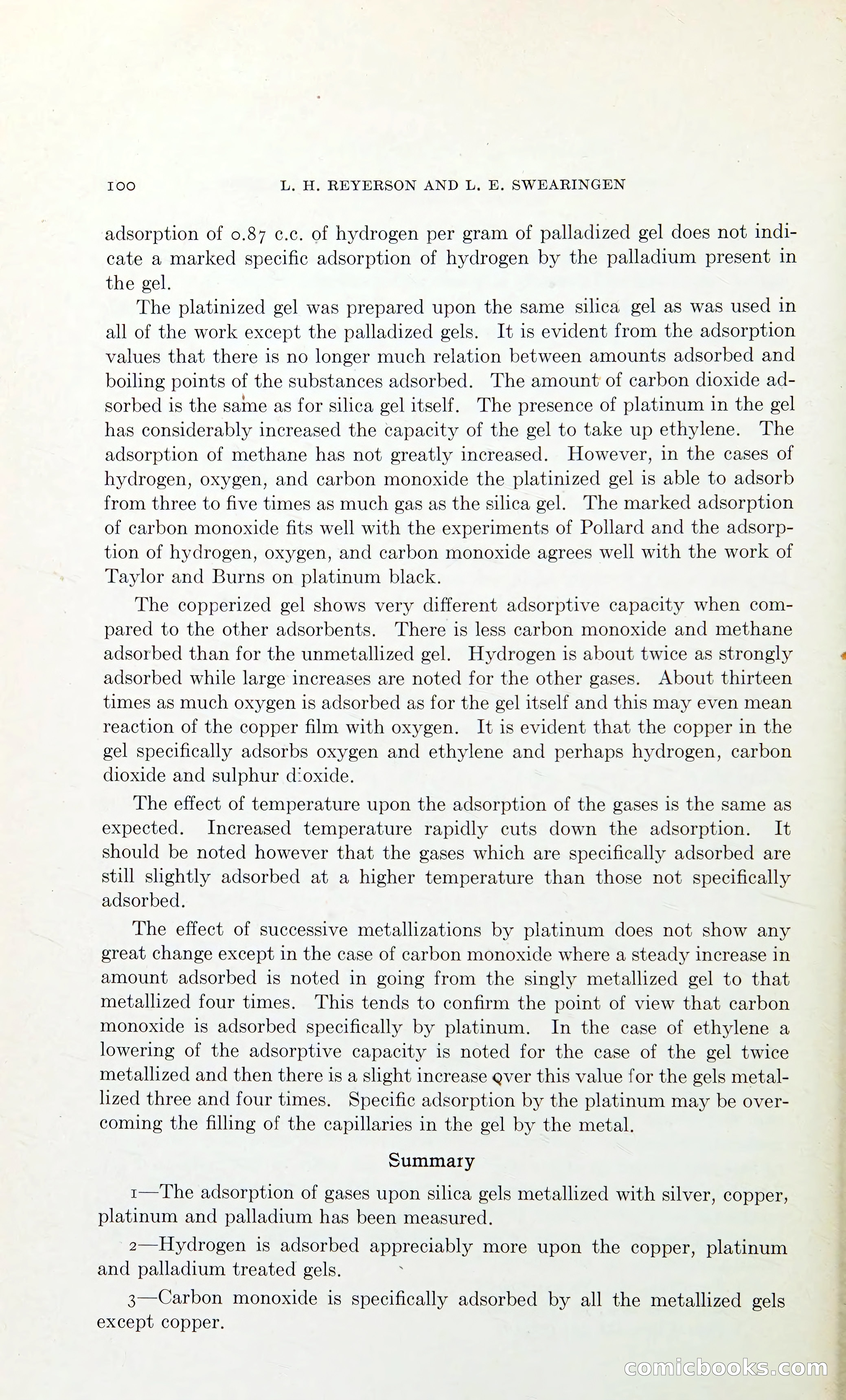
This is a page of scholarly scientific prose, not a Victorian penny dreadful. The page presents research findings by L. H. Reyerson and L. E. Swearingen on gas adsorption in metallized silica gels. The text discusses how different metals (platinum, copper, palladium, silver) deposited on silica gel affect the adsorption of various gases including hydrogen, oxygen, carbon monoxide, and ethylene. It concludes with a three-point summary of experimental results regarding which gases are preferentially absorbed by different metallized gels.
# Analysis This is **not** a Victorian penny dreadful page, but rather a **scientific article conclusion page** from an academic journal. The visible text presents numbered findings (points 4-7) summarizing experimental results about how various metallized silica gels absorb different gases—oxygen, methane, ethylene, and carbon dioxide. The page concludes with an institutional attribution to the University of Minnesota's School of Chemistry. This appears to be early-to-mid twentieth-century scientific publication, entirely unsuitable to the penny dreadful genre described in your prompt.

This page appears to be mostly blank or heavily degraded, with no clearly legible text visible. The OCR output consists almost entirely of scattered punctuation marks, symbols, and fragments that do not form coherent words or sentences. The image itself shows a pale, textured surface with some faint discoloration and marks, but no discernible printed content. It is impossible to determine from either the image or the OCR text whether this is a title page, illustration, or prose section, or what the intended content may have been. The page appears either blank, severely damaged, or poorly scanned.
This is a page of scientific research text, not a Victorian penny dreadful. It appears to be from an early 20th-century chemistry journal article titled "The Catalytic Activity of Metallized Silica Gels III: The Synthesis of Water" by L. E. Swearingen and L. H. Reyerson. The page contains the introduction and experimental methodology sections describing how the authors used metallized silica gel catalysts to study the chemical synthesis of water from hydrogen and oxygen gases, including detailed technical procedures for their apparatus and measurements.
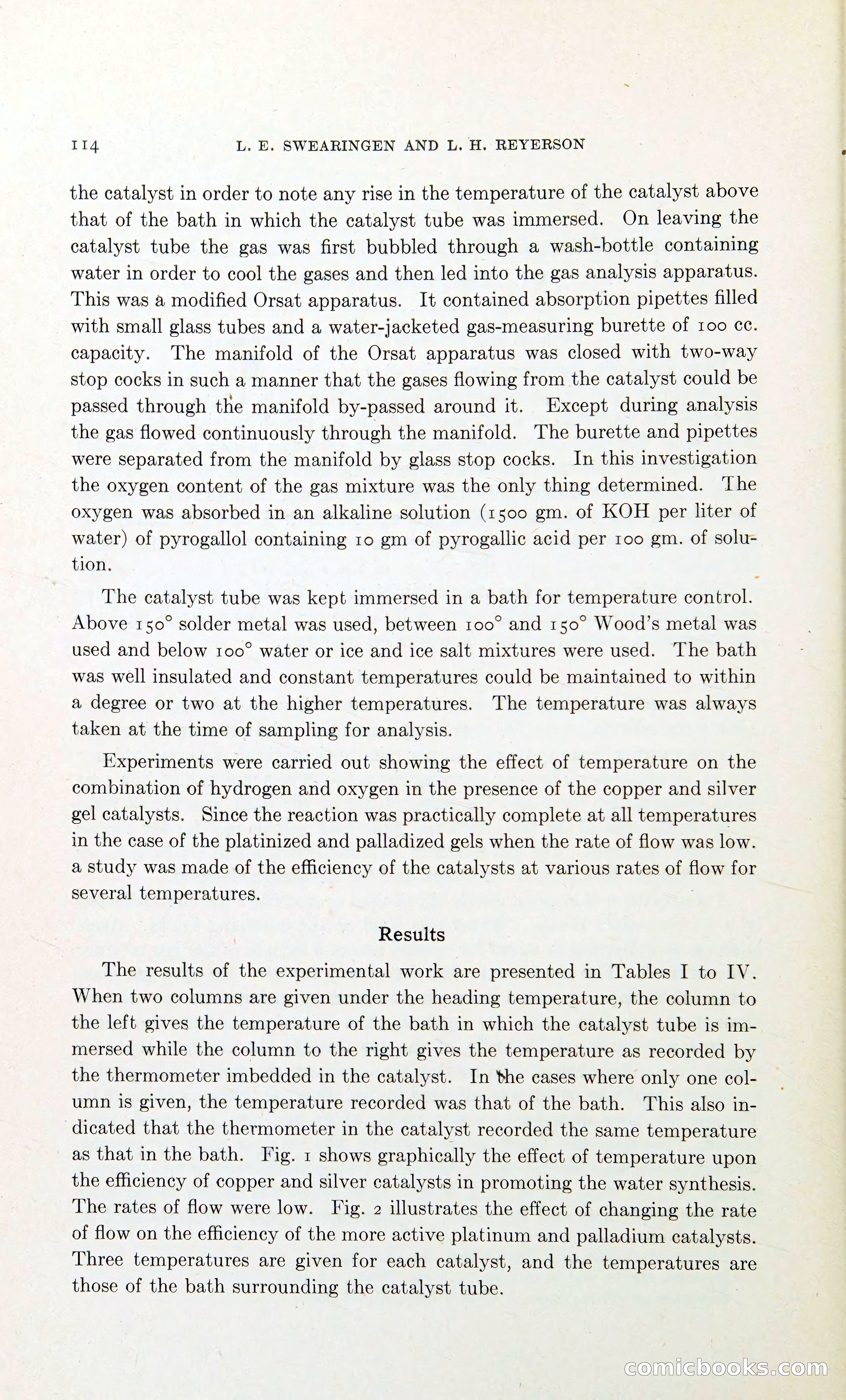
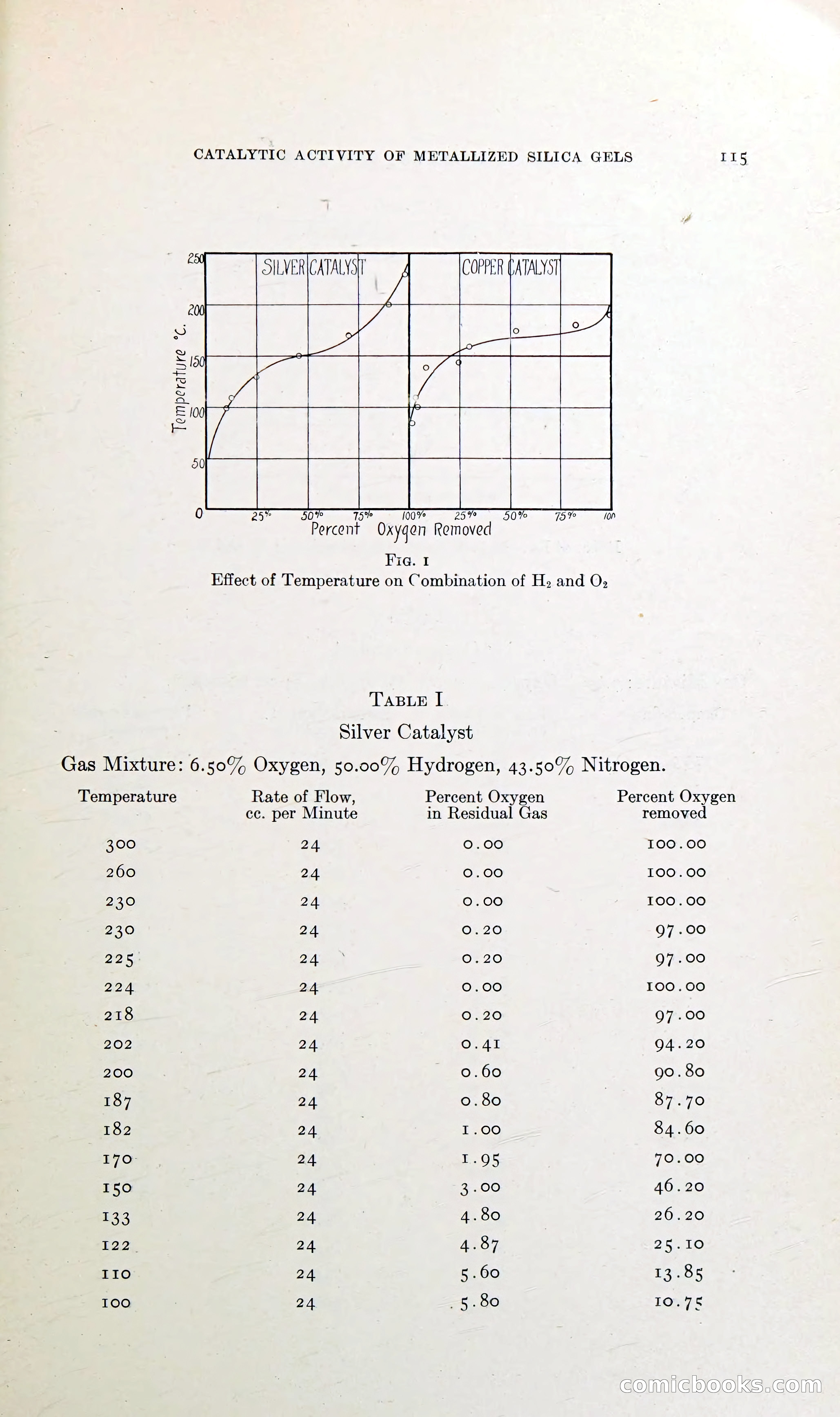
This is a scientific research page, not a Victorian penny dreadful. It contains a graph and detailed data table documenting the catalytic activity of metallized silica gels—specifically examining how temperature affects the combination of hydrogen and oxygen gases using silver and copper catalysts. The page presents experimental results showing the relationship between temperature (measured in degrees) and the percentage of oxygen removed from gas mixtures, with data points ranging from 100°C to 300°C.
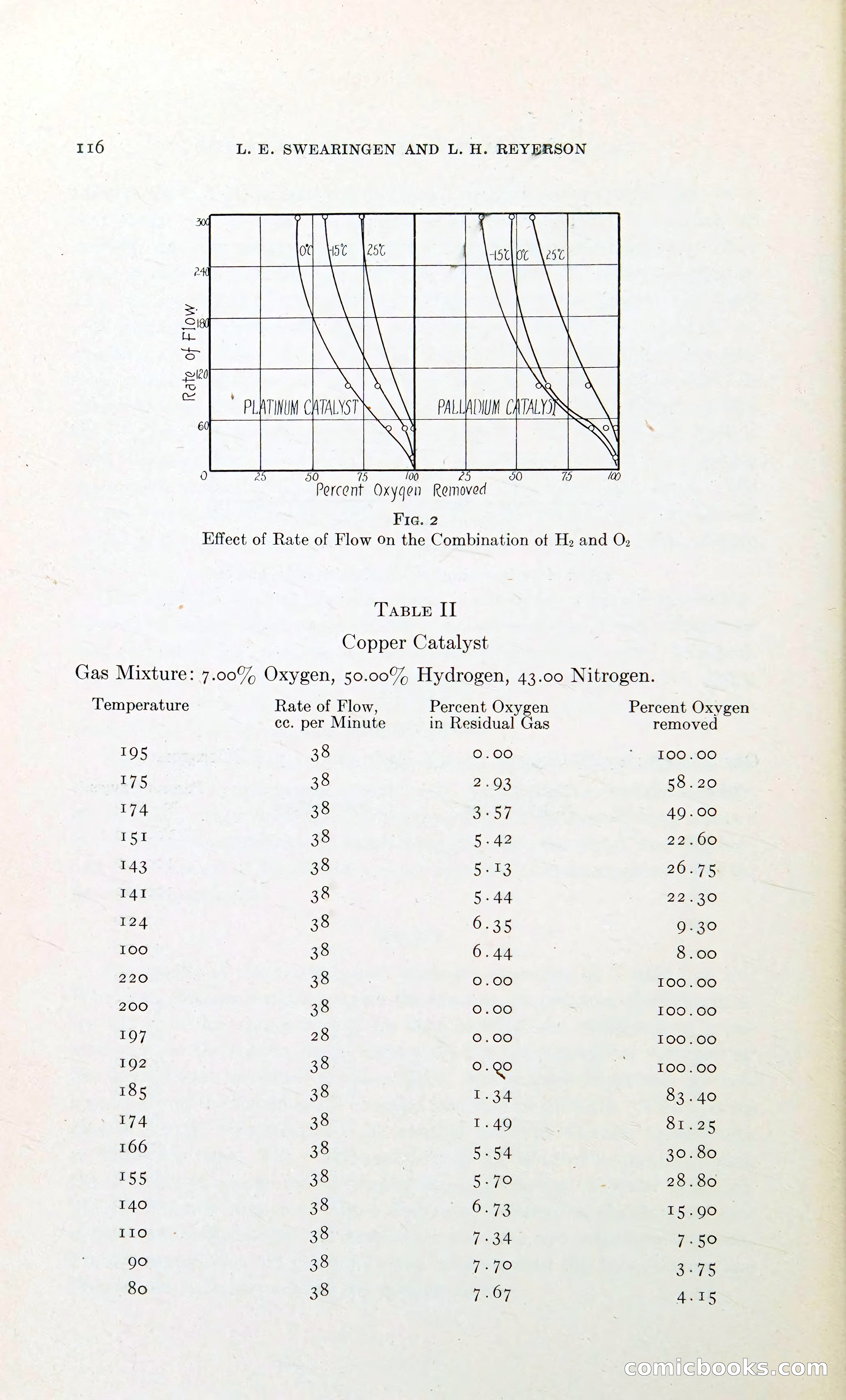
This page is not from a Victorian penny dreadful, but rather a scientific research article by L. E. Swearingen and L. H. Reyerson on chemical catalysis. It contains a graph (Fig. 2) showing the effect of flow rate on hydrogen and oxygen combination using platinum and palladium catalysts, and Table II presenting experimental data on a copper catalyst's ability to remove oxygen from a gas mixture at various temperatures. The table shows temperature, flow rate, and oxygen removal percentages from a test mixture containing 7% oxygen, 50% hydrogen, and 43% nitrogen.
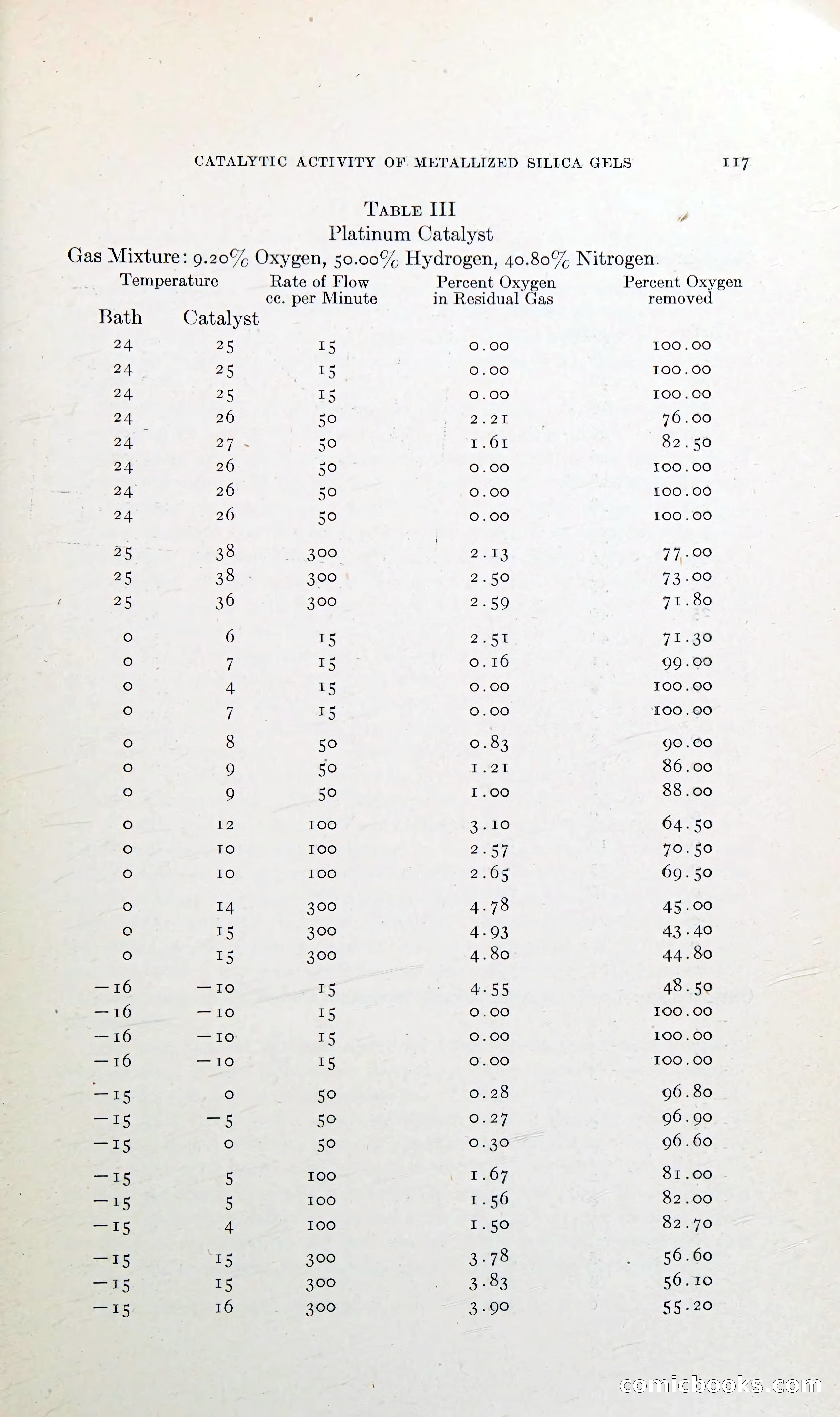
# What is on this page: This is a data table from a scientific or technical document, not a Victorian penny dreadful. Table III presents experimental results testing a platinum catalyst's effectiveness at removing oxygen from a gas mixture containing oxygen, hydrogen, and nitrogen. The table records measurements across varying temperatures (ranging from -16°C to 25°C), flow rates, and catalysts, showing the percent of oxygen remaining in residual gas and the percent removed. The page header indicates this is page 117 from a work on "Catalytic Activity of Metallized Silica Gels."
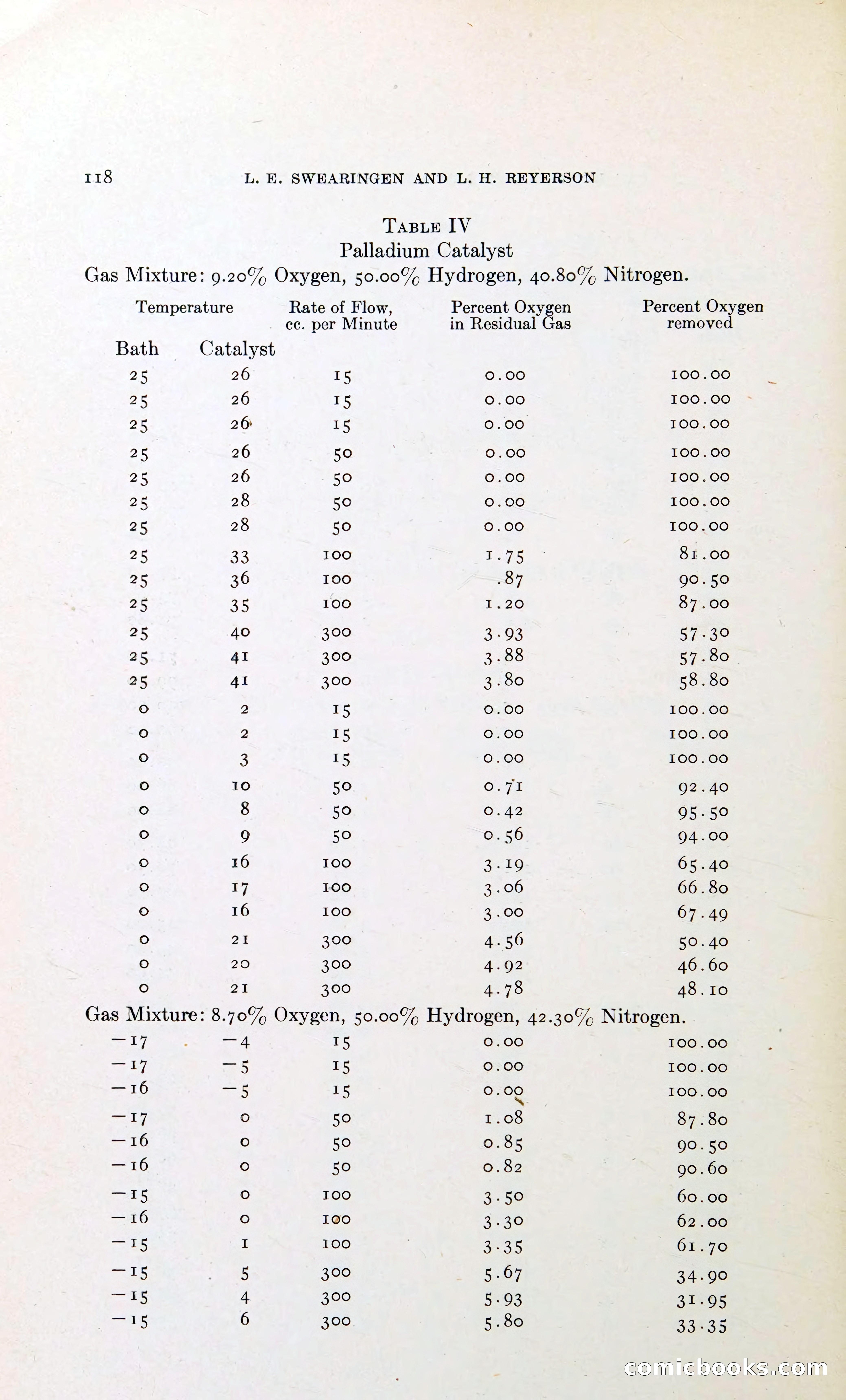
This page is a scientific data table, not a Victorian penny dreadful. It presents experimental results from chemists L. E. Swearingen and L. H. Reyerson testing a palladium catalyst's effectiveness at removing oxygen from gas mixtures under varying temperatures, flow rates, and initial gas compositions. The table records specific measurements of oxygen removal efficiency across different experimental conditions.
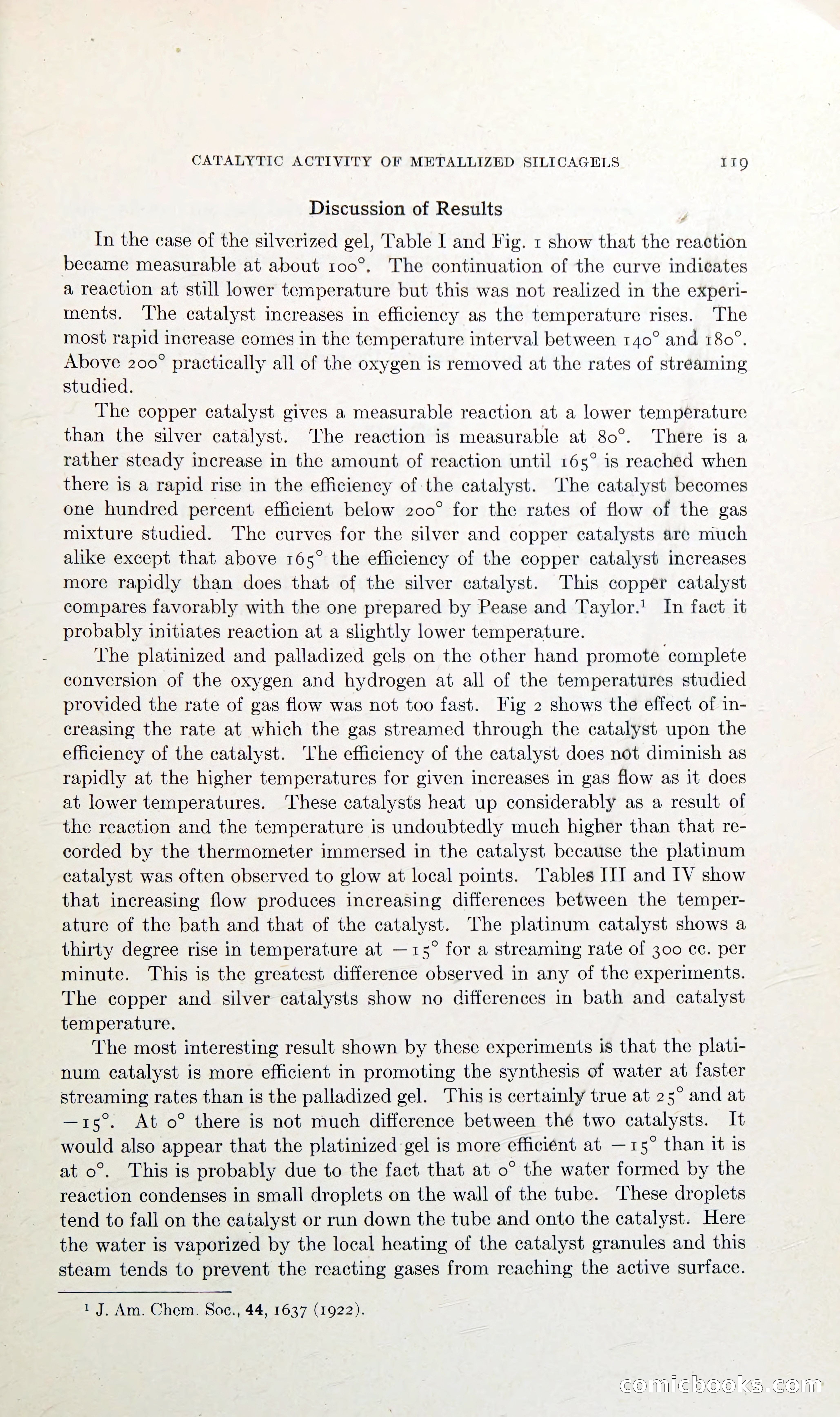
This is a page of running prose from a scientific journal article, not a penny dreadful. The text discusses experimental results on the catalytic activity of metallized silica gels—specifically comparing how silver, copper, platinum, and palladium catalysts promote chemical reactions at various temperatures and gas flow rates. The page analyzes data from tables and figures, noting that platinum catalysts prove most efficient at faster streaming rates, and explains how water condensation affects catalyst performance at different temperatures.
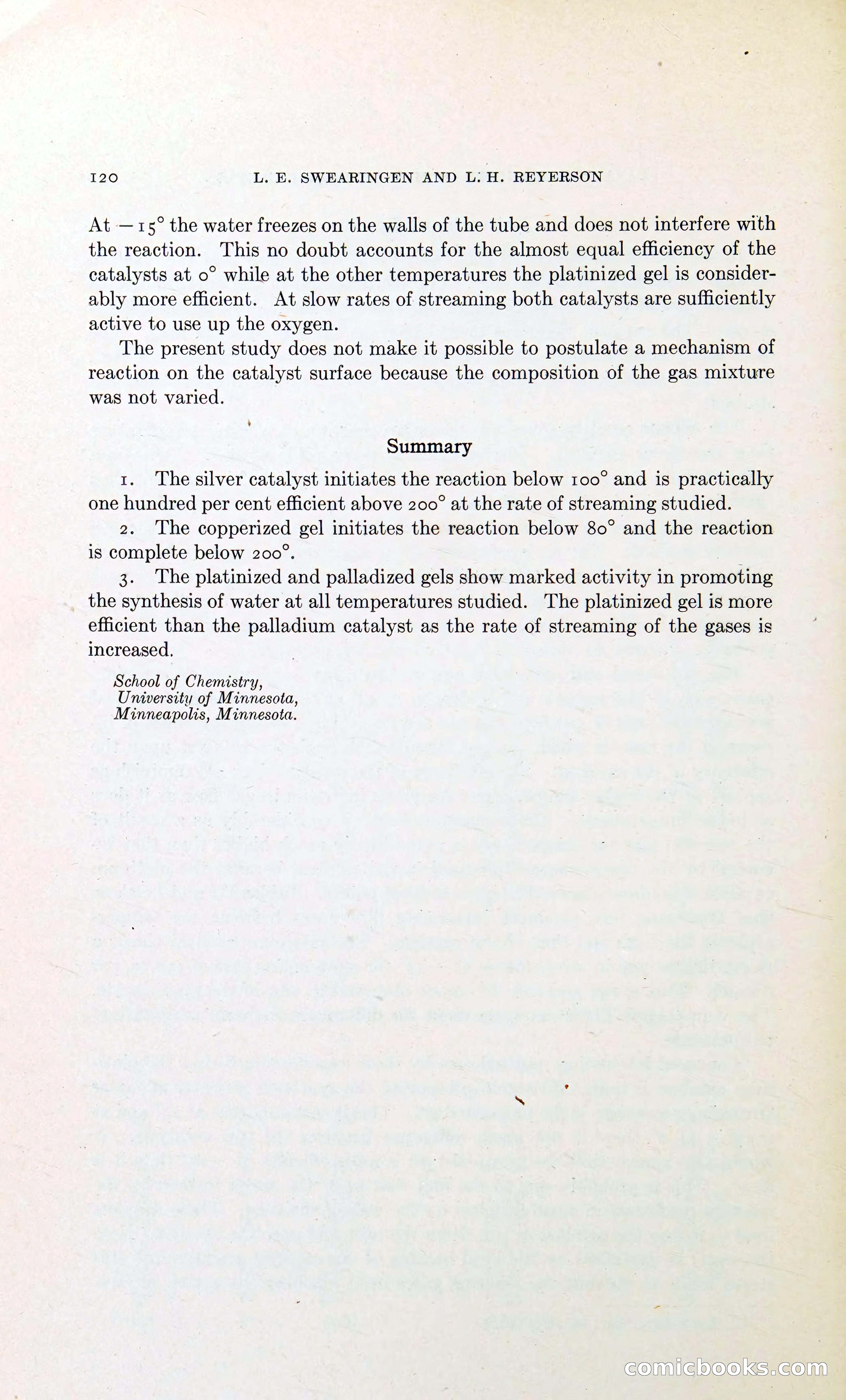
This page contains running prose—the conclusion and summary section of a scientific research article by L. E. Swearingen and L. H. Reyerson from the University of Minnesota's School of Chemistry. The text discusses experimental findings about various metal catalysts (silver, copper, platinum, palladium) and their efficiency in promoting water synthesis at different temperatures. This is **not** a penny dreadful; it appears to be a legitimate academic or scientific journal article from the early twentieth century, dealing entirely with chemistry and catalyst reactions.
# Page Assessment This is a **running prose page** from a Victorian penny dreadful, heavily degraded and difficult to read due to age, discoloration, and image quality. The text appears printed in small type across multiple columns or dense paragraphs, typical of serialized sensation fiction from the period. The OCR text provided is largely illegible in the image itself—the words are too faint and obscured by the pinkish-purple discoloration and age spots covering the page to discern specific plot details with confidence. What is visible suggests this is mid-narrative prose rather than a title page or illustration, but the actual content remains unclear from this reproduction.
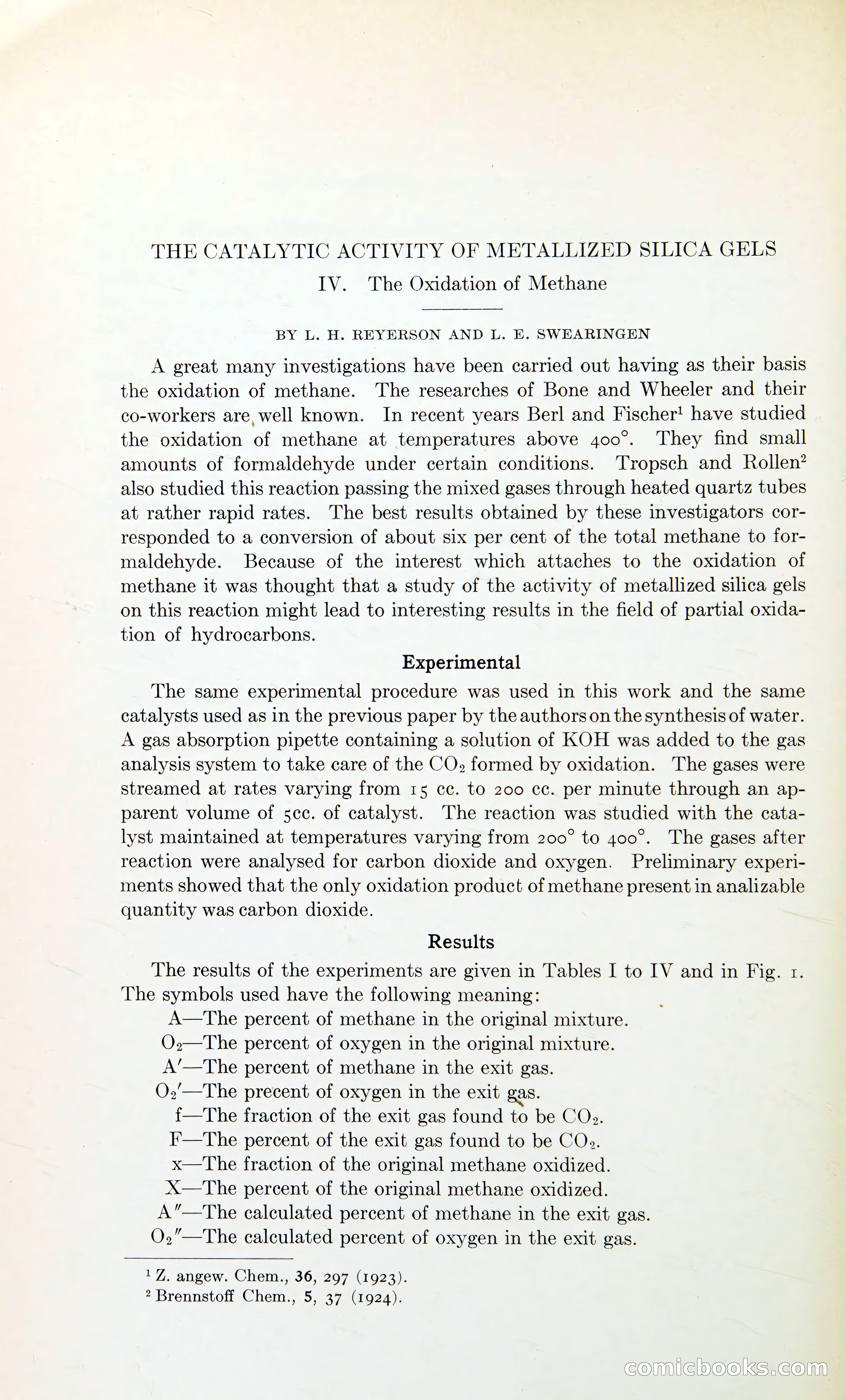
# This Page Does NOT Belong in a Victorian Penny Dreadful This is a scientific research paper, not Victorian popular literature. The page is the opening of an academic article titled "The Catalytic Activity of Metallized Silica Gels: IV. The Oxidation of Methane" by L. H. Reyerson and L. E. Swearingen. It contains an introduction reviewing prior chemical research on methane oxidation, followed by sections detailing experimental procedures and results involving catalysts, gas mixtures, and temperature measurements. The text references scholarly citations and technical data tables—entirely inconsistent with penny dreadful fiction, which featured sensational crime, horror, or melodrama for mass entertainment.
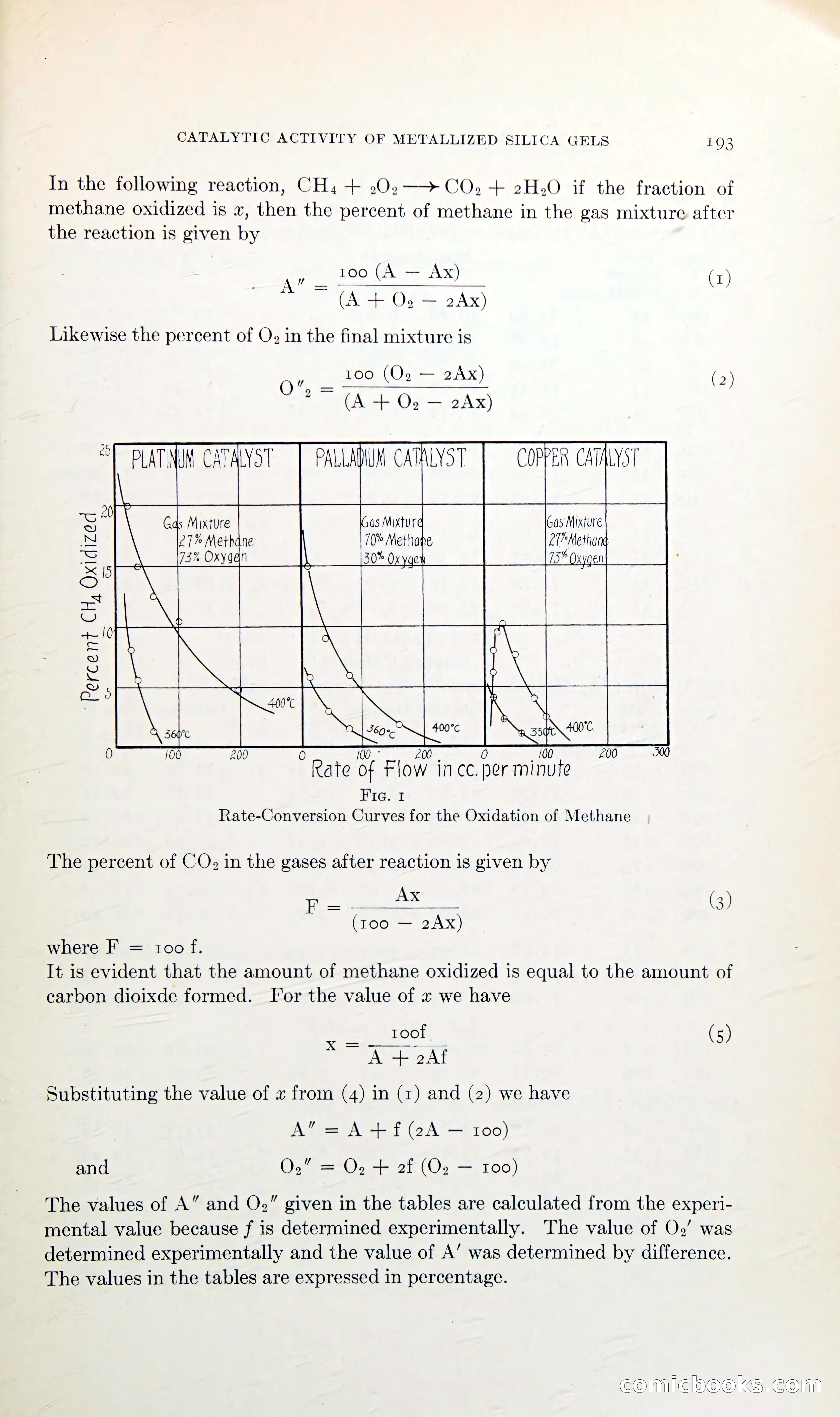
# Analysis This is **not** a Victorian penny dreadful page—it is a scientific journal article. The page contains technical prose and a scientific graph discussing the catalytic oxidation of methane using metallized silica gels with different metal catalysts (platinum, palladium, copper). The text presents mathematical equations for calculating gas composition percentages after a chemical reaction, accompanied by "Rate-Conversion Curves" showing oxidation rates at various temperatures and gas flow rates.
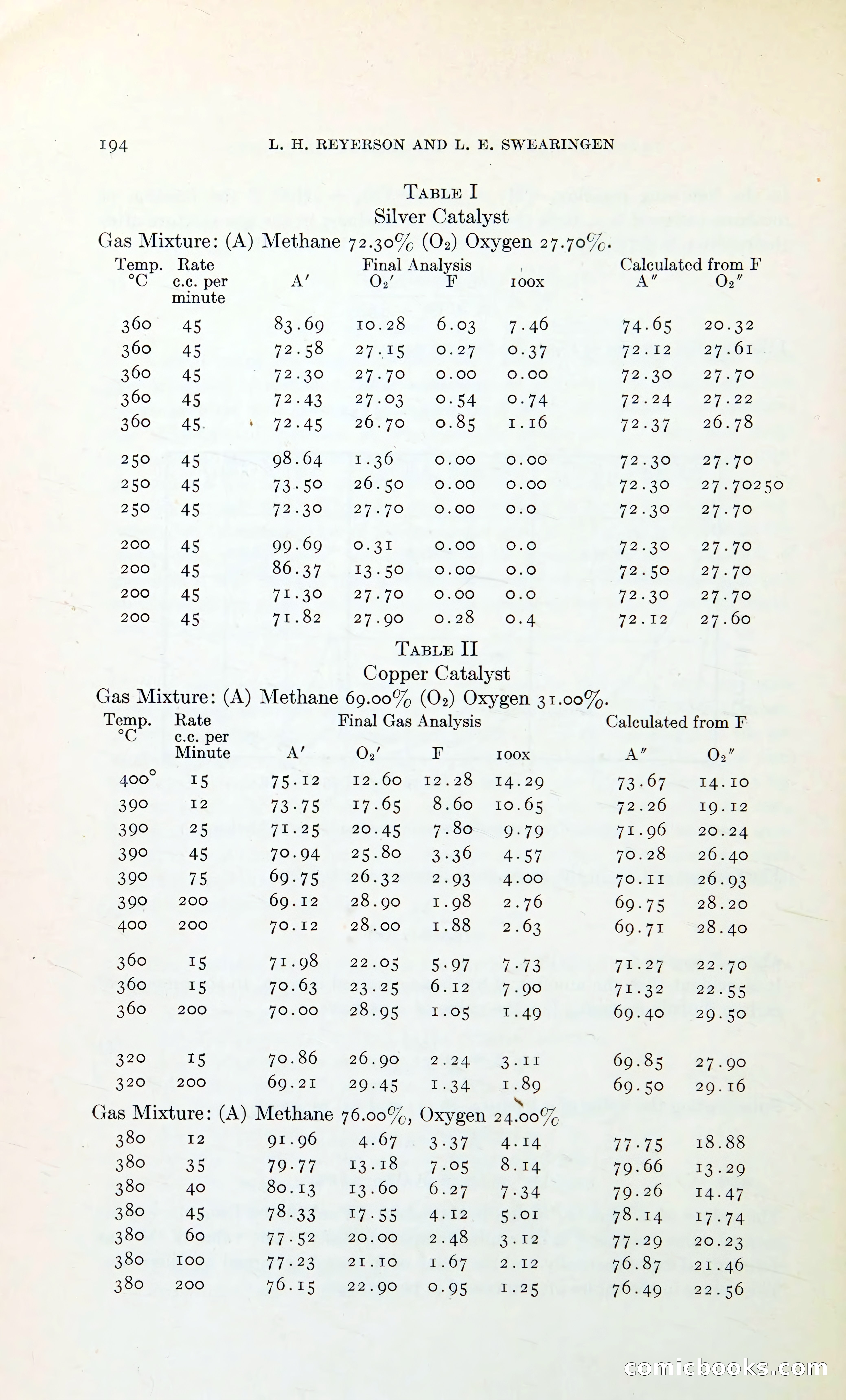
This page is not from a Victorian penny dreadful but rather a scientific research paper. It presents two data tables—Table I on "Silver Catalyst" and Table II on "Copper Catalyst"—documenting experimental results by L. H. Reyerson and L. E. Swearingen. The tables record temperatures, reaction rates, gas mixture compositions (methane and oxygen), and analytical measurements from what appears to be catalytic oxidation experiments. This is technical chemistry research, not serialized fiction.
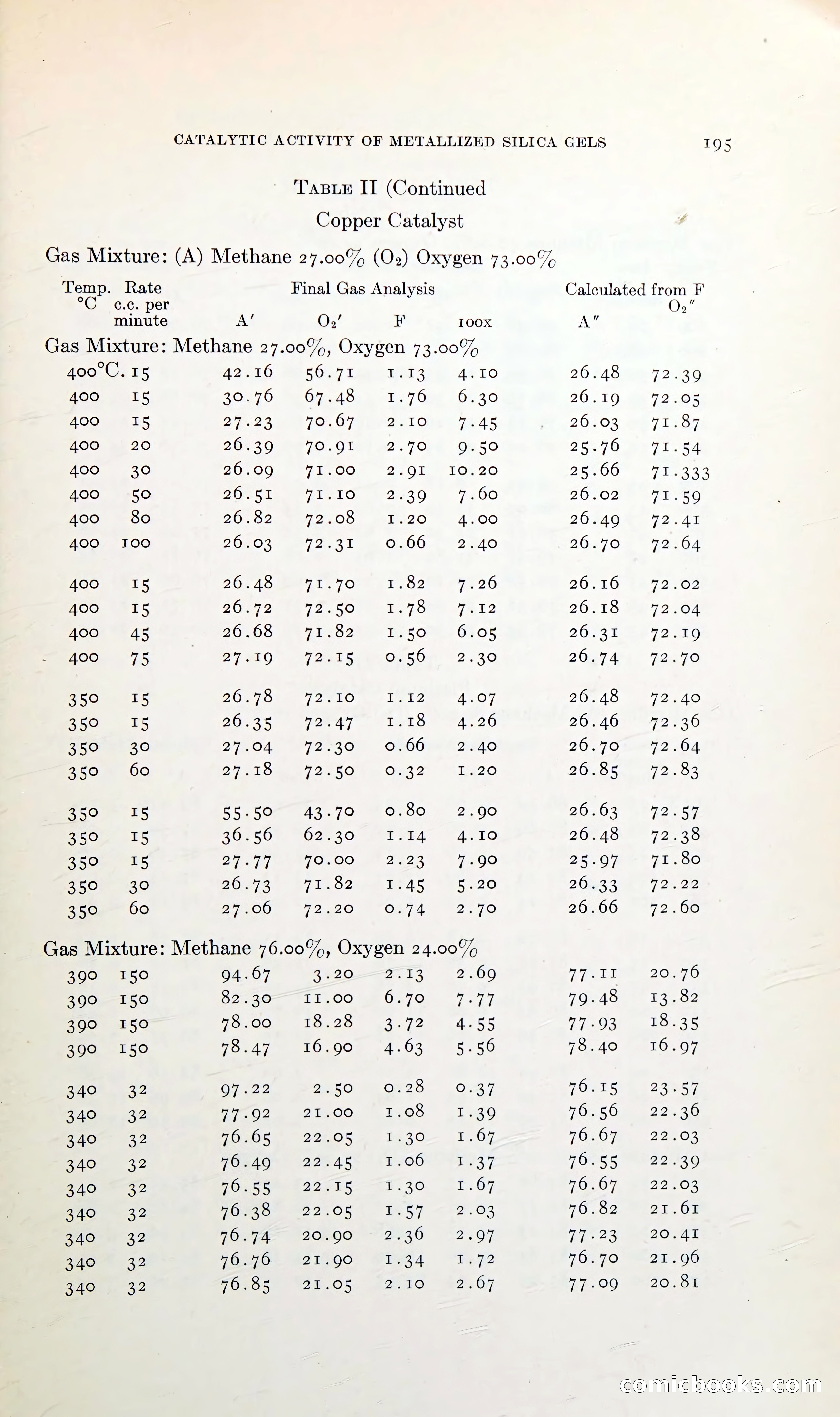
This page is not from a Victorian penny dreadful. It is a scientific data table from an academic chemistry journal or research paper titled "CATALYTIC ACTIVITY OF METALLIZED SILICA GELS" (visible at the top). The page presents experimental results measuring the catalytic activity of copper catalysts at various temperatures and gas mixture compositions, with columns for temperature, reaction rate, gas analysis measurements, and calculated values. The content is entirely technical and scientific in nature.
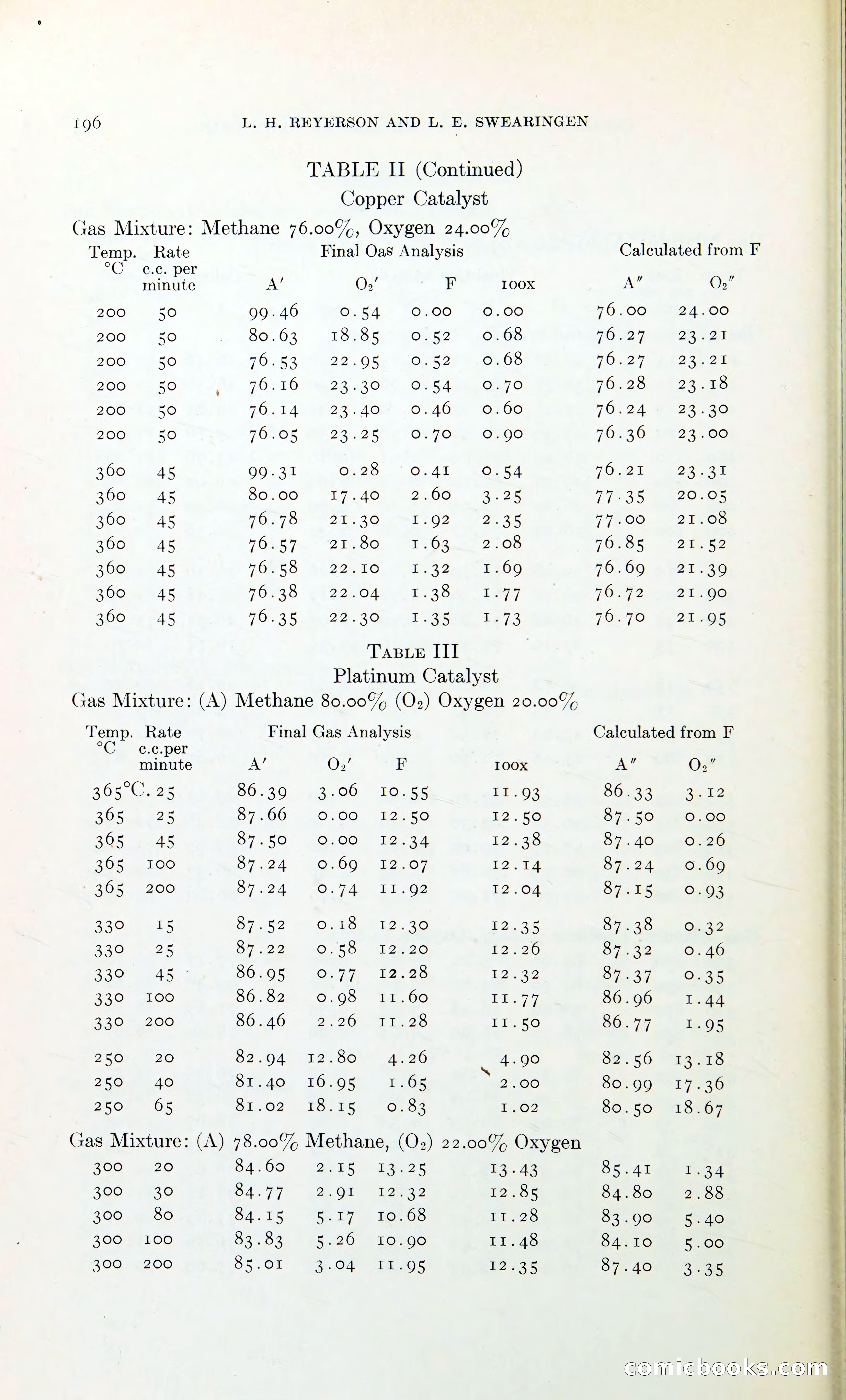
This page contains two scientific data tables, not a penny dreadful. Table II presents experimental results from a copper catalyst test using a gas mixture of methane and oxygen at various temperatures and reaction rates, showing final gas analysis measurements. Table III below presents similar experimental data for a platinum catalyst under comparable conditions. The page appears to be from a scientific journal article by L. H. Reyerson and L. E. Swearingen documenting chemical reaction studies—likely from an early-to-mid twentieth-century chemistry publication, not Victorian popular literature.
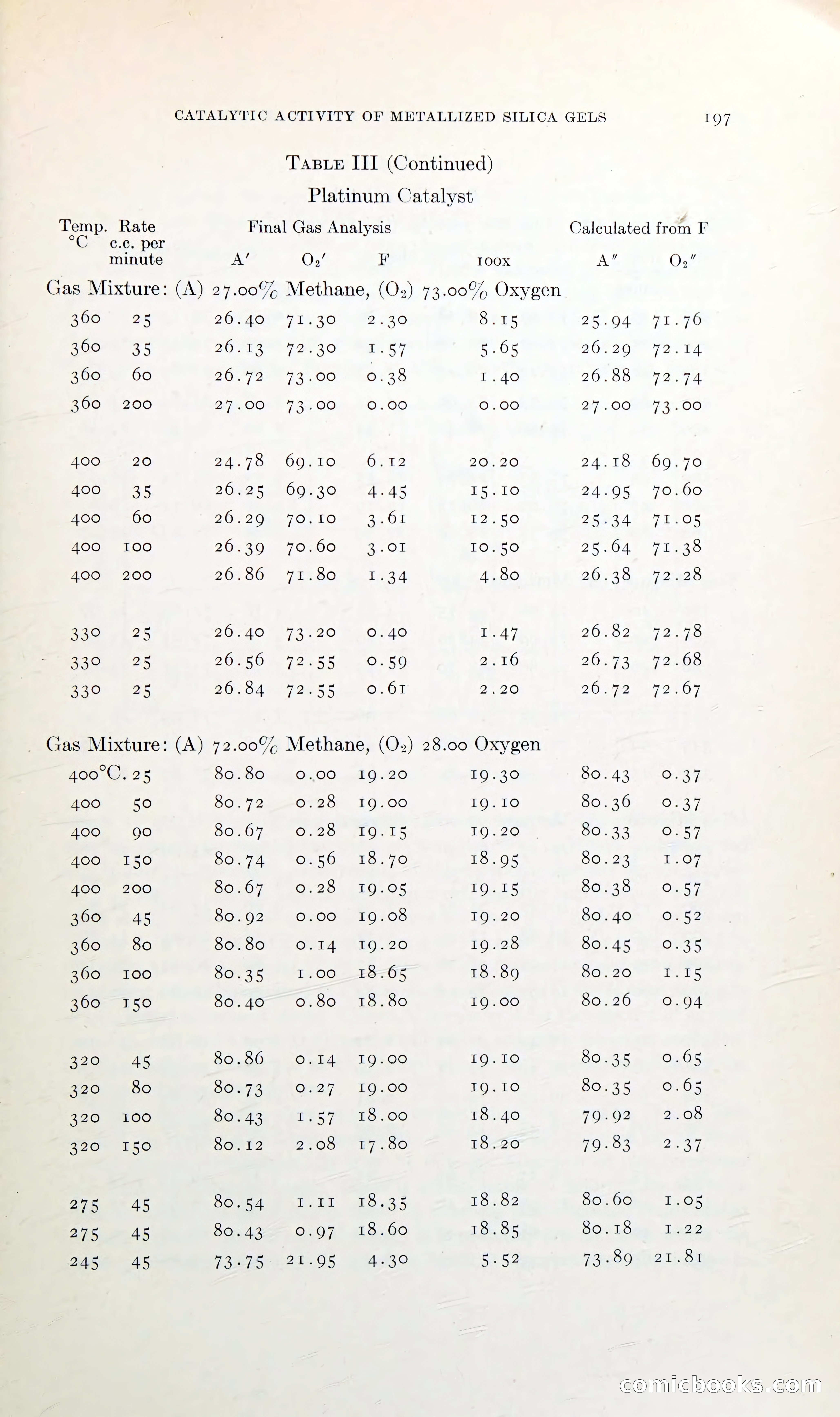
# What This Page Contains This page is **not a penny dreadful at all**, but rather a scientific data table from a chemistry or materials science publication. It displays experimental results titled "Catalytic Activity of Metallized Silica Gels," specifically testing the performance of a platinum catalyst under various temperatures and gas mixtures. The table records measurements of methane and oxygen content before and after reactions, with calculations derived from the experimental data. This is technical laboratory documentation, not popular fiction.
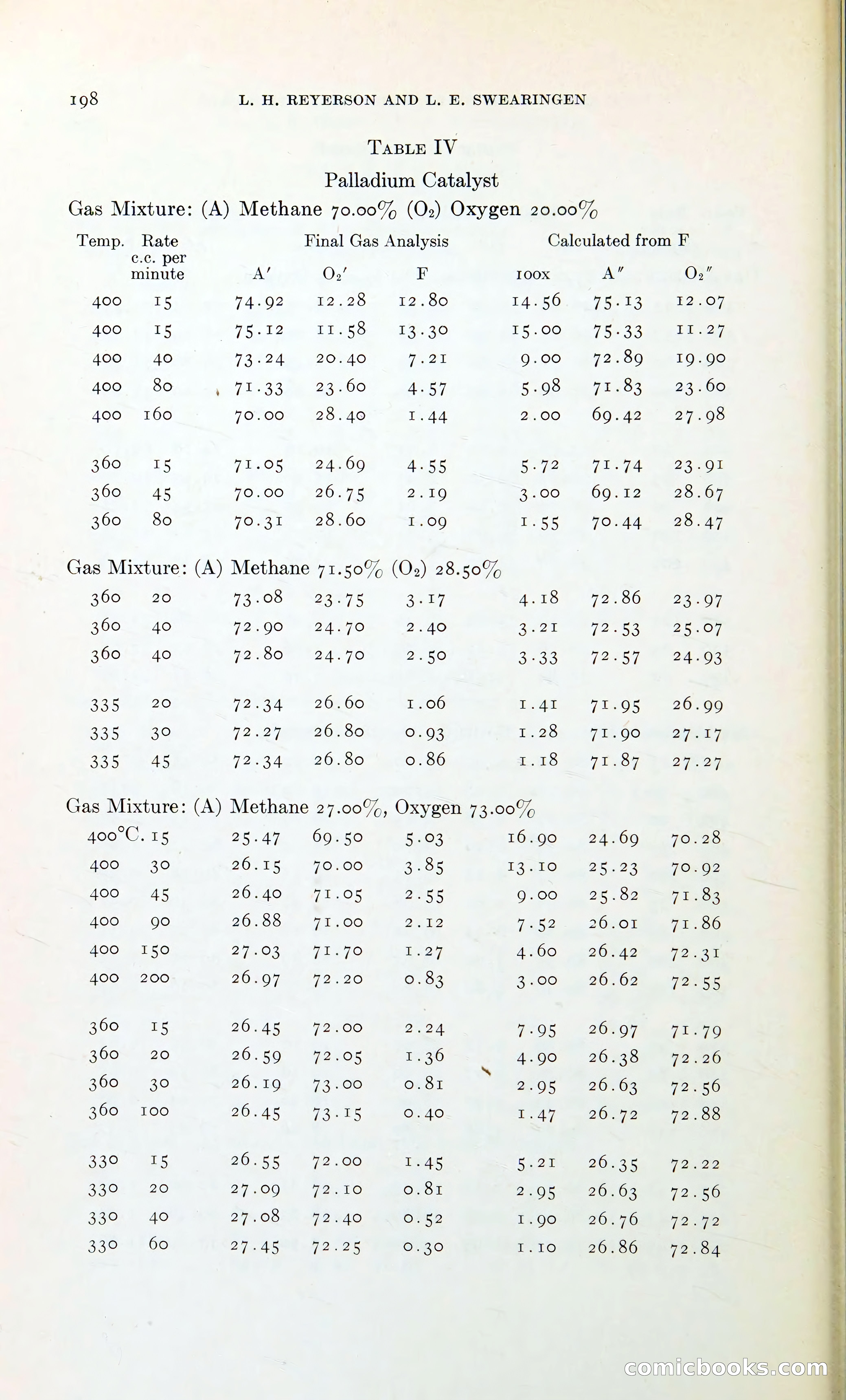
This page is not from a Victorian penny dreadful. It is a scientific data table from a scholarly chemistry journal article by L. H. Reyerson and L. E. Swearingen (page 198). Table IV presents experimental results using a palladium catalyst to measure gas mixtures containing methane and oxygen at various temperatures and reaction rates, with columns showing initial gas analysis, final gas analysis, and calculated values. The data appears to record combustion or catalytic reaction experiments.
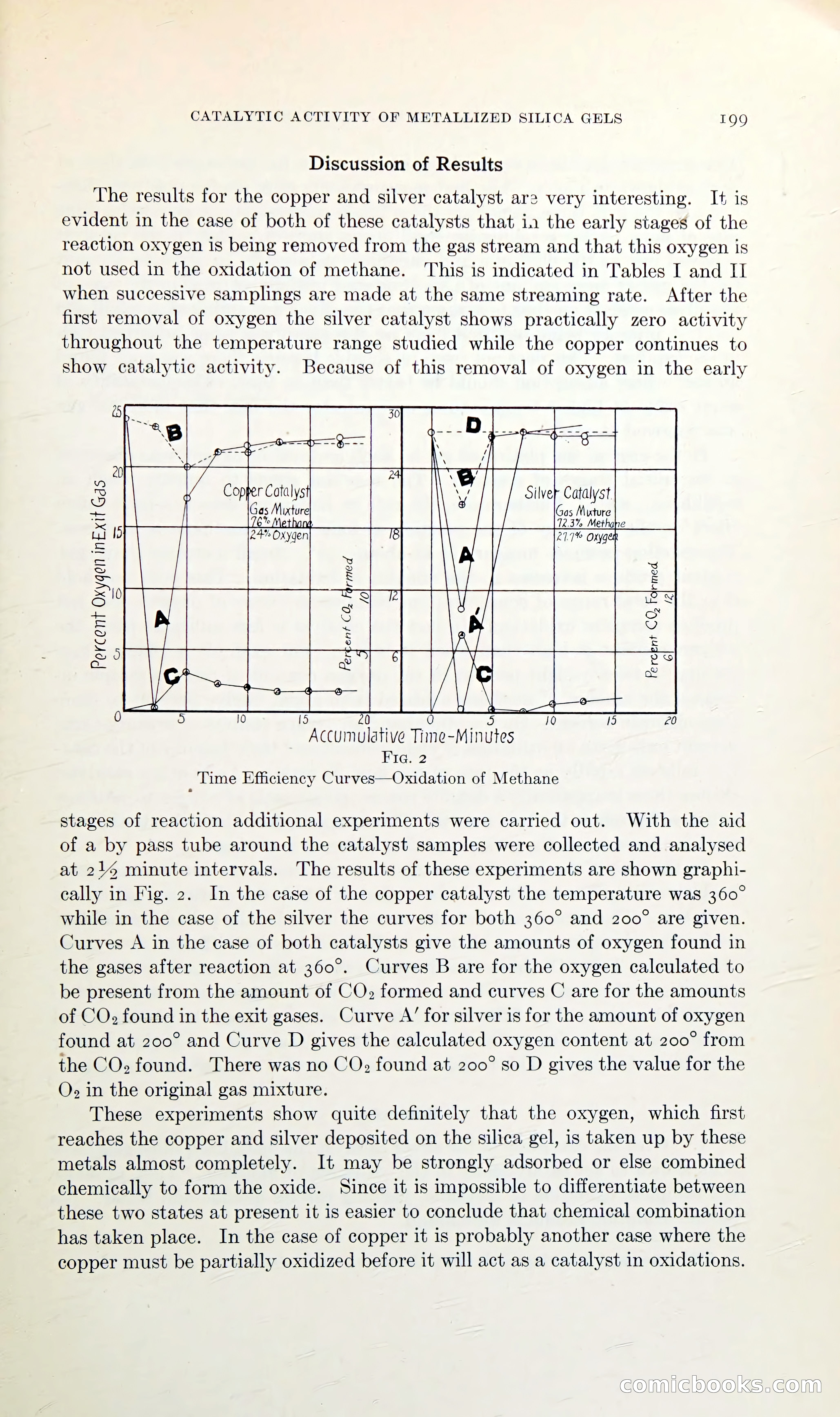
This is a page of scientific prose from an academic or technical journal article, not a Victorian penny dreadful. The visible text discusses experimental results on the catalytic properties of copper and silver deposited on silica gels, specifically their behavior during methane oxidation. The page includes a two-part graph (Fig. 2) showing "Time Efficiency Curves" plotting oxygen content against accumulative time in minutes, with multiple curves representing different measurements and temperatures. The prose explains that oxygen is initially removed from the gas stream by these metal catalysts, with the silver catalyst subsequently showing no activity while copper retains catalytic function.
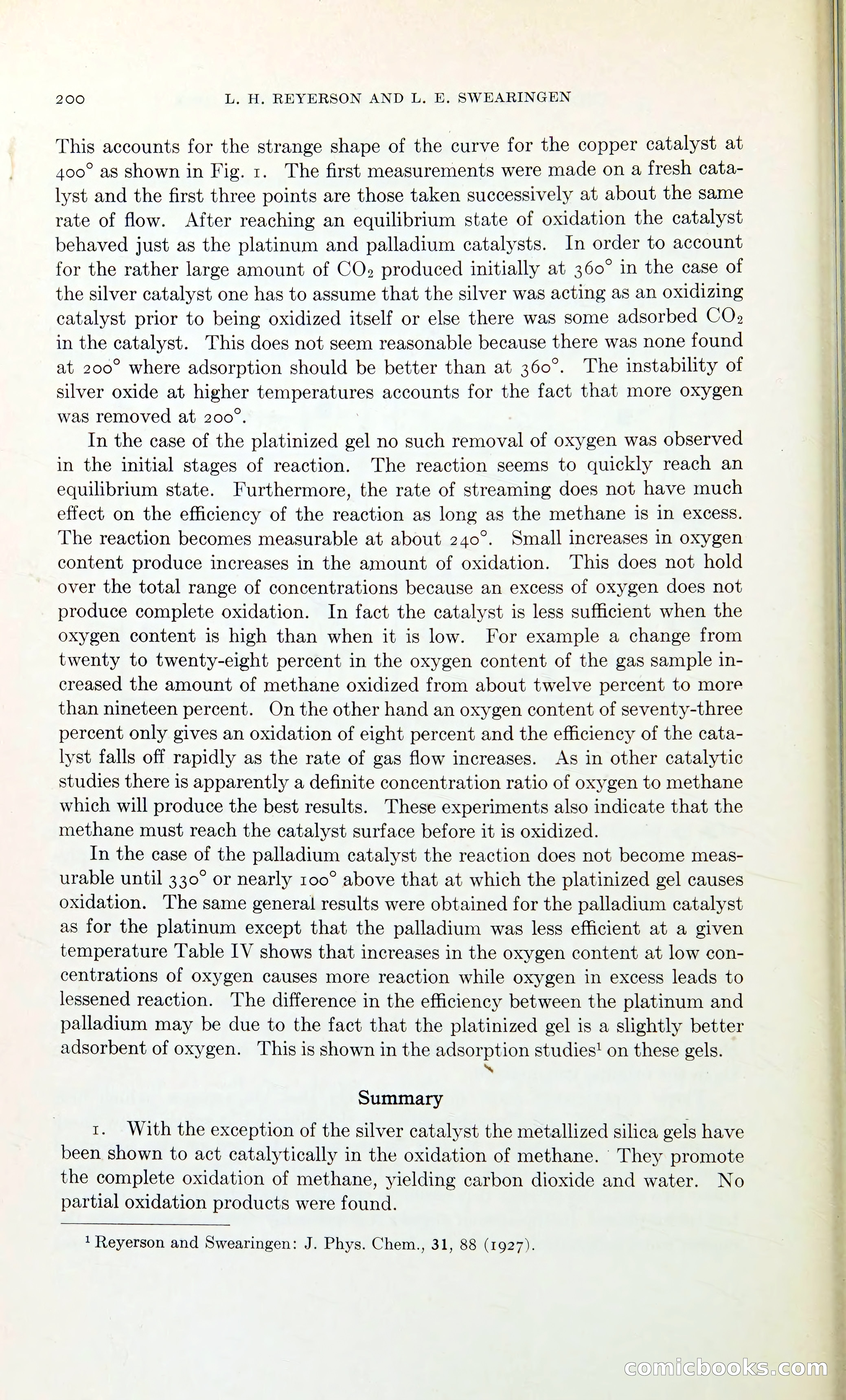
# Page Analysis This is a **scientific research paper**, not a Victorian penny dreadful. The page contains running prose discussing experimental results on catalytic oxidation of methane using various metallized silica gel catalysts (copper, silver, platinum, and palladium). The authors—L. H. Reyerson and L. E. Swearingen—examine how temperature, oxygen concentration, and gas flow rates affect the oxidation efficiency of different catalysts, concluding that most metallized silica gels successfully promote complete oxidation of methane to carbon dioxide and water. A footnote cites their work in *Journal of Physical Chemistry* (1927).
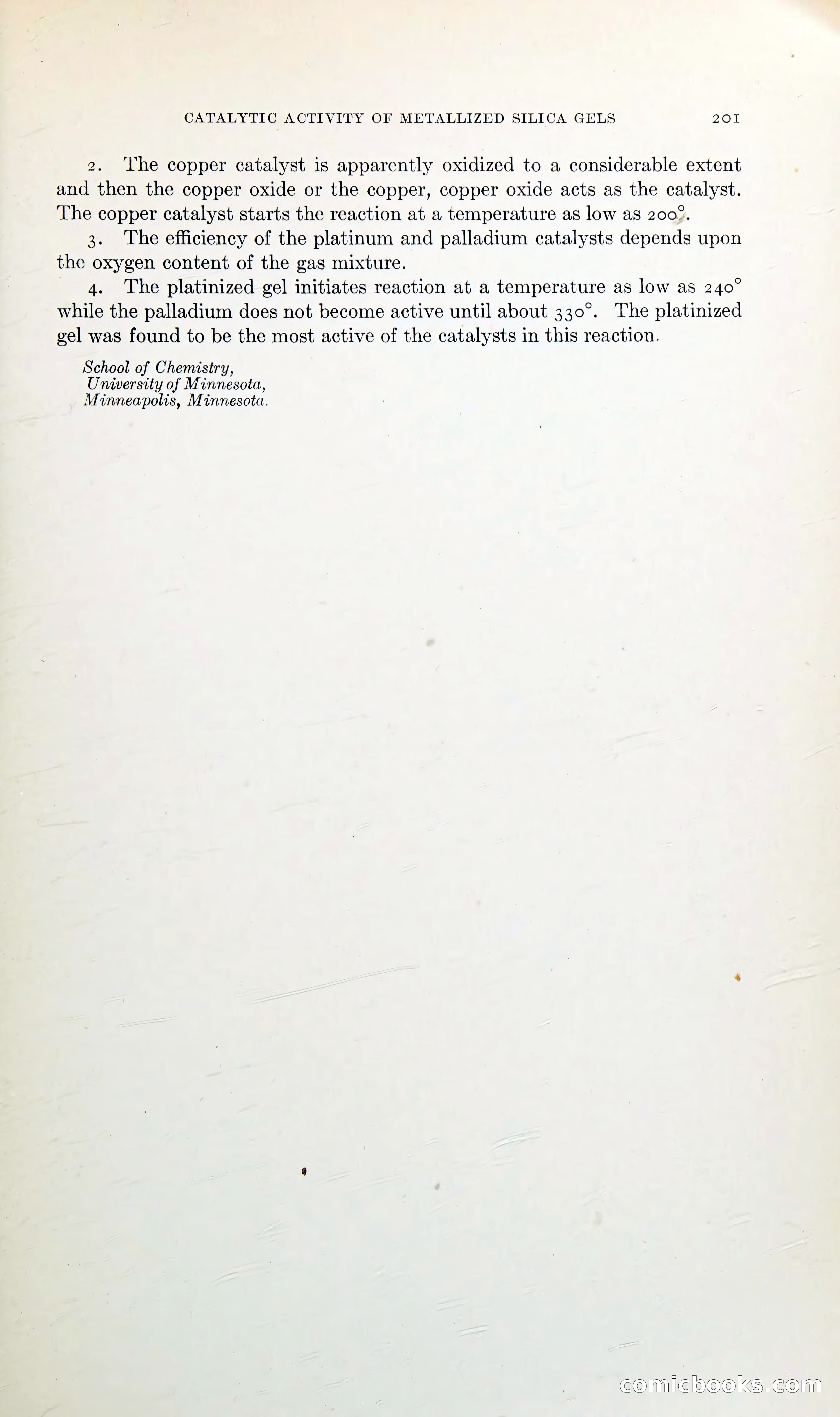
This is a scholarly article conclusion page, not a penny dreadful. The text discusses the catalytic activity of metallized silica gels, reporting experimental findings about copper, platinum, and palladium catalysts and their reaction temperatures. It concludes with an affiliation to the University of Minnesota's School of Chemistry. This appears to be from a scientific journal, not Victorian sensation fiction.

This appears to be a mostly blank page from a Victorian penny dreadful, with only faint, illegible text visible at the top of the page. The OCR text is too corrupted or unclear to determine specific content. The page shows significant aging with discoloration and minor marks scattered across its surface. Given the predominantly empty nature of the page and the illegible text, this may be a transitional page between sections, an advertisement page, or the beginning of a new installment where the printing is too faded to read reliably. The actual subject matter cannot be determined from what is visible.
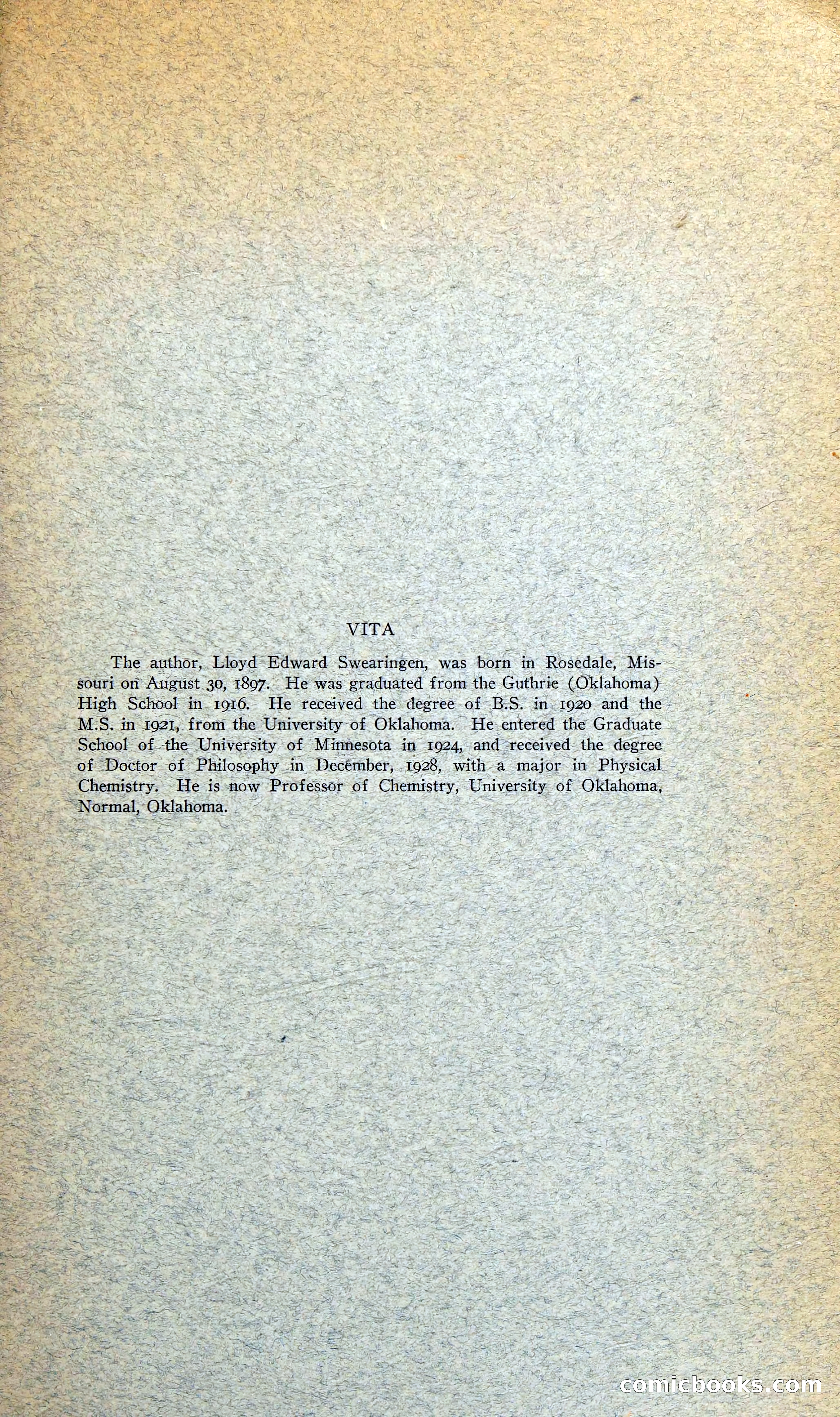
This is a biographical page titled "VITA" containing a brief autobiography of the author, Lloyd Edward Swearingen. The text states he was born in Rosedale, Missouri, on August 30, 1897, graduated from Guthrie High School in 1916, and earned degrees from the University of Oklahoma (B.S. in 1920, M.S. in 1921). He attended the University of Minnesota's Graduate School in 1924, earning a Doctor of Philosophy degree in December 1928 with a major in Physical Chemistry. The page concludes by noting he is a Professor of Chemistry at the University of Oklahoma, Normal, Oklahoma. The page appears to be from an academic or scholarly work rather than a Victorian penny dreadful.

This appears to be the back cover or inside back cover of a Victorian penny dreadful. The page is almost entirely blank, showing only a dark gray or black surface with visible wear, creasing, and tape reinforcement along the bottom edge. On the right side, there is partial text visible from an adjacent page, though it is largely illegible in this image. The OCR watermark "cbooks.com" appears at the bottom, suggesting this is a digitized archive copy. The page itself contains no readable narrative text or illustrations—it is primarily a structural element of the publication's binding rather than content-bearing material.
# Analysis This appears to be a **back cover or inside back cover of a Victorian penny dreadful**. The page is predominantly blank dark gray or black, with visible wear and deterioration including creasing at the bottom and edge damage. On the right side, partial text is visible from an adjacent page, though it is largely illegible in this image. The watermark "ccomicbooks.com" appears at the bottom, indicating this is a photograph of a cataloged archival item. The page itself contains no discernible printed content—it is essentially a blank endpaper or cover, typical of serial publication bindings from this era.