
Penny Dreadfuls, 1927 · page 28 of 42
Doctoral Thesis Cover Page — page 28: what you’re looking at
What you’re looking at
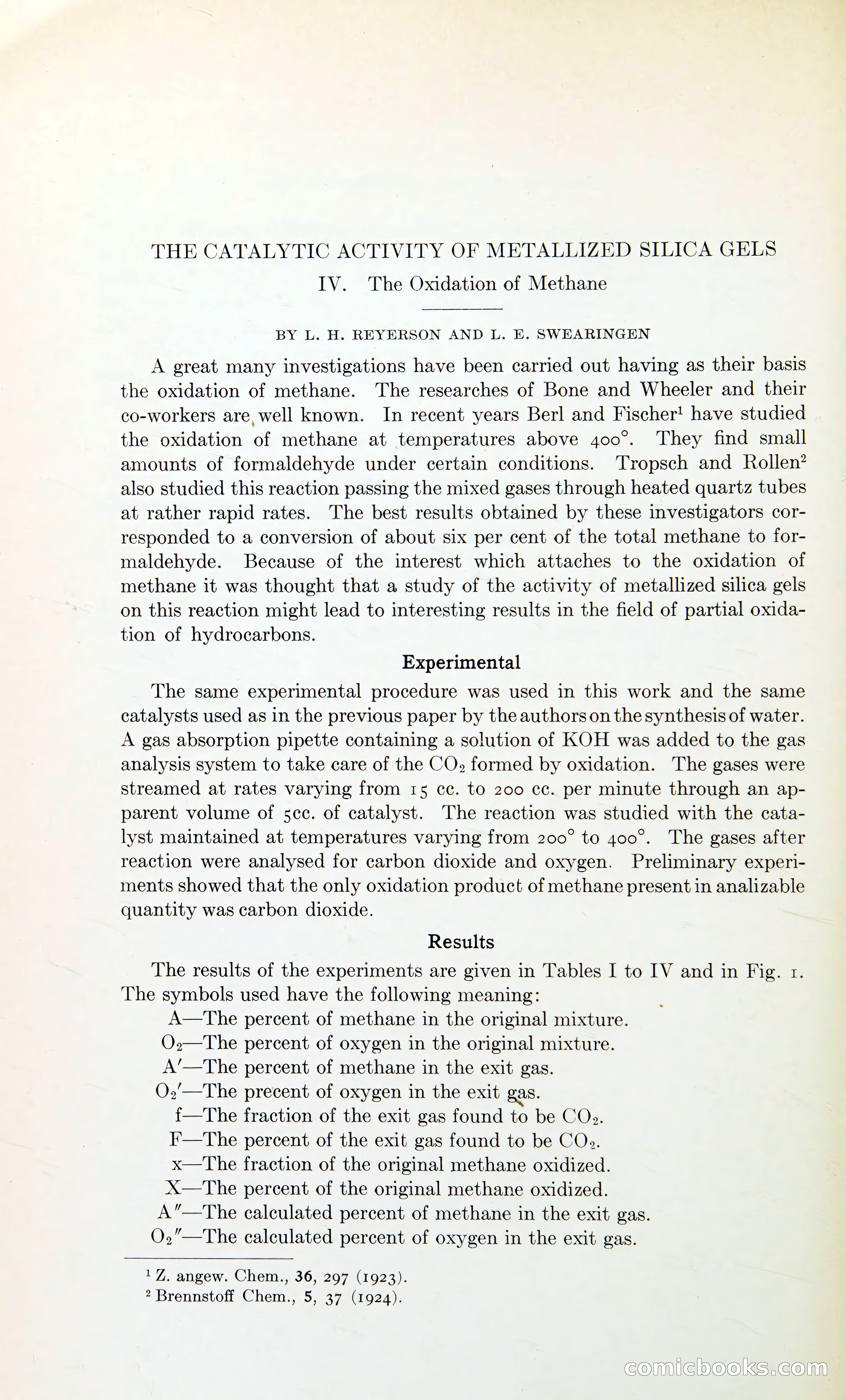
# This Page Does NOT Belong in a Victorian Penny Dreadful This is a scientific research paper, not Victorian popular literature. The page is the opening of an academic article titled "The Catalytic Activity of Metallized Silica Gels: IV. The Oxidation of Methane" by L. H. Reyerson and L. E. Swearingen. It contains an introduction reviewing prior chemical research on methane oxidation, followed by sections detailing experimental procedures and results involving catalysts, gas mixtures, and temperature measurements. The text references scholarly citations and technical data tables—entirely inconsistent with penny dreadful fiction, which featured sensational crime, horror, or melodrama for mass entertainment.
📄 Transcribed text from this page (OCR, searchable)
Machine-transcribed from the original scan — historical spelling and the odd misread are preserved.
THE CATALYTIC ACTIVITY OF METALLIZED SILICA GELS IV. The Oxidation of Methane BY L. H. REYERSON AND L. E. SWEARINGEN A great many investigations have been carried out having as their basis the oxidation of methane. The researches of Bone and Wheeler and their co-workers are, well known. In recent years Berl and Fischer! have studied the oxidation of methane at temperatures above 400°. They find small amounts of formaldehyde under certain conditions. Tropsch and Rollen’? also studied this reaction passing the mixed gases through heated quartz tubes at rather rapid rates. The best results obtained by these investigators cor- responded to a conversion of about six per cent of the total methane to for- maldehyde. Because of the interest which attaches to the oxidation of methane it was thought that a study of the activity of metallized silica gels on this reaction might lead to interesting results in the field of partial oxida- tion of hydrocarbons. Experimental The same experimental procedure was used in this work and the same catalysts used as in the previous paper by the authors on the synthesis of water. A gas absorption pipette containing a solution of KOH was added to the gas analysis system to take care of the CO, formed by oxidation. The gases were streamed at rates varying from 15 cc. to 200 cc. per minute through an ap- parent volume of scc. of catalyst. The reaction was studied with the cata- lyst maintained at temperatures varying from 200° to 400°. The gases after reaction were analysed for carbon dioxide and oxygen. Preliminary experi- ments showed that the only oxidation product of methane present in analizable quantity was carbon dioxide. Results The results of the experiments are given in Tables I to IV and in Fig. r. The symbols used have the following meaning: A—The percent of methane in the original mixture. O.—The percent of oxygen in the original mixture. A’—The percent of methane in the exit gas. O.’—The precent of oxygen in the exit gas. {—The fraction of the exit gas found to be COs. I'—The percent of the exit gas found to be COs. x—The fraction of the original methane oxidized. X—The percent of the original methane oxidized. A"—The calculated percent of methane in the exit gas. O.”—The calculated percent of oxygen in the exit gas. 1Z. angew. Chem., 36, 297 (1923). ? Brennstoff Chem., 5, 37 (1924). COMIEOOOKS.6O