
Penny Dreadfuls, 1927 · page 5 of 42
Doctoral Thesis Cover Page — page 5: what you’re looking at
What you’re looking at
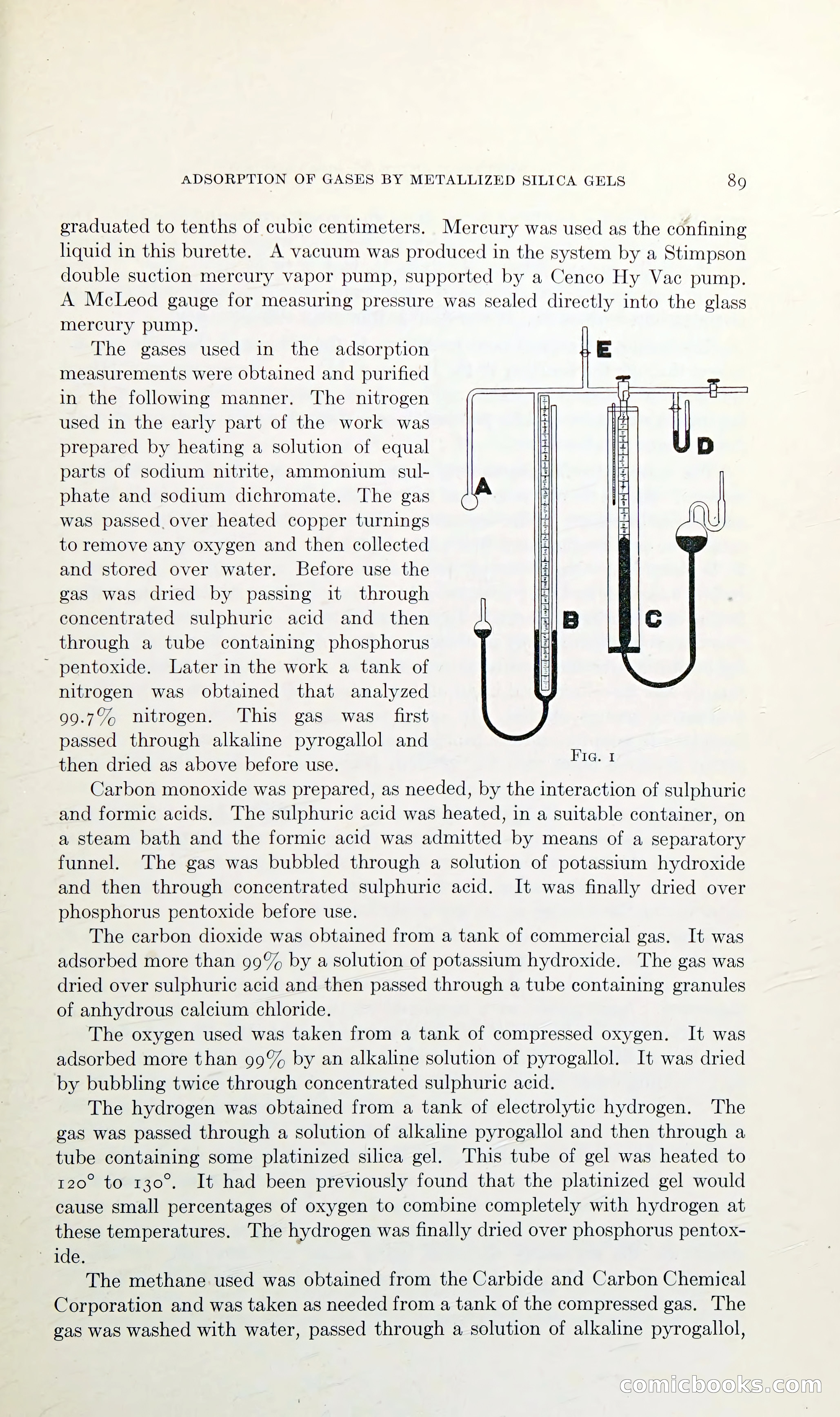
This is a page of technical prose from a scientific paper, not a Victorian penny dreadful. The text describes laboratory procedures for purifying various gases—nitrogen, carbon monoxide, carbon dioxide, oxygen, hydrogen, and methane—used in adsorption experiments with metallized silica gels. It includes a simple diagram (labeled "Fig. 1") showing laboratory apparatus with labeled components (A through E). The page is numbered 89 and appears to be from a chemistry or physics journal or academic publication, not popular fiction.
📄 Transcribed text from this page (OCR, searchable)
Machine-transcribed from the original scan — historical spelling and the odd misread are preserved.
ADSORPTION OF GASES BY METALLIZED SILICA GELS 89 graduated to tenths of cubic centimeters. Mercury was used as the confining liquid in this burette. A vacuum was produced in the system by a Stimpson double suction mercury vapor pump, supported by a Cenco Hy Vac pump. A McLeod gauge for measuring pressure was sealed directly into the glass mercury pump. The gases used in the adsorption ! E measurements were obtained and purified in the following manner. The nitrogen used in the early part of the work was prepared by heating a solution of equal parts of sodium nitrite, ammonium sul- phate and sodium dichromate. The gas was passed over heated copper turnings to remove any oxygen and then collected and stored over water. Before use the gas was dried by passing it through concentrated sulphuric acid and then sl through a tube containing phosphorus 1 - pentoxide. Later in the work a tank of nitrogen was obtained that analyzed 99.7% nitrogen. This gas was first passed through alkaline pyrogallol and then dried as above before use. Carbon monoxide was prepared, as needed, by the interaction of sulphuric and formic acids. The sulphuric acid was heated, in a suitable container, on a steam bath and the formic acid was admitted by means of a separatory funnel. The gas was bubbled through a solution of potassium hydroxide and then through concentrated sulphuric acid. It was finally dried over phosphorus pentoxide before use. The carbon dioxide was obtained from a tank of commercial gas. It was adsorbed more than 99% by a solution of potassium hydroxide. The gas was dried over sulphuric acid and then passed through a tube containing granules of anhydrous calcium chloride. The oxygen used was taken from a tank of compressed oxygen. It was adsorbed more than 99% by an alkaline solution of pyrogallol. It was dried by bubbling twice through concentrated sulphuric acid. The hydrogen was obtained from a tank of electrolytic hydrogen. The gas was passed through a solution of alkaline pyrogallol and then through a tube containing some platinized silica gel. This tube of gel was heated to 120° to 130°. It had been previously found that the platinized gel would cause small percentages of oxygen to combine completely with hydrogen at these temperatures. The hydrogen was finally dried over phosphorus pentox- ide. Bmp] Fia. I The methane used was obtained from the Carbide and Carbon Chemical Corporation and was taken as needed from a tank of the compressed gas. The gas was washed with water, passed through a solution of alkaline pyrogallol, = (COINA eIOOKS (C(O)