
Penny Dreadfuls, 1927 · page 16 of 42
Doctoral Thesis Cover Page — page 16: what you’re looking at
What you’re looking at
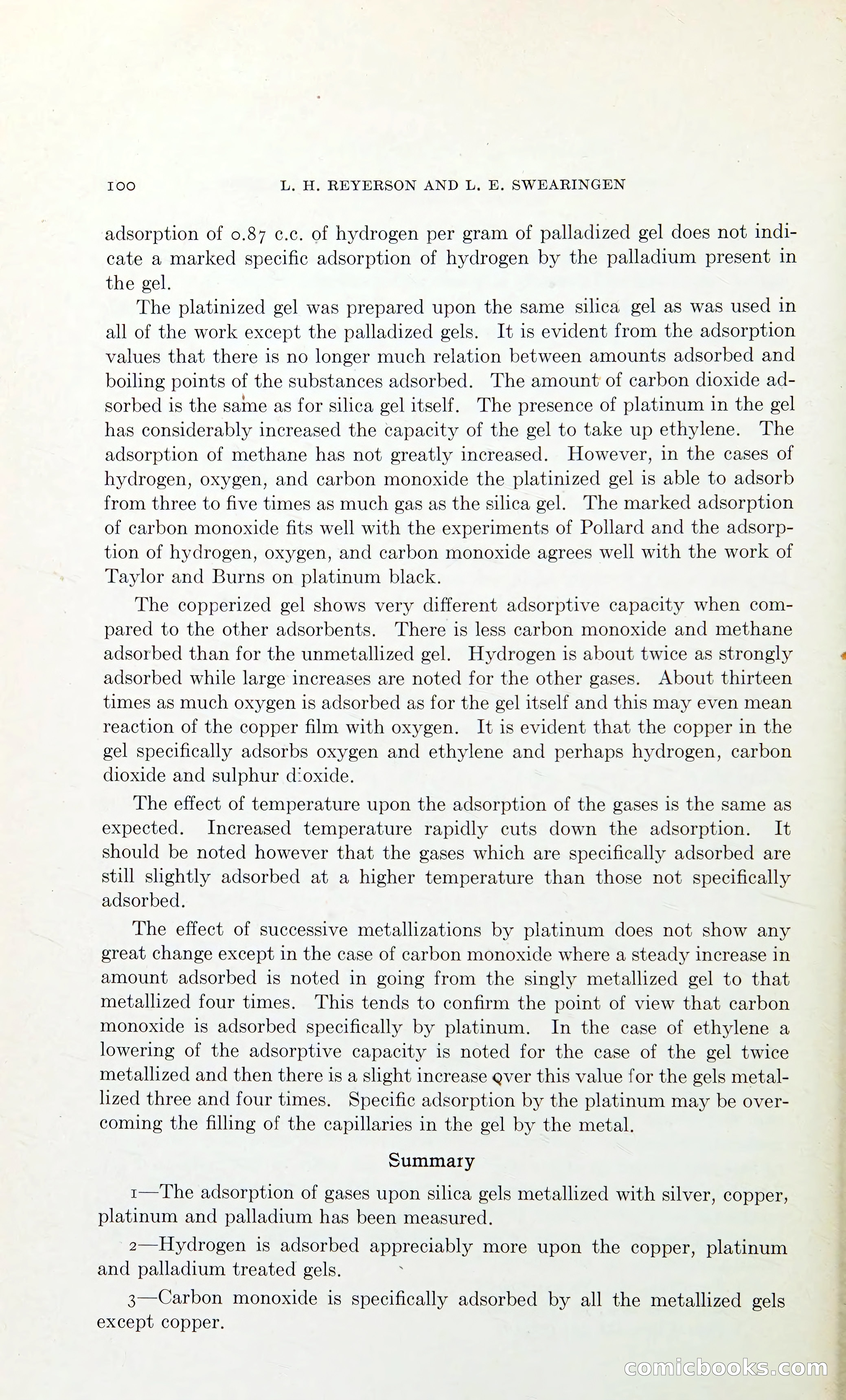
This is a page of scholarly scientific prose, not a Victorian penny dreadful. The page presents research findings by L. H. Reyerson and L. E. Swearingen on gas adsorption in metallized silica gels. The text discusses how different metals (platinum, copper, palladium, silver) deposited on silica gel affect the adsorption of various gases including hydrogen, oxygen, carbon monoxide, and ethylene. It concludes with a three-point summary of experimental results regarding which gases are preferentially absorbed by different metallized gels.
📄 Transcribed text from this page (OCR, searchable)
Machine-transcribed from the original scan — historical spelling and the odd misread are preserved.
IOO L. H. REYERSON AND L. E. SWEARINGEN adsorption of 0.87 ¢.c. of hydrogen per gram of palladized gel does not indi- cate a marked specific adsorption of hydrogen by the palladium present in the gel. The platinized gel was prepared upon the same silica gel as was used in all of the work except the palladized gels. It is evident from the adsorption values that there is no longer much relation between amounts adsorbed and boiling points of the substances adsorbed. The amount of carbon dioxide ad- sorbed is the same as for silica gel itself. The presence of platinum in the gel has considerably increased the capacity of the gel to take up ethylene. The adsorption of methane has not greatly increased. However, in the cases of hydrogen, oxygen, and carbon monoxide the platinized gel is able to adsorb from three to five times as much gas as the silica gel. The marked adsorption of carbon monoxide fits well with the experiments of Pollard and the adsorp- tion of hydrogen, oxygen, and carbon monoxide agrees well with the work of Taylor and Burns on platinum black. The copperized gel shows very different adsorptive capacity when com- pared to the other adsorbents. There is less carbon monoxide and methane adsorbed than for the unmetallized gel. Hydrogen is about twice as strongly adsorbed while large increases are noted for the other gases. About thirteen times as much oxygen is adsorbed as for the gel itself and this may even mean reaction of the copper film with oxygen. It is evident that the copper in the gel specifically adsorbs oxygen and ethylene and perhaps hydrogen, carbon dioxide and sulphur dioxide. The effect of temperature upon the adsorption of the gases is the same as expected. Increased temperature rapidly cuts down the adsorption. It should be noted however that the gases which are specifically adsorbed are still shightly adsorbed at a higher temperature than those not specifically adsorbed. The effect of successive metallizations by platinum does not show any great change except in the case of carbon monoxide where a steady increase in amount adsorbed is noted in going from the singly metallized gel to that metallized four times. This tends to confirm the point of view that carbon monoxide is adsorbed specifically by platinum. In the case of ethylene a lowering of the adsorptive capacity is noted for the case of the gel twice metallized and then there is a slight increase ever this value for the gels metal- lized three and four times. Specific adsorption by the platinum may be over- coming the filling of the capillaries in the gel by the metal. Summary 1—The adsorption of gases upon silica gels metallized with silver, copper, platinum and palladium has been measured. 2—Hydrogen is adsorbed appreciably more upon the copper, platinum and palladium treated gels, 3—Carbon monoxide is specifically adsorbed by all the metallized gels except copper. =) A (C(O) LOOKS aEO) “ee a Beer oe ee