
Penny Dreadfuls, 1927 · page 14 of 42
Doctoral Thesis Cover Page — page 14: what you’re looking at
What you’re looking at
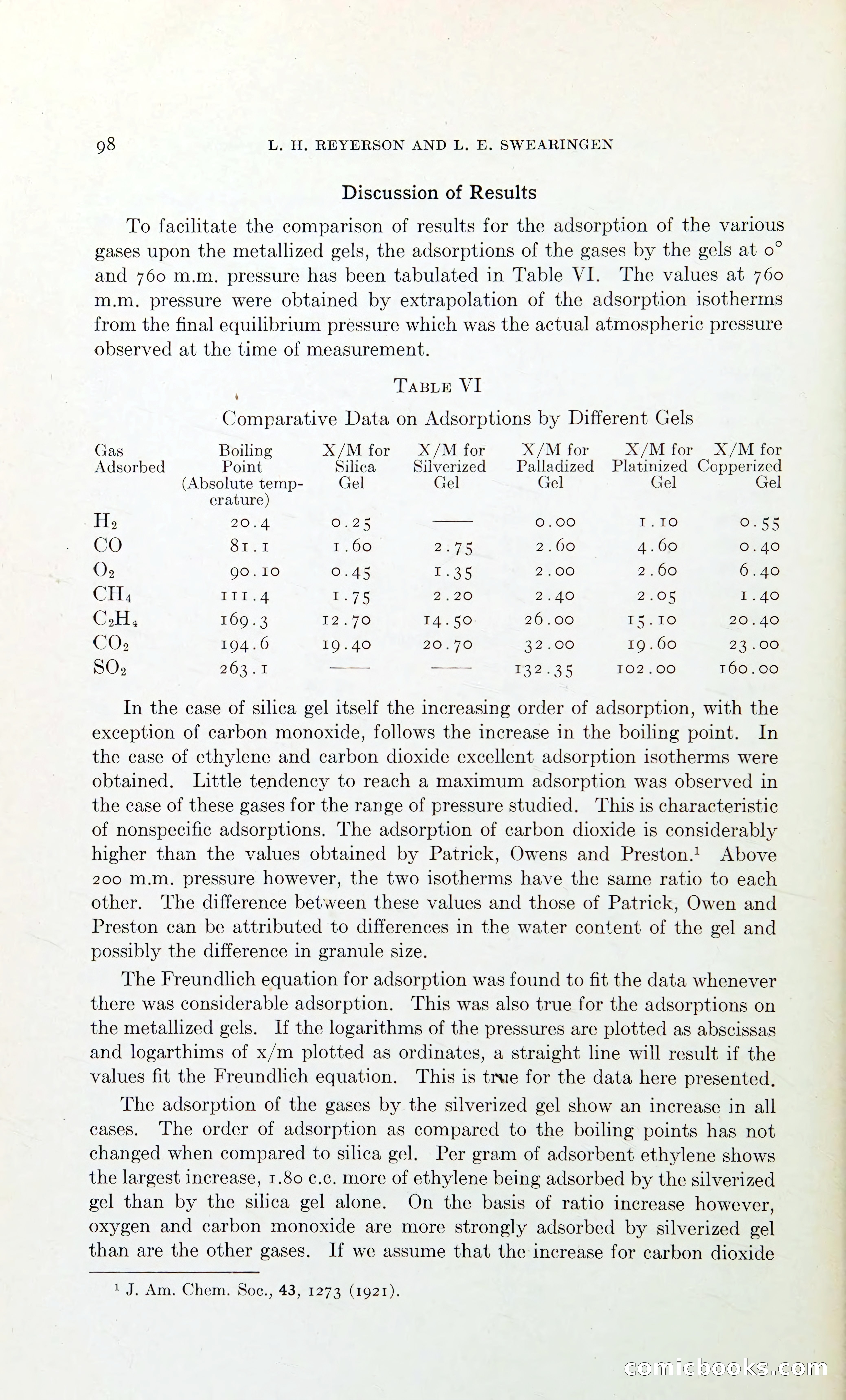
# This Page Contains Scientific Research, Not Victorian Penny Dreadful Fiction This is a page of academic scientific writing—specifically, a chemistry research paper discussing experimental results on gas adsorption by metallized gels. The page includes a "Discussion of Results" section and a data table (Table VI) comparing how different gases (hydrogen, carbon monoxide, oxygen, methane, ethylene, carbon dioxide, and sulfur dioxide) are adsorbed by various gel types (silica, silverized, palladized, platinized, and copperized gels). The text analyzes the adsorption patterns and references the Freundlich equation. This is clearly not a penny dreadful but a technical scientific journal article by L. H. Reyerson and L. E. Swearingen.
📄 Transcribed text from this page (OCR, searchable)
Machine-transcribed from the original scan — historical spelling and the odd misread are preserved.
98 L. H. REYERSON AND L. E. SWEARINGEN Discussion of Results To facilitate the comparison of results for the adsorption of the various gases upon the metallized gels, the adsorptions of the gases by the gels at o° and 760 m.m. pressure has been tabulated in Table VI. The values at 760 m.m. pressure were obtained by extrapolation of the adsorption isotherms from the final equilibrium pressure which was the actual atmospheric pressure observed at the time of measurement. TasBLE VI Comparative Data on Adsorptions by Different Gels Gas Boiling X/M for X/M for X/M for X/M for X/M for Adsorbed Point Silica Silverized Palladized Platinized Copperized (Absolute temp- Gel Gel Gel Gel Gel erature) H. 20.4 On.2 & —— 0.00 i.10 ovEt CO Sieg 1. 00 yea 2.60 4.60 0.40 Op» go.10 Ol4s ¥ 3% 2.00 2.60 6.40 CH4 7tt.4 Raya 2.20 2.40 208 L410 CoH, 169.3 12.76 Ld. £0 26.00 ee o. 20.40 CO, 194.6 I9Q.40 20.470 32.00 19.60 23.00 SO» 202 1 —— —— T3935 102.00 160.00 In the case of silica gel itself the increasing order of adsorption, with the exception of carbon monoxide, follows the increase in the boiling point. In the case of ethylene and carbon dioxide excellent adsorption isotherms were obtained. Little tendency to reach a maximum adsorption was observed in the case of these gases for the range of pressure studied. This is characteristic of nonspecific adsorptions. The adsorption of carbon dioxide is considerably higher than the values obtained by Patrick, Owens and Preston.! Above 200 m.m. pressure however, the two isotherms have the same ratio to each other. The difference between these values and those of Patrick, Owen and Preston can be attributed to differences in the water content of the gel and possibly the difference in granule size. The Freundlich equation for adsorption was found to fit the data whenever there was considerable adsorption. This was also true for the adsorptions on the metallized gels. If the logarithms of the pressures are plotted as abscissas and logarthims of x/m plotted as ordinates, a straight line will result if the values fit the Freundlich equation. This is true for the data here presented, The adsorption of the gases by the silverized gel show an increase in all cases. The order of adsorption as compared to the boiling points has not changed when compared to silica gel. Per gram of adsorbent ethylene shows the largest increase, 1.80 c.c. more of ethylene being adsorbed by the silverized gel than by the silica gel alone. On the basis of ratio increase however, oxygen and carbon monoxide are more strongly adsorbed by silverized gel than are the other gases. If we assume that the increase for carbon dioxide 1 J. Am. Chem. Soc., 43, 1273 (1921). CONMCOOOkKXS ‘2 (E()