
Penny Dreadfuls, 1927 · page 25 of 42
Doctoral Thesis Cover Page — page 25: what you’re looking at
What you’re looking at
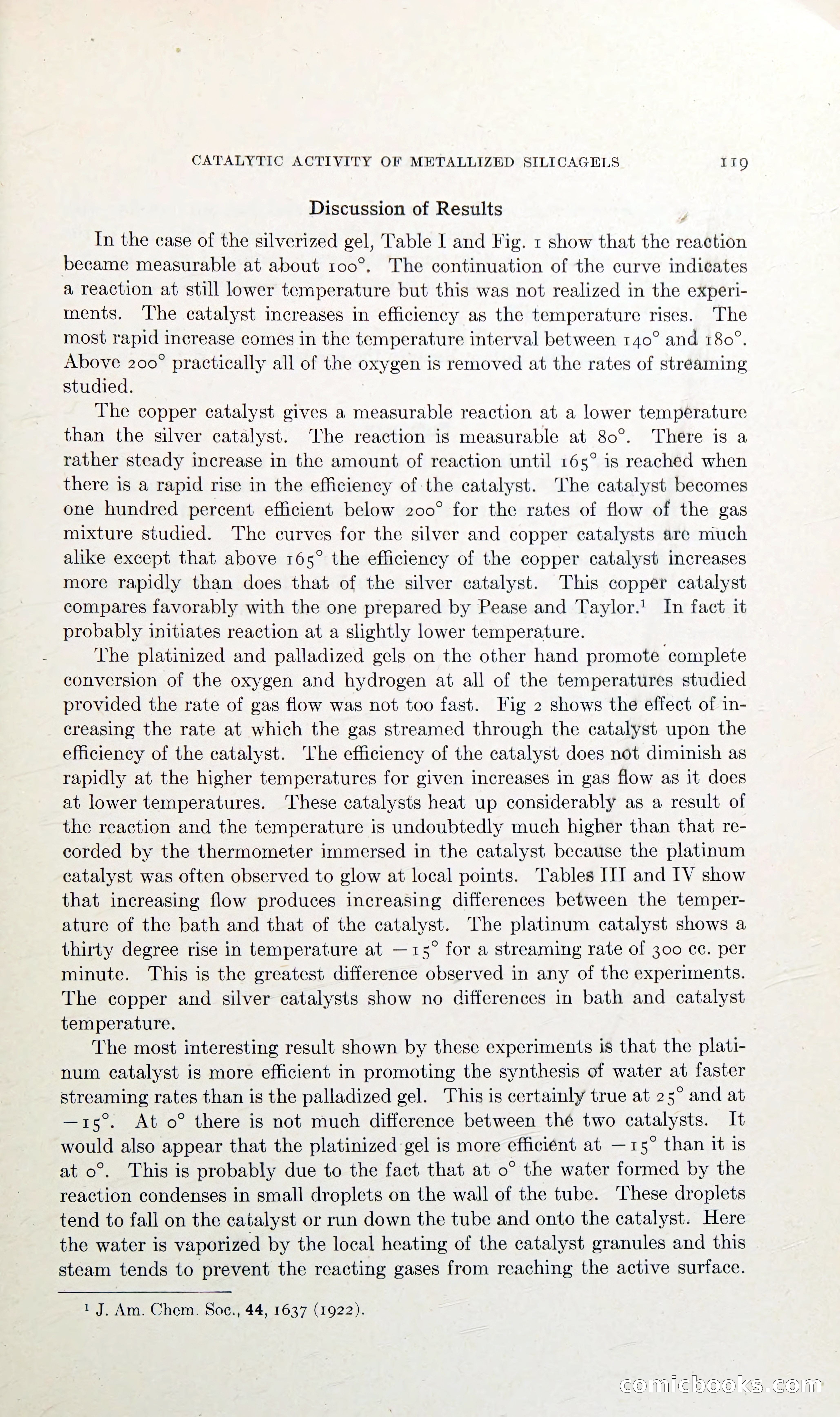
This is a page of running prose from a scientific journal article, not a penny dreadful. The text discusses experimental results on the catalytic activity of metallized silica gels—specifically comparing how silver, copper, platinum, and palladium catalysts promote chemical reactions at various temperatures and gas flow rates. The page analyzes data from tables and figures, noting that platinum catalysts prove most efficient at faster streaming rates, and explains how water condensation affects catalyst performance at different temperatures.
📄 Transcribed text from this page (OCR, searchable)
Machine-transcribed from the original scan — historical spelling and the odd misread are preserved.
CATALYTIC ACTIVITY OF METALLIZED SILICAGELS 11g Discussion of Results In the case of the silverized gel, Table I and Fig. 1 show that the reaction became measurable at about too°. The continuation of the curve indi¢ates a reaction at still lower temperature but this was not realized in the experi- ments. The catalyst increases in efficiency as the temperature rises. The most rapid increase comes in the temperature interval between 140° and 180°. Above 200° practically all of the oxygen is removed at the rates of streaming studied. The copper catalyst gives a measurable reaction at a lower temperature than the silver catalyst. The reaction is measurable at 80°. There is a rather steady increase in the amount of reaction until 165° is reached when there is a rapid rise in the efficiency of the catalyst. The catalyst becomes one hundred percent efficient below 200° for the rates of flow of the gas mixture studied. The curves for the silver and copper catalysts are much alike except that above 165° the efficiency of the copper catalyst increases more rapidly than does that of the silver catalyst. This copper catalyst compares favorably with the one prepared by Pease and Taylor.! In fact it probably initiates reaction at a slightly lower temperature. The platinized and palladized gels on the other hand promote complete conversion of the oxygen and hydrogen at all of the temperatures studied provided the rate of gas flow was not too fast. Fig 2 shows the effect of in- creasing the rate at which the gas streamed through the catalyst upon the efficiency of the catalyst. The efficiency of the catalyst does not diminish as rapidly at the higher temperatures for given increases in gas flow as it does at lower temperatures. These catalysts heat up considerably as a result of the reaction and the temperature is undoubtedly much higher than that re- corded by the thermometer immersed in the catalyst because the platinum catalyst was often observed to glow at local points. Tables II] and IV show that increasing flow produces increasing differences between the temper- ature of the bath and that of the catalyst. The platinum catalyst shows a thirty degree rise in temperature at —15° for a streaming rate of 300 cc. per minute. This is the greatest difference observed in any of the experiments. The copper and silver catalysts show no differences in bath and catalyst temperature. The most interesting result shown by these experiments is that the plati- num catalyst is more efficient in promoting the synthesis of water at faster streaming rates than is the palladized gel. This is certainly true at 25° and at —1s5°. At o° there is not much difference between thé two catalysts. It would also appear that the platinized gel is more efficient at —15° than it is at o°. This is probably due to the fact that at o° the water formed by the reaction condenses in small droplets on the wall of the tube. These droplets tend to fall on the catalyst or run down the tube and onto the catalyst. Here the water is vaporized by the local heating of the catalyst granules and this steam tends to prevent the reacting gases from reaching the active surface. 1 J. Am. Chem. Soc., 44, 1637 (1922). CORMNICLOOO @) SH (CO)